Bicep and tricep calisthenics use pulling and pushing movements to train the upper arms. Some options use the floor or your opposite hand for resistance. Others require a secured bar, rings, an exercise bench or a handheld load. A calisthenics pull workout gives examples of pulling exercises.
The muscles in our arms, including both biceps and triceps, are responsible for two major movements: pushing and pulling. The biceps bend the elbow during rows and chin-ups. The triceps straighten the elbow during push-ups and dips.
The guide below lists 15 home exercise options and two sample arm workouts. Equipment varies by move: some use the floor or self-resistance, while others require a towel, handheld load, exercise bench, or purpose-built pulling equipment. Use load-rated equipment installed according to its instructions.
Key takeaways
These points summarize how bicep and tricep calisthenics work and what to expect.
> * In 40 adults performing one repetition in each hand position, narrow-grip push-ups showed more triceps and chest muscle activity than wide-grip push-ups (1).
> * Chin-ups produced more biceps activity than pull-ups in one muscle activity study (2).
> * In a study using a portable pulling device, inverted rows showed very high biceps muscle activity with overhand and underhand grips (3).
> * Progressive push-up training and bench press training both raised bench press strength over 4 weeks in men (4).
> * Muscle growth was similar across light and heavy loads when sets were taken to failure (5).
> * Adults are advised to do muscle-strengthening activity on 2 or more days a week (6).
> * Self-resisted curls need no equipment; suspended rows and chin-ups require purpose-built, load-rated pulling equipment.
Can you build biceps and triceps with calisthenics?
Yes, you can build biceps and triceps with calisthenics when the exercises are hard enough and get harder over time. Bodyweight moves load the arms through pushing and pulling patterns.
Push-ups are the main triceps tool without equipment. In one trial, 23 moderately trained men did progressive push-ups or bench press for 4 weeks (4). Both groups improved their 1-repetition maximum bench press. Muscle thickness did not change significantly in either group over that short period.
Load size matters less for muscle growth than effort. A review of 21 studies found similar muscle growth with light and heavy loads. All sets in those studies went to failure (5). Heavy loads still produced greater gains in 1-repetition maximum strength.
Biceps are harder to train without equipment, because curling needs something to pull against. Rows on a purpose-built low bar, chin-ups, and self-resisted curls provide different pulling options.
Which triceps exercises can you do at home?
These six options load the triceps through elbow extension. Choose a floor variation or a fixed support designed for the movement.
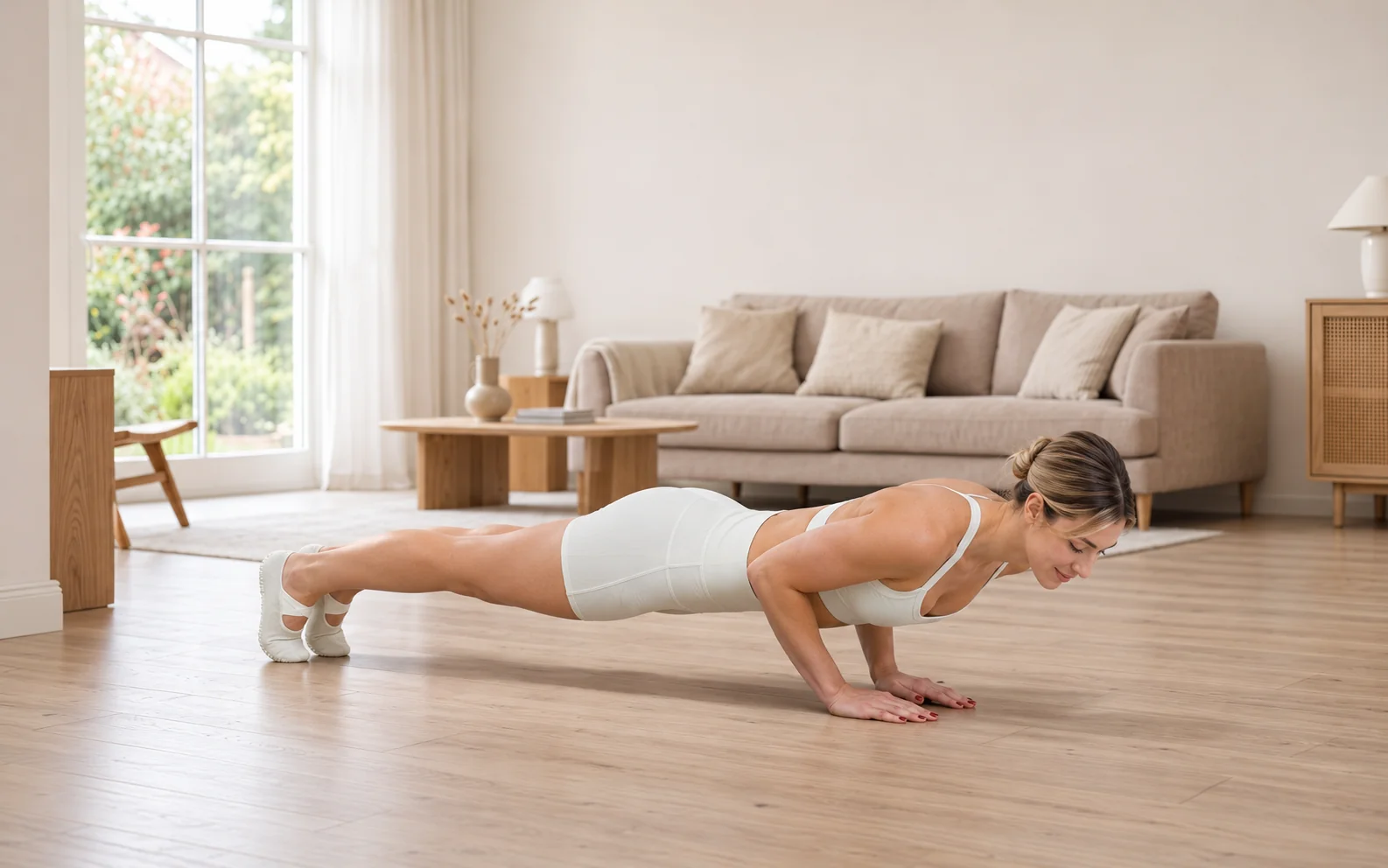
1. Diamond push-ups
In a study of 40 adults, each participant performed one push-up in each hand position. Narrow placement produced more acute chest and triceps muscle activity than wide placement (1). The study did not measure long-term muscle growth. For other pressing variations, see these chest calisthenics exercises.
> 1. Get into a push-up position with your feet braced on the ground.
> 2. Bring your hands together under your chest so your thumbs and index fingers form a diamond.
> 3. Lower your chest toward your hands while keeping your elbows close to your body.
> 4. Press back up until your arms are straight.
Use a fixed exercise support designed to carry your load for an incline variation.
2. Exercise-bench dips
Bench dips load the triceps as you lower and raise your body in front of an exercise bench. Use a load-rated bench secured against movement, or choose close-grip push-ups.
> 1. Sit on the edge of the exercise bench with your hands next to your hips.
> 2. Slide your hips off the seat with your knees bent.
> 3. Bend your elbows to lower your hips until your upper arms are near parallel to the floor.
> 4. Press through your palms to straighten your arms.
Straighten your legs to make it harder. Stop the range earlier if the front of your shoulder feels uncomfortable.
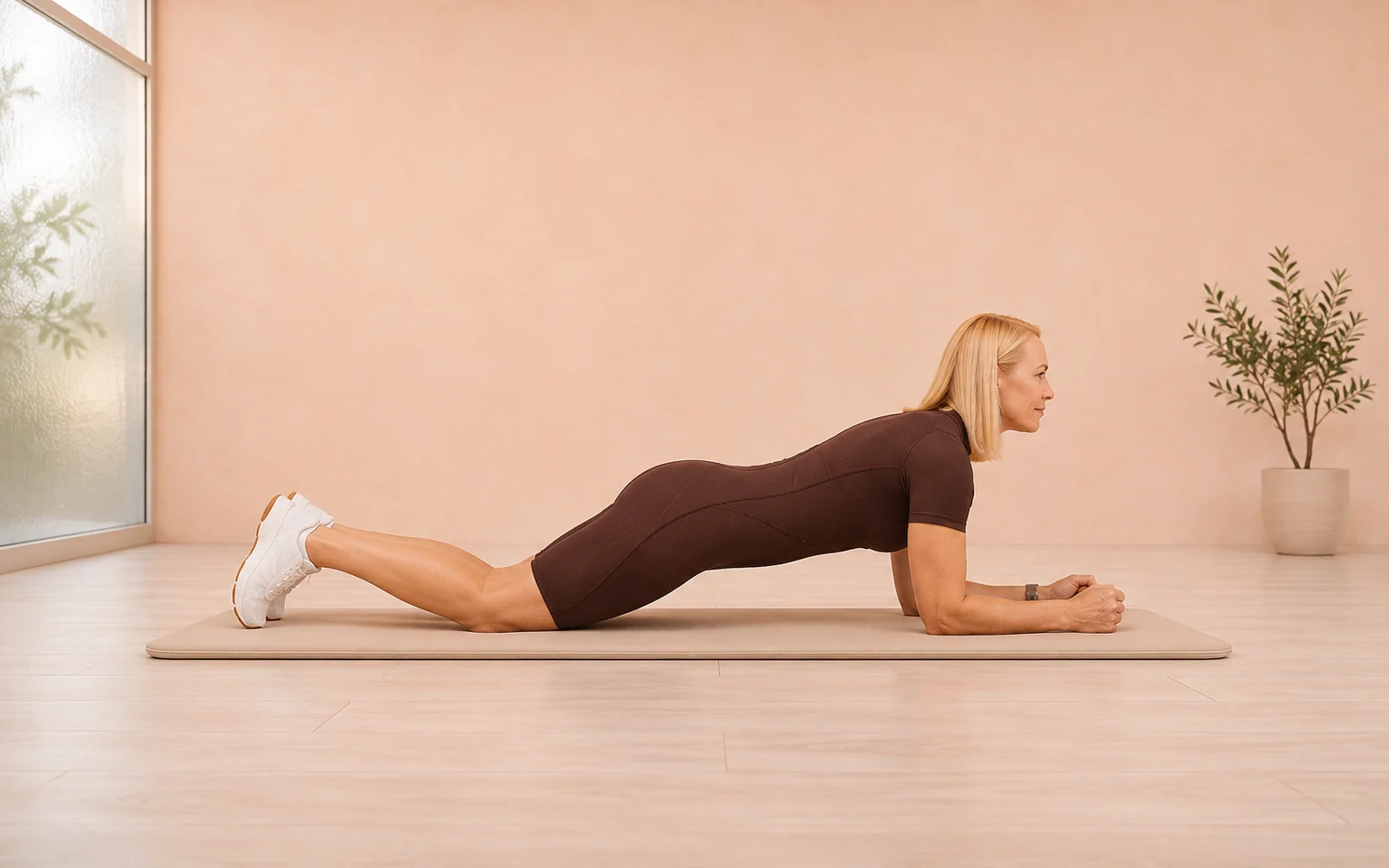
3. Bodyweight triceps extensions
Bodyweight triceps extensions work like a skull crusher using your body weight. The movement keeps your shoulders mostly still, so the triceps do most of the work.
> 1. Place your forearms on the floor in a plank or kneeling position.
> 2. Keep your elbows bent and your body straight.
> 3. Push through your palms to straighten your elbows and lift your forearms.
> 4. Lower back to your forearms with control.
4. Plank ups and downs
This exercise alternates between a forearm plank and a high plank. If you already follow a calisthenics push workout, count these sets toward your existing pressing work.
> 1. Start in a low plank resting on your forearms.
> 2. Keep your back and hips straight as you balance on your toes.
> 3. Straighten one arm into a push-up position and follow with the other arm.
> 4. Return to the forearm plank one arm at a time and repeat.
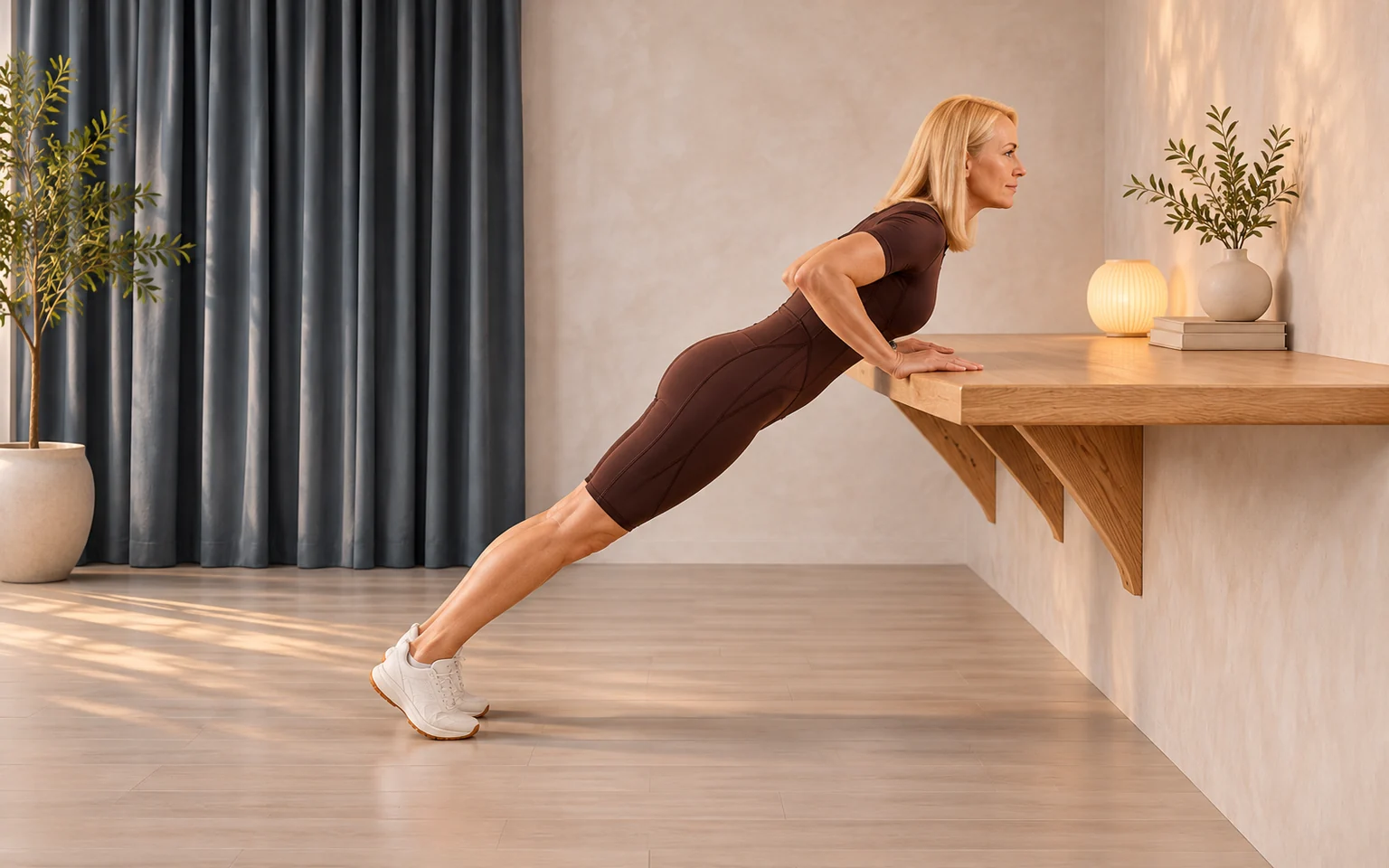
5. Incline one-arm push-ups
The one-arm version places more demand on the working arm. Start with a two-arm incline push-up when a single arm does not give you enough control.
> 1. Place one hand on a fixed exercise support rated for the load, with your feet wider than hip-width.
> 2. Rest your other hand behind your back.
> 3. Lower your chest toward the edge with control.
> 4. Press back up and switch sides after your set.
6. Isometric triceps press
An isometric press holds the triceps under tension without movement.
> 1. Stand at a fixed exercise support with your palms flat on top.
> 2. Press downward with a controlled effort while keeping your shoulders steady.
> 3. Hold the contraction for 20 to 30 seconds.
> 4. Release and repeat.
Which biceps exercises can you do at home?
Rows and chin-ups use the biceps during elbow flexion. In a row, some body weight stays on your feet. The support height, body angle and foot position change how much load the arms handle.
7. Low-bar inverted rows
In a study of 26 adults, researchers measured acute muscle activity during inverted rows on a portable pulling device. Biceps activity was very high in the overhand and underhand conditions tested (3). That finding describes the measured activity during the exercise.
> 1. Lie on your back beneath a purpose-built, load-rated low bar installed according to its instructions.
> 2. Grip the bar with your palms facing you, shoulder-width apart.
> 3. Keep your body in a line while pulling your chest toward the bar.
> 4. Lower yourself with control and repeat.
Do not suspend yourself from household furniture. If suitable pulling equipment is unavailable, use the self-resisted curl below.
8. Self-resisted bicep curls
Self-resisted curls use one hand to resist the other arm’s curling movement. They need no anchor, furniture, or suspended body-weight setup.
> 1. Sit or stand upright with one elbow bent beside your torso.
> 2. Place your opposite hand against the working arm’s wrist.
> 3. Curl the working hand upward while the opposite hand applies gentle resistance.
> 4. Lower slowly against the same resistance, then switch arms.
Adjust the opposing hand’s pressure so the movement stays controlled.
9. Chin-ups with a pull-up bar
Chin-ups use an underhand grip. Chin-ups produced more biceps activity than pull-ups in one study (2).
> 1. Hang from a load-rated pull-up bar installed as directed, with your palms facing toward you.
> 2. Pull yourself up until your chin is at bar height.
> 3. Hold for 1 to 2 seconds.
> 4. Lower slowly until your arms are straight.
10. Pull-ups with a pull-up bar
Pull-ups use an overhand grip and shift more work toward the back. The biceps still work hard during the pull (2).
> 1. Use a load-rated pull-up bar installed according to its instructions. Grip it with your palms facing away from you.
> 2. Pull your body up until your chin is at bar height.
> 3. Lower back down with control and repeat.
11. Towel bicep curls
In this seated option, a towel and your own leg provide adjustable resistance.
> 1. Sit on a firm stationary seat with one foot flat on the floor. Loop the middle of a towel around the sole of the other foot.
> 2. Hold both ends securely with your palms facing up and elbows near your sides.
> 3. Bend your elbows to raise the unweighted foot slightly. Press gently into the towel with that leg to provide resistance you can control.
> 4. Lower the foot with control. Use the self-resisted curl if the towel slips or you cannot stay steady.
12. Self-resisted biceps hold
Use your opposite hand to resist the working arm without moving the elbow.
> 1. Sit or stand comfortably and bend the working elbow beside your torso.
> 2. Place your other hand against the working wrist.
> 3. Press the wrist gently upward while the other hand keeps it still.
> 4. Hold only while you can breathe and control the effort comfortably.
> 5. Release the pressure and change arms.
13. Modified concentration curls
Modified concentration curls use your leg as resistance while seated.
> 1. Sit on a chair and hook your right hand under your left thigh.
> 2. Curl your right hand up while pressing your left leg down.
> 3. Hold the effort for 10 to 15 seconds.
> 4. Repeat on the other side.
14. Household-weight curls
Choose a secure handheld load with a handle you can grasp comfortably. Check that the contents and any closure stay secure as you move.
> 1. Stand steadily with a load in each hand, or hold a single appropriate load with both hands.
> 2. Bend at the elbows and bring the load toward your shoulders.
> 3. Lower over 2 to 3 seconds.
> 4. End the set when you can no longer keep the movement controlled. Adjust the load or repetitions for your next set.
15. Bodyweight curls with a low bar or rings
Bodyweight curls move only at the elbows while your body leans back from a low bar or rings.
> 1. Grip a purpose-built low bar or rings installed and rated for your load. Use a self-resisted curl if this setup is unavailable.
> 2. Lean back with your arms straight and body in a line.
> 3. Bend your elbows to bring your forehead toward your hands.
> 4. Lower slowly until your arms are straight.

How many sets and reps should you do for arms?
As one example, choose a pushing and a pulling exercise and use manageable sets and repetitions. Adjust the amount to your experience, other weekly training and recovery. End a set if you lose control of the movement.
A review of 21 studies found similar muscle growth with lighter and heavier loads when participants took their sets to momentary muscular failure (5). It does not establish that every arm set should reach failure or predict the effects of daily high-repetition curls.
Try adding a repetition to a familiar movement before changing its difficulty. An eight-week lower-body trial found broadly similar training adaptations from progressing repetitions or load (7). That trial did not test this arm routine.
What does a bicep and tricep calisthenics workout look like?
The two sample sessions alternate a triceps movement with a biceps movement. Choose a smaller selection or fewer sets when fitting arm work into an existing routine.
|
Workout |
Exercises |
Sets x reps or hold |
Rest |
|---|---|---|---|
|
Beginner |
Incline diamond push-ups |
3 x 8 to 12 |
90 seconds |
|
Beginner |
Inverted rows with a higher fixed bar |
3 x 8 to 12 |
90 seconds |
|
Beginner |
Exercise-bench dips, knees bent |
2 x 8 to 12 |
90 seconds |
|
Beginner |
Self-resisted biceps hold |
2 x 20 seconds |
60 seconds |
|
Intermediate |
Diamond push-ups |
4 x 8 to 15 |
2 minutes |
|
Intermediate |
Chin-ups or low inverted rows |
4 x 6 to 12 |
2 minutes |
|
Intermediate |
Bodyweight triceps extensions |
3 x 8 to 12 |
90 seconds |
|
Intermediate |
Towel bicep curls |
3 x 10 to 15 |
60 seconds |
Warm up with easy versions of the movements you plan to use. Two weekly sessions are one example when you can recover between them. General adult guidance includes strengthening the major muscle groups on at least two days a week (6); it does not prescribe two additional arm workouts.
Count pressing and pulling sets from the rest of your training. You can replace some of those sets with an arm exercise, then adjust the next session to your recovery. For a full schedule, see this women’s calisthenics guide with weekly structure.
FAQs
Can I build biceps without equipment?
Self-resisted curls let you train elbow flexion without equipment. Progress depends on the resistance you can apply and control. A purpose-built low bar or handheld weights provide additional ways to increase the challenge.
What is 777 bicep exercise?
The 777 method, also called 21s, splits a curl set into three parts of 7 reps. You do 7 reps in the bottom half, 7 in the top half, then 7 full reps. You can apply it to household-weight curls or low-bar bodyweight curls.
What will 100 bicep curls a day do?
The cited research does not establish the outcome of 100 curls every day. Its load comparison used sets taken to muscular failure (5). Consider the load, technique and total work you already do, and allow recovery before repeating a demanding session.
The bottom line
Choose a pushing and a pulling exercise that fit your equipment and current ability. Record the repetitions or hold time you can control. When you repeat the session, change one part of the workload if you are ready. BetterMe offers calisthenics workouts.
DISCLAIMER:
This article is intended for general informational purposes only and does not serve to address individual circumstances. It is not a substitute for professional advice or help and should not be relied on for making any kind of decision-making. Any action taken as a direct or indirect result of the information in this article is entirely at your own risk and is your sole responsibility.
BetterMe, its content staff, and its medical advisors accept no responsibility for inaccuracies, errors, misstatements, inconsistencies, or omissions and specifically disclaim any liability, loss or risk, personal, professional or otherwise, which may be incurred as a consequence, directly or indirectly, of the use and/or application of any content.
You should always seek the advice of your physician or other qualified health provider with any questions you may have regarding a medical condition or your specific situation. Never disregard professional medical advice or delay seeking it because of BetterMe content. If you suspect or think you may have a medical emergency, call your doctor.
SOURCES:
- Comparison of muscle activation using various hand positions during the push-up exercise (2005, nih.gov)
- Surface electromyographic activation patterns and elbow joint motion during a pull-up, chin-up, or perfect-pullup™ rotational exercise (2010, nih.gov)
- Activation of Spinal Stabilizers and Shoulder Complex Muscles During an Inverted Row Using a Portable Pull-up Device and Body Weight Resistance (2016, nih.gov)
- Effect of Progressive Calisthenic Push-up Training on Muscle Strength and Thickness (2018, nih.gov)
- Strength and Hypertrophy Adaptations Between Low- vs. High-Load Resistance Training: A Systematic Review and Meta-analysis (2017, nih.gov)
- World Health Organization 2020 guidelines on physical activity and sedentary behaviour (2020, nih.gov)
- Progressive overload without progressing load? The effects of load or repetition progression on muscular adaptations (2022, nih.gov)
 By
 Reviewed by
 Reviewed by