A 6-pack ab workout builds the muscles across your midsection using moves such as crunches, planks, and leg raises. For many people, visible abs come from two things working together: developing these muscles and lowering overall body fat enough to see them. Genetics also shape how your abs look.
Many people do endless crunches to grow a 6-pack and still feel stuck. That can be frustrating, and it often has less to do with effort than approach. Here’s why it matters: your abs are muscles, and they respond to smart training, not just repetition. A good 6-pack ab workout mixes the right moves, enough effort, and steady progress over time.
This guide breaks it all down in plain language. You’ll learn which muscles matter, how to train them, how to progress, and what to do when things get too easy. Keep reading to get a simple, practical plan that you can actually follow.
What Muscles Make up the Abs?
The abs are made up of several muscles that wrap around your midsection and support your posture. When people picture a “six-pack”, they usually mean one main muscle, but a few others matter too (1):
- Rectus abdominis: The long muscle at the front of your belly. This is the “six-pack” muscle. It bends your torso toward your hips.
- Obliques: These run along the sides of your torso. They help you twist and bend sideways.
- Transverse abdominis: The deepest layer. It wraps around like a belt and helps stabilize your midsection.
Other muscles, such as those in your back and hips, also support your core. The core is simply the group of muscles around your trunk that link your upper and lower body (2).
For appearance, the rectus abdominis matters most. For function and a balanced look, the obliques and deep core matter too. Training all of them tends to work best.
Can Ab Workouts Alone Give You Visible Abs?
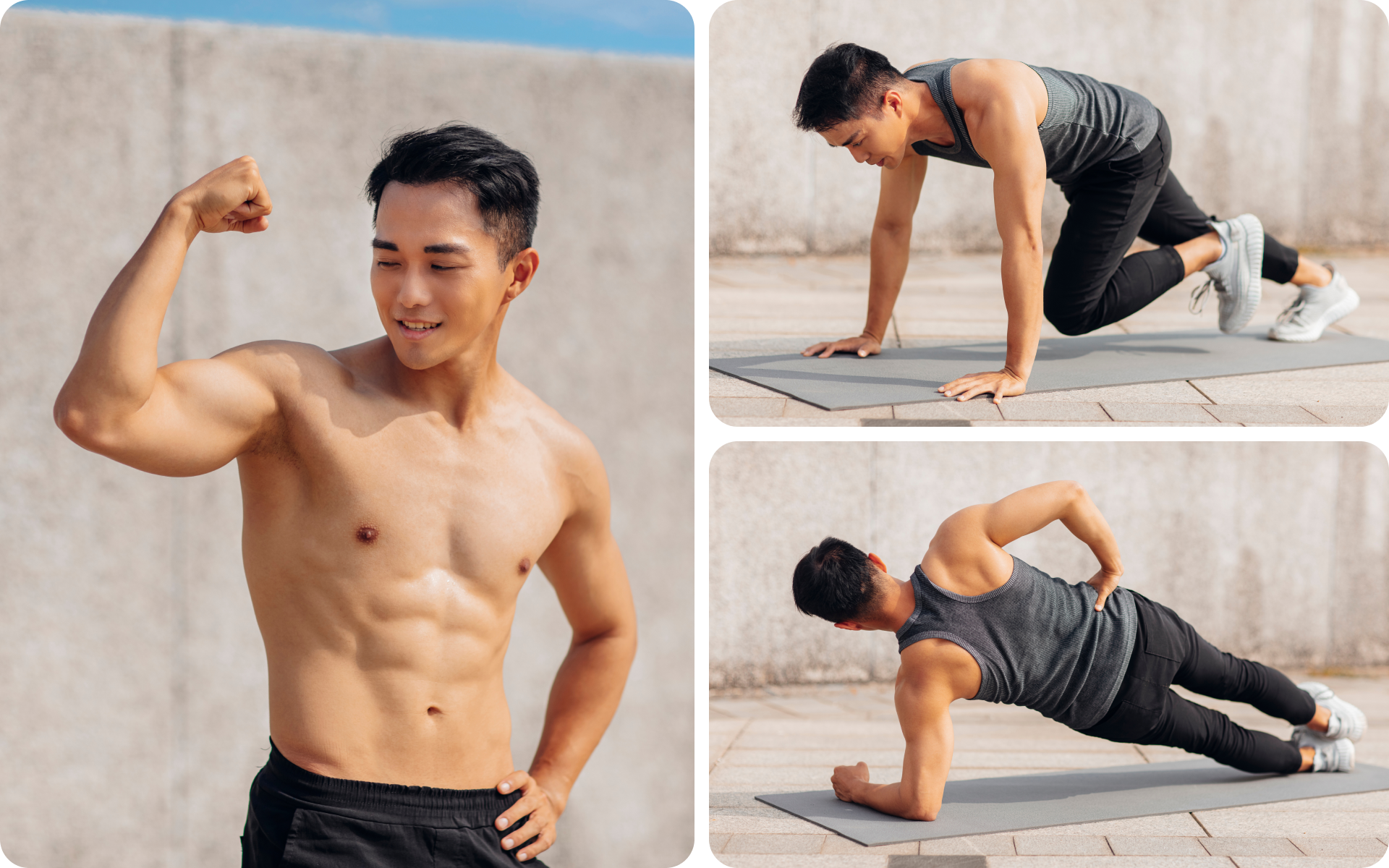
Ab workouts alone usually cannot give you visible abs, because appearance depends on both muscle development and low enough body fat. You can build strong abs with training. However, a layer of body fat can keep them hidden.
Think of it this way—your abs may already be there. They just need enough definition and a lean enough midsection to show.
Three things tend to shape visible abs:
- Muscle development from consistent ab exercises
- Body fat levels low enough for the muscle to show
- Genetics, which affect symmetry, waist shape, and where you store fat
One older study found that several weeks of ab exercise alone did not meaningfully reduce belly fat (3). Newer research adds some nuance, hinting that local exercise may use some nearby fat (4).
However, the bigger picture holds: overall body composition tends to drive whether abs become visible. Individual outcomes vary.
Read more: The Top 5 Abs Exercises You Should Be Doing For A Six-Pack
Which Exercises Should a 6-Pack Ab Workout Include?
A well-rounded 6-pack ab workout should include a mix of movement-based and anti-movement core work. Movement-based moves create motion, such as a crunch. Anti-movement moves resist motion, such as a plank.
Covering different functions tends to build a balanced midsection. Here are the categories to include:
- Back flexion (rib-to-pelvis crunching) for the rectus abdominis
- Pelvic tilt work for lower-belly emphasis
- Anti-extension to resist arching, like planks and rollouts
- Oblique work for twisting and side stability
Below is a quick comparison to help you choose exercises for abs by category.
| Category | What it trains | Example moves |
|---|---|---|
| Back flexion | Upper rectus abdominis | Cable crunch, crunch |
| Pelvic tilt | Lower-belly emphasis | Reverse crunch, hanging knee raise |
| Anti-extension | Deep core, trunk control | Plank, ab wheel rollout |
| Oblique focus | Twisting, side stability | Side plank, Pallof press |
Picking one move from each category is a simple way to build a complete ab training routine. If you want a low-impact option, a Pilates reformer workout plan for abs can be a nice addition to explore.
How Do You Perform the Main Ab Exercises With Proper Form?
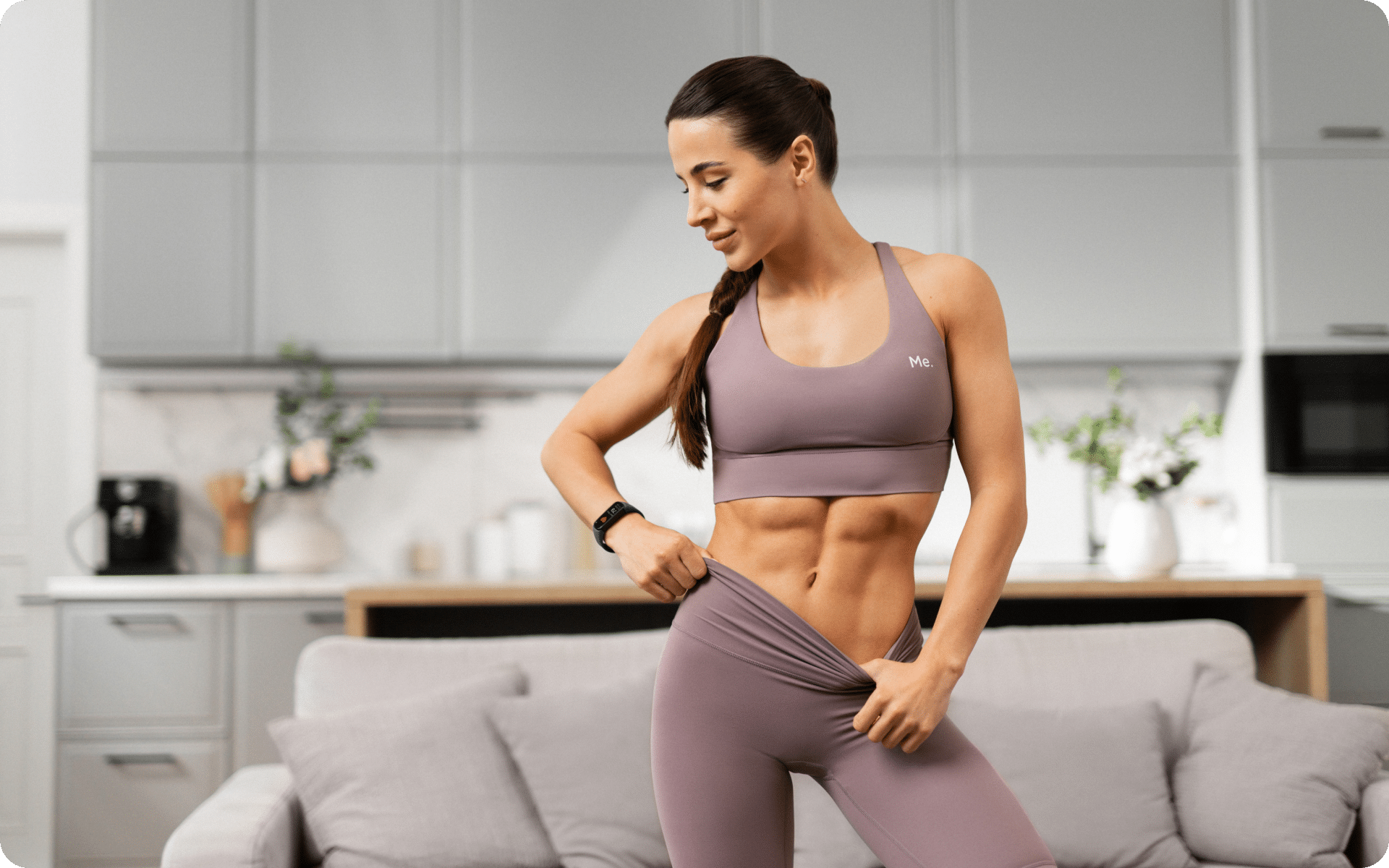
Good form on the main ab exercises means moving with control and keeping tension on the target muscle. Many people accidentally train their hips or lower back instead. The cues below can help you feel the right muscles.
Cable Crunch
- Kneel facing a cable machine with a rope by your head.
- Keep your hips fairly still.
- Curl your ribs toward your pelvis.
- Pause briefly, then return slowly.
Reverse Crunch
- Lie on your back with your knees bent at about 90 degrees.
- Gently press your lower back down.
- Roll your pelvis up to bring knees toward your chest.
- Lower slowly without swinging.
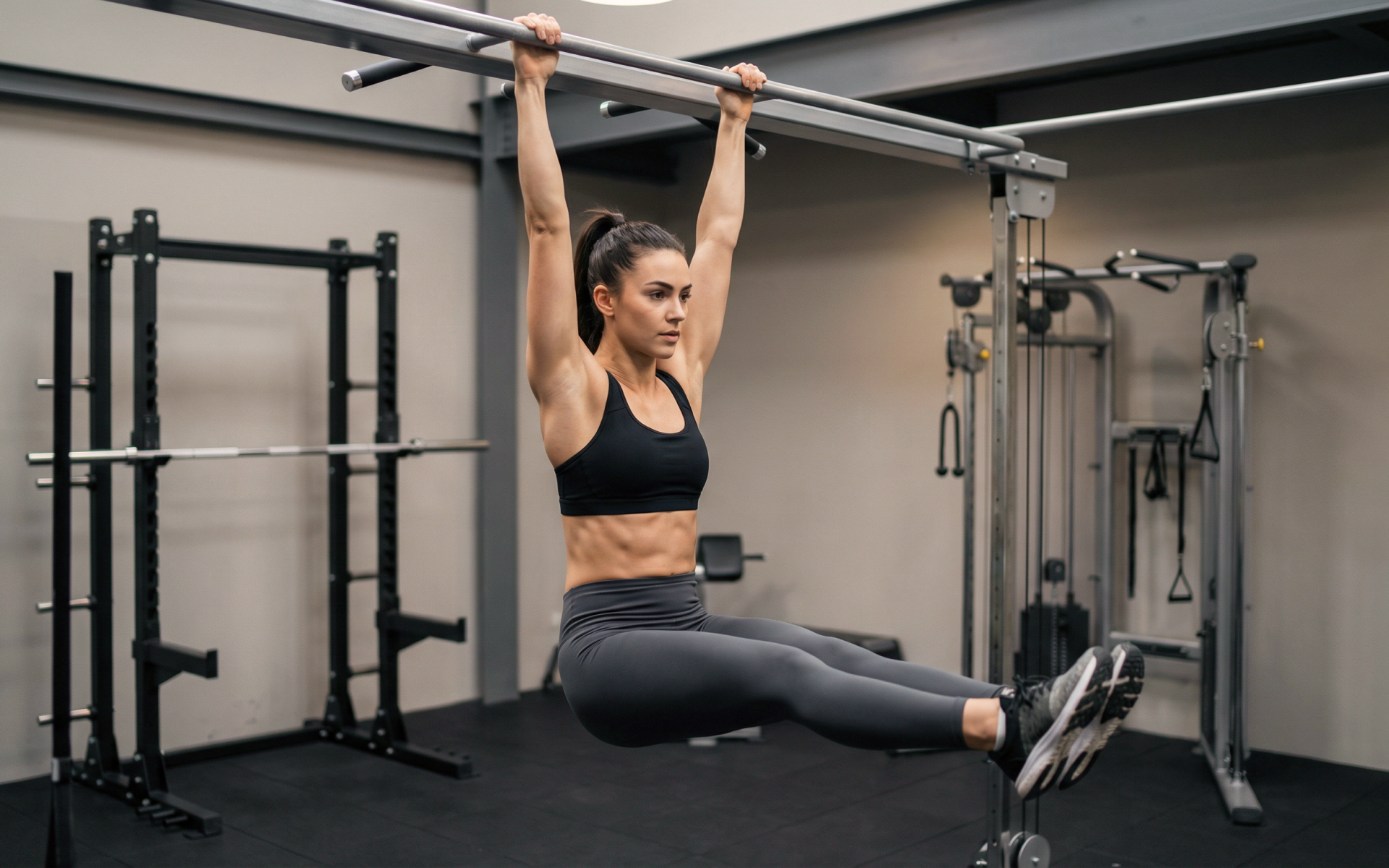
Hanging Knee Raise
- Hang from a bar with shoulders slightly pulled down.
- Raise your knees toward your chest.
- At the top, tuck your tailbone up a little.
- Lower with control, avoiding momentum.
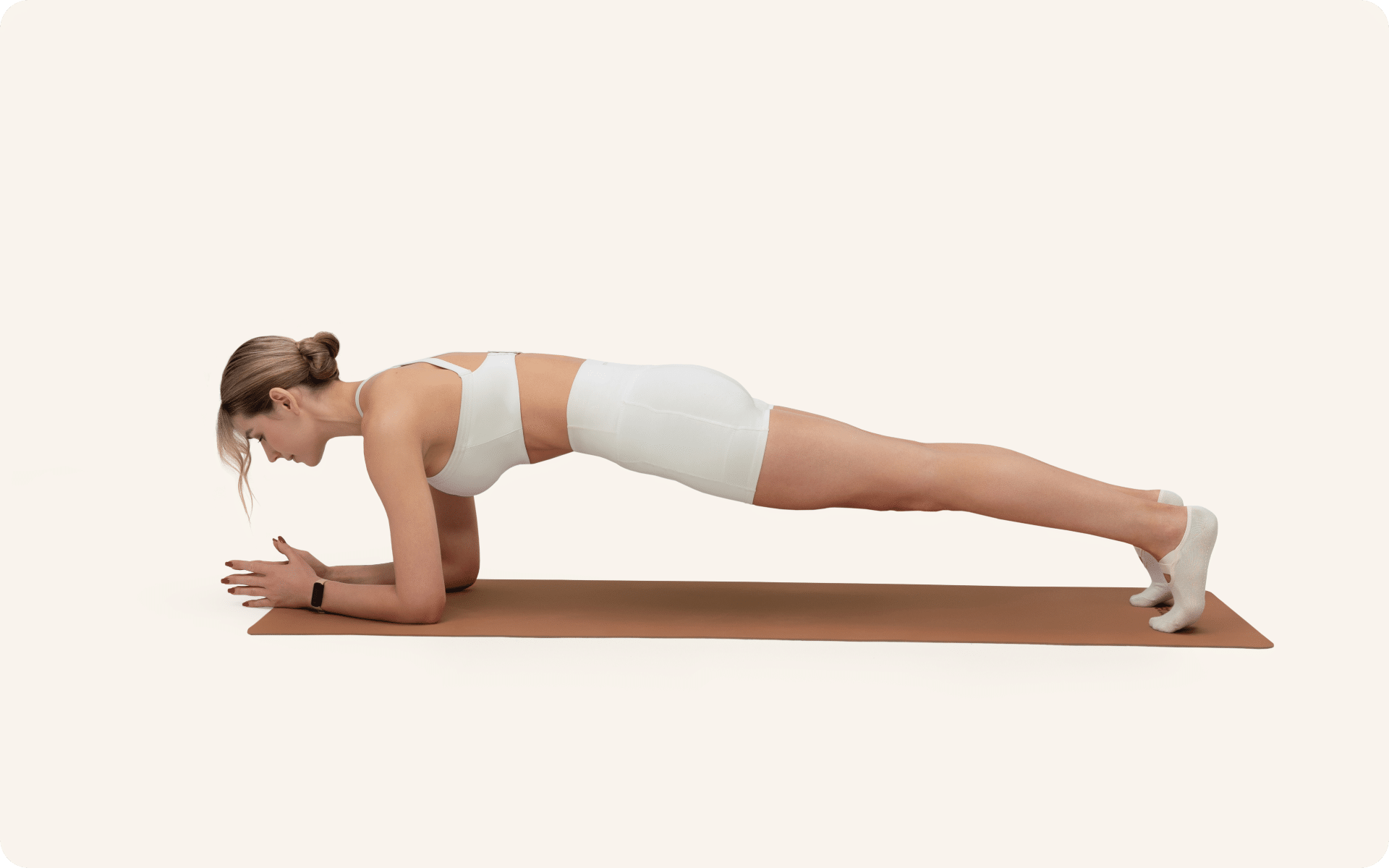
Plank
- Place your elbows under your shoulders.
- Squeeze your glutes and tuck your ribs down.
- Keep your body in a straight line.
- Breathe steadily and hold.
Side Plank
- Set your elbow under your shoulder.
- Stack your body in a straight line.
- Lift your hips off the floor.
- Keep your ribcage over your pelvis.
Ab Wheel Rollout
- Start kneeling and brace your core.
- Keep your ribs tucked.
- Roll forward only as far as you can without arching.
- Pull back through your abs, not your lower back.
Quality beats quantity here. A slower, controlled rep tends to build more useful tension than a rushed one.
How Can You Train the Upper Abs, Lower Abs, and Obliques?
You can bias your training toward your upper abs, lower abs, and obliques, but you can’t fully isolate them. The rectus abdominis is one muscle, so “upper” and “lower” simply describe emphasis, rather than separate parts.
Here’s how to shift the focus:
- Upper ab exercises: Moves that bring your ribs toward your pelvis. Try crunches and cable crunches.
- Lower ab exercises: Moves that involve pelvic tilt. Try reverse crunches and hanging knee raises.
- Oblique exercises: Moves that twist or resist side bending. Try side planks and Pallof presses.
The Pallof press is an anti-rotation move. You hold a band or cable at your chest and resist the pull as it tries to twist you.
For most people, chasing the whole midsection matters more than obsessing over regions. Build the full rectus abdominis, add oblique work, and let overall leanness do the rest. For a fun variation that targets the lower belly area, you might enjoy an 11-line abs workout.
How Often Should You Train Your Abs?
You can train your abs 2-4 times per week for a solid balance of progress and rest (5). Your abs are muscles, so they benefit from rest, as with any other muscle group.
A short, focused dose works well for many people:
- Frequency: 2-4 sessions per week
- Duration: 5-10 focused minutes per session
- Weekly volume: Roughly 8-16 quality sets across your abs and obliques
You don’t need to train them daily. Hitting them hard every day can stall your progress and rest. They’re also involved in just about every exercise that you do. So even without direct training, they’ll still be getting used.
Consistency over the week tends to matter more than any single session. If you prefer structure, a set core workout routine tacked onto other workouts fits easily into a busy schedule.
Whether you’re just starting your fitness journey or looking to add more structure to your routine, BetterMe offers tools that can support different wellness goals. Explore the app and see how its workout, nutrition, and habit-building features can fit into your lifestyle.
How Can You Make Ab Exercises More Challenging over Time?
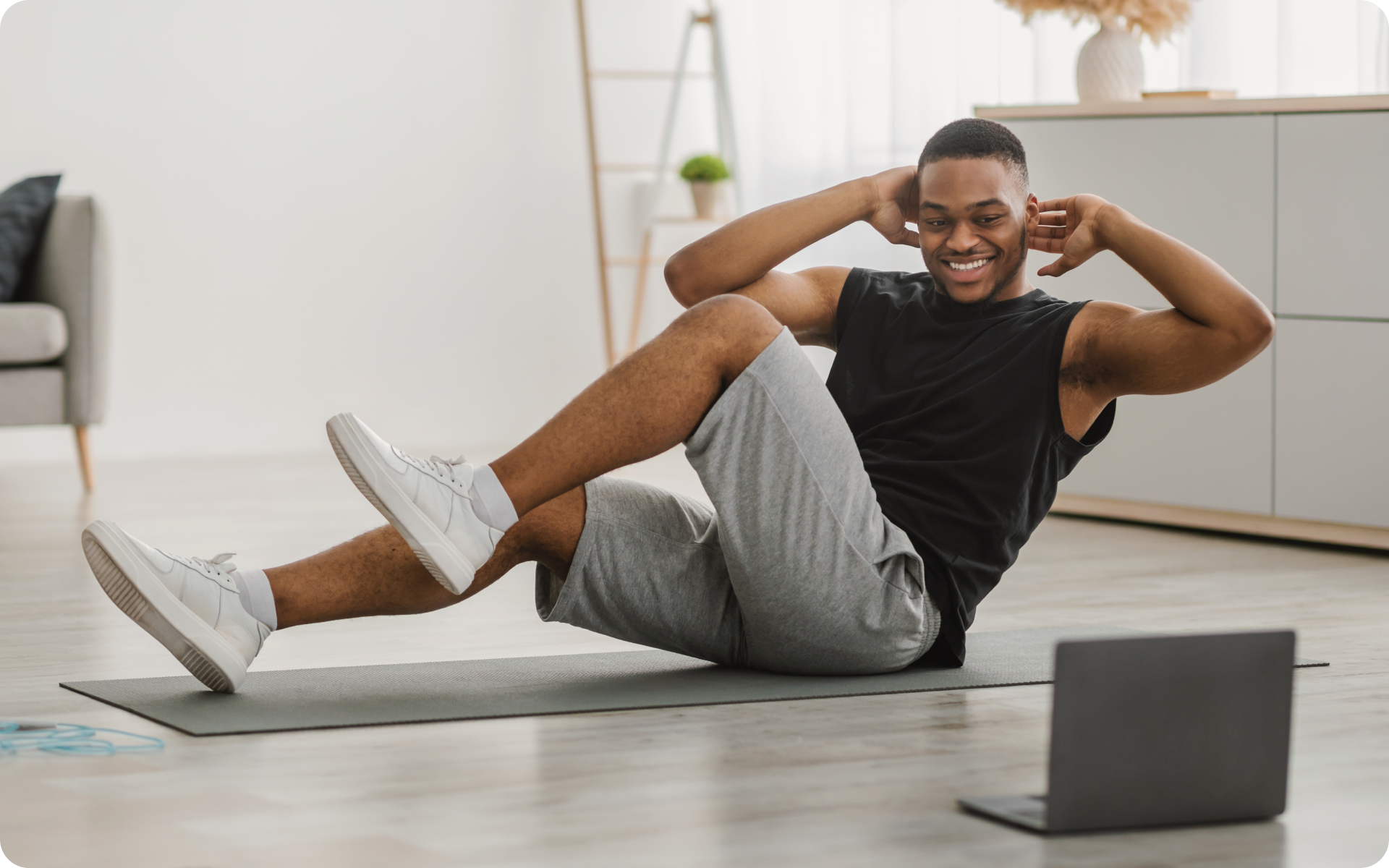
You make ab exercises more challenging over time through progressive overload. Progressive overload means gradually making a move harder so your muscles keep adapting (6).
Mechanical tension, the force your muscles produce during a rep, is the main driver of muscle growth (7). Chasing a “burn” or “pump” is not, so aim to increase the challenge, not just the rep count.
Practical ways to progress include:
- Improve control with slower lowering, around 2-3 seconds.
- Add reps within your target range.
- Add resistance for weighted ab exercises, such as a cable or dumbbell.
- Upgrade the move, such as a plank to an ab wheel rollout.
- Extend the lever, such as moving from bent-knee to straight-leg raises.
Aim for an effort of about RPE 7-9. RPE means rate of perceived exertion, a 1-10 scale of how hard a set feels. That leaves roughly 1-3 reps in reserve (8).
Read more: 20-Day Abs Challenge: A Progressive Core Workout Routine
What Common Mistakes Can Limit Your Ab Training?
The most common mistake is expecting ab workouts alone to reveal your abs without any change in overall body composition. A few other habits can quietly hold back your progress too.
Watch for these:
- No progression: Doing the same easy reps forever.
- Using momentum: Swinging through reps instead of controlling them.
- Training hip flexors: Feeling leg raises mostly in your hips.
- Arching your back: Losing tension during planks or rollouts.
- Chasing soreness: Targeting soreness as proof of a good session.
One narrow approach, such as only crunches, can also leave gaps. A mix of core strengthening exercises tends to build a more balanced midsection. Core strengthening exercises are simply moves that build strength and control in your trunk.
Keep your form clean and your effort meaningful. This combination tends to serve most people better than piling on random reps.
How Does Overall Training Fit into an Ab-Focused Routine?
Overall training supports an ab-focused routine by building total muscle mass, raising energy expenditure, and helping your midsection look leaner. Focusing only on abs is a common misstep.
Full-body resistance training helps in several ways:
- Preserves and builds muscle during fat loss
- Adds indirect core work through big lifts
- Supports a favorable body composition over time
A simple weekly setup might look like this:
- 3-4 lifting days per week covering squats, hinges, presses, and rows
- 5-10 minutes of direct abs after your main lifts
- Some walking or cardio you enjoy for extra activity
This tends to beat a giant standalone ab session. If you want more structure, a full ab workout can slot neatly into this kind of plan.
Below is a sample six-pack workout you can follow 2-3 times per week.
| Exercise | Main focus | Sets | Reps or time | Rest | Progression |
|---|---|---|---|---|---|
| Cable crunch | Upper abs | 2-4 | 8-15 reps | 60-90 secs | Add load once reps feel easy |
| Reverse crunch | Lower abs | 2-4 | 10-15 reps | 60-90 secs | Slow the lowering phase |
| Side plank | Obliques | 2-3 | 20-45 secs/side | 60-90 secs | Add time or light load |
| Ab wheel rollout | Deep core | 2-3 | 6-12 reps | 2-3 mins | Roll a little farther |
What Should You Do When Your Current Ab Workout Gets Too Easy?
When your current ab workout gets too easy, progress it, rather than just adding more mindless reps. An easy workout is a sign to raise the challenge in a smart order.
Here’s a simple progression ladder to follow.
| Step | What to change | Example |
|---|---|---|
| 1 | Refine execution | Slower, more controlled reps |
| 2 | Add reps | From 10 to 15 controlled reps |
| 3 | Add resistance | Cable, dumbbell, or band |
| 4 | Upgrade the move | Plank to body saw or rollout |
| 5 | Adjust tempo | Add a 2-second pause at the hardest point |
Work through these steps as each level feels manageable. This keeps your abs workout fresh and your progress steady. Individual outcomes vary, so adjust to how you feel.
BetterMe offers a variety of workouts, recipes, challenges, and support tools to help you stay more consistent with your wellness routine. Explore the app to find features that fit your goals, preferences, and schedule.

FAQs
How long should an ab workout last?
An ab workout can last around 5-10 focused minutes for many people. Short, quality sessions tend to work well when tacked onto other training. You might do 2-4 exercises with controlled reps. If abs are a priority, you could add a few extra sets. Quality of movement matters more than total time spent.
Can you train abs every day?
You can train abs daily, but it isn’t necessarily better than 2-4 sessions per week. Your abs are muscles that benefit from rest. Training them hard every day may limit progress and leave you feeling worn out. Spacing sessions across the week, with varied effort, tends to support better results for most people.
How many ab exercises should you do in one workout?
You can do around 2-4 ab exercises in one workout for a balanced session. Picking one move from different categories helps cover flexion, pelvic tilt, and oblique work. Aim for 2-4 sets each, with 8-15 reps or 15-60-second holds. This keeps the session efficient while still challenging your whole midsection.
Do you need weights to train your abs?
You do not need weights to train your abs, as bodyweight moves work well to start. Planks, reverse crunches, and hanging knee raises are effective options.
That being said, adding light load later can help you keep progressing. A cable, dumbbell, or band gives you an easy way to increase the challenge over time.
Are crunches enough for an ab workout?
Crunches alone are usually not enough for a complete ab workout. They mainly train rib-to-pelvis flexion and skip pelvic tilt and oblique work. A balanced routine adds moves such as reverse crunches, side planks, and rollouts. This mix tends to build a more well-rounded midsection than crunches on their own.
The Bottom Line
A smart 6-pack ab workout blends the right moves, steady effort, and gradual progression, paired with overall training and a lean enough midsection. Remember that muscle development and body fat both shape whether your abs show, and genetics play a role too. Individual outcomes vary. Pick a routine you enjoy, keep progressing it, and let consistency carry you forward.
DISCLAIMER:
This article is intended for general informational purposes only and does not serve to address individual circumstances. It is not a substitute for professional advice or help and should not be relied on for making any kind of decision-making. Any action taken as a direct or indirect result of the information in this article is entirely at your own risk and is your sole responsibility.
BetterMe, its content staff, and its medical advisors accept no responsibility for inaccuracies, errors, misstatements, inconsistencies, or omissions and specifically disclaim any liability, loss or risk, personal, professional or otherwise, which may be incurred as a consequence, directly or indirectly, of the use and/or application of any content.
You should always seek the advice of your physician or other qualified health provider with any questions you may have regarding a medical condition or your specific situation. Never disregard professional medical advice or delay seeking it because of BetterMe content. If you suspect or think you may have a medical emergency, call your doctor.
SOURCES:
- Anatomy, Abdomen and Pelvis: Anterolateral Abdominal Wall (2023, ncbi.nlm.nih.gov)
- The Multi-Component Structure of Core Strength (2024, pmc.ncbi.nlm.nih.gov)
- The effect of abdominal exercise on abdominal fat (2011, pubmed.ncbi.nlm.nih.gov)
- Abdominal aerobic endurance exercise reveals spot reduction exists: A randomized controlled trial (2023, pmc.ncbi.nlm.nih.gov)
- Core training and performance: a systematic review with meta-analysis (2023, pmc.ncbi.nlm.nih.gov)
- Effects of Resistance Training Overload Progression Protocols on Strength and Muscle Mass (2024, pubmed.ncbi.nlm.nih.gov)
- Anabolic signals and muscle hypertrophy – Significance for strength training in sports medicine (2025, sciencedirect.com)
- Loading Recommendations for Muscle Strength, Hypertrophy, and Local Endurance: A Re-Examination of the Repetition Continuum (2021, mdpi.com)
 Reviewed by

 Reviewed by