Walking into the weight room for the first time or even just unboxing your first set of dumbbells can feel a lot like being the new kid at school. You know you belong there, but the “how-to” part feels a bit blurry.
Basically, it doesn’t really make a massive difference if you’re clearing floor space for a beginner’s weightlifting routine at home, heading to a high-end gym, or hiring a pro to show you the ropes. You should focus on following the correct form and frequency. When you finally do that, you’ll find that strength brings with it a heavy load of confidence. And that’s what you need to tread on the path to fitness.
Today, we’re breaking down how to build a foundation that lasts, no matter where you choose to train.
What Is a Simple Female Beginner’s Lifting Routine?
Weights don’t have a gender and a barbell doesn’t know if a man or a woman is lifting it – the fundamental mechanics of building muscle, progressive overload and proper form, remain the same across the board.
However, when you’re searching for a gym workout plan for female beginners, there are a few body-specific details that can actually work in your favor. Women often have a higher capacity for metabolic stress and recovery (1). This means that while a man may need a long break between sets to stop huffing and puffing, many women can handle shorter rest periods or higher repetitions while maintaining great form.
Why Strength Training Is a Non-Negotiable
If you’re still worried about bulking up overnight, take a look at the data below. Lifting weights is arguably the best thing you can do for your long-term health.
A study published in The Journal of Applied Physiology found that just 10 weeks of resistance training can increase resting metabolic rate by roughly 7% and increase lean muscle weight by about 1.4 kg (2).
This means that your body becomes a more efficient engine. It can burn more energy, even when you’re just sitting on the couch.
What Makes a Female-Focused Plan Different?
Although the exercises (squats, presses, rows) remain the same, a tailored gym workout plan for beginner females often shifts the focus in these three areas:
- Skeletal Support: As women are statistically at higher risk for bone density loss as they age, compound lifts such as the deadlift or overhead press are essential (3). They place healthy stress on the skeletal system, which signals your body to keep those bones dense and strong.
- The Posterior Chain: Many women-specific routines place a slightly higher volume on the glutes, hamstrings, and lower back (4). This helps counteract hip instability and protects the knees (specifically the ACL) from injury during daily movement.
- Hormonal Periodization: You aren’t a robot! Your strength levels may fluctuate based on your cycle (5). A great beginner’s plan teaches you to listen to your body. It makes you push hard when you feel like Wonder Woman, and focus on mobility or lighter technique days when your energy naturally dips.
Don’t feel pressured to learn 50 different machines on day one. A solid start usually involves 3 days a week, focusing on full-body movements. This allows you to practice the same movements frequently enough to build muscle memory without feeling totally burnt out.
Read more: Strength and Conditioning Program for Beginners: The Ultimate Guide
Does Weightlifting Burn Fat?
It’s a common myth that you need to spend hours on a treadmill to lose body fat. Yes, cardio is good for the heart and great at maximizing calorie burn in an individual session. On the other hand, weightlifting is actually a metabolic powerhouse that helps you torch fat in ways running simply cannot.
Let’s put it this way – cardio burns calories while you’re moving, but weightlifting turns your body into a fat-burning machine that stays on long after you’ve left the gym.
- The Afterburn Effect
When you lift weights, particularly if you’re pushing yourself, your body enters a recovery state called excess post-exercise oxygen consumption (EPOC) (6). Basically, your system keeps working overtime after your workout to repair muscle and recharge energy. This is mainly due to that post-workout hormonal boost and metabolism kick. Your body doesn’t stop burning calories when you leave the gym. Instead, you keep torching them for hours, and sometimes even days, afterward.
Reasons why BetterMe is a safe bet: a wide range of calorie-blasting workouts, finger-licking recipes, 24/7 support, challenges that’ll keep you on your best game, and that just scratches the surface! Start using our app and watch the magic happen.
- The Science Behind Muscle and Metabolism
Building muscle raises your resting metabolic rate as muscle takes more energy to maintain than fat, even when you’re doing nothing. And this isn’t just hype: a 2001 study published in Medicine and Science in Sports and Exercise found that after 24 weeks of weight training, participants boosted their basal metabolic rate by 9% (7).
Basically, more muscle = more calories burned on autopilot.
As Effective as Cardio
For several years, many people believed that cardio was the only way to burn fat, but science has finally cleared that up. You don’t have to pick between getting stronger or getting leaner – you can absolutely do both at the same time. In fact, an extensive systematic review and meta-analysis published in Sports Medicine found that strength training alone can reduce total body fat by about 1.4% (8). This is pretty much on par with what you’d expect from cardio or aerobic workouts.
Weightlifting does more than simply burn fat – it also reshapes your entire body composition. While the scale may not drop as quickly as we’d all hope (because you’re adding heavy, dense muscle), your clothes may start to fit better, and your metabolism may improve.
How Should a Female Beginner Lift Weights?
When it comes to weight training for women, there’s no secret hidden in pink dumbbells or complicated machines. It’s actually the way you structure your routine and entire lifestyle around it. If you’re starting, the goal is to build a foundation that makes you feel strong and capable, not exhausted.
Here’s how you should approach weightlifting for beginner females to get the best results without the guesswork:
- Focus on form first, not the weight: It’s easy to peek at what someone else is lifting and try to keep up, but don’t. Start light (or even use your body weight) and learn the movement correctly. Once your body understands how the exercise should feel, adding weight can become much easier.
- Learn the big basics: Almost every good workout is built around four moves: squats, hinges (such as deadlifts), pushes, and pulls. Get comfortable with these, and you’ve basically cracked most of the gym code.
- Progress little by little: To see results, you need to challenge your body slowly. This doesn’t always mean lifting heavier – you can do more reps, slow things down, speed things up, or shorten your rest time. Minor upgrades still count.
- Track your wins: You won’t notice changes in the mirror every day, and that’s normal. Keeping a simple workout log can be very helpful. Seeing that you lifted more or did extra reps than last week is a huge motivation boost.
- Don’t be scared of heavy weights: Lifting heavier weights won’t make you bulky. Given how women’s hormones work, it can help you look strong and toned. Aim for weights that feel tough but doable for about 8 to 12 reps.
- Work with your cycle, not against it: Some days (particularly around your period), your energy may be low. That’s okay. Show up anyway and switch to lighter weights or mobility work instead of skipping altogether.
- Eat well and rest up: Muscles don’t grow during workouts. They grow when you’re eating and sleeping (9). Get enough protein, and try to sleep 7-8 hours. Recovery is part of the workout, too.
What Weights Should a Female Beginner Lift?
Determining your starting point is less about picking a specific number and more about finding your baseline. Every woman starts at a different level of natural strength, but they all have the same aim. They all want to find a weight that challenges them while allowing them to maintain perfect technique.
When aiming for a 4-month weightlifting transformation for females, athletes, and beginners alike should focus on the RPE (rate of perceived exertion) scale. On a scale of 1-10, your lifting weight should feel like a 7 or 8. This means you finish your set feeling like you could have done two more reps, but certainly not ten.
A study published in the Journal of Strength and Conditioning Research suggested that, for hypertrophy (muscle building) and strength gains, beginners should aim for a load of roughly 60% to 70% of their one-rep max (10). As a beginner doesn’t yet know their max, trial-and-error sets are your best friend. Start with a weight you know you can move, and increase it by small increments (2.5 to 5 lbs) until you reach that Level 8 difficulty.
While everyone is different, here’s a general guide for where most women find their starting challenge weight for everyday movements:
| Exercise type | Movement example | Recommended starting weight (dumbbells/bar) |
|---|---|---|
| Lower-body | Goblet squat | 10-20 lbs (single DB) |
| Lower-body | Deadlift | 30-45 lbs (barbell or 2 DBs) |
| Upper-push | Overhead press | 5-10 lbs (per DB) |
| Upper-pull | One-arm row | 8-12 lbs (single DB) |
| Core/stability | Chest press | 10-15 lbs (per DB) |
The 4-Month Progression Rule
To see a significant 4-month weightlifting transformation, female beginners should follow the 2-for-2 rule. This is a gold-standard guideline in exercise science (11). It states that if you can perform two more repetitions than your goal in the final set of an exercise for two consecutive workouts, it’s time to increase the weight.
By consistently applying this, you’ll ensure that you aren’t just going through the motions, but forcing your muscles to adapt and tone up.
Read more: Weekly Weight Lifting Plan: 3-Day, Full-Body Program For Beginners (Dumbbell Only)
Is It Better to Lift Heavier or Lighter Dumbbells?
When it comes to the “heavy vs. light” debate, the fitness world is split. They associate heavy weights with bulk and light weights with tone. The latest research is flipping these ideas.
Recent studies have shown that your muscles can grow (hypertrophy) regardless of whether you lift heavy or light weights (12). You must push the set to volitional failure (the point at which you can’t do another rep with good form).
You should choose what you do according to the goals you have in mind.
Go Heavier for Strength and Muscle
If your aim is muscle growth or strength, heavier weights usually win (13). Training in the 6-12 rep range with challenging resistance can serve the purpose.
- 6-8 reps: Strength-focused
- 8-12 reps: Strength + muscle size
Using adjustable dumbbell weights allows you to gradually increase the load as you become stronger. This saves you the trouble of buying new dumbbells every few months.
Whether you’re a workout beast or just a beginner making your first foray into the world of fitness and dieting – BetterMe has a lot to offer to both newbies and experts! Install the app and experience the versatility first-hand!
Choose Lighter for Recovery and Toning
Lifting lighter weights for 15-30 reps can improve your endurance and burn more calories (14). At the same time, it can help you recover. It’s also perfect for beginners, rehab, or joint-friendly training.
A beginner’s weightlifting routine at home should include lighter weights to build confidence and improve your form. Once that’s locked in, going heavier is easy.
Lighter weights also pair well with heavy days. This can strengthen smaller stabiliser muscles and reduce injury risk (15).
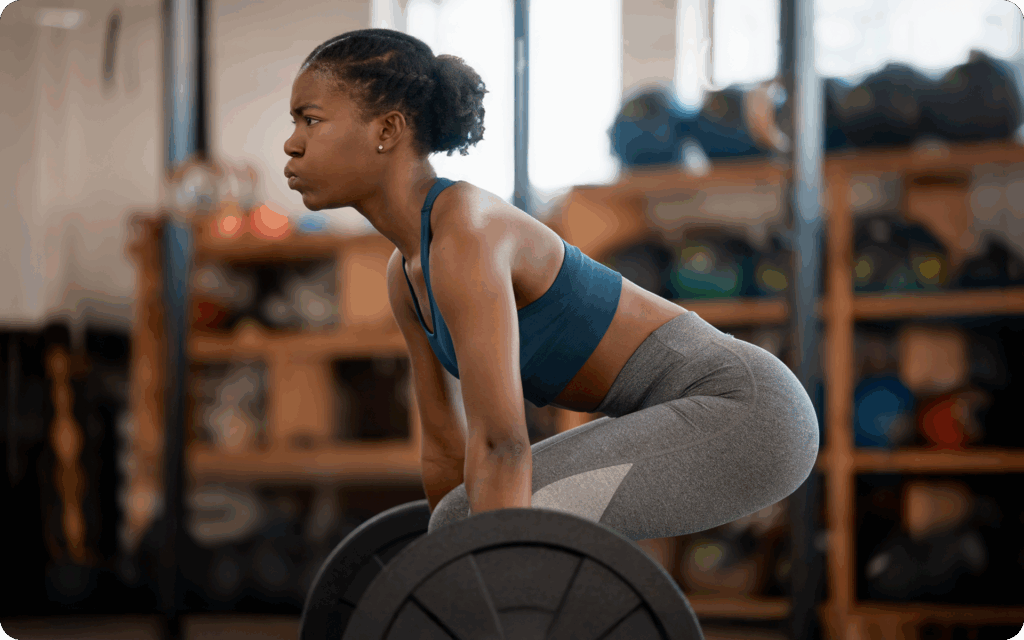
Progressive Overload Is What Really Matters
Whether you lift light or heavy, your focus should be on tracking your progress. As time passes, try to do more by:
- Adding weight
- Doing more reps
- Improving your form
- Reducing the rest time
The Synergy Approach
The best muscle-building workout plans mix both heavy and light weights.
- Start Heavy: Begin with heavier dumbbells for your first one or two big moves (such as squats or rows) while your energy is high. This is where you can build absolute strength.
- Finish Light: Switch to lighter dumbbells for your “accessory” exercises (such as lateral raises or bicep curls). This can allow you to chase the pump and create metabolic stress. These are the key drivers of muscle definition (16).
Ultimately, the “heavy vs. light” debate is kind of pointless. Your body actually loves a mix of both. The real win in a beginner’s weightlifting routine is focusing on steady progress, not stressing over the exact number printed on the dumbbell.
What Is a Good Female Beginner’s Weightlifting Routine?
A good beginner routine is full-body, easy to follow, and focuses on learning proper form before lifting heavy. Aim for 2 to 3 workouts per week, with at least one rest day in between.
Warm-Up (5 minutes)
Light cardio (walking, marching in place) + dynamic stretches for arms, hips, and legs.
Workout Routine
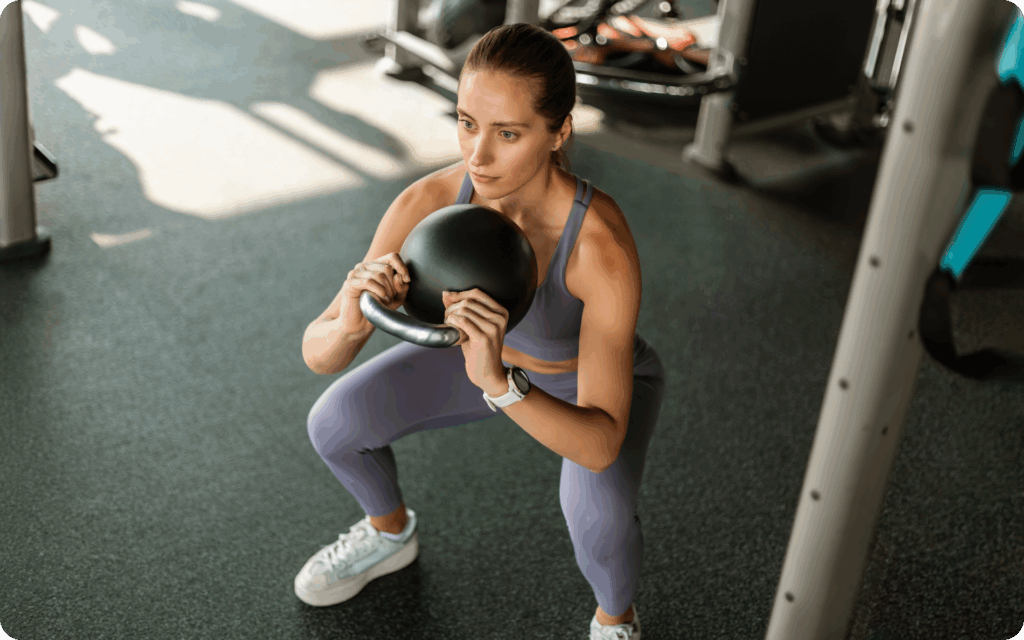
- Goblet squats: 3 sets × 10-12 reps
- Dumbbell chest press (floor or bench): 3 sets × 8-10 reps
- Dumbbell rows: 3 sets × 10-12 reps
- Lateral raises: 2-3 sets × 8-10 reps
- Bicep curls: 2 sets × 12-15 reps
- Tricep kickbacks or overhead extensions: 2 sets × 12-15 reps
- Glute bridges or bodyweight hip thrusts: 3 sets × 12-15 reps
Cool-Down (5 minutes)
Gentle stretching for the legs, arms, shoulders, and lower back.
Beginner tip: Start with weights that feel challenging but still allow you to finish all reps with good form. When it starts to feel easy, slowly increase the weight or reps.
How Many Days a Week Should a Beginner Lift Weights?
If you’re a beginner, the sweet spot for lifting weights is usually 3 to 5 days a week, and there’s a good reason for that.
Consider strength training like learning a new language. Practising once in a while won’t get you far, but showing up consistently helps everything click faster. Research backs this up too. Studies have suggested that at least 3 days a week are needed to see real strength gains. At the same time, five days a week can be even more effective if recovery is managed well (17).
In fact, a 2023 study found that training three days a week clearly beat two days a week for building bicep strength. The two-day group trained for 4 weeks and showed no meaningful strength gains. At the same time, the three-day group increased both concentric and eccentric bicep strength, revealing that a slightly higher training frequency yields better results (18).
For most beginners, this is how it usually works:
- 3 days a week: Helps to learn the exercises, build strength, and avoid burnout
- 4-5 days a week: Works well if you enjoy training and want faster progress, as long as you alternate muscle groups and rest properly
You should show up every day and let your body adapt. Start with three solid sessions per week, listen to your recovery, and add more days only when lifting feels like a habit, not a struggle.
How Long Should a Beginner Lift Weights to See Results?
Research has indicated that results happen in waves. According to a 2025 study from Florida Atlantic University, beginners can see meaningful strength gains with as little as one to two high-intensity sets per session, as long as they’re consistent across several weeks (19).
The initial rapid progress is called newbie gains. Neurological adaptations drive it, but consistent training over months is essential to build substantial muscle mass.
A study co-authored by Dr Brad Schoenfeld in the Journal of Applied Physiology (2025) suggested that muscle growth for beginners can be achieved even without constantly increasing the intensity, as long as the total volume remains consistent (20). It’s like your body is working like a sponge for strength in these first few months.
To see a physical difference in appearance, science suggests a minimum of roughly 16 to 20 adequately spaced workout sessions. If you lift three times a week, you can reach this milestone in about 6 weeks. This is usually the point where the internal changes can finally manifest as external results. For more details about weightlifting for female beginners, take a look at our prior publication.
Yes, flabby upper arms can be toned with a combination of strength training and overall fat loss. As fat loss happens throughout the body, not in just one area, consistent workouts, a balanced diet, and enough protein are key to seeing definition in your arms. Lifting weights can help reduce belly fat, but not by targeting the stomach alone. Strength training increases muscle mass. This can boost your metabolism and help your body burn more calories, even when you’re at rest. Yes, you can grow your arm muscles with light weights if you use proper technique and enough intensity. They can be particularly effective for beginners or when paired with slow tempo and minimal rest between sets. Early signs of muscle growth include feeling stronger and a slight increase in firmness or tightness in the trained area. You may also notice your muscles looking fuller after workouts and recovering faster over time.Frequently Asked Questions
Can flabby upper arms be toned?
Can I lose belly fat by lifting?
Can you grow your arms with light weights?
What are the first signs of muscle growth?
The Bottom Line
It’s natural to be hesitant before you start a weightlifting routine. You don’t need to lift the heaviest weights on day one. Focus on learning the Big Four moves (squats, hinges, pushes, and pulls) using a weight that feels like a solid 7 or 8 out of 10. And when you feel like you’ve figured out the formula that works for you, stick with the process for at least six weeks.
Show up three days a week and track your small wins. You’ll slowly build a stronger, more resilient version of yourself.
DISCLAIMER:
This article is intended for general informational purposes only and does not serve to address individual circumstances. It is not a substitute for professional advice or help and should not be relied on for making any kind of decision-making. Any action taken as a direct or indirect result of the information in this article is entirely at your own risk and is your sole responsibility.
BetterMe, its content staff, and its medical advisors accept no responsibility for inaccuracies, errors, misstatements, inconsistencies, or omissions and specifically disclaim any liability, loss or risk, personal, professional or otherwise, which may be incurred as a consequence, directly or indirectly, of the use and/or application of any content.
You should always seek the advice of your physician or other qualified health provider with any questions you may have regarding a medical condition or your specific situation. Never disregard professional medical advice or delay seeking it because of BetterMe content. If you suspect or think you may have a medical emergency, call your doctor.
SOURCES:
- Sex differences in skeletal muscle fiber types: A meta-analysis (2023, ro.ecu.edu.au)
- Osteoporosis in Females (2025, ncbi.nlm.nih.gov)
- Female Lower Body Muscle Forces: A Musculoskeletal Modeling Comparison of Back Squats, Split Squats and Good Mornings (2024, researchgate.net)
- The Influence of the Menstrual Cycle on Muscle Strength and Power Performance (n.d., johk.pl)
- Effects of exercise intensity and duration on the excess post-exercise oxygen consumption (2006, pubmed.ncbi.nlm.nih.gov)
- Effect of strength training on resting metabolic rate and physical activity: age and gender comparisons (2001, pubmed.ncbi.nlm.nih.gov)
- The Effect of Resistance Training in Healthy Adults on Body Fat Percentage, Fat Mass and Visceral Fat: A Systematic Review and Meta-Analysis (2022, link.springer.com)
- The effect of acute sleep deprivation on skeletal muscle protein synthesis and the hormonal environment (2021, physoc.onlinelibrary.wiley.com)
- Loading Recommendations for Muscle Strength, Hypertrophy, and Local Endurance: A Re-Examination of the Repetition Continuum (2021, mdpi.com)
- Different resistance training volumes on strength, functional fitness, and body composition of older people: A systematic review with meta-analysis (n.d., sciencedirect.com)
- For Bigger Muscles Push Close to Failure, For Strength, Maybe Not (2024, fau.edu)
- Resistance training prescription for muscle strength and hypertrophy in healthy adults: a systematic review and Bayesian network meta-analysis (n.d., bjsm.bmj.com)
- Slow and Steady, or Hard and Fast? A Systematic Review and Meta-Analysis of Studies Comparing Body Composition Changes between Interval Training and Moderate Intensity Continuous Training (2021, mdpi.com)
- Light weights are as effective as heavy weights for muscle activation in the Hammerobics exercise (2024, journals.plos.org)
- Strength Training: A Comprehensive Guide to Using Science to Build Muscles (n.d., performancemedinst.com)
- The Effects of 3 vs. 5 Days of Training Cessation on Maximal Strength (2022, journals.lww.com)
- Weekly minimum frequency of one maximal eccentric contraction to increase muscle strength of the elbow flexors (2023, link.springer.com)
- To Build Muscle and Gain Strength, Train Smarter – Not Longer (2025, fau.edu)
- New Study Could Change Approach to Strength Training (2025, lehman.edu)

 Reviewed by