
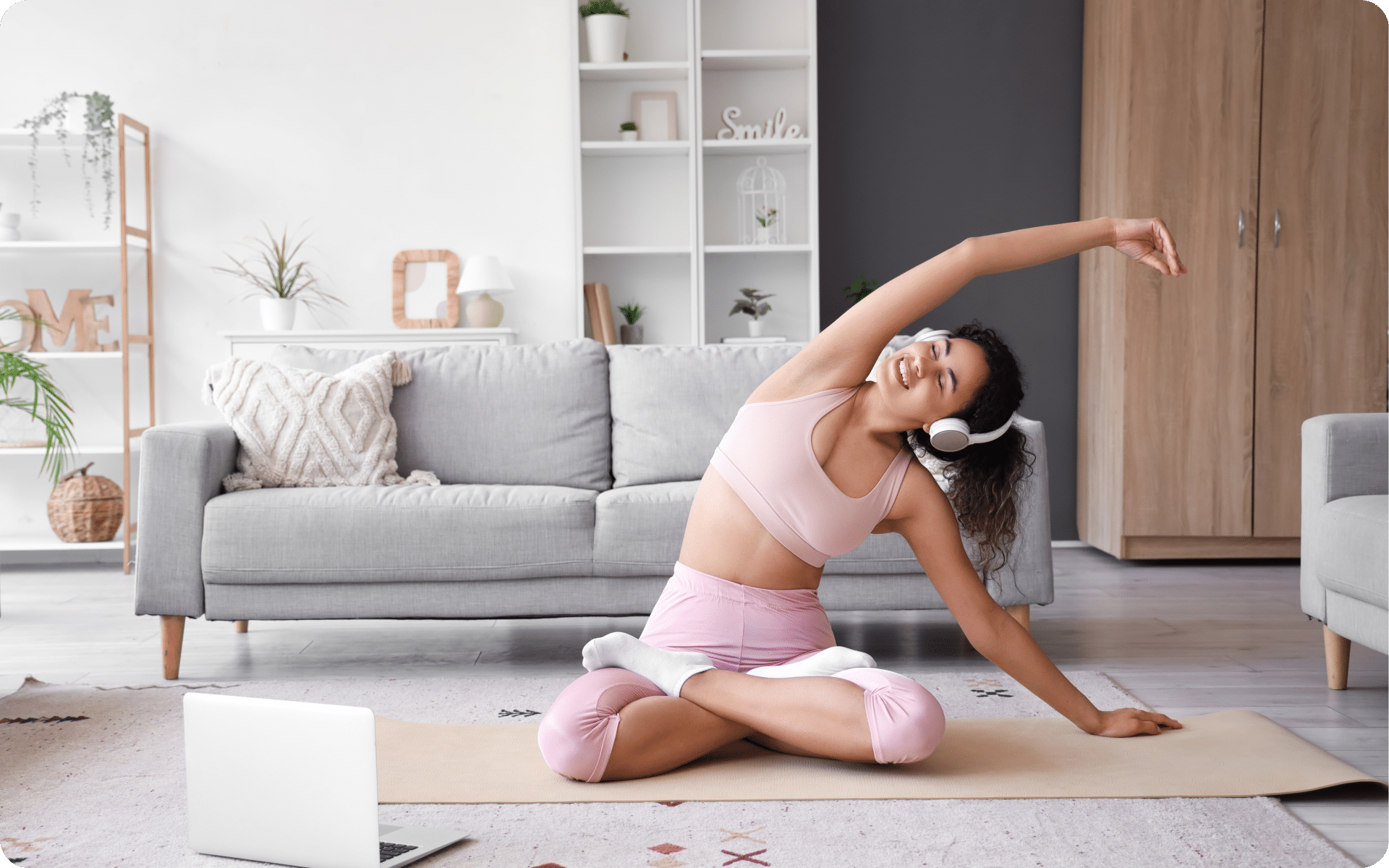
An at-home Pilates workout plan can start with a 30-minute mat session: 5 minutes to prepare, 20 minutes for controlled exercises and rest, and 5 minutes to finish gently. Use the timed table to guide your session, choose easier versions when needed, and repeat the routine before adding difficulty.
One of the most significant advantages of Pilates at home is its flexibility. You can roll out your mat whenever it fits into your schedule instead of trying to match a studio’s timetable. If you need movement demonstrations before starting, use our Pilates exercise reference for beginners.
Key takeaways
- This 30-minute sample session uses 5 minutes of preparation, 20 minutes of practice and rest, and a 5-minute finish.
- Five main exercise blocks cover pelvic curls, leg stretch preparation, seated stretches, side-lying leg lifts, and swimming preparation.
- Beginner exercise targets are optional; use the remainder of each block for rest or setup.
- Start with two practice days and leave a day between them before considering a third.
- Adult guidance includes at least 150 minutes of moderate aerobic activity weekly and strengthening on at least two days (1).
- A 12-week Pilates trial found muscular endurance and flexibility gains, not a guaranteed result from this session (2).
What do you need for Pilates at home?
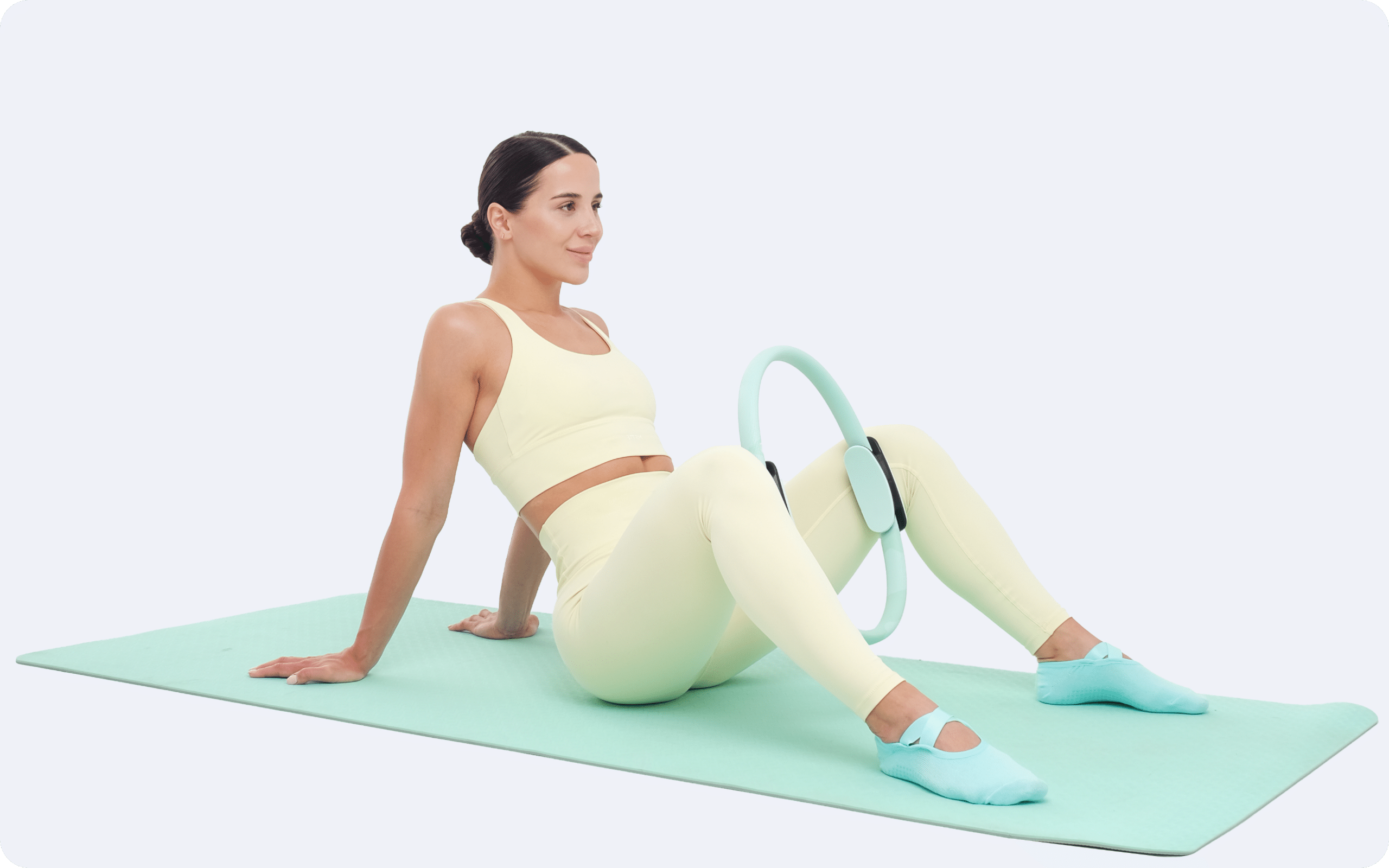
You need a mat, clear floor space, and enough time to move without rushing. A mat provides cushioning for floor work. Clear enough space to lie down and reach your arms and legs without hitting furniture. Keep the floor dry, wear clothing that allows movement, and place water within reach. You do not need a reformer for the mat exercises in this guide.
Begin with small movements and steady breathing. Stop an exercise if it causes discomfort, and ask a qualified professional for help if you are unsure about the movement or whether this routine fits your circumstances.
Pilates emphasizes concentration, control, centering, flow, precision, and breathing (3). A beginner can put these principles into practice by choosing a smaller movement range and breathing continuously instead of chasing more repetitions.
Read more: Wall Pilates for Back Fat: 9 At-Home Exercises
How do you follow a 30-minute home Pilates session?
Use 5 minutes to prepare, 20 minutes to practice, and 5 minutes to finish. BetterMe’s editorial session has five main exercise blocks; their time includes setup, changing sides, and rest. The targets are suggestions, so completing fewer repetitions does not make the session incomplete.
| Time | Movement | Starting target | Easier option |
|---|---|---|---|
| 0-2 minutes | Gentle marching and arm reaches | Easy, continuous movement | Seated marching |
| 2-5 minutes | Standing shoulder circles, then gentle cat-cow | Small, comfortable movements | Stay standing and use gentle back movement |
| 5-9 minutes | Pelvic curl | 1-2 sets of 6-8 reps | Pelvic tilt or smaller lift |
| 9-13 minutes | Single-leg stretch preparation | 1-2 sets of 4-6 per leg | Heel slides with head down |
| 13-17 minutes | Seated forward stretch | 4-6 slow repetitions | Bent knees; shorter reach |
| 17-21 minutes | Side-lying leg lift | 1 set of 6-8 per side | Bent upper knee |
| 21-25 minutes | Swimming preparation | 4-6 alternating lifts per side | Lengthen the leg without lifting |
| 25-27 minutes | Gentle walking or marching | Gradually slow your pace | Seated heel lifts |
| 27-29 minutes | Seated side reach | 15-20 seconds per side; release between holds | Keep the lower hand on the mat |
| 29-30 minutes | Comfortable breathing | Relaxed, unforced breaths | Sit or lie in a comfortable position |
Rest about 30-60 seconds between sets, or longer when needed. Let the remaining time in each block be rest; do not fill it with extra repetitions. Before more demanding activity, general guidance recommends a 5-10 minute gradual warm-up and a gradual cool-down (4). This session includes 5 minutes for each.
For a calendar around this single session, follow our weekly Pilates workout plan.
How do you perform the five main exercises?
Learn the starting position for each movement before attempting the full target.
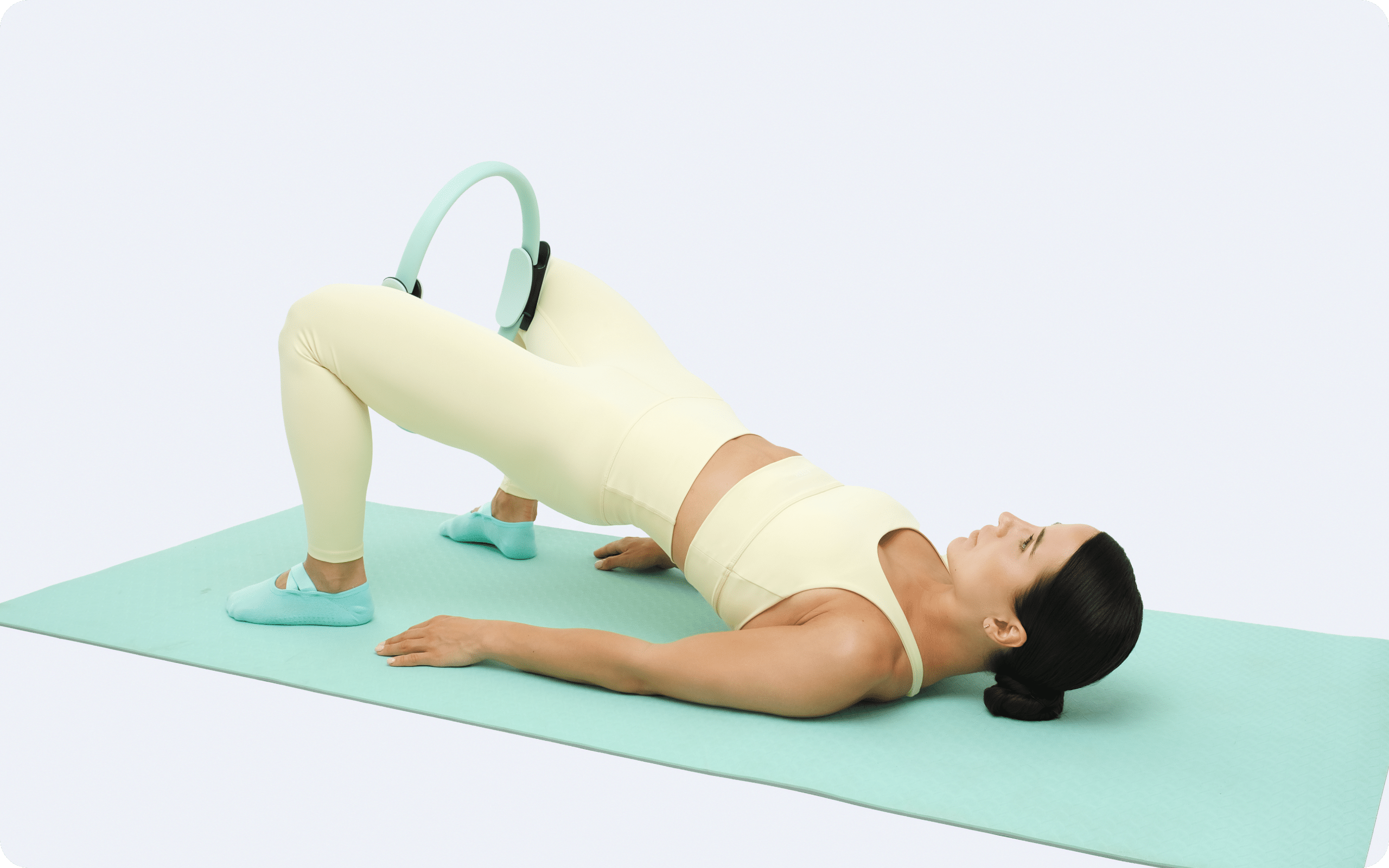
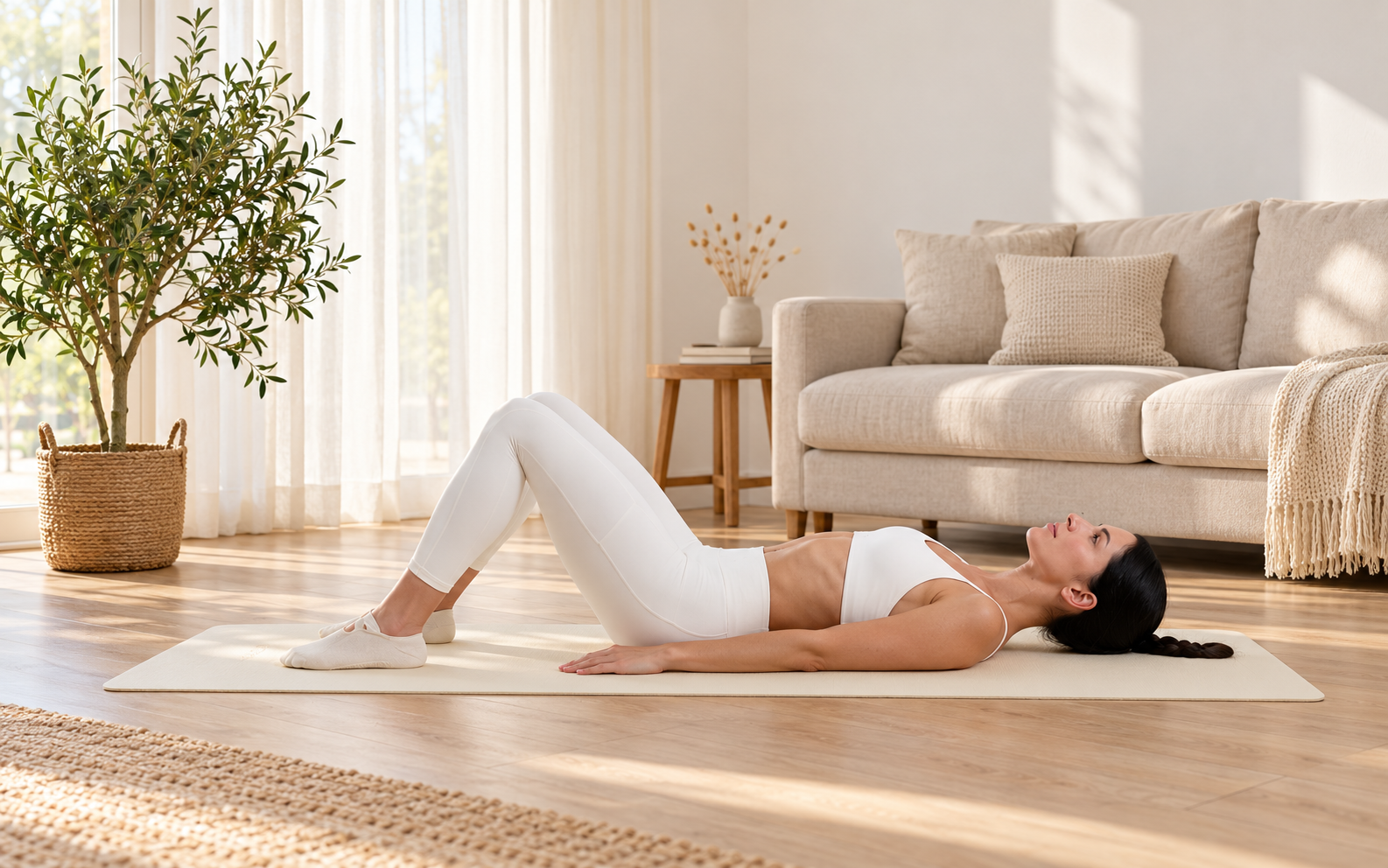
Pelvic curl
- Lie on your back with your knees bent and feet flat on the mat.
- Exhale as you lift your hips through a comfortable range.
- Pause without pushing your ribs upward.
- Lower your hips slowly to the mat.
Easier option: Use a small lift or practice a gentle pelvic tilt without lifting your hips. Keep both feet down.
BetterMe can help you add more structure to your daily wellness routine with workouts, meal planning tools, and habit-building features. Explore the app and take a practical step toward a routine that feels more manageable for you.
Single-leg stretch preparation
- Lie on your back with both knees bent and feet down.
- Slide one heel away from your body while keeping your head resting on the mat.
- Bring that heel back toward your body.
- Repeat the heel slide with the other leg.
Progression: When heel slides feel controlled, bring one bent knee toward your chest while extending the opposite leg higher in the air. Keep the range small; lifting your head is optional.
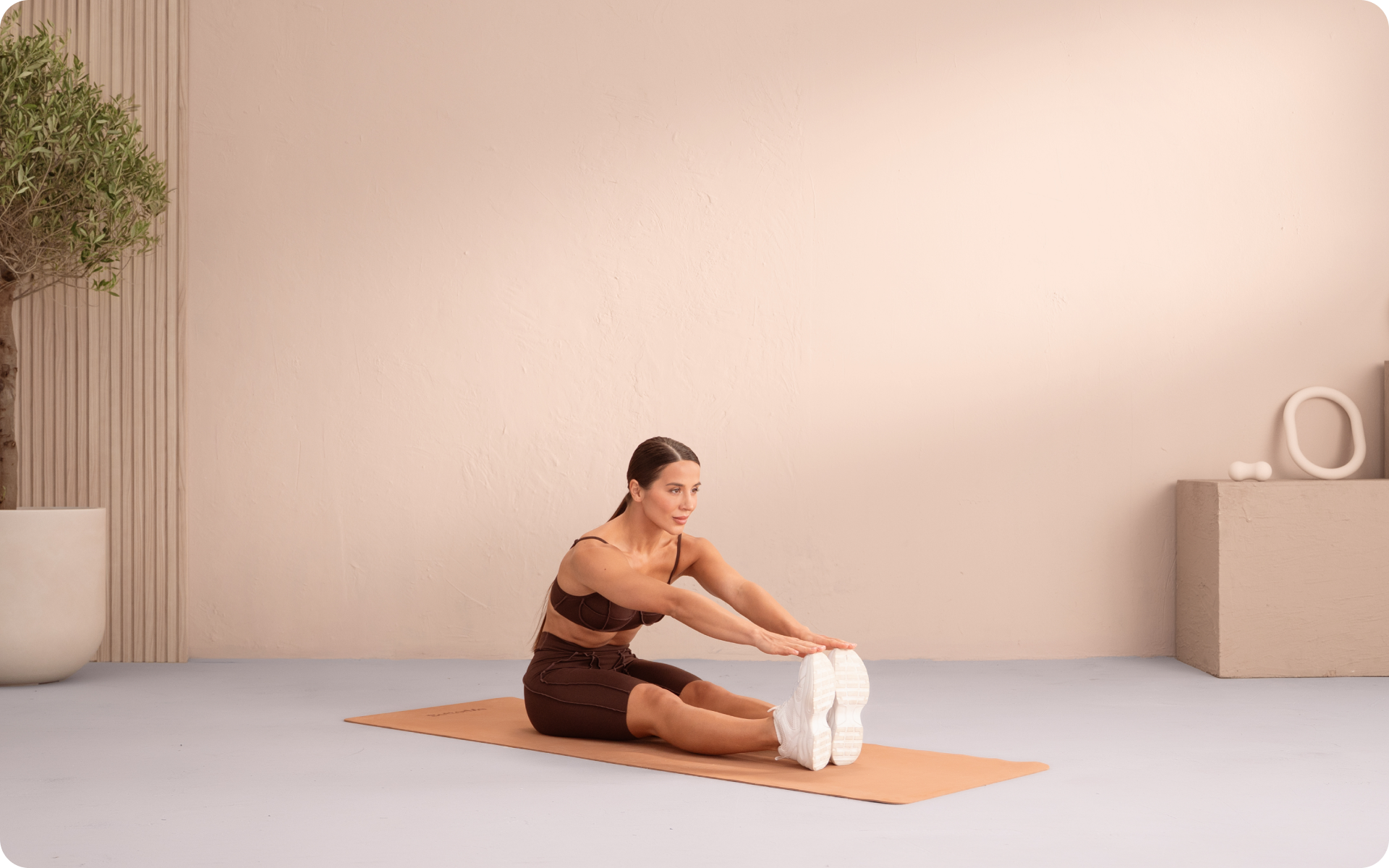
Seated forward stretch
- Sit tall with your knees slightly bent and feet comfortably apart.
- Reach your arms forward at shoulder height.
- Exhale as you reach forward through a comfortable range.
- Return to an upright seat.
Easier option: Sit on a folded towel and bend your knees further. Avoid bouncing or forcing your fingertips toward your toes.
Side-lying leg lift
- Lie on your side with your head supported and your lower knee bent.
- Lift your top leg a short distance while keeping your pelvis still.
- Lower the leg with control.
- Turn onto your other side for the second set.
Easier option: Bend your top knee or reduce the lift. Keep the upper foot facing forward rather than turning it toward the ceiling.
Swimming preparation
- Lie face down with your forehead supported on your hands.
- Lengthen one leg along the mat.
- Lift that leg slightly without arching your back.
- Lower the leg before switching sides.
Progression: Reach one arm forward and lift it slightly with the opposite leg. Keep your neck comfortable and avoid trying to lift high.
Read more: 5-Minute Pilates: The Perfect Quick Workout
How often should you repeat this session?
Start with two sessions on nonconsecutive days, then consider a third if the routine feels manageable. This is a sample practice schedule, not a requirement to complete 30 minutes every day. General adult guidance includes at least 150 minutes of moderate aerobic activity weekly and muscle-strengthening activity on at least two days (1). Slow mat work does not automatically meet the aerobic target or challenge every major muscle group.
Keep the same repetitions until you can finish with steady breathing and controlled movement. Then change one thing: add one or two repetitions to one exercise, or use a slightly larger comfortable range. Keep rest intervals. If you want a longer attendance framework, our 30-day home Pilates challenge includes scheduled lighter days and rest.
What changes can you expect from Pilates?
Pilates may support muscular endurance and flexibility, although a particular result cannot be promised. Pilates research offers reasons to practice, but it does not establish a result deadline for this sample schedule. One 12-week trial found improvements in muscular endurance and hamstring flexibility, but not balance or posture compared with its control group (2). A review in adult women found flexibility improvements across varied Pilates programs (5). Individual results vary, and these findings do not mean this particular home routine produces the same changes.
Physical activity can contribute to weight management, but weight changes depend on activity, eating patterns, and individual factors (6). No exercise in this guide selectively changes one body area. Track attendance, movement control, and how manageable the session feels rather than using a promised appearance change as your deadline.
For a short-session alternative, try the busy mom Pilates challenge.
Workouts, weight management tools, and recipe ideas come together in the BetterMe: Health Coaching app, giving you practical support for building a more consistent wellness routine.

Thirty minutes gives you time for preparation, several controlled exercises, and a gradual finish. Whether it meets your wider fitness needs depends on effort, exercise selection, and the rest of your weekly activity. You can perform the mat session with a mat and clear floor space. Equipment-based Pilates exercises need their specified apparatus, so do not improvise a reformer or Pilates chair with household furniture. Beginners do not need a demanding Pilates session every day. Start with two practice days, keep rest days, and add an optional third session only when your current workload feels manageable. Thirty days can help you learn a repeatable practice schedule, but it does not guarantee a particular appearance change. Individual results depend on several factors, and the research cited here did not test this exact 30-minute plan.FAQs
Is 30 minutes of Pilates enough?
Can you do Pilates at home without equipment?
Should beginners do Pilates every day?
Can Pilates change your body in 30 days?
The bottom line
Roll out your mat, follow the 5-minute preparation, and use the 20-minute practice block at your own pace. Keep the 5-minute finish, even if you shorten the main exercises. Repeat a familiar session before adding difficulty.
DISCLAIMER:
This article is intended for general informational purposes only and does not serve to address individual circumstances. It is not a substitute for professional advice or help and should not be relied on for making any kind of decision-making. Any action taken as a direct or indirect result of the information in this article is entirely at your own risk and is your sole responsibility.
BetterMe, its content staff, and its medical advisors accept no responsibility for inaccuracies, errors, misstatements, inconsistencies, or omissions and specifically disclaim any liability, loss or risk, personal, professional or otherwise, which may be incurred as a consequence, directly or indirectly, of the use and/or application of any content.
You should always seek the advice of your physician or other qualified health provider with any questions you may have regarding a medical condition or your specific situation. Never disregard professional medical advice or delay seeking it because of BetterMe content. If you suspect or think you may have a medical emergency, call your doctor.
SOURCES:
- Adult Activity: An Overview (2023, cdc.gov)
- Pilates for Improvement of Muscle Endurance, Flexibility, Balance, and Posture (2010, journals.lww.com)
- Pilates: how does it work and who needs it? (2011, pmc.ncbi.nlm.nih.gov)
- Warm Up, Cool Down (2024, heart.org)
- Effects of Pilates Programs on Body Composition, Flexibility, Muscular Strength, Balance, Functional Performance and Respiratory Function in Adult Women: A Systematic Review and Meta-Analysis (2026, pmc.ncbi.nlm.nih.gov)
- Physical Activity and Your Weight and Health (2026, cdc.gov)
 Reviewed by
 Reviewed by