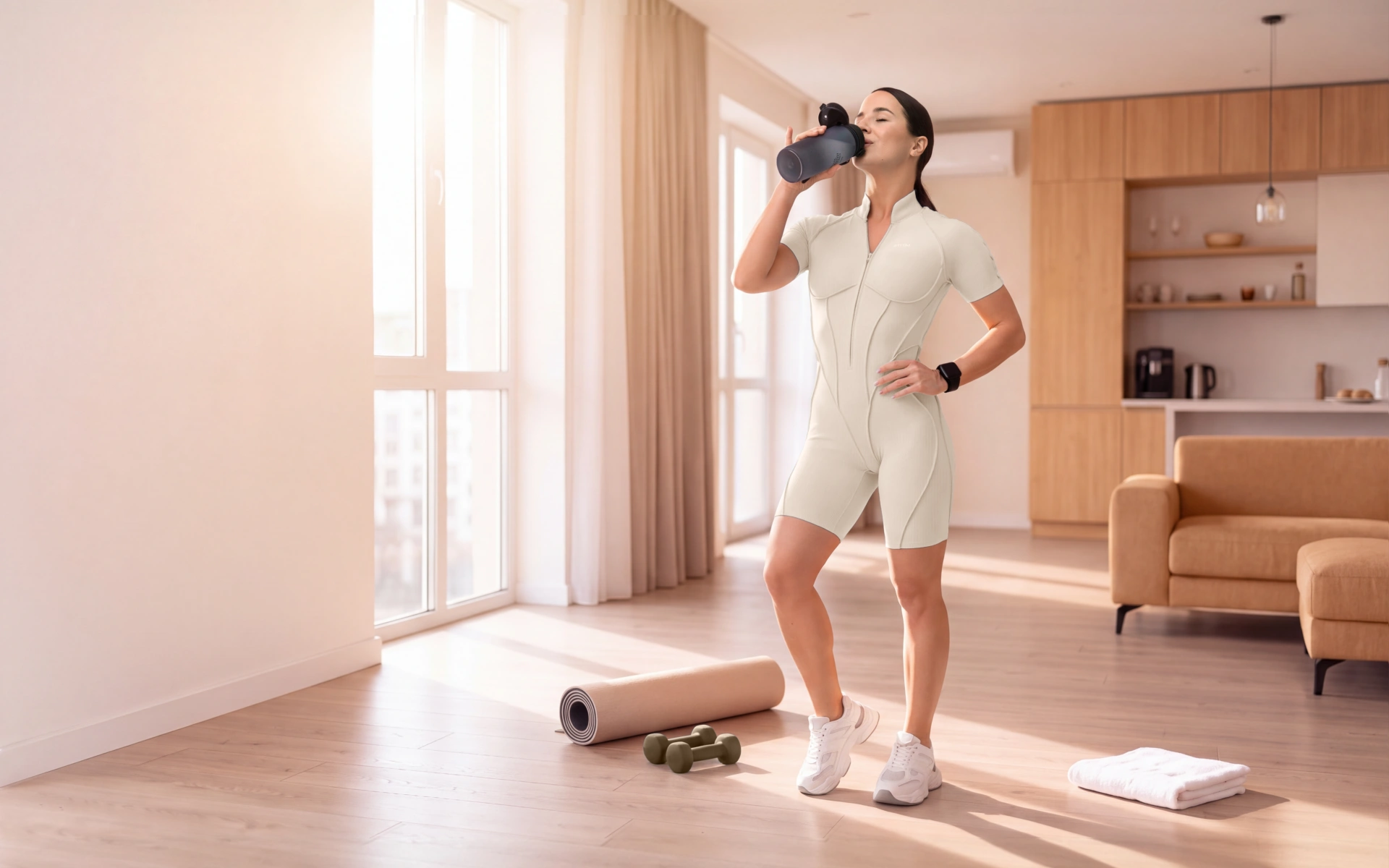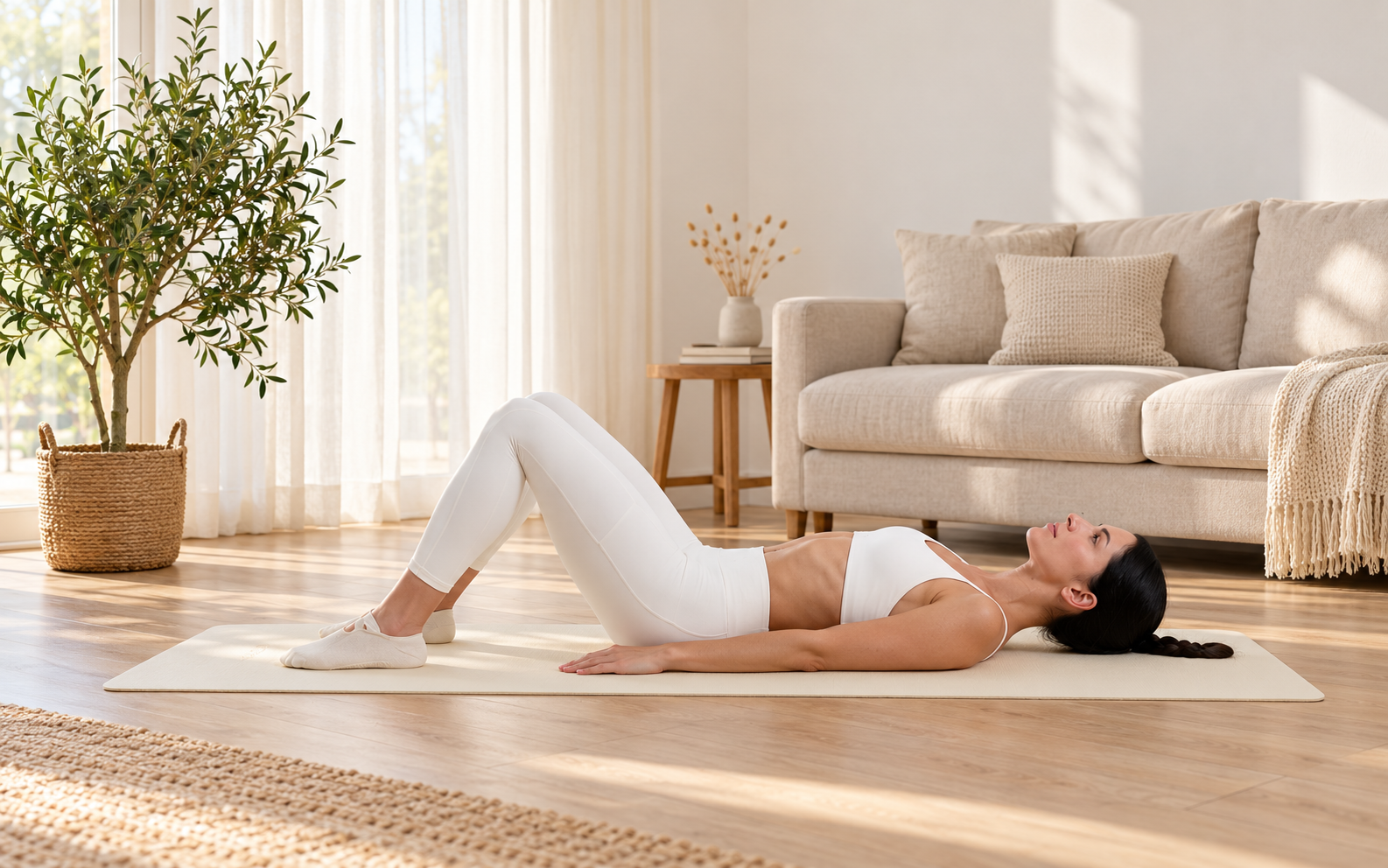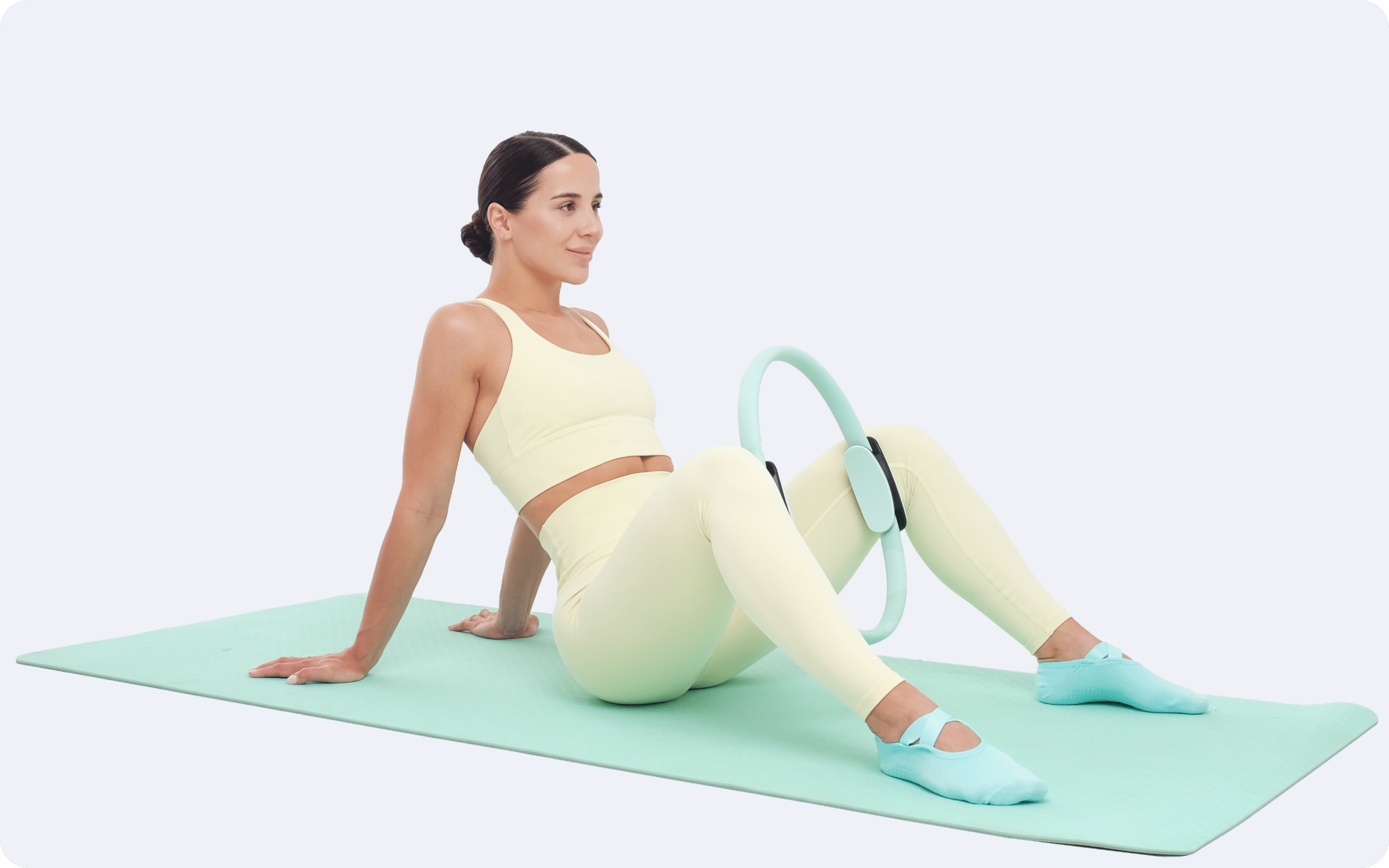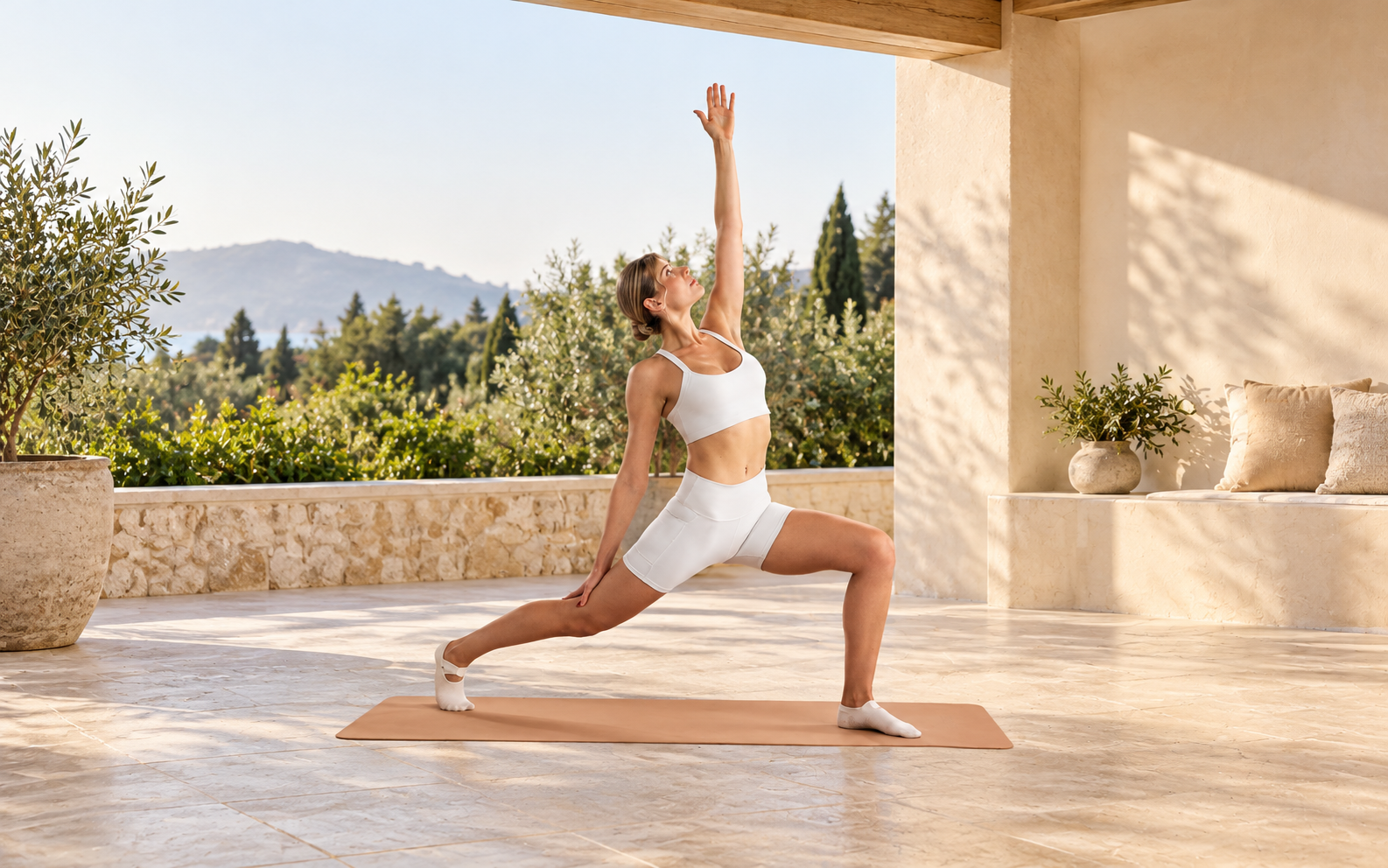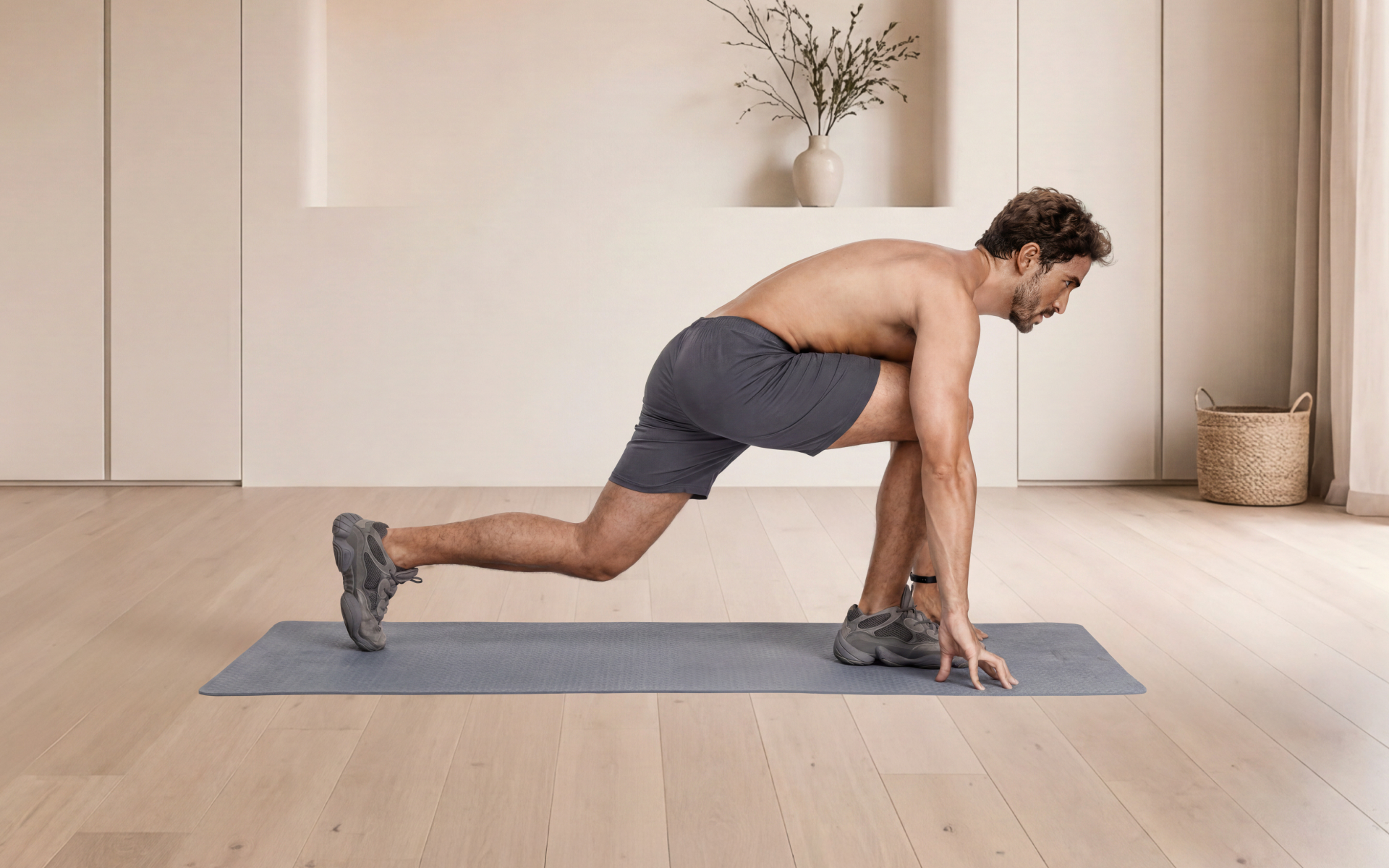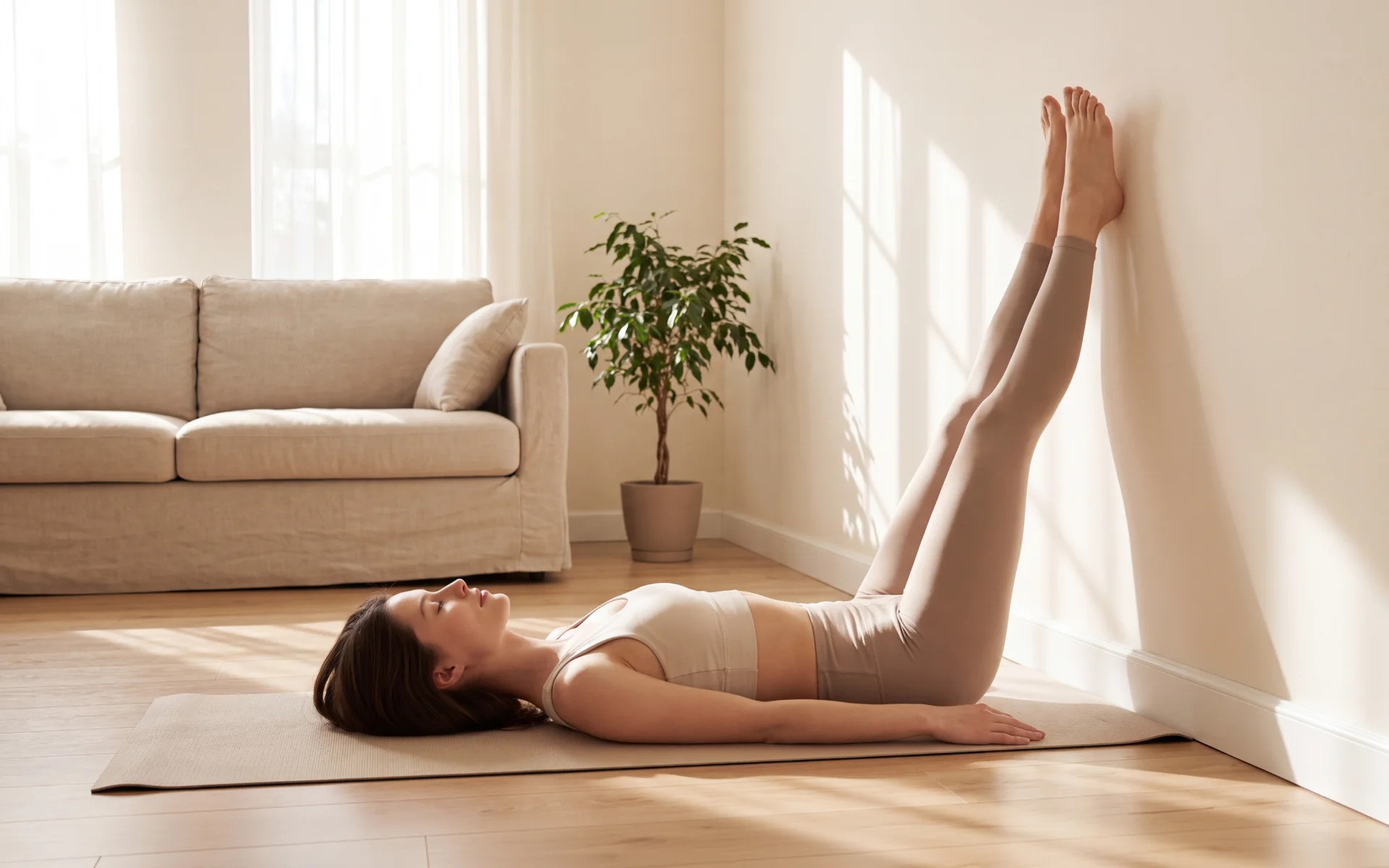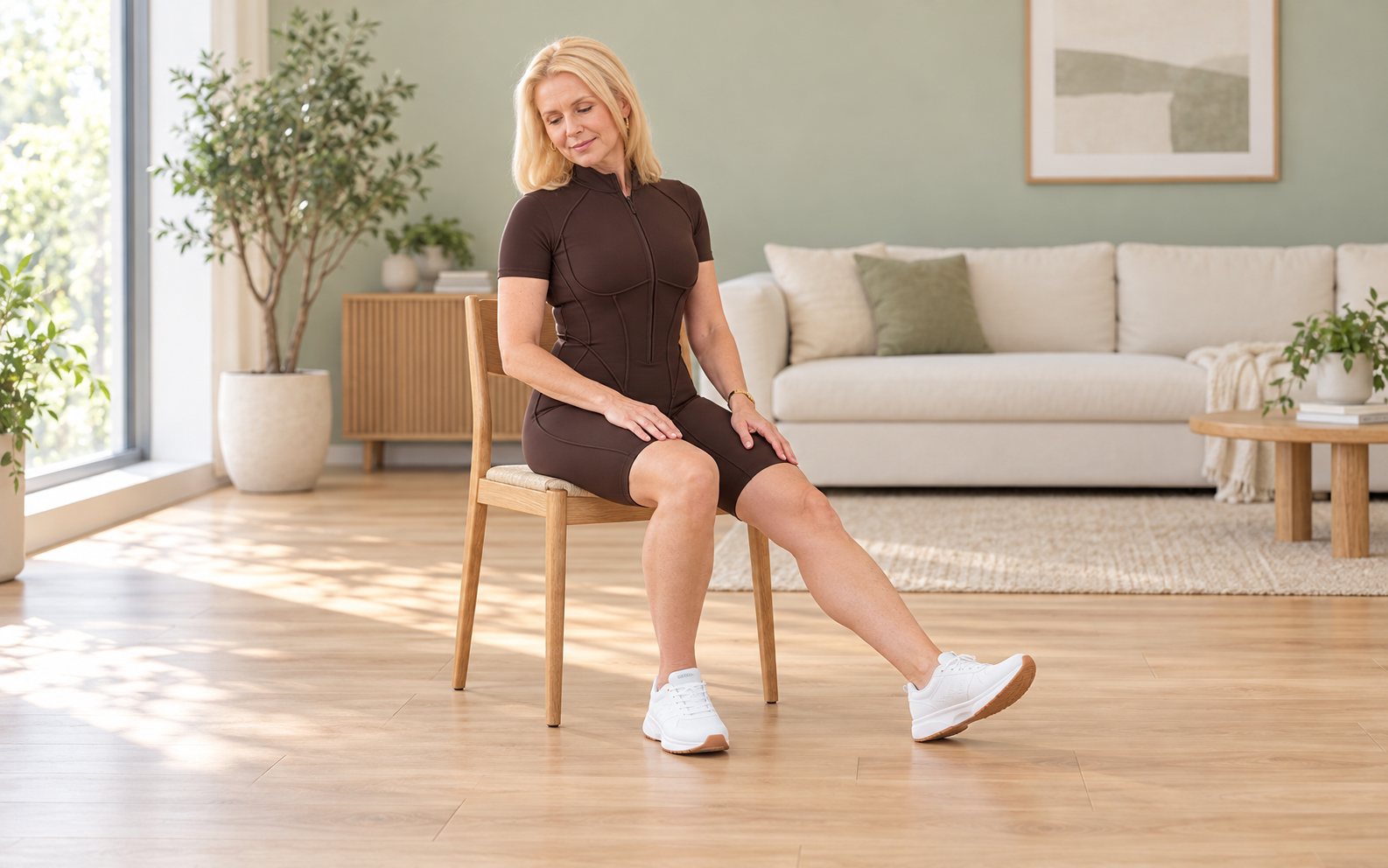

Pilates is a system of movement that can significantly enhance strength, flexibility, and concentration. Many people assume you need a dedicated studio and expensive machines to get started. However, you can build a strong foundation and achieve impressive results right from the comfort of your home.
This guide will walk you through everything you need to know about starting an effective Pilates at-home program, including 6 foundational principles, 7 beginner Pilates exercises, and a step-by-step workout routine you can begin today.
What Is Pilates?
Pilates is a physical training regimen developed in the early 20th century by Joseph Pilates.
Originally named “Contrology,” the method focuses on the connection between mind and body to improve:
- Physical strength
- Flexibility
- Posture
It combines controlled movements with a strong emphasis on breath, concentration, and a stable core (1).
The practice isn’t just a set of exercises; it’s a precise science of motion. It involves both mat exercises and work on specialized spring-driven machines.
For those starting a full body Pilates at home program, using just a mat is a fantastic and accessible entry point. The core philosophy centers on 6 original principles that establish the quality and effectiveness of every workout (2).
Can Pilates At Home Be Effective?
Yes, a Pilates at home program can be highly effective. The success of Pilates doesn’t depend on a specific location but on the quality of your movement and your commitment to its core principles. Consistency and proper form are the keys to unlocking the benefits, whether you’re in a professional studio or your living room.
An at-home practice offers several advantages. It allows you to work out on your own schedule, eliminating travel time and the cost of studio classes. This convenience can lead to greater consistency–a crucial factor for seeing results.
With a focus on the foundational mat exercises without any specialized equipment, you can perform Pilates at home without equipment, while:
- Building significant core strength
- Improving your posture
- Increasing cardiovascular endurance (3).
BetterMe: Health Coaching app helps you achieve your body goals with ease and efficiency by helping to choose proper meal plans and effective workouts. Start using our app and you will see good results in a short time.
Can I Teach Myself Pilates?
You can certainly teach yourself the fundamentals of Pilates, especially the introductory mat exercises. The method is built on clear principles and a specific language of movement that, once understood, can guide your practice.
Let’s break down these foundational concepts.
The Philosophy and Principles of Form
Joseph Pilates formulated 6 original principles to establish and improve the quality of your workout. These concepts are not limited to Pilates but can be applied to any physical activity and even to daily life.
Mastering them is essential for a safe and effective practice (2).
- Breath: Proper breathing is central to Pilates. It oxygenates the blood, increases circulation, and helps engage the correct muscles. The standard practice is to inhale through the nose to prepare for a movement and exhale through the mouth during the most strenuous part of the execution.
- Concentration: This is the mind-body connection in action. You must focus your mind entirely on the exercise at hand. Conduct an internal dialogue to direct your body, ensuring every movement is deliberate.
- Control: Pilates demands complete mental control over your body. Practitioners calculate and plan every motion while avoiding sloppy or momentum-driven movements.
- Centering: All movement in Pilates flows outward from a strong center. This center, often called the “powerhouse,” includes the muscles of your midsection–from your navel around to your lower back and from your lower ribs down to just below your buttocks.
- Precision: Focus on performing each exercise as perfectly as possible. Quality over quantity is a key mantra. It’s better to do fewer repetitions with perfect form than several with poor technique.
- Flow: Your movements should connect smoothly and gracefully. Concentrate on the flow within each exercise and as you transition from one exercise to the next. This focus on flow improves balance, control, and coordination.
The Language of Pilates
To practice effectively, you need to understand some key terms. This specific terminology helps you execute movements with the correct intention and muscular engagement.
- The Powerhouse: This is the collective group of muscles in your core–abdominals, lower back, hips, and glutes. It’s the center of your body’s strength and control (4).
- The Pilates Box: Imagine a square formed by your two shoulders and two hips. Keeping this “box” stable and aligned is a constant reference point for maintaining symmetry throughout your workout.
- Articulate the Spine: This refers to moving your spine one vertebra at a time, like peeling a sticker off a surface. This technique improves spinal mobility and control.
- Navel to Spine (Scoop): This is the action of drawing your abdominal muscles inward and upward. It creates a hollowed, “scooped” look at your waistline and is crucial for stabilizing your core.
- Pilates Stance: This involves tensing the gluteal muscles to rotate the legs together from the hips down to the heels. Your feet will form a small ‘V’ shape.
- Stabilize (Anchor): This anchor means engaging your core muscles to hold your body in place, creating a stable base from which to move your limbs.
By understanding these concepts, you can perform a Pilates workout at home for beginners with confidence and precision.
Read more: How To Perform Thigh Stretch Pilates For A More Flexible Body
What Is An Easy Pilates At Home Program To Try?
The Introductory Program integrates the foundational Pilates exercises with their corresponding principles. In this sequence, you’ll develop your breath and concentration, establishing a solid base for the entire system (5).
Try to perform this routine daily, even if it’s just for 10 minutes.
Program Notes
- Glossary:
-
- Powerhouse: Your core muscles (abdominals, lower back, hips, glutes).
- Pilates Stance: Legs rotated outward from the hips, heels together, toes apart.
- Articulate: Move the spine one vertebra at a time.
- Equipment: A yoga or Pilates mat.
- Split Structure: This is a full-body routine.
- Reps and Sets: Follow the specific repetitions listed for each exercise.
- Rest: You can rest through transitions between exercises. Take additional short rests as needed, especially if you feel your form degrading.
Beginner Pilates At Home Program
| Exercise | Repetitions |
|---|---|
| 1. The Hundred | 5-10 sets of full breath cycles (50-100 pumps) |
| 2. The Roll Down | 3 times |
| 3. Single Leg Circles | 5 times in each direction, with each leg |
| 4. Rolling Like a Ball | 6-10 times |
| 5. Single Leg Stretch | 5-8 sets of alternating legs |
| 6. Double Leg Stretch | 5-8 times |
| 7. Spine Stretch Forward | 3-5 times |
Exercise Instructions
The Hundred
This is a classic warm-up that stimulates circulation and builds stamina.
- Lie on your back with your knees drawn into your chest. Feel your entire spine pressing into the mat.
- Engage your powerhouse to lift your head and shoulders off the mat. Extend your legs up so your toes are just above your knees, keeping the knees bent. Reach your arms long, hovering just above the mat.
- Begin rhythmically pumping your arms up and down. Breathe in through your nose for 5 pumps and out through your mouth for 5 pumps. Start with 5 full breath cycles (50 pumps) and work your way up to 10 (100 pumps).
- To increase the difficulty, you can straighten both legs toward the ceiling. When finished, lower your head and draw your knees back to your chest.
The Roll Down
This exercise develops abdominal control and spinal articulation.
- Sit tall with your heels on the mat, feet flat if possible. Your legs should be parallel and hip-width apart. Wrap your hands behind your thighs and lift your elbows wide.
- Engage your glutes and curl your pelvis under you, aiming your lower back toward the floor. Simultaneously, tilt your chin down and look at your midsection, creating a ‘C’ shape with your spine.
- Continue to curl back, pressing your spine firmly into the mat. Hold this position and take 3 deep breaths, feeling the lower back muscles open as the abdominals pull in deeper.
- Curl back up to your starting position, sinking the waist in even deeper. Repeat the sequence.
Single Leg Circles
This movement strengthens hip muscles while improving flexibility.
- Lie flat on the mat with your right leg extended to the ceiling. Bend your left knee and plant your left foot firmly on the mat. Press your arms down by your sides.
- Inhale and cross the right leg over your body, aiming for your left shoulder. Do not let your right hip lift off the mat.
- Sweep the leg down through the centerline of your body and out in line with your right shoulder.
- Exhale as you carry the leg back to the starting position to complete the circle.
- Circle 5 times in one direction, then reverse for 5 circles. Switch legs and repeat.
Rolling Like a Ball
This exercise challenges your balance and control.
- Sit with your legs hip-width apart and hands wrapped behind your thighs. Tip back to find your balance point, curving your lower back.
- Inhale and roll backward onto the mat, keeping your ‘C’ curve shape. Roll only to the base of your shoulder blades–do not roll onto your neck.
- Without changing your shape, exhale and use your powerhouse to roll back up to the starting balance position.
- Repeat 6–10 times, moving with control and flow.
BetterMe will shake off your mental funk, rid you of your energy-zapping habits, and help you sculpt the body of your dreams. Intrigued? Hurry up and change your life for the better!
The Single Leg Stretch
This exercise requires you to move your legs while bracing your powerhouse.
- Lie on your back and draw both knees into your chest.
- Lift your head and shoulders off the mat. Pull one knee into your chest as you extend the other leg up toward the sky. Keep your elbows wide.
- Without disrupting your alignment, switch legs. Keep your navel pulled toward your spine as you alternate, stretching one leg out as you hug the other knee in.
- Breathe in for one set (left and right) and out for the next.
Looking for more ways to enhance your workout? You can find an expanded home Pilates workout routine that builds on these basics.
The Double Leg Stretch
This move tests your powerhouse by moving arms and legs simultaneously while keeping the torso still.
- Begin with both knees drawn into your chest, one hand on each ankle. Lift your head and shoulders off the mat.
- Inhale and extend both legs out at a 45-degree angle. Simultaneously, reach your arms straight back past your ears. Keep your lower back anchored to the mat.
- Exhale and circle your arms around as you draw your knees back to your chest, returning to the starting position. Hug your knees tightly.
- Repeat 5–8 times. To properly equip your space, consider the best at-home Pilates equipment to support your practice. Pilates equipment for home.
Spine Stretch Forward
- This exercise opens the lower back and stretches the hamstrings.
- Sit tall with your legs extended in front of you, about hip-width apart. Flex your feet and extend your arms forward at shoulder height.
- Exhale and lower your head as if diving through your arms. Round your upper back forward, keeping your lower back pressed against an imaginary wall behind you. Pull your navel to your spine.
- Inhale to reverse the motion, stacking your spine one vertebra at a time until you are sitting tall again.
- Repeat 3–5 times.
As you progress, you might want a more structured regimen, and a detailed at home Pilates workout plan can provide the guidance you need.
Read more: How to Combine Pilates and Cardio for an Effective Cross-Training Routine
Will 30 Minutes Of Pilates Make A Difference?
Consistent 30-minute Pilates sessions (3-4 times per week) provide a focused, full-body routine with precision and control.
This duration allows for a thorough warm-up, a challenging core workout, and a cool-down stretch.
The effectiveness comes from the quality of the work, not just the duration. In 30 minutes, you can improve core strength, enhance flexibility, and refine your mind-body connection (6).
Research has shown that even short bouts of regular exercise yield significant health benefits (7). The key is to remain focused and intentional with every movement, making every minute count.
How Soon Will I See Results From At Home Pilates?
The timeline for seeing results varies from person to person, depending on factors such as starting fitness level, consistency, and diet.
Most people begin to “feel” the results within a few weeks of starting consistent practice.
These results include:
- Feeling stronger in your core
- Standing taller due to improved posture
- Moving with more awareness
Visible changes, such as more defined muscles and a leaner appearance, typically follow after 1–2 months of dedicated practice.
Remember to be patient; significant changes take months, even years, of consistent training.
Pilates can contribute to weight loss when part of a comprehensive wellness plan. While it’s not a high-intensity cardio workout that burns a massive number of calories per session, it can help build lean muscle mass in beginner or sedentary populations (8, 9). More muscle increases your resting metabolic rate, meaning you burn more calories even when you’re not exercising (10). When combined with a healthy diet and complementary activities like brisk walking or cycling, the best at home Pilates workout can be an effective tool for weight management (11, 12). Neither is inherently “better”–they offer different benefits and complement each other well. Walking is an excellent form of low-impact cardiovascular exercise that improves heart health and endurance (13, 14). Pilates is a form of strength training that focuses on core strength, flexibility, posture, and muscular control (15). Combining the two creates a well-rounded fitness routine that addresses both cardiovascular health and musculoskeletal integrity. Knowing what is a pilates at home program for daily fitness can accelerate your results, particularly in terms of core strength and flexibility (16). Because it is a low-impact form of exercise, daily practice is generally safe, provided you listen to your body and vary the intensity of your sessions. You might choose to do a more intense, full-length workout on some days and a shorter, stretch-focused session on others. Daily practice reinforces the mind-body connection and can quickly improve your posture and body awareness (17, 18). Pilates is a full-body workout, but it places a special emphasis on the powerhouse muscles. This focus includes the deep abdominal muscles (such as the transverse abdominis), the lower back muscles, the pelvic floor, the hips, and the glutes (19). Beyond the core, every exercise can strengthen and lengthen muscles throughout the body (6), including the arms, shoulders, and legs. It promotes balanced muscle development, ensuring no single muscle group is over or undertrained.Frequently Asked Questions
Is Pilates good for weight loss?
What is better, walking or Pilates?
What will happen if I do Pilates every day?
What muscles does Pilates work?
The Bottom Line
Starting a Pilates practice at home is an empowering step toward greater strength, control, and physical awareness. By committing to the foundational principles and performing the exercises with precision, you can build a resilient body and a focused mind. This journey is about progress, not perfection. Embrace the process, listen to your body, and enjoy the transformative power of this incredible discipline.
DISCLAIMER:
This article is intended for general informational purposes only and does not serve to address individual circumstances. It is not a substitute for professional advice or help and should not be relied on for making any kind of decision-making. Any action taken as a direct or indirect result of the information in this article is entirely at your own risk and is your sole responsibility.
BetterMe, its content staff, and its medical advisors accept no responsibility for inaccuracies, errors, misstatements, inconsistencies, or omissions and specifically disclaim any liability, loss or risk, personal, professional or otherwise, which may be incurred as a consequence, directly or indirectly, of the use and/or application of any content.
You should always seek the advice of your physician or other qualified health provider with any questions you may have regarding a medical condition or your specific situation. Never disregard professional medical advice or delay seeking it because of BetterMe content. If you suspect or think you may have a medical emergency, call your doctor.
SOURCES:
- The Pilates method: history and philosophy (2001, academia.edu)
- Pilates: What Is It? Should It Be Used in Rehabilitation? (2011, pmc.ncbi.nlm.nih.gov)
- Effects of Mat Pilates on Physical Functional Performance of Older Adults (2018, journals.lww.com)
- Pilates and the “powerhouse”—I (2004, sciencedirect.com)
- PILATES’ – Return to Life Through Contrology (1945, books.out.csli.me)
- Pilates: how does it work and who needs it? (2011, pmc.ncbi.nlm.nih.gov)
- Short bouts of accumulated exercise: Review and consensus statement on definition, efficacy, feasibility, practical applications, and future directions (2026, sciencedirect.com)
- Effects of reformer pilates on body composition, strength, and psychosomatic factors in overweight and obese women: A randomized controlled trial (2025, nature.com)
- The effects of mat Pilates exercise and barrel Pilates exercise on body composition and muscle activity in adult women (2025, sciencedirect.com)
- Increasing muscle mass to improve metabolism (2013, pmc.ncbi.nlm.nih.gov)
- The Effects of Online Home-Based Pilates Combined with Diet on Body Composition in Women Affected by Obesity: A Preliminary Study (2024, mdpi.com)
- Weight Management and Various Other Benefits of Physical Activity in Human Life (2025, eu-opensci.org)
- Walking as an Opportunity for Cardiovascular Disease Prevention (2019, cdc.gov)
- The multifaceted benefits of walking for healthy aging: from Blue Zones to molecular mechanisms (2023, link.springer.com)
- Defining Pilates exercise: A systematic review (2012, sciencedirect.com)
- Effect of the Pilates method on physical conditioning of healthy subjects: a systematic review and meta-analysis (2016, pubmed.ncbi.nlm.nih.gov)
- Effects of Pilates on Body Posture: A Systematic Review (2024, sciencedirect.com)
- Physical and psychological benefits of once-a-week Pilates exercises in young sedentary women: A 10-week longitudinal study (2016, sciencedirect.com)
- Pilates: Core and More (2016, journals.lww.com)