If you’re aiming to lose weight and don’t know where to start, a structured 4-day workout plan targets both fat loss and fitness, which removes the confusion from your routine. Strategic exercises combined with intentional training splits have been proven to boost metabolism, preserve lean muscle, and speed up fat loss.
By following this plan, you’ll be taking science-backed steps to burn more calories, gain energy, and achieve sustainable results, which makes every workout count toward your weight loss goals.
This guide is designed to make your workouts clear and manageable. You’ll discover exactly what to do in each session, how to target every major muscle group, and how a systematic approach accelerates your progress – no matter your starting point.
What Is a Structured 4-Day Workout Plan for Beginners to Lose Weight?
A structured workout plan is a pre-designed exercise schedule that specifies the exercises, sets, repetitions (reps), and rest periods for each training session.
For a beginner focused on weight loss, a 4-day plan provides a consistent framework to build foundational strength, increase muscle mass, and boost metabolism. The goal is to move beyond random workouts and apply proven principles such as progressive overload – gradually increasing the demands on your body – to drive continuous improvement (1).
This structure is crucial for beginners because it reduces the initial complexity of training. Instead of wondering what to do at the gym, you have a clear roadmap. This helps you focus on developing proper exercise form, building a strong mind-muscle connection, and establishing a consistent routine, which is the most important factor for long-term success.
Is a 4-Day Split Good for Beginners?
A 4-day split can be an excellent choice for beginners, but its effectiveness depends entirely on the way it’s structured. Training splits refer to how you divide your workouts to target different muscle groups throughout the week.
A common 4-day split for beginners is the upper/lower split, where you train your upper body twice a week and your lower body twice a week.
BetterMe: Health Coaching app helps you achieve your body goals with ease and efficiency by helping to choose proper meal plans and effective workouts. Start using our app and you will see good results in a short time.
This approach offers several key benefits for someone who is new to lifting:
- Adequate Recovery: By splitting workouts, you allow specific muscle groups ample time to recover. For example, after an upper-body day, those muscles rest while you train your lower body. This is essential as muscle growth and repair happen during rest, not during the workout itself (2).
- Sufficient Frequency: Training each muscle group twice per week is a research-supported frequency for promoting muscle growth or hypertrophy. Studies have shown that this frequency provides a robust stimulus for adaptation without leading to overtraining (3).
- Manageable Session Duration: Focusing on either the upper or lower body allows for shorter, more focused workouts. This can be less intimidating than a full-body routine and helps maintain high-quality effort throughout the session.
While some experts recommend full-body workouts 2-3 times per week for absolute beginners, an upper/lower 4-day split is a fantastic next step once you’ve built some initial familiarity with basic movements (4).

Is a 4-Day Workout Enough to Lose Weight?
Yes, a 4-day workout plan is more than sufficient for weight loss, as long as it’s paired with the right nutritional strategy. Weight loss is ultimately governed by energy balance – you must expend more calories than you consume (5). Resistance training plays a powerful role in this equation.
Here’s how a 4-day strength training plan contributes to weight loss:
- Increased Muscle Mass: Strength training is the most effective way to build and maintain muscle (6). Muscle tissue is more metabolically active than fat tissue, which means it burns more calories at rest. By increasing your muscle mass, you elevate your resting metabolic rate (RMR), which helps you burn more calories throughout the day (7).
- Caloric Expenditure During and After Exercise: A challenging strength training session burns a significant number of calories. More importantly, it creates an “afterburn” effect that is known as excess post-exercise oxygen consumption (EPOC). This is where your body continues to burn calories at an elevated rate for hours after your workout as it works to repair muscle tissue and restore itself to a resting state (8).
- Improved Body Composition: Focusing solely on the number on the scale can be misleading. A 4-day strength training plan helps you achieve fat loss while preserving – or even gaining – lean muscle. This leads to a more toned, athletic physique and is a healthier, more sustainable approach than weight loss from calorie restriction alone, which often results in losing valuable muscle (9).
To maximize weight loss, experts recommend creating a daily caloric deficit of 500-1,000 calories through a combination of diet and exercise. This typically results in a sustainable weight loss of 1-2 pounds per week (10).
Explore our 7-day weight loss meal plan with grocery list for a simple week of balanced meals, straightforward portions, and a ready-to-use shopping list to help you plan ahead and stay consistent.
Read more: Beginner Workout Plan: Key Elements For an Effective Routine and More
How to Structure a 4-Day Workout Plan
Structuring a workout plan requires applying a few core scientific principles to ensure it’s both effective and sustainable. The key variables to manipulate are frequency, volume, intensity, and exercise selection.
- Training Frequency
As established, training four days a week allows for an optimal training frequency where each major muscle group is stimulated twice. This is a sweet spot that is supported by a 2021 study published in Einstein (São Paulo), which found that training muscles twice per week produced similar strength and hypertrophy gains as training them four times per week, as long as the total weekly volume was the same (11).
- Training Volume
Volume refers to the total amount of work performed, which is typically calculated as sets × reps × weight. For beginners, a good starting point is performing at least 4 weekly sets per muscle group. A meta-analysis published in the Journal of Sports Sciences found a clear dose-response relationship between volume and muscle growth, with higher volumes leading to greater gains. However, even low volumes (<5 weekly sets) produced significant hypertrophy (12).
- Training Intensity (Load)
Intensity refers to the weight you lift, which is often expressed as a percentage of your one-repetition maximum (1RM) – the most weight you can lift for a single rep. For beginners who are aiming for both strength and hypertrophy, the 6-15 RM loading range is highly effective. This means choosing a weight you can lift for 6 to 15 repetitions with good form before reaching muscular failure (13).
Recent research, including a 2021 narrative review in Sports Medicine, has shown that hypertrophy can occur across a wide spectrum of loads, as long as sets are taken close to muscular failure. However, heavier loads (≥80% of 1RM) are superior for maximizing strength gains (13). Beginners can start with lower loads (60-70% 1RM) and work up to heavier loads over time.
- Exercise Selection
For time-efficiency and overall functional strength, prioritize multi-joint (compound) exercises. These movements, such as the squat, bench press, and deadlift, engage multiple muscle groups simultaneously. This allows you to train more muscle mass in less time and has a greater carryover to real-life activities (14).
Single-joint (isolation) exercises, such as bicep curls, can be added to provide targeted work but should be secondary to your main compound lifts.
What Body Parts Should You Work on What Days when Training 4 Days a Week?
The most effective and straightforward 4-day split for a beginner is the upper/lower body split. This structure is simple to follow and ensures a balanced approach to training, reducing the risk of muscular imbalances.
Here’s a common and effective way to schedule an upper/lower split:
- Day 1: Upper body (push and pull)
- Day 2: Lower body and core
- Day 3: Rest or active recovery
- Day 4: Upper body (push and pull)
- Day 5: Lower body and core
- Day 6: Rest or active recovery
- Day 7: Rest
This schedule allows for 48-72 hours of recovery for each muscle group before it’s trained again, which is perfectly aligned with muscle protein synthesis (MPS) cycles. MPS is the process of building new muscle proteins, and it remains elevated for up to 48 hours following a workout in beginners (15).
Interested in learning more about how to optimize your training schedule? Check out our guide to the best 4-day workout split.
Read more: Six-Week Beginner Workout Plan: Tips for Sustainable, Long-Term Success and Sample Plan
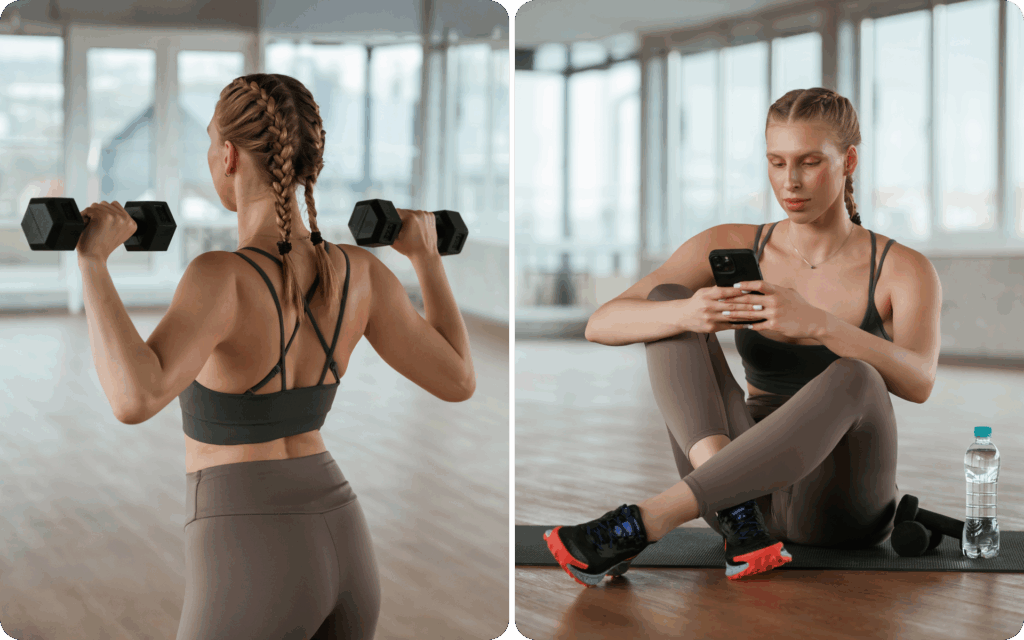
What’s a Good 4-Day Workout Plan for Beginners to Lose Weight?
This program is designed to help beginners lose weight by combining efficient full-body strength work (to preserve muscle while dieting) with simple conditioning and daily movement targets.
Program Notes:
- Terms:
- Reps: Repetitions, the number of times you perform an exercise.
- Sets: A group of repetitions.
- RPE: Rate of perceived exertion, a scale of 1-10 to measure how hard you feel you’re working. An RPE of 8 means you feel you could have done 2 more reps.
- 1RM: One-repetition maximum, the heaviest weight you can lift for one rep.
- Equipment: You will need access to barbells, dumbbells, a squat rack, a bench, a pull-up bar (or lat pulldown machine), and a cable machine.
- Split Structure: Upper body/lower body.
- Reps and Sets: Aim for 3 sets of 8-12 reps for most exercises. This range supports muscle retention and strength gains while dieting – beginners will often build some muscle as a bonus.
- Rest: Rest for 60-90 seconds between sets.
- Progression: The goal is progressive overload. Each week, try to add a small amount of weight (e.g. 2.5-5 lbs) to your lifts or increase the number of reps you perform with the same weight.
- Increasing daily activity: To amplify your weight loss results, aim to walk for 6,000-10,000 steps a day. Take walking breaks throughout the day, park further from the building, take the stairs at work, and so on.
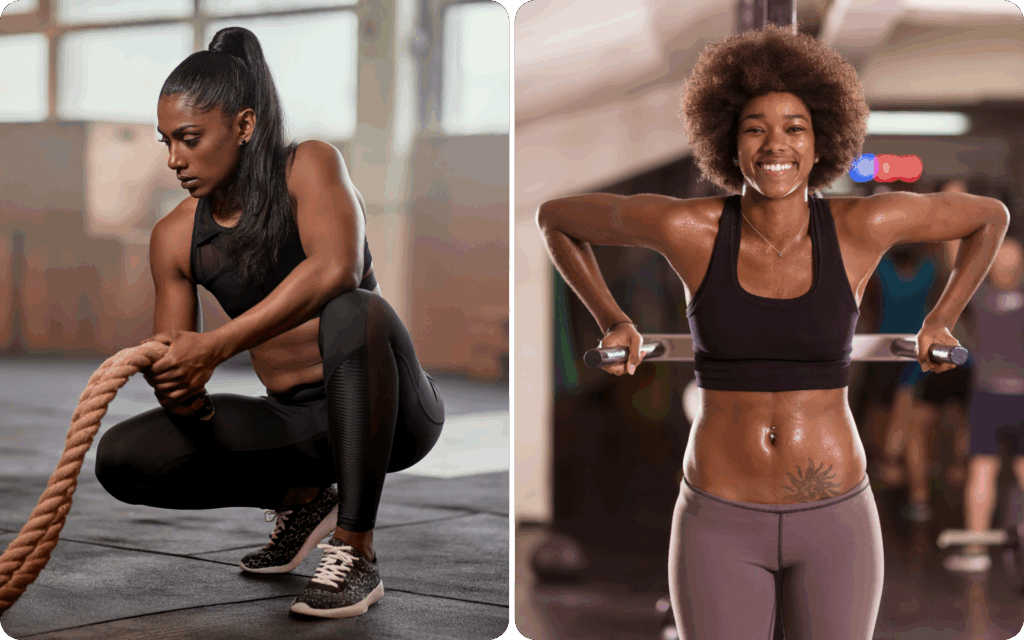
4-Day Upper/Lower Workout Program
| Day 1: Upper Body A | Sets | Reps | Rest |
|---|---|---|---|
| Barbell bench press | 3 | 8-12 | 90s |
| Dumbbell row | 3 | 8-12 | 90s |
| Overhead press | 3 | 8-12 | 60s |
| Lat pulldown | 3 | 10-15 | 60s |
| Dumbbell bicep curl | 2 | 10-15 | 60s |
| Triceps pushdown | 2 | 10-15 | 60s |
Optional Conditioning Finisher:
Intervals (5 minutes): :30 hard / :30 easy on a bike, rower, or treadmill (5 rounds)
| Day 2: Lower Body A and Core | Sets | Reps | Rest |
|---|---|---|---|
| Barbell back squat | 3 | 8-12 | 90s |
| Romanian deadlift | 3 | 8-12 | 90s |
| Dumbbell lunges | 3 | 10-12 per leg | 60s |
| Leg press | 3 | 10-15 | 60s |
| Plank | 3 | 30-60s hold | 60s |
| Hanging knee raises | 3 | 10-15 | 60s |
Optional Conditioning Finisher:
Incline walk (10-15 minutes): Easy/moderate pace on a treadmill incline
| Day 4: Upper Body B | Sets | Reps | Rest |
|---|---|---|---|
| Pull-ups (or assisted) | 3 | As many as possible | 90s |
| Incline dumbbell press | 3 | 8-12 | 90s |
| Seated cable row | 3 | 8-12 | 60s |
| Dumbbell lateral raise | 3 | 12-15 | 60s |
| Hammer curl | 2 | 10-15 | 60s |
| Overhead triceps extension | 2 | 10-15 | 60s |
Optional Conditioning Finisher:
Intervals (5 minutes): :30 hard / :30 easy on a bike, rower, or treadmill (5 rounds)
| Day 5: Lower Body B and Core | Sets | Reps | Rest |
|---|---|---|---|
| Deadlift | 3 | 6-8 | 120s |
| Goblet squat | 3 | 10-15 | 90s |
| Leg curl | 3 | 10-15 | 60s |
| Calf raise | 3 | 15-20 | 60s |
| Russian twist | 2 | 15-20 | 60s |
| Crunches | 2 | 15-20 | 60s |
Optional Conditioning Finisher:
Incline walk (10-15 minutes): Easy/moderate pace on a treadmill incline
If you’re new to conditioning, start with the 5 minutes of intervals or incline walk, and keep effort at RPE 6-7/10.
This comprehensive program is a great starting point. For more options, explore our complete guide to a 4-day workout routine for beginners.
Reasons why BetterMe is a safe bet: a wide range of calorie-blasting workouts, finger-licking recipes, 24/7 support, challenges that’ll keep you on your best game, and that just scratches the surface! Start using our app and watch the magic happen.
Exercise Instructions
Barbell Bench Press
- Lie flat on a bench with your feet firmly on the floor. Your eyes should be directly under the barbell.
- Grip the bar with your hands slightly wider than shoulder-width apart.
- Lift the bar off the rack and hold it straight over your chest with your arms fully extended.
- Inhale as you lower the bar to your mid-chest, your elbows at roughly a 45-degree angle.
- Lightly touch your chest with the bar, then press the bar back up while exhaling, fully extending your arms.
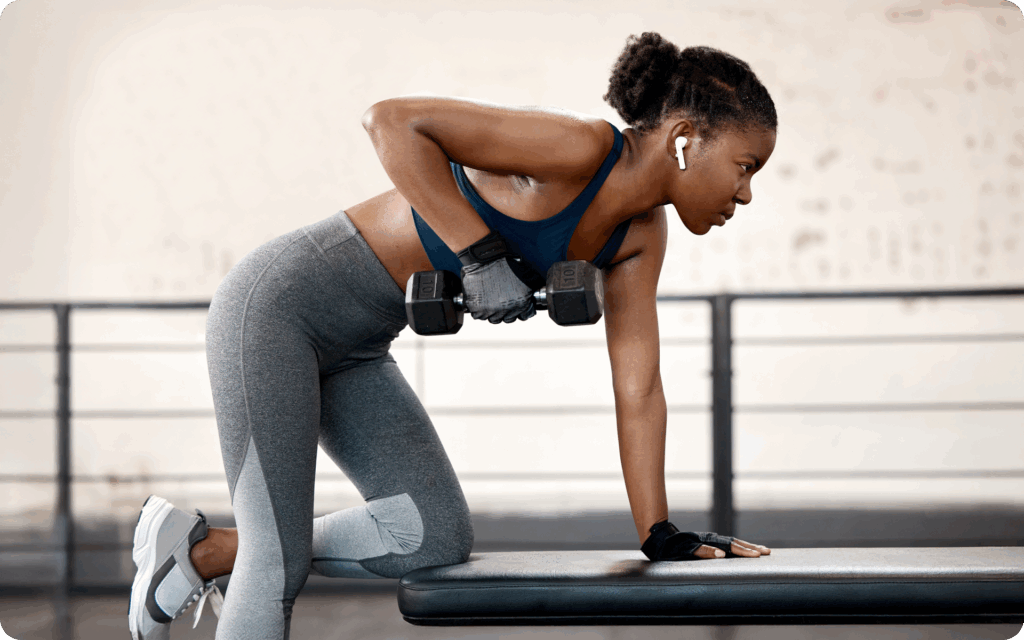
Dumbbell Row
- Place your left knee and left hand on a flat bench. Keep your back straight and parallel to the floor.
- Hold a dumbbell in your right hand, your arm extended downward.
- Engage your back and pull the dumbbell up toward your hip, focusing on squeezing your shoulder blade at the top.
- Lower the dumbbell back to the starting position in a controlled manner. Complete all reps, then switch sides.
Overhead Press
- Stand with your feet shoulder-width apart, holding a barbell or dumbbells at shoulder level, your palms facing forward.
- Brace your core and press the weight straight overhead, keeping your elbows slightly forward.
- Fully extend your arms at the top, then lower the weight slowly back to shoulder height.
- Avoid leaning back or arching your lower back as you press.
Lat Pulldown
- Sit at a lat pulldown machine and adjust the thigh pad to keep your knees stable.
- Grasp the bar with your hands wider than shoulder-width apart with an overhand grip.
- Slightly lean back, then pull the bar down toward your upper chest, pulling your shoulder blades down and together.
- Pause, then slowly let the bar return to the starting position with control.
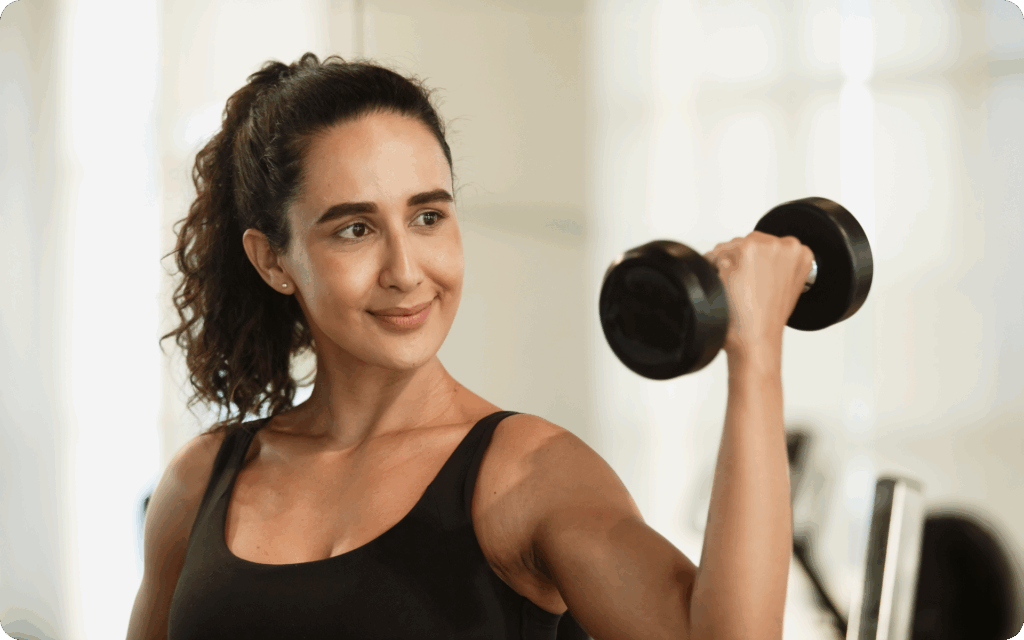
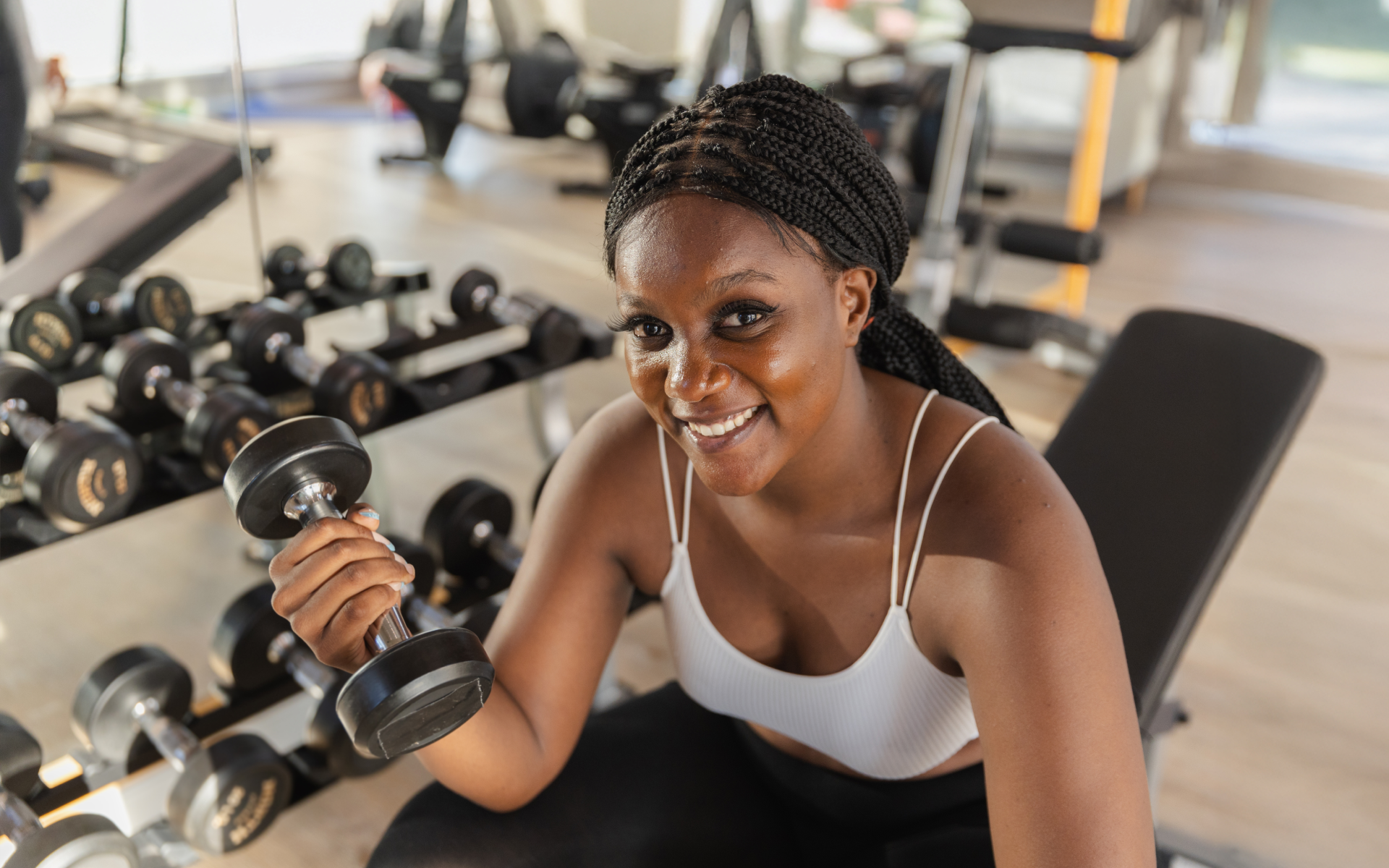
Dumbbell Bicep Curl
- Stand with your feet hip-width apart, holding dumbbells by your sides, your palms facing forward.
- Keep your elbows close to your torso and curl the dumbbells up toward your shoulders.
- Squeeze your biceps at the top, then slowly lower the dumbbells back down.
Triceps Pushdown
- Stand upright at a cable machine with a straight or angled bar attachment.
- Hold the bar with an overhand grip, your elbows pinned at your sides.
- Push the bar downward until your arms are fully extended without locking your elbows.
- Pause, then slowly bring the bar back up with control.
Pull-Ups (or Assisted Pull-Ups)
- Grasp a pull-up bar with your hands just wider than shoulder-width apart, your palms facing away from you.
- Start from a dead hang with your arms fully extended and your legs off the ground.
- Pull your chest up toward the bar by engaging your upper back and arms.
- Lower yourself all the way back to the starting position. Use an assisted machine or resistance band if necessary.
Incline Dumbbell Press
- Set an adjustable bench to a 30-45 degree angle. Sit back with a dumbbell in each hand at chest level.
- Plant your feet flat on the floor and press the dumbbells upward until your arms are extended.
- Lower the dumbbells back to the starting position with your elbows at 45 degrees.
Seated Cable Row
- Sit at a cable row machine with your feet against the platform, your knees slightly bent.
- Grip the handle with both hands, sit up straight, and pull the attachment toward your abdomen.
- Squeeze your shoulder blades together as you row. Slowly extend your arms to return to the start.
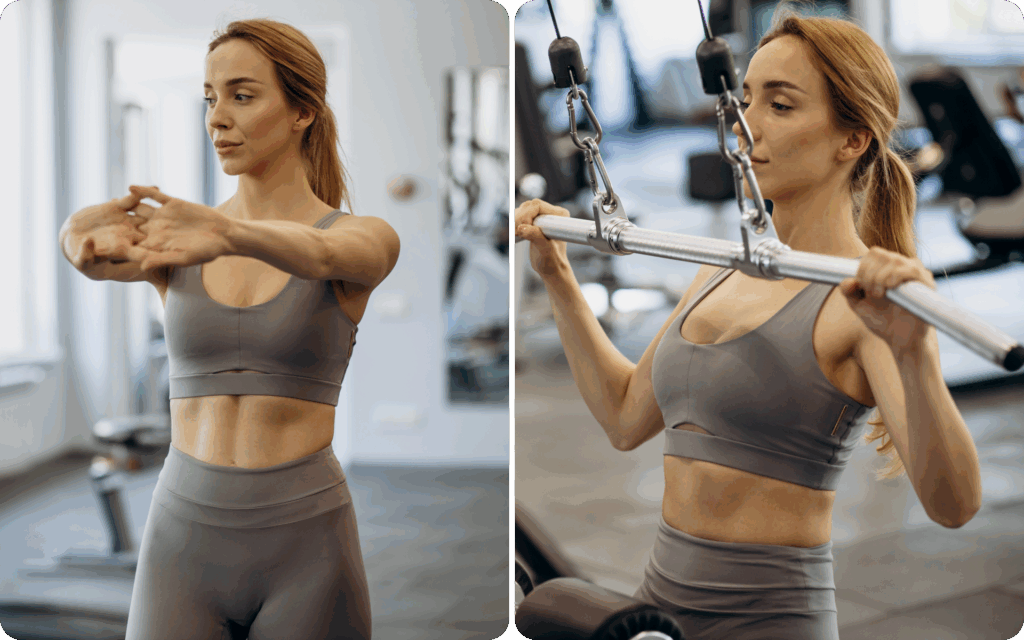
Dumbbell Lateral Raise
- Stand with your feet hip-width apart, dumbbells at your sides, your palms facing in.
- With a slight bend in your elbows, lift both arms out to your sides until they reach shoulder level.
- Pause, then lower the weights back to your sides with control.
Hammer Curl
- Stand tall and hold a dumbbell in each hand with your palms facing your thighs (neutral grip).
- Curl the weights up toward your shoulders, keeping your palms facing in.
- Squeeze at the top and then lower back to the starting position.
Overhead Triceps Extension
- Stand or sit, holding a dumbbell in both hands overhead with your arms fully extended.
- Keep your elbows close to your ears. Bend only at the elbows to lower the dumbbell behind your head.
- Raise the dumbbell back up by straightening your arms.
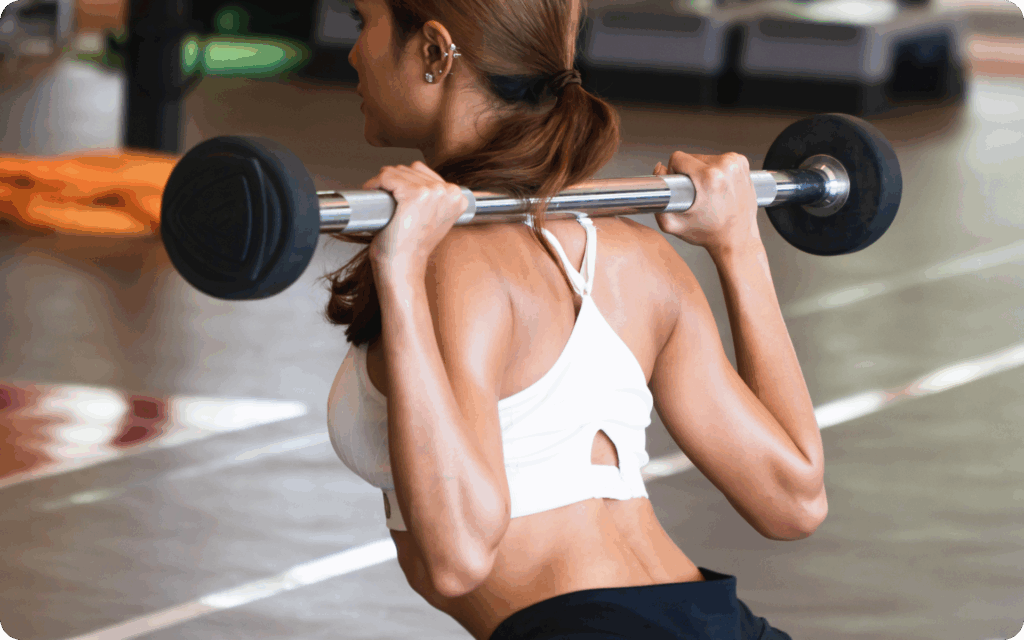
Barbell Back Squat
- Position a barbell on a squat rack at about upper-chest height.
- Step under the bar, set it across your upper back (not neck), and grip the bar with your hands wider than shoulder-width apart.
- Unrack the bar and step back so your feet are shoulder-width apart, your toes slightly out.
- Inhale and lower yourself by bending at your hips and knees, keeping your chest up and your back flat until your thighs are at least parallel to the ground.
- Drive through your heels to stand up as you exhale, fully extending your hips and knees.
Romanian Deadlift
- Stand holding a barbell (or dumbbells) in front of your thighs, your feet hip-width apart.
- Keeping your knees only slightly bent, hinge at your hips to lower the bar down the front of your legs.
- Lower until you feel a stretch in your hamstrings (bar just below knees), maintaining a flat back.
- Return to standing by driving your hips forward.
Dumbbell Lunges
- Stand with your feet hip-width apart, holding a dumbbell in each hand at your sides.
- Step forward with one foot and lower your body until both knees are at 90 degrees.
- Push through your front heel to return to the starting position.
- Alternate legs with each rep.
Leg Press
- Sit on the leg press machine and place your feet flat on the platform, shoulder-width apart.
- Release the safety handles and lower the platform by bending your knees until they form a 90-degree angle.
- Press the weight back up by extending your knees, keeping your feet flat.
Plank
- Lie face down and prop yourself up on your forearms and toes.
- Keep your body in a straight line from your head to your heels, bracing your core and glutes.
- Hold for the prescribed time without allowing your hips to sag or rise.

Hanging Knee Raise
- Hang from a pull-up bar with your arms fully extended and your legs straight.
- Keep your core tight and slowly raise your knees toward your chest.
- Lower your legs back to the starting position with control.
Goblet Squat
- Stand with your feet shoulder-width apart, holding a dumbbell or kettlebell at your chest.
- Keeping your chest upright, squat down by pushing your hips back and bending your knees.
- Lower until your elbows touch your knees, then stand back up.
Leg Curl
- Lie face down on a leg curl machine, your ankles under the pad.
- Curl your feet up toward your glutes by bending your knees.
- Pause at the top, then lower the pad slowly to the start.
Calf Raise
- Stand on the edge of a step with the balls of your feet, your heels hanging off.
- Push through the balls of your feet to raise your heels as high as possible.
- Pause, then lower your heels below step level for a stretch.
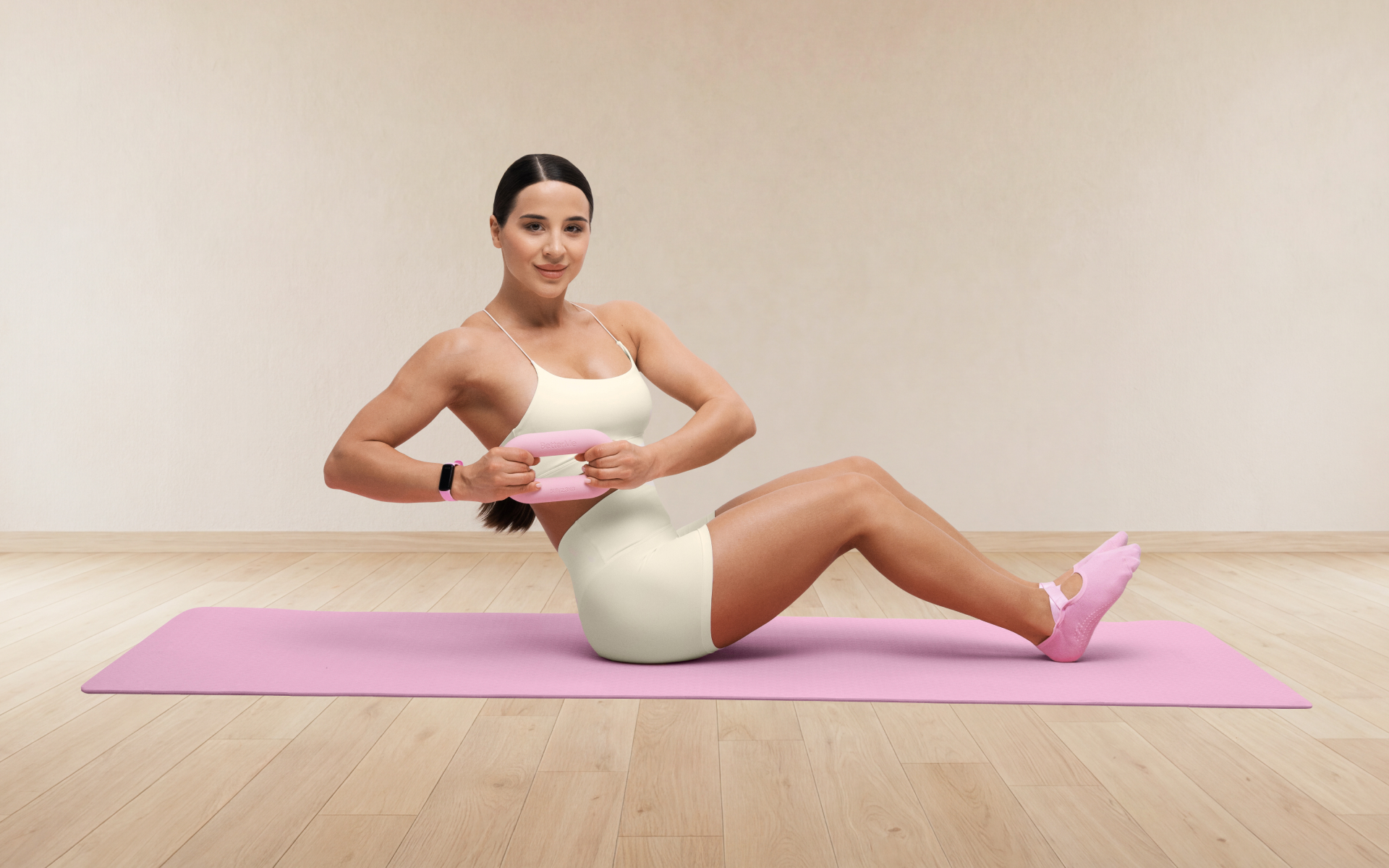
Russian Twist
- Sit on the floor with your knees bent and your feet flat (or elevated for more challenge).
- Lean back slightly, keeping your back straight, and hold a weight or medicine ball at your chest.
- Twist your torso to the right, then to the left, tapping the weight beside your hip each time.
Crunches
- Lie on your back with your knees bent, your feet flat, and your hands either crossed on your chest or lightly behind your head.
- Press your lower back into the floor and engage your core.
- Lift your shoulder blades off the mat, exhaling as you crunch upward.
- Lower back down slowly, keeping tension in your abs throughout.
Absolutely. Training 4 days a week is a highly effective frequency for achieving significant gains in muscle strength, hypertrophy, and fat loss, particularly for beginners and intermediates. As research has confirmed, the key is consistency and ensuring your total weekly training volume is sufficient to stimulate adaptation (12). Walking is a fantastic low-impact cardiovascular exercise that improves heart health, reduces stress, and helps with weight management (16). However, to get “in shape” in a comprehensive sense – which includes muscular strength, endurance, and a toned physique – walking alone is not enough. Combining it with a structured resistance training program, such as the 4-day plan in this guide, will yield far superior results. No single exercise works every muscle in the body, but some compound movements come close by engaging large portions of your musculature. The deadlift is often cited as one of the most comprehensive exercises, as it targets the entire posterior chain (hamstrings, glutes, and back), in addition to your core, quads, and grip (17). Squats and pull-ups are also incredibly effective full-body movements. There are no strict rules about which muscles “shouldn’t” be trained together, as it largely depends on your specific goals and recovery capacity. However, a common consideration is avoiding training major muscle groups that interfere with each other on consecutive days. For example, as your triceps are heavily involved in chest presses, it may be counterproductive to have a heavy triceps day immediately before a heavy chest day. This is why well-designed splits, such as the upper/lower routine, are so effective – they manage fatigue and recovery intelligently.Frequently Asked Questions
Can I work out 4 days a week and see results?
Can you get in shape by just walking?
What is the one exercise that works all muscles?
Which muscles shouldn’t be trained together?
The Bottom Line
Embarking on a fitness journey is one of the most rewarding investments you can make in your long-term health and well-being. This 4-day workout plan provides a scientifically-grounded, structured, and manageable path for beginners to lose weight, build strength, and gain confidence. The principles of consistency, progressive overload, and proper nutrition are your tools for transformation.
DISCLAIMER:
This article is intended for general informational purposes only and does not serve to address individual circumstances. It is not a substitute for professional advice or help and should not be relied on for making any kind of decision-making. Any action taken as a direct or indirect result of the information in this article is entirely at your own risk and is your sole responsibility.
BetterMe, its content staff, and its medical advisors accept no responsibility for inaccuracies, errors, misstatements, inconsistencies, or omissions and specifically disclaim any liability, loss or risk, personal, professional or otherwise, which may be incurred as a consequence, directly or indirectly, of the use and/or application of any content.
You should always seek the advice of your physician or other qualified health provider with any questions you may have regarding a medical condition or your specific situation. Never disregard professional medical advice or delay seeking it because of BetterMe content. If you suspect or think you may have a medical emergency, call your doctor.
SOURCES:
- Effects of Resistance Training Overload Progression Protocols on Strength and Muscle Mass (2024, pubmed.ncbi.nlm.nih.gov)
- The Importance of Recovery in Resistance Training Microcycle Construction (2024, pmc.ncbi.nlm.nih.gov)
- Effects of Resistance Training Frequency on Measures of Muscle Hypertrophy: A Systematic Review and Meta-Analysis (2016, link.springer.com)
- Determination of Resistance Training Frequency (2017, nsca.com)
- Fat Loss Depends on Energy Deficit Only, Independently of the Method for Weight Loss (2007, karger.com)
- Resistance Training Load Effects on Muscle Hypertrophy and Strength Gain: Systematic Review and Network Meta-analysis (2021, journals.lww.com)
- Increasing muscle mass to improve metabolism (2013, pmc.ncbi.nlm.nih.gov)
- 7 Things to Know About Excess Post-exercise Oxygen Consumption (EPOC) (2014, acefitness.org)
- Resistance training effectiveness on body composition and body weight outcomes in individuals with overweight and obesity across the lifespan: A systematic review and meta-analysis (2022, onlinelibrary.wiley.com)
- What is the Required Energy Deficit per unit Weight Loss? (2008, pmc.ncbi.nlm.nih.gov)
- Split or full-body workout routine: which is best to increase muscle strength and hypertrophy? (2021, scielo.br)
- Dose-response relationship between weekly resistance training volume and increases in muscle mass: A systematic review and meta-analysis (2016, tandfonline.com)
- Loading Recommendations for Muscle Strength, Hypertrophy, and Local Endurance: A Re-Examination of the Repetition Continuum (2021, mdpi.com)
- 5 Benefits of Compound Exercises (2016, acefitness.org)
- Resistance training‐induced changes in integrated myofibrillar protein synthesis are related to hypertrophy only after attenuation of muscle damage (2016, pmc.ncbi.nlm.nih.gov)
- Walking for good health (2023, betterhealth.vic.gov.au)
- Electromyographic activity in deadlift exercise and its variants. A systematic review (2020, journals.plos.org)

 Reviewed by

 Reviewed by