Most people think that getting fit requires a six-day-a-week gym grind, never-ending protein shakes, and a nonexistent social life as you have to track your macros and never miss a workout.
But what if we were to tell you that you could still be fit with just two intentional sessions a week? A 2-day-a-week full-body workout isn’t a lazy shortcut. Instead, it’s a smart way to incorporate fitness into your life without rearranging your life or losing out on social activities.
Read on to learn more about this routine and how you can make this more relaxed program work for your goals.
What Is a Good 2-Day-a-Week Full-Body Workout to Build Muscle?
A good 2-day-a-week full-body workout to build muscle should be simple and efficient. Each session should be structured around compound movements that target multiple muscles at once. As such a program only allows 2 exercise sessions a week, every workout needs to count.
Here are some key elements that help make an effective 2-day-a-week full-body workout muscle and strength program.
- Compound Lifts as a Foundation
Also known as multi-joint or compound exercises, these train multiple muscle groups as the movement occurs through numerous joints. They are the opposite of isolation workouts that only use one muscle joint and muscle group to complete a rep.
Common examples of these multi-joint movements include:
- Deadlifts
- Squats
- Bench press
- Pull-ups and push-ups
- Leg press
As you only have two days a week to exercise, doing compound movements helps you work the entire body more effectively and with greater time efficiency than isolation workouts.

- Balance Your Upper- and Lower-Body Exercises
Each workout session should include a balanced number of push, pull, and leg exercises.
- Push exercises are upper-body movements that push the load away from the body. They utilize your ‘pushing muscles’ – chest, shoulders, and triceps. Examples include lateral raises, push-ups, bench press, and overhead press.
- Pull exercises involve pulling a weight toward the body. These exercises generally target the back and biceps. Examples include bicep curls, pull-ups, bent-over rows, dumbbell shrugs, and chin-ups.
- Leg exercises are all lower-body movements that target all the muscles from the hips to your ankles – glutes, quadriceps, hamstrings, and calves. Common examples include squats, glute bridges, calf raises, leg press, wall sit, hamstring curls, deadlifts, and lunges.
Balancing these three areas ensures balanced muscle development, which helps you gain a balanced physique.
- Warm-Up and Cool-Down
Always start and end your 2-day-a-week workout plan for weight loss or muscle growth sessions with a warm-up and cool-down. This is true whether you’re doing a quick 20-minute workout session or an hour of exercise.
Just 5 to 10 minutes of warming up before the main workout can help get your mind, body, and muscles ready for the session. Your mind is in the game, and your muscles have enough oxygen and blood flow, which reduces the risk of strain and can boost your performance (1).
Ending the session with a short cool-down routine – even as short as just 5 minutes – helps you slowly reduce your heart rate and breathing. Cool-down stretches can also help reduce the risk of muscle soreness (a.k.a. DOMS) that many exercisers face the day after a workout (2, 3).
Reasons why BetterMe is a safe bet: a wide range of calorie-blasting workouts, finger-licking recipes, 24/7 support, challenges that’ll keep you on your best game, and that just scratches the surface! Start using our app and watch the magic happen.
- Include Progressive Overload in Your Routine
Progressive overload refers to the practice of gradually making your workout routine more challenging. A simple rule of thumb is to increase the challenge once your current weights start to feel manageable (4):
- When to increase: If you can complete all sets and reps with good form and still feel like you could do 1–2 more reps, then it’s time to progress.
- How much to increase: Add 2–5% more weight (or 2–5 lb/1–2 kg) to upper-body lifts and 5–10% to lower-body lifts.
- Other options: You can also add 1–2 reps per set, an extra set, or slightly reduce rest time.
- How often: Aim to progress every 1–2 weeks, depending on recovery and how challenging the workouts feel.
These small, gradual adjustments can help keep your muscles adapting without increasing the risk of strain or burnout. Studies on progressive overload on resistance training have shown that this practice can help exercisers increase muscle hypertrophy (mass) and strength (5, 6).
- Considers Your Fitness Level
Any good routine should be tailored to suit the user’s fitness level. This is important as it helps match the routine to the user’s needs and current abilities. It also plays a huge part in motivating the exerciser – doing workouts that are above your fitness level can be unenjoyable and frustrating, as you’ll find yourself failing more often than not and not reaching your milestones.
Therefore, beginners don’t usually attempt a 2-day-a-week full-body workout intermediate program. It can only increase your risk of strain and frustrate you with little or no progress.
Read more: Flat Stomach Treadmill Workout for Weight Loss: Fact Checked
Is Full-Body Better Than Split?
Neither option is necessarily better than the other, as both full-body and split workouts have their benefits. For example:
- Full-body routines are often better for beginners as they help novice exercisers build a strong foundational base.
- Full-Body workouts can teach essential movement patterns while providing plenty of time to rest, which can help prevent strain.
- Full-body routines generally require less training frequency. This makes them ideal for those who can only hit the gym 2-3 times a week.
- Full-body routines are generally more focused since you’re usually in the gym less.
If you’re an intermediate or advanced exerciser, a split routine could work better for you. Just ensure that you balance the program to work all the muscle groups more effectively for balanced muscle growth and strength.
On the other hand, beginners to fitness may find a full-body program more suitable than a split routine. Here are more benefits of a full-body workout to convince you to give this style of exercise a chance.
Can I Do Full-Body Workouts 2 Days a Week?
Yes, particularly if you’re new to fitness. Such a routine:
- Allows ample rest time in between workouts, which helps your body repair and recover from the exercises.
- Targets all major muscle groups in a single session, which is great for anyone who doesn’t have a lot of time to spend exercising.
- Is easy to maintain due to lower time requirements.
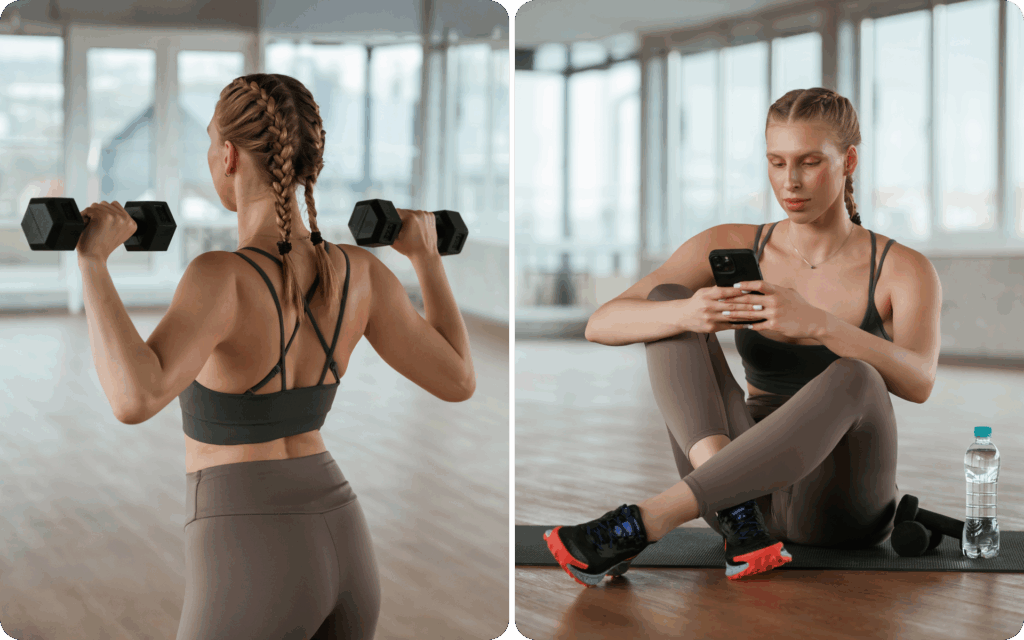
Sample 2-Day Full-Body Workout Routine
| Exercise | Sets | Number of reps |
|---|---|---|
| Squats | 3 | 10-12 |
| Bent over row | 3 | 10-12 |
| Forward lunges | 3 | 10 per leg |
| Dumbbell shoulder press | 3 | 8-10 |
| Pull-ups | 3 | 8-10 |
| Plank | - | 30-60 seconds |
| Exercise | Sets | Number of reps |
|---|---|---|
| Deadlifts | 2-3 | 10-12 |
| Dumbbell bench press | 2-3 | 8-10 |
| Hip thrusts | 2-3 | 10-12 |
| Lat pull-downs | 2-3 | 8-10 |
| Bulgarian split squats | 2-3 | 8-12 |
| Torso twists | -2-3 | 8-10 per side |
Points to note:
- Remember to start and end each workout routine with a warm-up and cool down.
- Use an appropriate weight. It shouldn’t be too light or too heavy. Find a weight that feels challenging, but allows you to complete your set reps with proper form.
Check out this full-body calisthenics routine to see the best exercises for an at-home routine.
Is Working Out 2 Days a Week Enough to Build Muscle?
Yes, exercising twice a week is enough to build muscle, particularly for those who are new to fitness. With the right strategy, you can easily achieve your desired physique through this program through:
- Prioritizing compound movements
- Practicing progressive overload
- Eating a healthy, high-protein diet
It should be noted that while weights are great for muscle building, you can still increase your muscle mass and strength without them. Check out this full-body workout at home without equipment to see exactly how to do this.
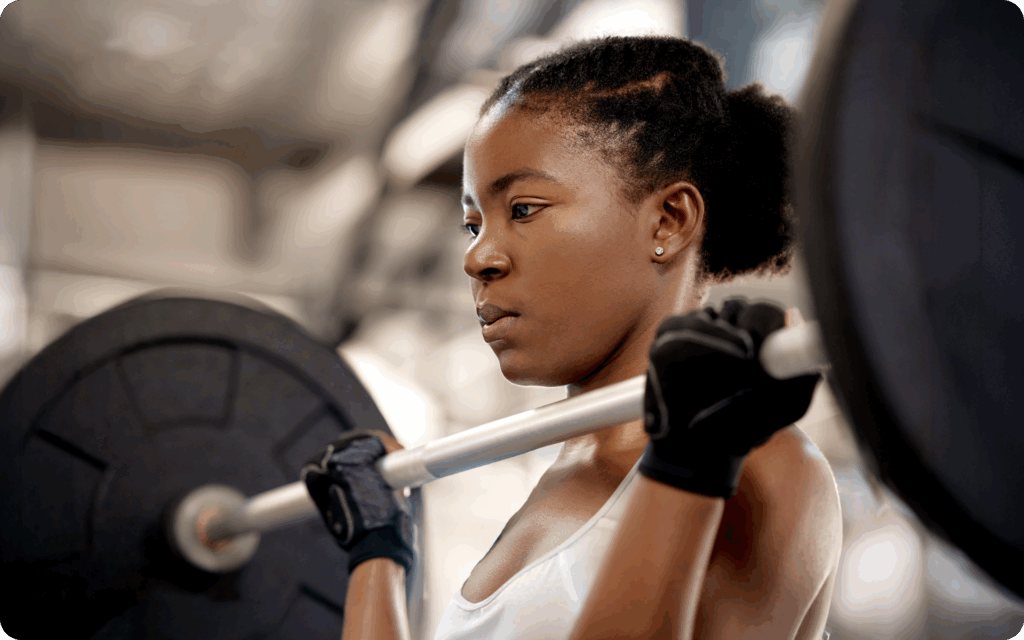
What Is the Best Full-Body Workout Routine?
The best full-body workout routine should incorporate the key elements that were mentioned earlier. It should:
- Be made up of compound exercises
- Incorporate progressive overload to constantly challenge your muscles and avoid exercise plateaus
- Be done consistently, at least 2-3 days a week – beginners can stick to a 2-3-day-a-week program
Read more: The Perfect Daily Workout Routine For Women Who Hate Long Gym Sessions
What Is a Muscle-Building 2-Day-a-Week Full-Body Workout?
This is a routine that is specifically curated to boost muscle growth by exercising twice a week. The routine incorporates:
- Exercises that target all major muscle groups in every session
- Constantly varies the load, number of sets, number of reps, and intensity
- Duration of the weekly routines.
This can keep the routine enjoyable and constantly challenge the muscles for better results.
Whether this is a 2-day-a-week full-body routine for female or male exercises or something else, all the factors must be incorporated to ensure sustained, long-term success.
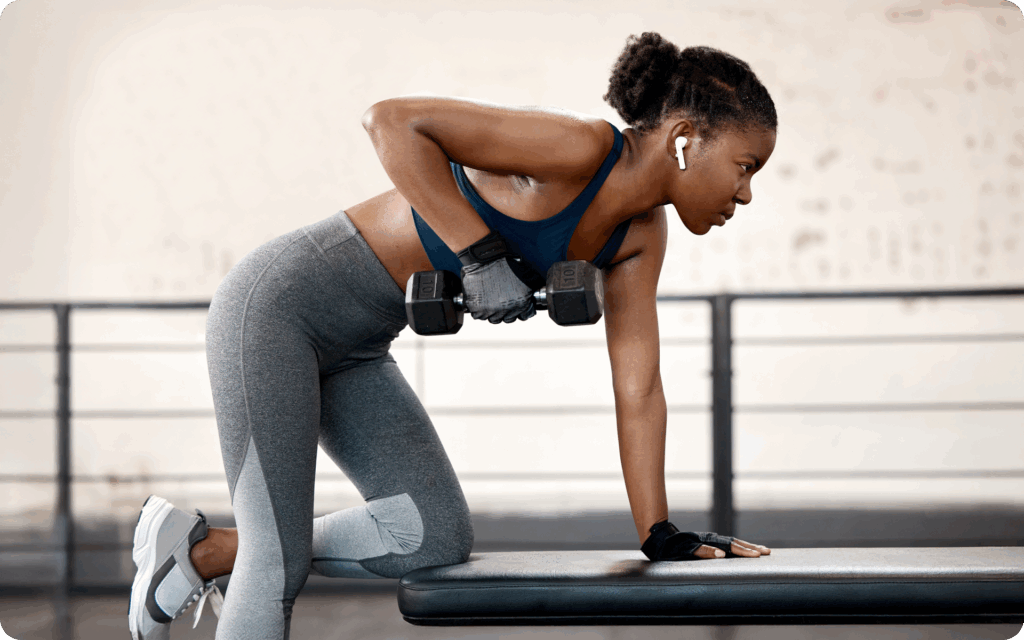
You should do a full-body workout 2-3 times a week (7). If you have the time and want to train more days, a body split such as upper/lower or PPL would be more suitable. Yes, it can make a difference. A 2-day-a-week exercise routine is better than leading a sedentary lifestyle. Experts state that participating in exercise helps with (8, 9): Therefore, working out twice a week may lead to positive changes in your mental health, muscle mass, strength, and quality of life. The answer to this is dependent on the individual. Some find the calves to be the hardest to grow, while others say it’s the biceps, forearms, hamstrings, or deltoids. Yes, you can increase your muscle mass and strength at any age, including at 40 (10, 11). All you need is a well-structured muscle-building fitness routine and a healthy, high-protein diet. Consistency with the exercise program and a healthy diet can help you build muscle in the long term.Frequently Asked Questions
How many days a week should I do a full-body workout?
Will working out twice a week make a difference?
What muscle is hardest to grow?
Can you build muscle at 40?
DISCLAIMER:
This article is intended for general informational purposes only and does not serve to address individual circumstances. It is not a substitute for professional advice or help and should not be relied on for making any kind of decision-making. Any action taken as a direct or indirect result of the information in this article is entirely at your own risk and is your sole responsibility.
BetterMe, its content staff, and its medical advisors accept no responsibility for inaccuracies, errors, misstatements, inconsistencies, or omissions and specifically disclaim any liability, loss or risk, personal, professional or otherwise, which may be incurred as a consequence, directly or indirectly, of the use and/or application of any content.
You should always seek the advice of your physician or other qualified health provider with any questions you may have regarding a medical condition or your specific situation. Never disregard professional medical advice or delay seeking it because of BetterMe content. If you suspect or think you may have a medical emergency, call your doctor.
SOURCES:
- Dynamic Warm-ups Play Pivotal Role in Athletic Performance and Injury Prevention (2025, sciencedirect.com)
- Warm Up, Cool Down (2024, heart.org)
- The Effectiveness of Post-exercise Stretching in Short-Term and Delayed Recovery of Strength, Range of Motion and Delayed Onset Muscle Soreness: A Systematic Review and Meta-Analysis of Randomized Controlled Trials (2021, frontiersin.org)
- The impact of progressive overload on the proportion and frequency of positive cardio-respiratory fitness responders (2023, sciencedirect.com)
- Progressive overload without progressing load? The effects of load or repetition progression on muscular adaptations (2022, pmc.ncbi.nlm.nih.gov)
- Effects of Resistance Training Overload Progression Protocols on Strength and Muscle Mass (2024, pubmed.ncbi.nlm.nih.gov)
- Beyond physical exhaustion: Understanding overtraining syndrome through the lens of molecular mechanisms and clinical manifestation (2025, sciencedirect.com)
- Benefits of Physical Activity (2025, cdc.gov)
- Benefits of exercise (2024, nhs.uk)
- Effects of resistance training on muscle strength, exercise capacity, and mobility in middle-aged and elderly patients with coronary artery disease: A meta-analysis (2016, sciencedirect.com)
- Effect of resistance training on local muscle endurance in middle-aged and older adults: A systematic review with meta-analysis and meta-regression (2023, sciencedirect.com)

 Reviewed by