So much has been written on how to best structure your training for muscle growth. It follows that getting the structure right is one of the most important things that truly matters. One of the most popular and effective training structures is the upper/lower split.
An upper/lower split divides your training into upper-body days and lower-body days. This approach allows you to train with high frequency and adequate volume, both of which are essential for building muscle and strength.
This guide will provide a science-backed, structured approach to using an upper/lower split for maximum muscle growth. We’ll explore its effectiveness and how to structure it, and provide a detailed workout plan you can start using today.
Are Upper/Lower Splits Effective for Muscle Growth?
Yes, upper/lower splits are highly effective for muscle growth, or hypertrophy. The effectiveness of any training program hinges on its ability to manage key variables such as volume, frequency, and intensity. Upper/lower splits provide an excellent framework for optimizing these variables.
To understand why, let’s look at the science. Muscle growth is primarily driven by three mechanisms:
- Mechanical Tension: Lifting challenging weights through a full range of motion. This is the most important factor for hypertrophy (1).
- Metabolic Stress: The “pump” you feel from performing higher repetitions, which leads to a buildup of metabolic byproducts in the muscle (1).
- Muscle Damage: Microscopic tears in muscle fibers that occur during intense exercise, which signal the body to repair and rebuild them stronger and larger (1).
An upper/lower split allows you to hit each muscle group at least twice a week. Research has consistently shown there to be a positive dose-response relationship between training frequency and hypertrophy gains. Stimulating a muscle more frequently provides more opportunities to trigger the growth process (2).
Furthermore, a recent systematic review and meta-analysis directly comparing split routines to full-body routines found no significant difference in muscle growth or strength gains when the total training volume was equated. The researchers concluded that individuals can confidently choose a routine based on personal preference (3).
This means that an upper/lower split is just as effective as other popular structures, provided your total weekly work is sufficient.
For beginners, both full-body and split routines have been shown to be effective. A study on untrained university students found that both approaches led to significant improvements in strength and body composition over an eight-week period, with neither being definitively superior (4).
This gives beginners flexibility in choosing a program that fits their schedule.
BetterMe: Health Coaching app helps you achieve your body goals with ease and efficiency by helping to choose proper meal plans and effective workouts. Start using our app and you will see good results in a short time.
How to Structure an Upper/Lower Split?
Structuring an upper/lower split is straightforward. The core principle is to dedicate separate days to training the muscles in the upper body and the muscles in the lower body. This allows for focused effort and sufficient recovery.
Training Frequency
The most common and effective way to structure an upper/lower split is over four days a week. This allows you to train each muscle group twice per week with adequate rest in between. A typical 4-day upper/lower split workout plan looks like this:
- Monday: Upper body
- Tuesday: Lower body
- Wednesday: Rest
- Thursday: Upper body
- Friday: Lower body
- Saturday: Rest or active recovery
- Sunday: Rest
This structure provides 48-72 hours of recovery for each muscle group before it’s trained again, which is optimal for muscle repair and growth (5).

For those with less time, a 3-day upper/lower split workout plan is also a viable option. This involves rotating between upper and lower body workouts. For example:
- Week 1: Upper, lower, upper
- Week 2: Lower, upper, lower
While this lowers the frequency for each muscle group to 1.5 times per week on average, it’s still an effective approach, particularly for those with demanding schedules. A beginner upper/lower split can also follow this 3-day structure to ease into a higher training frequency.
For advanced trainees who are looking for more volume, an upper/lower split 5-day variation can be implemented, but it requires careful management to avoid overtraining. An example would be upper, lower, rest, upper, lower, upper, rest, and then rotating the cycle.
Exercise Selection and Order
A well-structured session prioritizes compound, multi-joint movements before moving to isolation, single-joint exercises. Compound lifts engage multiple muscle groups and allow you to lift heavier weights, which creates significant mechanical tension (6). If you’re curious about compound exercises for women, check out our earlier article.
- Upper-Body Day: Focus on horizontal and vertical pressing and pulling movements. Examples include the bench press, overhead press, pull-ups, and bent-over rows. Follow these with isolation exercises like bicep curls, tricep extensions, and lateral raises.
- Lower-Body Day: Prioritize major compound lifts such as squats and deadlifts. Follow up with accessory movements like lunges, leg presses, hamstring curls, and calf raises.
Stimulating each muscle group with at least two different exercises per week, using a mix of bilateral (both limbs) and unilateral (one limb) movements, has been shown to ensure balanced development in athletes (7).
For more information on program design, you can explore the best workout split for muscle gain.
Read more: Bodyweight Circuit Exercises: Your Definitive Scientific Guide
What Is a Muscle-Building Upper/Lower Split Workout Plan?
Here’s a comprehensive 4-day upper/lower split workout plan that is designed for muscle growth. This plan balances strength and hypertrophy principles to deliver maximum results.
Program Notes
- Key Terms:
- 1RM: One-repetition maximum, the most weight you can lift for a single repetition.
- Reps In Reserve (RIR): How many more reps you could have done with good form at the end of a set. 1 RIR means you could have done one more rep.
- Progressive Overload: The gradual increase of stress placed upon the body during training. Aim to add a small amount of weight (2.5-5 lbs or 1-2.5 kg) to your lifts weekly or increase reps.
- Equipment Needed: Barbell, dumbbells, pull-up bar, cable machine, leg press machine, leg curl machine.
- Split Structure: This is a 4-day upper/lower split. You’ll train four days a week.
- Set and Rep Schemes:
- Strength Focus (Lower Reps): Sets in the 3-5 rep range at 85-90% of your 1RM. These are for your main compound lifts.
- Hypertrophy Focus (Higher Reps): Sets in the 8-12 rep range at 70-80% of your 1RM. This applies to most accessory exercises.
- Rest Schemes:
- Strength Sets: Rest for 3-5 minutes between sets.
- Hypertrophy Sets: Rest for 1.5-3 minutes between sets.

4-Day Upper/Lower Split Program
Day 1: Upper-Body Strength Focus
| Exercise | Sets | Reps | Rest |
|---|---|---|---|
| Barbell bench press | 3 | 3-5 | 3-5 mins |
| Bent-over barbell row | 3 | 3-5 | 3-5 mins |
| Seated dumbbell overhead press | 3 | 8-12 | 2-3 mins |
| Lat pulldown | 3 | 8-12 | 2-3 mins |
| Dumbbell lateral raise | 3 | 10-15 | 1.5-2 mins |
| Tricep pushdown | 3 | 10-15 | 1.5-2 mins |
| Dumbbell bicep curl | 3 | 10-15 | 1.5-2 mins |
| Exercise | Sets | Reps | Rest |
|---|---|---|---|
| Barbell back squat | 3 | 3-5 | 3-5 mins |
| Romanian deadlift | 3 | 6-8 | 3-5 mins |
| Leg press | 3 | 8-12 | 2-3 mins |
| Walking lunge | 3 | 10-12 per leg | 2-3 mins |
| Seated leg curl | 3 | 10-15 | 1.5-2 mins |
| Standing calf raise | 3 | 10-15 | 1.5-2 mins |
Day 3: Rest or Active Recovery
Day 4: Upper-Body Hypertrophy Focus
| Exercise | Sets | Reps | Rest |
|---|---|---|---|
| Incline dumbbell press | 3 | 8-12 | 2-3 mins |
| Pull-ups (or assisted) | 3 | As many reps as possible (AMRAP) | 2-3 mins |
| Single-arm dumbbell row | 3 | 8-12 per arm | 2-3 mins |
| Arnold press | 3 | 10-15 | 2-3 mins |
| Cable face pull | 3 | 15-20 | 1.5-2 mins |
| Skull crushers | 3 | 10-15 | 1.5-2 mins |
| Hammer curl | 3 | 10-15 | 1.5-2 mins |
| Exercise | Sets | Reps | Rest |
|---|---|---|---|
| Leg press | 3 | 10-15 | 2-3 mins |
| Barbell hip thrust | 3 | 8-12 | 2-3 mins |
| Dumbbell step-up | 3 | 10-12 per leg | 2-3 mins |
| Lying leg curl | 3 | 10-15 | 1.5-2 mins |
| Leg extension | 3 | 15-20 | 1.5-2 mins |
| Seated calf raise | 4 | 15-20 | 1.5-2 mins |
Exercise Instructions
Day 1: Upper Body
- Barbell Bench Press
- Lie flat on the bench with your feet firmly on the floor. Your eyes should be directly under the barbell.
- Grip the bar slightly wider than shoulder-width apart. Arch your lower back slightly while keeping your glutes on the bench.
- Unrack the bar and hold it directly over your chest with your arms locked.
- Lower the bar in a controlled manner (1-3 seconds) to your mid-chest.
- Press the bar back up explosively (1-2 seconds) to the starting position without locking your elbows completely.
- Bent-Over Barbell Row
- Stand with your feet shoulder-width apart. Hinge at your hips, keeping your back straight, until your torso is nearly parallel to the floor.
- Grab the barbell with an overhand grip, your hands slightly wider than shoulder-width apart.
- Pull the bar toward your lower chest, squeezing your shoulder blades together.
- Lower the bar slowly back to the starting position, keeping control throughout.
- Seated Dumbbell Overhead Press
- Sit on a bench with back support. Hold a dumbbell in each hand at shoulder height, your palms facing forward.
- Keep your feet flat on the floor and your core engaged.
- Press the dumbbells overhead until your arms are fully extended, but not locked.
- Lower the dumbbells in a controlled manner back to shoulder height.
- Lat Pulldown
- Sit with your thighs secured under the pad and grip the bar with your hands slightly wider than shoulder-width apart.
- Lean back slightly, keep your chest up, and pull the bar down to your upper chest by driving your elbows down and back.
- Pause and squeeze your lats at the bottom.
- Slowly return the bar to the starting position with your arms extended.
- Dumbbell Lateral Raise
- Stand with your feet hip-width apart, holding a dumbbell in each hand at your sides, your palms facing inward.
- With a slight bend in your elbows, raise your arms out to the sides until they reach shoulder height. Keep your shoulders down.
- Pause briefly at the top.
- Lower the dumbbells slowly to your sides.
- Tricep Pushdown
- Stand facing a cable machine and grab the bar or rope attachment with an overhand grip, your hands shoulder-width apart.
- Pull your elbows tight to your sides.
- Press the bar or rope down until your arms are fully extended.
- Slowly return the bar or rope until your forearms are parallel to the floor.
- Dumbbell Bicep Curl
- Stand tall with a dumbbell in each hand, your arms fully extended and your palms facing forward.
- Keep your elbows close to your torso.
- Curl the weights up toward your shoulders while keeping your upper arms stationary.
- Lower the dumbbells with control to the starting position.

Day 2: Lower Body
- Barbell Back Squat
- Position the barbell across your upper back (traps), not your neck, and grip the bar firmly.
- Stand with your feet shoulder-width apart, your toes slightly outward.
- Brace your core, take a deep breath, and lower yourself by hinging your hips and bending your knees.
- Go down until your thighs are at least parallel to the floor.
- Press through your heels and return to the starting position.
- Romanian Deadlift (RDL)
- Stand with your feet hip-width apart, holding a barbell with an overhand grip in front of your thighs.
- Keep a slight bend in your knees and hinge at your hips as you lower the bar, maintaining a straight back.
- Lower the bar until you feel a deep stretch in your hamstrings.
- Push your hips forward and squeeze your glutes to return to standing.
- Leg Press
- Sit at the leg press machine and place your feet shoulder-width apart on the platform.
- Unlock the safety handles and extend your legs, but keep a small bend in your knees.
- Lower the platform slowly by bending your knees until they form an approximate 90-degree angle.
- Press the platform upward by driving through your heels.
- Walking Lunge
- Stand with your feet together, holding a dumbbell in each hand at your sides.
- Step forward with one leg, lowering your hips until both knees are bent at about a 90-degree angle.
- Push through the heel of your front foot and bring your back leg forward to step into the next lunge.
- Alternate your legs as you continue walking forward.
- Seated Leg Curl
- Adjust the machine so the pad rests just above your heels.
- Sit with your knees in line with the pivot point of the machine and grip the handles.
- Flex your knees to pull the pad downward toward your glutes.
- Slowly release back to the starting position.
- Standing Calf Raise
- Stand with the balls of your feet on the platform and your heels hanging off.
- Keep your legs straight and raise your heels by pushing up onto your toes.
- Pause at the top and squeeze your calves.
- Lower your heels below the platform to feel a stretch.
Day 4: Upper Body
- Incline Dumbbell Press
- Set an incline bench to a 30-45 degree angle.
- Lie back with a dumbbell in each hand at chest level, your palms facing forward.
- Press the dumbbells up and in until your arms are fully extended.
- Lower the weights back to the start position, under control.
- Pull-Ups
- Grab a pull-up bar with an overhand grip, your hands slightly wider than shoulder-width apart.
- Hang with your arms fully extended and legs straight or crossed.
- Pull your body up until your chin crosses the bar, focusing on your back muscles.
- Lower yourself back to the starting position with control.
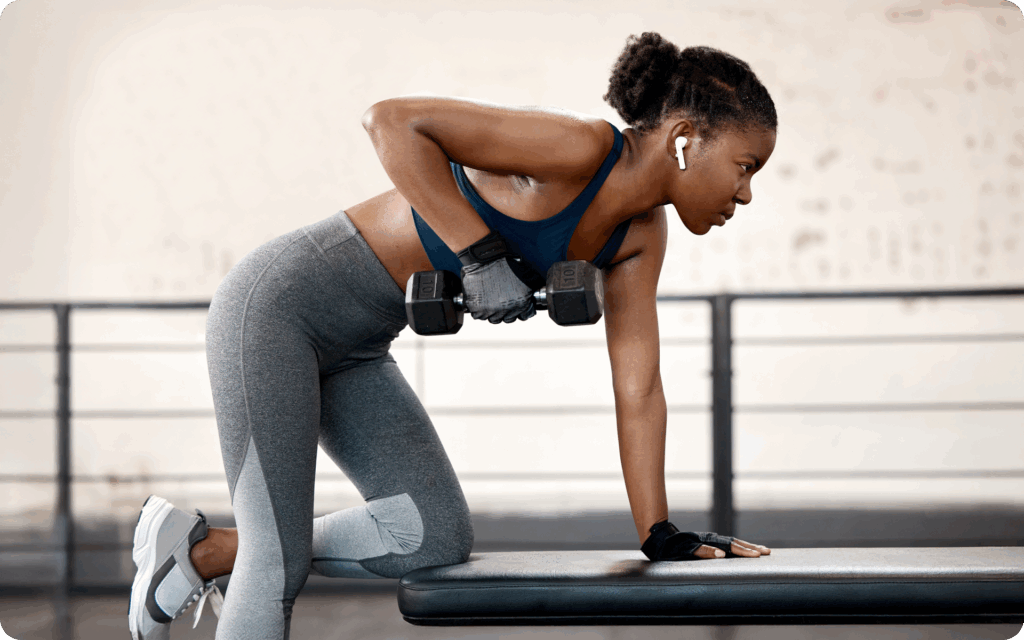
- Single-Arm Dumbbell Row
- Place one knee and one hand on a bench, keeping your back flat.
- Grasp a dumbbell with your free hand, your arm extended toward the floor.
- Pull the dumbbell up to your hip, keeping your elbow close to your body.
- Lower back down slowly and repeat before switching sides.
- Arnold Press
- Sit upright, holding two dumbbells in front of your shoulders, your palms facing you.
- Start pressing the dumbbells overhead while rotating your palms outward.
- Finish with your arms extended overhead, your palms facing forward.
- Reverse the motion to bring the weights back to the starting position.
- Cable Face Pull
- Set a cable at upper chest height with a rope attachment.
- Grip the rope with both hands, step back, and hold your arms straight.
- Pull the rope toward your face, flaring your elbows out to the sides.
- Squeeze your upper back at the end, then return to the starting point.
- Skull Crushers
- Lie on a bench holding an EZ bar or dumbbells with your arms extended over your chest.
- Keeping your elbows fixed, bend your arms to lower the weight toward your forehead.
- Press the weights back up to the starting position, extending fully at the elbow.
- Hammer Curl
- Stand tall holding a dumbbell in each hand, your arms at your sides and your palms facing your body.
- Curl the dumbbells up while maintaining the neutral hand position.
- Lower back down with control to the starting position.
Day 5: Lower Body
- Leg Press
- Sit at the machine and place your feet on the platform shoulder-width apart.
- Unrack the safety handles and extend your legs without locking your knees.
- Lower the platform by bending your knees until your legs form a 90-degree angle.
- Push the platform upward by driving through your heels.
- Barbell Hip Thrust
- Sit on the floor with your upper back against a bench. Place a padded barbell across your hips.
- Bend your knees and keep your feet flat on the floor, hip-width apart.
- Drive through your heels, lifting your hips until your shoulders, hips, and knees form a straight line.
- Squeeze your glutes at the top, then lower your hips under control back to the floor.
- Dumbbell Step-Up
- Stand facing a bench or sturdy platform, holding a dumbbell in each hand at your sides.
- Step up onto the bench with one foot, pressing through your heel to rise.
- Bring your trailing foot up to meet the lead foot on the bench.
- Step down with the same lead foot and repeat, alternating legs each rep.
Whether you’re a workout beast or just a beginner making your first foray into the world of fitness and dieting – BetterMe has a lot to offer to both newbies and experts! Install the app and experience the versatility first-hand!
- Lying Leg Curl
- Lie face down on the machine, adjust the ankle pads so they rest just above your heels.
- Grip the handles and keep your hips in contact with the bench.
- Curl your legs up as far as possible without lifting your hips.
- Lower back down under control to the starting position.
- Leg Extension
- Sit on the machine with your back flat and your shins behind the pad.
- Grip the handles and align your knees with the pivot point.
- Extend your knees to lift the weight, squeezing your quads at the top.
- Lower the weight back down smoothly to the starting position.
- Seated Calf Raise
- Sit on the calf raise machine with the pad resting on your thighs and the balls of your feet on the platform.
- Release the safety lever and allow your heels to drop as far as is comfortable for you.
- Press through the balls of your feet to lift your heels as high as possible.
- Pause at the top, then lower your heels below the platform for a stretch.
Read more: Full-Body Calisthenics Exercises: How to Get Ripped Without Touching a Single Weight
How Often Should I Do an Upper/Lower Split to See Results?
To see significant results, consistency is key. As outlined above, a 4-day upper/lower split workout plan is ideal for most people. This frequency allows you to train each muscle group twice a week, which is aligned with research-backed recommendations for hypertrophy (8).
A study of young women showed that both whole-body and split routines produced similar results over 20 weeks of training, which highlights that consistent training over several months is essential for adaptation (9).
For beginners, starting with a 3-day upper/lower split workout plan can be a great way to lay a solid foundation without feeling overwhelmed. As you adapt and your recovery improves, you can transition to a 4-day split. It’s important to listen to your body. If you feel excessive fatigue or your performance is declining, you may need more rest.
Advanced lifters might experiment with an upper/lower split with a 5-day or even a 6-day cycle, but this requires precise management of volume and intensity to prevent CNS (central nervous system) fatigue and allow for adequate recovery (10). Remember, more isn’t always better. The goal is to find the optimal frequency that allows for progressive overload and recovery.
To build your own workout from scratch, consider a bodyweight workout split.

What Are the Downsides of Upper/Lower Splits?
While the upper/lower split is a fantastic training structure, it’s not without its potential downsides.
- Longer Workouts
Upper-body days can feel long and grueling. You’re training your chest, back, shoulders, and arms all in one session. This can lead to accumulated fatigue, where the performance on exercises performed later in the session may suffer (11).
- Recovery Challenges
Training four days a week requires a significant time commitment and a solid recovery strategy. If your nutrition, sleep, or stress management is poor, you may struggle to recover between sessions, which can hinder your progress (12).
- Less Focus on Individual Muscle Groups
Unlike a “bro split” where you might have a dedicated day for chest or arms, an upper/lower split provides less session-specific volume for smaller muscle groups. While the overall weekly volume may be sufficient, some individuals may prefer the targeted “pump” of a more isolated training day.
- Not Ideal for Very High Frequency
If you want to train more than four days a week, other splits could be more appropriate. For example, a push/pull/legs (PPL) split is better suited for a 6-day training week, as it allows for more recovery between sessions that hit similar muscles.
Ultimately, the best split is one you can stick to consistently. If the downsides of an upper/lower split outweigh the benefits for your lifestyle, it’s worth exploring other options.
For a deeper dive into different training frequencies, check out this guide to the best 4-day workout split.
Yes, an upper/lower split is excellent for building muscle mass. It allows for high training frequency (hitting each muscle group twice a week) and sufficient volume, both of which are crucial drivers of hypertrophy (1). Neither is definitively “better”. Research has shown that when total weekly volume is equated, both full-body and split routines produce similar gains in strength and muscle mass (2). The choice depends on your training experience, schedule, and personal preference. Beginners often start with full-body workouts, while intermediate and advanced lifters may prefer splits to manage higher volume. A good upper/lower split routine is well-balanced and focuses on compound movements. A 4-day split is a great standard: Day 1 (upper), Day 2 (lower), Day 3 (rest), Day 4 (upper), Day 5 (lower). Each day should include 1-2 main compound lifts followed by 3-5 accessory exercises to ensure all muscles are targeted. The plan provided in this article is a great example of an effective upper/lower workout plan. There is no single “best” split for everyone. The upper/lower split is one of the most effective and popular splits for a reason – it balances frequency, volume, and recovery very well. However, other splits such as push/pull/legs, full-body, or body-part splits can also be effective. The “best” split is the one that is aligned with your goals, fits your schedule, and that you can perform consistently with high effort.Frequently Asked Questions
Is an upper/lower split good for mass?
Is full-body training better than a split?
What is a good upper/lower split routine?
Is upper/lower actually the best split?
The Bottom Line
The upper/lower split is a time-tested and scientifically-validated method for building muscle and strength. Its structure allows for a perfect blend of frequency and volume, which enables consistent progress without overtaxing your body. By prioritizing compound lifts, managing your recovery, and applying progressive overload, you can leverage this split to achieve significant results.
DISCLAIMER:
This article is intended for general informational purposes only and does not serve to address individual circumstances. It is not a substitute for professional advice or help and should not be relied on for making any kind of decision-making. Any action taken as a direct or indirect result of the information in this article is entirely at your own risk and is your sole responsibility.
BetterMe, its content staff, and its medical advisors accept no responsibility for inaccuracies, errors, misstatements, inconsistencies, or omissions and specifically disclaim any liability, loss or risk, personal, professional or otherwise, which may be incurred as a consequence, directly or indirectly, of the use and/or application of any content.
You should always seek the advice of your physician or other qualified health provider with any questions you may have regarding a medical condition or your specific situation. Never disregard professional medical advice or delay seeking it because of BetterMe content. If you suspect or think you may have a medical emergency, call your doctor.
SOURCES:
- Anabolic signals and muscle hypertrophy – Significance for strength training in sports medicine (2025, sciencedirect.com)
- The Resistance Training Dose-Response: Meta-Regressions Exploring the Effects of Weekly Volume and Frequency on Muscle Hypertrophy and Strength Gain (2024, sportrxiv.org)
- Efficacy of Split Versus Full-Body Resistance Training on Strength and Muscle Growth: A Systematic Review With Meta-Analysis (2024, pubmed.ncbi.nlm.nih.gov)
- Split versus full-body strength training workouts in untrained people. A randomised study (2020, researchgate.net)
- The Importance of Recovery in Resistance Training Microcycle Construction (2024, pmc.ncbi.nlm.nih.gov)
- 5 Benefits of Compound Exercises (2016, acefitness.org)
- Effect of unilateral training and bilateral training on physical performance: A meta-analysis (2023, frontiersin.org)
- Effects of Resistance Training Frequency on Measures of Muscle Hypertrophy: A Systematic Review and Meta-Analysis (2016, link.springer.com)
- Comparison of Whole and Split Weight Training Routines in Young Women (1994, researchgate.net)
- Central and Peripheral Fatigue in Physical Exercise Explained: A Narrative Review (2022, mdpi.com)
- Muscle fatigue: general understanding and treatment (2017, nature.com)
- EXPLORING THE SCIENCE OF RECOVERY (n.d., nasm.org)

 Reviewed by
 Reviewed by