
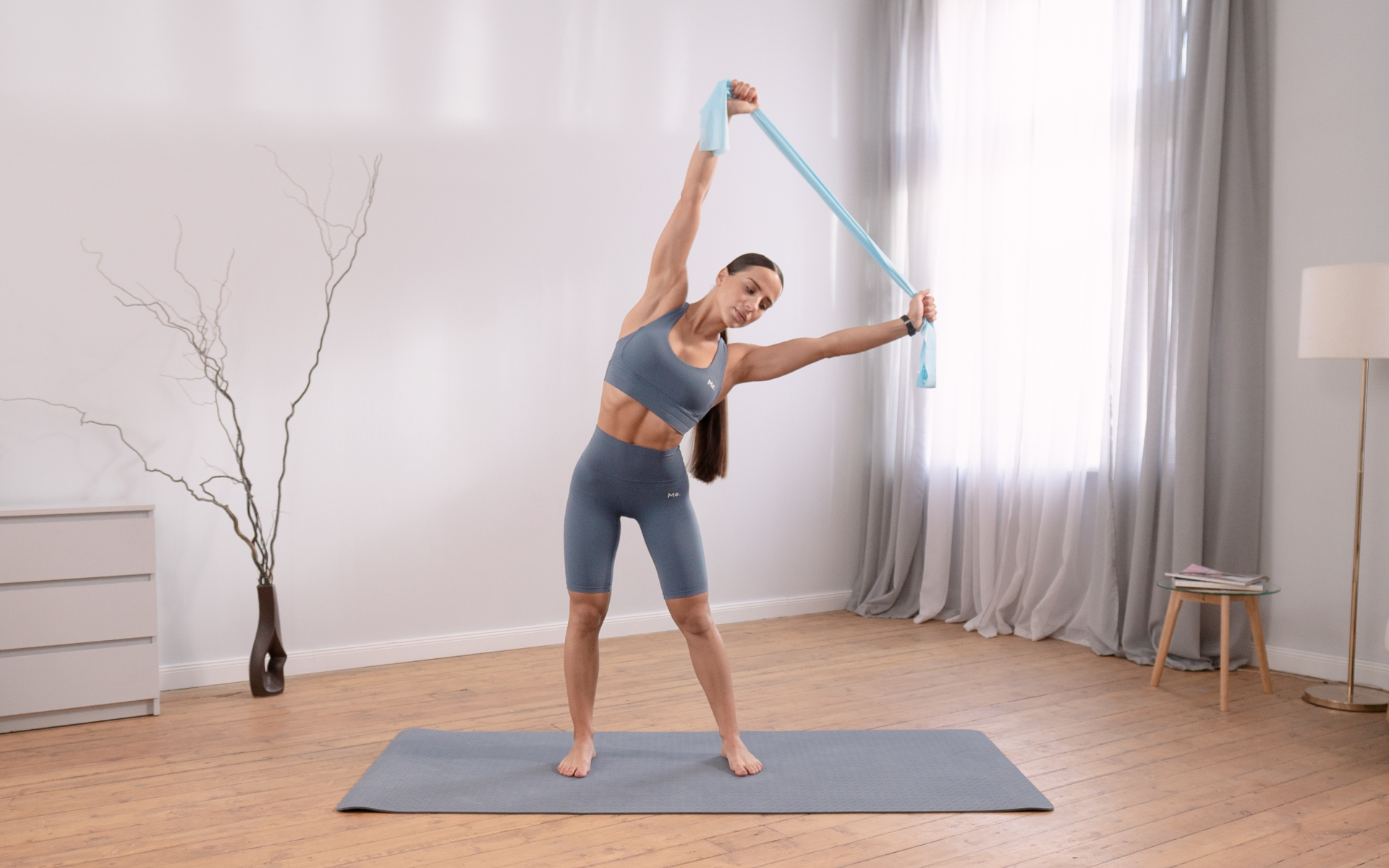
We often equate core training with the floor. Mat Pilates, hundreds of crunches, and endless minutes spent in a plank position are the standard prescription for a stronger midsection. However, many daily movements and functional activities require core engagement while standing. While traditional floor work has its place, it often fails to integrate the core with the rest of the kinetic chain. To build a body that truly supports you in everyday life, it’s important to train your stabilizer muscles in positions that reflect how you most often use them.
We want to share a different approach – one that prioritizes vertical integration. This approach focuses on standing deep core exercises for beginners, specifically targeting the muscles that stabilize your spine while you are upright.
What are Standing Deep Core Exercises?
Standing deep core exercises are movements performed on your feet that specifically target the local stabilizing system of the trunk.
Unlike superficial exercises that target the “six-pack” muscles (rectus abdominis), deep core training focuses on:
- The transverse abdominis (TVA)
- The multifidus
- The diaphragm
- The pelvic floor
These muscles act as a natural corset, holding your core and allowing intra-abdominal pressure to stabilize the spine. (1). When you engage them while standing, you force them to work in coordination with your hips and shoulders to maintain balance against gravity.
This type of training is often more functional than floor-based work. It mimics the demands of daily life and athletics, teaching your body to transfer force efficiently from the ground up through your extremities.

What Are Signs of a Weak Deep Core?
A weak deep core often manifests in subtle ways before it causes a major injury. As the deep core acts as a spinal stabilizer (2), inefficiency here forces other muscles to compensate.
Lower Back Discomfort During Prolonged Standing
You may experience a dull ache in your lumbar spine after standing for periods as short as 15-20 minutes. Without the active support of the TVA and multifidus, the passive structures of your spine – such as your discs and ligaments – bear the brunt of gravity’s load (3, 4).
This can lead to fatigue and discomfort that resolves only when you sit down.
Poor Single-Leg Balance
You might struggle to stand on one leg for more than 10 seconds without swaying significantly or putting your foot down. The deep core works intimately with the hip stabilizers to keep your pelvis level (1).
If your core is weak, your center of gravity shifts erratically, which makes balance difficult to maintain.
Reasons why BetterMe is a safe bet: a wide range of calorie-blasting workouts, finger-licking recipes, 24/7 support, challenges that’ll keep you on your best game, and that just scratches the surface! Start using our app and watch the magic happen.
Reliance on External Support
You may find yourself constantly leaning on counters, walls, or shopping carts when standing still. This habitual leaning is a subconscious strategy to offload the spine as the muscular support system is lacking endurance.
It signals that your deep stabilizers fatigue quickly under low-load conditions.
Persistent Pelvic Tilt Issues
You may notice an excessive arch in your lower back (anterior pelvic tilt) or a flattened lower back (posterior pelvic tilt) when you stand naturally. While anatomical variances exist, an inability to find and hold a neutral pelvic position often indicates that the deep core muscles aren’t firing to align the pelvis correctly.
If you’re interested in learning how targeted routines support a slimmer midsection, you might want to read more about deep core exercises for a smaller waist.
Read more: Core Workouts at Home: Exercises, Tips, and Frequently Asked Questions
How Can I Strengthen My Core While Standing?
To strengthen your core while standing, you must master the art of creating tension without movement. This is often referred to as “anti-movement” training, where the goal is to resist flexion, extension, or rotation of the spine (5).
Start by mastering the “bracing” maneuver. Imagine you are about to be punched in the stomach; the reflexive tightening of your midsection is a brace. Unlike “sucking in”, which hollows the stomach, bracing expands the abdominal wall 360 degrees to create intra-abdominal pressure.
Once you can brace, apply it to standing deep core exercises with no equipment required. Simply standing on one leg while maintaining a neutral spine and braced core is a potent stimulus for the deep stabilizers. From there, you can progress to adding unstable loads or dynamic limb movements.
Physiotherapists often recommend integrating breathing with this bracing. Aim for a firm, steady brace that still allows diaphragmatic breathing – tight enough to support your back, but not so hard that you need to hold your breath. This ensures your core provides stability continuously, not just when you’re holding your breath (6).
Do Standing Core Exercises Actually Work?
The efficacy of standing core exercises is supported by both biomechanical logic and electromyography (EMG) research.
Studies utilizing EMG analysis have shown that multi-joint standing movements, such as the overhead press or squat, elicit significant activation in the trunk stabilizers (7). While isolation exercises such as crunches produce high activation in the rectus abdominis (8), standing movements require co-contraction of the anterior and posterior core musculature to protect the spine.
Furthermore, the principle of specificity dictates that adaptations are specific to the imposed demand (9). If you want a core that protects your back while you walk, run, or lift objects, you must train it in those positions.
Standing deep core exercises for beginners bridge the gap between rehabilitation and high-performance athletics by training the muscles in their functional context.
However, do not assume they replace heavy compound lifting entirely. They are a supplementary tool to enhance stability and motor control, which carries over to heavier lifts and daily activities.
If you’re looking for additional routines that require minimal setup, you’ll find more inspiration in our guide to easy core exercises.
What Is the Best Standing Core Exercise?
There is no single “best” exercise, as efficacy depends on your specific goal and current ability level. However, if we define “best” as the movement offering the highest return on investment for stability and safety, the Pallof press is a top contender.
The Pallof Press trains anti-rotation, a primary function of the deep core. It forces the TVA and obliques to resist the rotational pull of a cable or band, stabilizing the spine against lateral forces. It is highly scalable, safe for those with back pain, and teaches the fundamental concept of proximal stability for distal mobility.
For those without cables, standing deep core exercises with weights such as the offset carry (suitcase carry) are arguably equally effective. Holding a heavy weight in one hand while walking forces the opposite side of the core to fire intensely to prevent the torso from collapsing. This builds dynamic stability that directly transfers to walking and running mechanics.

What Is an Intense Standing Deep Core Exercise Sequence?
To truly challenge the deep core, you need a sequence that hits all planes of motion: anti-flexion, anti-extension, anti-lateral flexion, and anti-rotation.
Program Notes:
- Glossary:
- DB: Dumbbell.
- Unilateral: Performed on one side at a time.
- Tempo: The speed of movement (e.g. 2-1-2 means 2 seconds down, 1 second pause, 2 seconds up).
- AMRAP: As many reps as possible with perfect form.
- Equipment Needed: A pair of dumbbells (or water bottles/canned goods for standing deep core exercises with no equipment variations).
- Split Structure: Perform this routine 2-3 times per week, either after your main workout or as a standalone session.
- Optimal Rep and Set Schemes: We’re focusing on endurance and motor control. Rest periods are kept short (45-60 seconds) to increase metabolic demand.
- Load Selection: Use a “moderate load”, defined here as a weight that allows you to complete the rep target with 2-3 reps in reserve (RPE 7-8).
The Standing Deep Core Matrix
| Exercise order | Exercise name | Sets | Reps | Rest | Focus |
|---|---|---|---|---|---|
| 1 | Pallof press | 3 | 10-12 / side | 45 secs | Anti-rotation |
| 2 | Standing overhead march | 3 | 12-15 / leg | 45 secs | Anti-extension |
| 3 | Dumbbell suitcase deadlift | 3 | 10-12 / side | 60 secs | Anti-lateral flexion |
| 4 | Standing cross-body chop | 3 | 12-15 / side | 45 secs | Rotation control |
| 5 | Standing around the worlds | 3 | 10 each way | 45 secs | Dynamic stability |
| 6 | Waiter’s bow (good morning) | 3 | 12-15 | 60 secs | Posterior chain |
Exercise Instructions
Pallof Press
The Pallof press is a proven anti-rotation exercise that targets deep core stabilizers by challenging your ability to resist lateral force.
- Stand sideways to a cable machine or a resistance band anchored at chest height.
- Grip the handle or band with both hands, holding it close to your chest.
- Step sideways away from the anchor point until there’s slight tension in the band or cable, your feet hip-width apart and your knees slightly bent.
- Engage your core by bracing as if preparing to be pushed from the side.
- Press the handle or band straight out from your chest, fully extending your arms while resisting any rotation of your torso.
- Hold at full extension for 1-2 seconds, keeping your core tight and your pelvis steady.
- Bring your hands back to your chest with control. This completes one repetition.
- Perform the assigned reps, then turn and repeat on the opposite side.
Standing Overhead March
This is excellent for those who are looking for standing deep core exercises with dumbbells.
- Stand tall, holding one dumbbell horizontally with both hands directly over your head.
- Lock your elbows and pull your ribcage down to prevent arching your lower back.
- Brace your core tightly.
- Slowly lift one knee up toward your chest until your thigh is parallel to the floor.
- Pause for 1-2 seconds at the top, ensuring your standing leg is fully extended and your torso remains vertical.
- Lower the leg with control and switch to the other side.
Dumbbell Suitcase Deadlift
This is a staple standing deep core exercise with weights for building lateral stability.
- Stand with your feet hip-width apart, with a dumbbell placed on the floor outside your right foot.
- Hinge at your hips and bend your knees to grip the dumbbell with your right hand.
- Before lifting, square your shoulders and engage your core to ensure your spine is neutral.
- Drive through your feet to stand up tall, keeping the dumbbell close to your side.
- Resist the urge to lean toward the weighted side – your shoulders should remain perfectly level throughout the movement.
- Lower the weight back down with control and repeat.
Standing Cross-Body Chop
This dynamic movement mimics chopping wood and targets the obliques.
- Stand with your feet shoulder-width apart, holding one dumbbell with both hands.
- Rotate your torso to bring the dumbbell up toward your right shoulder.
- Pivot your right foot slightly as you chop the weight down and across your body toward your left hip.
- Focus on initiating the movement from your core, not your arms.
- Control the deceleration at the bottom of the movement – don’t let the weight pull you out of position.
- Return to the starting position and repeat all reps on one side before switching.
Standing Around the Worlds
This creates a 360-degree challenge for the core stabilizers.
- Stand with your feet hip-width apart, holding a dumbbell with both hands in front of your thighs.
- Brace your core and maintain a slight bend in your knees.
- In a circular motion, lift the dumbbell up and around to the right, behind your head, and then down to the left side, returning to the front.
- Keep the dumbbell as close to your body as possible without touching it.
- Your torso should remain rock solid – only your arms should move.
- Perform the specified reps in one direction, then switch directions.

Waiter’s Bow (Good Morning)
This functions well as a standing core exercise for seniors when done without weight, or loaded for advanced lifters.
- Stand with your feet shoulder-width apart, your hands placed lightly behind your head (or holding a dumbbell against your chest for load).
- Keep a “soft” bend in your knees (about 15 degrees).
- Hinge at the hips, pushing your glutes backward while keeping your chest up and your back flat.
- Lower your torso until it’s nearly parallel to the floor, or until you feel a stretch in your hamstrings.
- Squeeze your glutes and hamstrings to return to the standing position.
- Focus on maintaining a neutral spine – don’t round your back.
If you’re interested in a routine that targets your abs efficiently, you can explore our quick ab workout for more ideas to add to your core training.
Whether you’re a workout beast or just a beginner making your first foray into the world of fitness and dieting – BetterMe has a lot to offer to both newbies and experts! Install the app and experience the versatility first-hand!
How Long Should a Standing Core Workout Last?
A standing core session doesn’t need to be a marathon. In fact, if you’re truly engaging the deep stabilizers with high intensity and focus, you’ll likely fatigue relatively quickly.
For most people, including those who are looking for standing deep core exercises for beginners, a focused session of 10 to 15 minutes is sufficient. This timeframe allows for 3-4 exercises performed for 3 sets each.
Extending the workout beyond 20 minutes often leads to “junk volume”, where fatigue compromises form. When form breaks down in core training, the load shifts from the muscles to the lumbar spine, which increases the risk of injury. Quality of contraction is far superior to the duration of the session.
Read more: 7 Core Pilates Ball Exercises For Your Next Workout
What Are Some Common Mistakes in Standing Ab Workouts?
Even with the best standing deep core exercises with dumbbells or bodyweight, execution errors can negate the benefits.
- Hyperextending the Lower Back: Particularly during overhead movements, many people flare their ribs and arch their back. This disengages the anterior core and compresses the lumbar facet joints. Always cue “ribs down” and “belt buckle to chin” to maintain a neutral pelvis.
- Relying on Momentum: Swinging the weight during chops or leg lifts uses inertia rather than muscle tension. Every repetition should have a distinct start and stop point. If you can’t control the weight, it’s too heavy.
- Holding the Breath: Brief breath-holding can be intentional during very heavy lifts (e.g. a Valsalva maneuver) to increase trunk stiffness. However, for longer-duration bracing, breath-holding can spike blood pressure and reduce your ability to maintain dynamic core control. For most training and daily movement, aim to “breathe behind the brace” – keep a steady, moderate brace while breathing diaphragmatically.
- Neglecting the Glutes: The glutes are the foundation of the core. If your glutes aren’t engaged during standing exercises, your lower back often compensates. Squeeze your glutes to set a stable base for your upper-body movements.
Can I Do Standing Core Exercises Every Day?
The deep core muscles – specifically the TVA and postural stabilizers – are designed for endurance. They fire at low levels almost constantly throughout the day to keep you upright. As they’re composed largely of slow-twitch muscle fibers (10), they recover faster than prime movers like the hamstrings or pectorals.
Therefore, you can perform low-intensity standing deep core exercises with no equipment required, such as balance drills or bracing practice, on a daily basis. These serve as excellent activation drills before a walk or run.
However, if you’re performing higher-intensity standing deep core exercises with weights designed to create hypertrophy or significant strength adaptations, you should treat them like any other resistance training. Allow 24-48 hours of recovery between intense sessions. A frequency of 3-4 times per week is generally the “sweet spot” for most non-elite athletes.
This balance ensures you stimulate the muscles enough to adapt without exceeding their recovery capacity, which is essential for long-term progression and injury prevention.
Yes, 10 minutes of focused, high-quality core training is sufficient to build stability and endurance if the intensity is adequate. If you already have a low body fat percentage, doing 100 crunches daily may help strengthen your abdominal muscles, but visible abs depend on more than just high-rep crunches. Muscle development requires a combination of progressive overload, varied core exercises, and balanced training that includes resistance work for the entire midsection – not just the rectus abdominis. Genetics, diet, and recovery also play significant roles. So, while crunches can contribute, they’re just one part of achieving visible abs. It’s physiologically impossible for most individuals to lose enough body fat to reveal abdominal muscles in just two weeks safely. While it’s better than nothing, 3 sets of 20 crunches is an outdated approach – lower reps with higher resistance or stability challenges are generally more effective for strength. Whether you’re standing or sitting, what matters most for your health is regularly changing positions and avoiding long periods in any one posture. Varying your stance and taking frequent movement breaks helps reduce muscle fatigue, supports spinal health, and encourages better overall function.Frequently Asked Questions
Is 10 minutes of core a day enough?
Will 100 crunches a day give you abs?
Can I get visible abs in 2 weeks?
Is 3 sets of 20 crunches good?
Is it healthier to stand instead of sit?
The Bottom Line
Building a resilient, powerful midsection requires more than just mat work. By integrating standing deep core exercises into your routine, you’ll bridge the gap between aesthetics and function. You teach your body to handle load, resist gravity, and move with efficiency in the real world.
Whether you’re lifting weights, carrying groceries, or simply navigating daily life, a strong standing core is your best defense against injury and your greatest asset for performance. Start with the basics, respect the mechanics, and remain consistent.
DISCLAIMER:
This article is intended for general informational purposes only and does not serve to address individual circumstances. It is not a substitute for professional advice or help and should not be relied on for making any kind of decision-making. Any action taken as a direct or indirect result of the information in this article is entirely at your own risk and is your sole responsibility.
BetterMe, its content staff, and its medical advisors accept no responsibility for inaccuracies, errors, misstatements, inconsistencies, or omissions and specifically disclaim any liability, loss or risk, personal, professional or otherwise, which may be incurred as a consequence, directly or indirectly, of the use and/or application of any content.
You should always seek the advice of your physician or other qualified health provider with any questions you may have regarding a medical condition or your specific situation. Never disregard professional medical advice or delay seeking it because of BetterMe content. If you suspect or think you may have a medical emergency, call your doctor.
SOURCES:
- Core strengthening (2004, archives-pmr.org)
- Core Stability Training for Injury Prevention (2013, pmc.ncbi.nlm.nih.gov)
- The Role of Multifidus in the Biomechanics of Lumbar Spine: A Musculoskeletal Modeling Study (2023, pmc.ncbi.nlm.nih.gov)
- Lumbar Stabilization (2025, ncbi.nlm.nih.gov)
- What is ‘Anti’ core training? (2021, humankinetics.me)
- Importance of Bracing and How to Do It (n.d., us.humankinetics.com)
- Core Muscle Activity during Physical Fitness Exercises: A Systematic Review (2020, pmc.ncbi.nlm.nih.gov)
- The effects of performing integrated compared to isolated core exercises (2019, pmc.ncbi.nlm.nih.gov)
- (PDF) Implications and Applications of Training Specificity for Coaches and Athletes (2006, researchgate.net)
- Core Stability Exercise Principles (2008, researchgate.net)

 Reviewed by

 Reviewed by
 Reviewed by