Somatic Pilates benefits remain uncertain because most research has studied other Pilates formats. The practice emphasizes body awareness through slow, controlled movement and attention to breathing. A study of mat Pilates found increased mindfulness, but it did not test every class labeled somatic Pilates (1).
For a practical introduction to somatic Pilates exercises, see our somatic Pilates workout guide. Check the class setup and movement options before your first session.
Following exercise and diet plans is the key in your fitness journey and greatly impacts results. In 4 weeks users can typically expect to lose not more than 1-2 lbs per week. Individual results may vary.
Key takeaways
- Somatic Pilates uses slow movements and attention to breathing and bodily sensations.
- A study of mat Pilates found increased mindfulness over a 15-week semester; it did not test every approach called somatic Pilates (1).
- Mindful attention is already part of traditional Pilates (2).
- A review found support for flexibility, dynamic balance, and endurance benefits from Pilates, with limitations in study quality (3).
- Adjust the range or pause when you need help maintaining control.
- The cited weight-loss research concerns Pilates generally, not this specific method or a BetterMe program (4).
What is somatic Pilates?
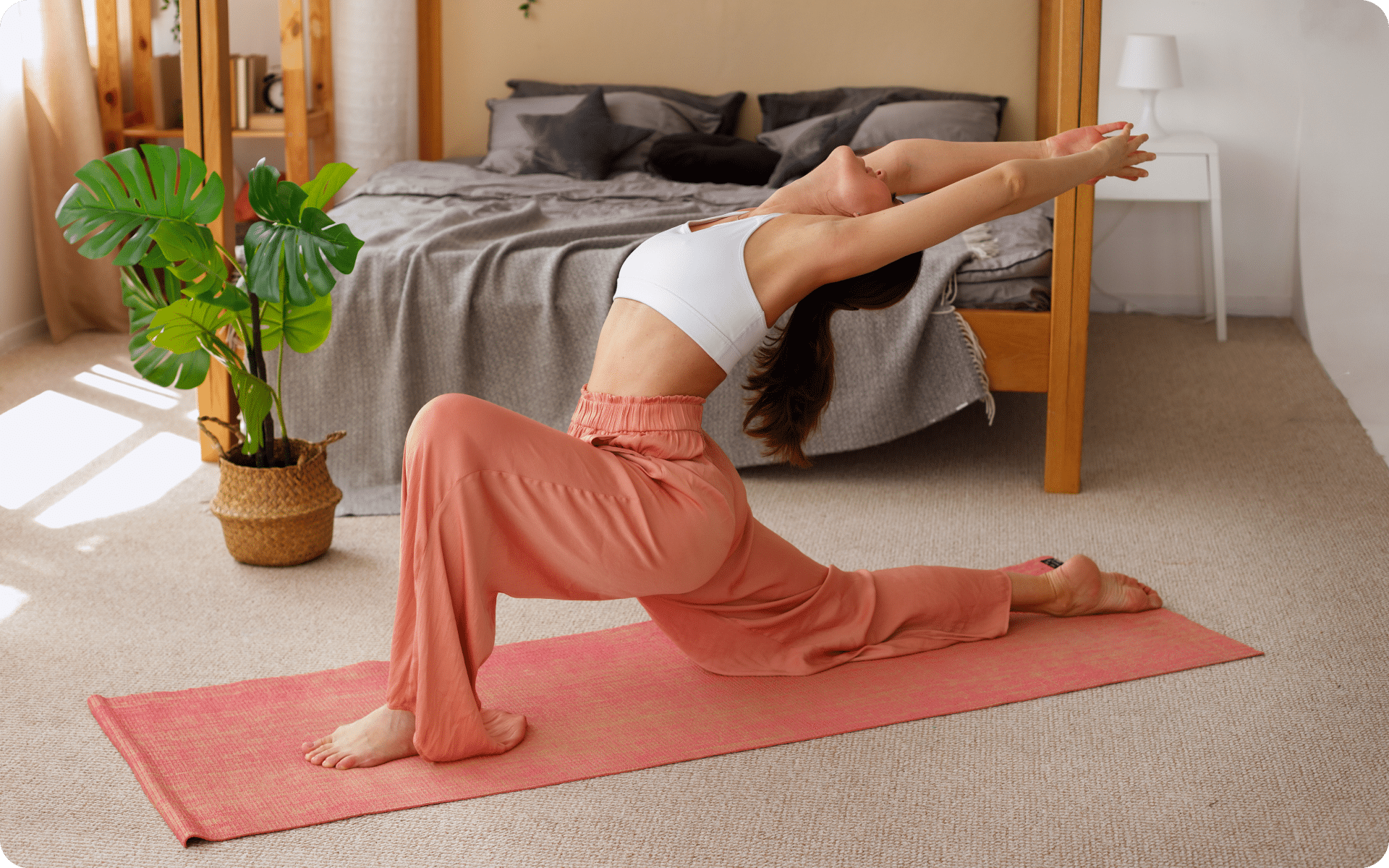
Somatic Pilates blends Pilates movements with attention to how your body feels as you move. Here, the term describes a teaching approach, rather than a single standardized program tested in the studies cited below.
Movements are often slow and small, giving you time to notice breathing, posture, and the effort each movement requires.
Try noticing whether you hold your breath or tense your shoulders during a movement. These observations can guide a smaller range of motion or a pause; they do not show that a workout changes nervous system function.
For somatic Pilates for beginners, look for a class that explains each starting position and offers smaller movement ranges. Check with your healthcare provider before starting, particularly if you have any health concerns.
Read more: Somatic Regulation Techniques: How to Calm Your Nervous System Naturally
What are some somatic Pilates benefits?
Pilates research has examined mindfulness, flexibility, and muscular endurance. These findings can inform expectations, with the limits of each study in view.
Traditional Pilates already includes mindful attention and controlled movement (2). The somatic label places extra emphasis on noticing sensations during practice.
A review of 16 studies in healthy people found support for flexibility, dynamic balance, and muscular endurance benefits. The studies had methodological limitations and did not test a distinct somatic Pilates program (3). During practice, you can pay attention to:
- How your breathing changes during a movement
- Where you notice muscular effort
- Whether your movement feels controlled
- Which range of motion feels comfortable
- When you need to pause or adjust your position
Do somatic workouts actually work?
Some research suggests benefits from structured Pilates classes. Evidence for a distinct somatic Pilates method remains limited, so the content of the class matters.
A quasi-experimental study compared mat Pilates classes with recreational exercise classes over a 15-week semester. Mindfulness scores increased in the Pilates group but not the comparison group. The design does not establish that every somatic movement practice has the same effect (1).
Treat a first session as a chance to learn the movements and notice your response. Individual results vary, and the cited studies cannot predict when you will notice a change.
BetterMe offers a variety of workouts, recipes, challenges, and support tools to help you stay more consistent with your wellness routine. Explore the app to find features that fit your goals, preferences, and schedule.
What’s the difference between Pilates and somatic Pilates?
Pilates and somatic Pilates share attention to breathing and controlled movement (2). Class descriptions vary, so compare the actual instruction and movement options. Our comparison of Pilates and somatic Pilates discusses these approaches.
Ask how the class is organized, what equipment it uses, and whether the instructor offers pauses or smaller movement ranges.
What are the results of somatic Pilates?
Research cannot give a reliable timeline for results from somatic Pilates. One small study followed 20 Pilates-trained women through eight weeks of mat training. Researchers measured improvements in abdominal curl performance, lower-body flexibility, and aerobic capacity (5). The study did not test somatic Pilates.
For a simple practice log, record the movement, your starting position, and any adjustment that helped you follow the instructions.
Bring questions from your log to the instructor. Your notes describe your experience; they cannot establish a clinical or training effect.
Read more: What Is Somatic Pilates for Weight Loss? Everything You Need to Know
Can you lose weight with somatic Pilates?
The cited research does not establish weight loss from somatic Pilates. A meta-analysis of 11 trials involving 393 adults with overweight or obesity found weight-related changes with Pilates, but it did not evaluate this specific approach or a BetterMe program (4).
Those findings cannot predict an individual result from gentle somatic sessions. Our article on somatic Pilates and weight loss discusses the topic further. If weight management is your goal, discuss your overall activity and eating habits with a qualified professional.
How can you adapt a somatic Pilates session?
You can adapt a session by adjusting the movement range, pace, and position. Choose changes that let you follow the instructions comfortably.
For a first session, choose a short sequence with an instructor who can explain the setup. Ask how to pause or change position when needed.
Before starting, check your available space and choose a comfortable position. During the session:
- Keep movements within a comfortable range.
- Breathe without forcing a particular rhythm.
- Pause when you need to reposition.
- Ask for an alternative when a movement does not suit you.
- Stop if you feel discomfort.
There is no need to increase the range or duration every session. Make adjustments based on how well you can perform the movement.
Workouts, weight management tools, and recipe ideas come together in the BetterMe: Health Coaching app, giving you practical support for building a more consistent wellness routine.
Frequently asked questions
Are somatic exercises worth trying?
They may suit you if you enjoy slow movement and time to notice how it feels. Before committing to a class, check the equipment, instruction, and options for adjusting each movement.
Is Pilates more effective than the gym?
Pilates can be practiced in a gym, and the two are not competing categories. Compare the actual activities with your goals: a class focused on gentle movement differs from a session built around heavy resistance or sustained aerobic work.
What is the most intense form of Pilates?
The cited studies do not establish one most intense form of Pilates. Ask about the actual exercises, resistance, and pace when comparing classes, and choose a workload you can control.
Does somatic Pilates help you lose weight?
The cited research does not establish weight loss from this specific method (4). Avoid choosing a class on the expectation of a particular weight change.
The bottom line
Somatic Pilates offers slow movement with attention to breathing and bodily sensations. Choose a class you can follow comfortably and use your observations to ask for adjustments.
Keep expectations modest and stop if a movement causes discomfort.
Visit BetterMe to see its current offerings.
DISCLAIMER:
This article is intended for general informational purposes only and does not serve to address individual circumstances. It is not a substitute for professional advice or help and should not be relied on for making any kind of decision-making. Any action taken as a direct or indirect result of the information in this article is entirely at your own risk and is your sole responsibility.
BetterMe, its content staff, and its medical advisors accept no responsibility for inaccuracies, errors, misstatements, inconsistencies, or omissions and specifically disclaim any liability, loss or risk, personal, professional or otherwise, which may be incurred as a consequence, directly or indirectly, of the use and/or application of any content.
You should always seek the advice of your physician or other qualified health provider with any questions you may have regarding a medical condition or your specific situation. Never disregard professional medical advice or delay seeking it because of BetterMe content. If you suspect or think you may have a medical emergency, call your doctor.
SOURCES:
- Pilates, Mindfulness and Somatic Education (2013, pubmed.ncbi.nlm.nih.gov)
- About Pilates (n.d., pilatesfoundation.com)
- A systematic review of the effects of pilates method of exercise in healthy people (2011, pubmed.ncbi.nlm.nih.gov)
- Pilates for Overweight or Obesity: A Meta-Analysis (2021, nih.gov)
- Pilates-mat training and detraining: Effects on body composition and physical fitness in pilates-trained women (2023, pubmed.ncbi.nlm.nih.gov)
 By
By