A six-week training program is one of the most effective ways to jump-start weight loss and build sustainable fitness habits. This guide offers a clear, evidence-based approach to help you lose weight, improve your health, and understand the core principles behind a program that works.
You’ll find step-by-step strategies for structuring your workouts, managing nutrition, and maximizing results so you can train smarter and achieve real progress in just 42 days.
What Is a Realistic Six-Week Training Program?
A realistic training program isn’t just a list of exercises, it’s a structured approach that accounts for your physiological limits and lifestyle constraints. When we say “realistic”, we aren’t suggesting “easy” – we’re suggesting “doable consistently for 42 days”.
Includes All Pillars of Fitness
You can’t rely on just one modality. A comprehensive plan integrates:
- Resistance Training: To build or maintain lean muscle mass (1), which drives your metabolic rate (2).
- Cardiovascular Work: To improve heart health and increase daily energy expenditure (3).
By addressing these elements, you’ll ensure that your body is becoming more functional, not just smaller.
Prioritizes Progressive Overload
“Realistic” implies progress. You shouldn’t be doing the exact same thing in Week 6 as you did in Week 1. Whether you’re adding weight (load), increasing reps, or reducing rest times, the program must get harder over time.
For a beginner, a 2.5% to 10% increase in load per week on compound lifts is a standard, achievable target (4).
Has Sufficient Recovery Protocols
A program that demands you crush yourself in the gym seven days a week is a fast track to burnout or injury. A realistic six-week training program prioritizes recovery just as much as exertion. Physiological adaptations – such as muscle growth and fat oxidation – occur during rest, not during the workout itself (5).
Therefore, a sound plan includes at least 1-2 full rest days where your only “work” is light walking or mobility drills. If you’re sleeping less than 7 hours a night, your cortisol levels (stress hormone) may rise, which can inhibit fat loss (6).
Read more: Nutrition and Workout Plan for Strength and Balanced Wellness
Can I Get in Shape in 6 Weeks?
The short answer is yes.
Six weeks is a significant microcycle in the world of periodization. While you won’t transform from a sedentary lifestyle to an elite athlete in a month and a half, you can set a foundational baseline that dramatically changes your body composition and metabolic health.
Fat Loss In 6 Weeks
Fat loss is fundamentally an energy balance equation, but the nuance lies in how that energy is used. In six weeks, if you’re in a consistent caloric deficit (consuming fewer calories than you burn), your body is more likely to tap into adipose tissue (stored fat) for fuel (7).
Research has suggested that healthy weight loss occurs at a rate of 0.5% to 1% of body weight per week (8). Over six weeks, this accumulation is visually noticeable.
Reasons why BetterMe is a safe bet: a wide range of calorie-blasting workouts, finger-licking recipes, 24/7 support, challenges that’ll keep you on your best game, and that just scratches the surface! Start using our app and watch the magic happen.
Muscle Gain In 6 Weeks
Neuromuscular adaptations happen quickly – often within the first 2-3 weeks. This means your brain gets better at recruiting muscle fibers before the muscles themselves grow significantly in size (hypertrophy) (9).
However, by weeks 4-6, assuming adequate protein intake (roughly 1.2-2.0g per kg of body weight) (10), early signs of hypertrophy can occur. This dual effect – fat loss plus increased muscle tone – creates the “in shape” look most people desire.
If you’re looking for a dedicated 6-week workout plan to gain muscle, understanding these physiological timelines is essential for managing expectations.
How to Plan a Six-Week Training Program
Planning is where most people fail before they even set foot in the gym. A haphazard approach leads to haphazard results. Below is a structured, step-by-step guide to help you design your most effective six-week training program yet.
Choosing a Split Structure for Weight Training
The way you organize your weekly workouts – the “split structure” – is key to managing recovery, training volume, and results. Here are some popular split options:
- Full-Body Split: Involves training your entire body each session, typically 2-3 times per week. This split maximizes training frequency, is excellent for beginners, and supports balanced fat loss and muscle gain.
- Upper/Lower Split: Divides workouts into upper-body days and lower-body days. It usually runs on a four-day schedule (e.g. Monday/Thursday: upper, Tuesday/Friday: lower), offering a good balance for those with some experience who prefer slightly more training frequency per muscle group.
- Push/Pull/Legs Split: Separates workouts based on movement patterns: push (chest, shoulders, triceps), pull (back, biceps), and legs. Often performed over three to six days per week, this split best suits intermediate to advanced lifters who want higher volume and specificity.
- Body Part (“Bro”) Split: Each session targets a single muscle group (e.g. chest day, back day). While it’s popular in bodybuilding, for most weight loss or general fitness goals, this split is less efficient due to reduced training frequency per muscle group.
For weight loss and overall conditioning, full-body or upper/lower splits tend to work best, keeping you active most days while allowing vital recovery time. Consider your experience level, schedule, and preferences when choosing a split – you’ll progress fastest with a routine you can stick to consistently.
Selecting Starting Weights
Always start lighter than you think necessary, particularly if you’re new to resistance training or returning from a break. Choose a weight that allows you to complete every rep with good form, but that challenges you noticeably during the last 2-3 reps of each set.
For compound exercises, most people find that starting at roughly 60-70% of their estimated one-repetition maximum (1RM) is effective.
- If you’re unsure of your 1RM, select a weight you can lift for about 12 reps with moderate difficulty, then use it for sets of 8-10 reps.
Setting Intensity
Intensity refers to how hard you are working relative to your maximum. For most of your strength and hypertrophy work, aim to train at about a 7-8 on a rate of perceived exertion (RPE) scale, where 10 is maximum effort. This means you should feel like you could do 2-3 more reps at the end of each set, but no more.
Calculating Training Volume
Training volume refers to the total amount of work performed, often expressed as sets x reps x weight lifted. For beginners and those who want to achieve fat loss, 9-15 quality sets per major muscle group per week is a smart starting point.
This strikes a balance between stimulus and recovery across your full-body sessions.
- General guidelines:
- 3 sets of 8-12 reps per exercise is standard for most movements.
- Choose 1-2 exercises per major muscle group in each full-body session.
Programming Your Routine
A balanced weekly schedule for weight loss could look like this:
- Monday: Full-body strength
- Tuesday: HIIT (high-intensity interval training)
- Wednesday: Active recovery (walking/mobility)
- Thursday: Full-body strength
- Friday: HIIT
- Saturday: LISS (low-intensity steady state cardio)
- Sunday: Rest
This structure works exceptionally well as a six-week training program for beginners as it balances intensity with recovery.
Determining Calorie Consumption
You can’t out-train a diet that exceeds your energy needs. To lose weight, you must establish a caloric deficit.
- Find Maintenance Calories: Calculate your total daily energy expenditure (TDEE). This is the number of calories you burn just existing, plus maintaining your activity level.
- Create the Deficit: Subtract 200-500 calories from your TDEE. This is a moderate deficit that triggers fat loss without making you feel deprived.
Strategic Food Swaps
Instead of overhauling your entire life overnight, use strategic swaps to cut calories painlessly:
- Liquid Calories: Swap soda or sugary lattes for water, black coffee, or zero-calorie sparkling water. This alone can save 200-400 calories daily.
- Volume Eating: Swap calorie-dense sides like pasta for high-volume, low-calorie vegetables such as zucchini noodles or leafy greens. You get to eat a larger physical volume of food for fewer calories.
- Whole Foods: Prioritize single or minimal-ingredient foods. For example, an apple is more satiating than apple juice because of the fiber content and the act of chewing.
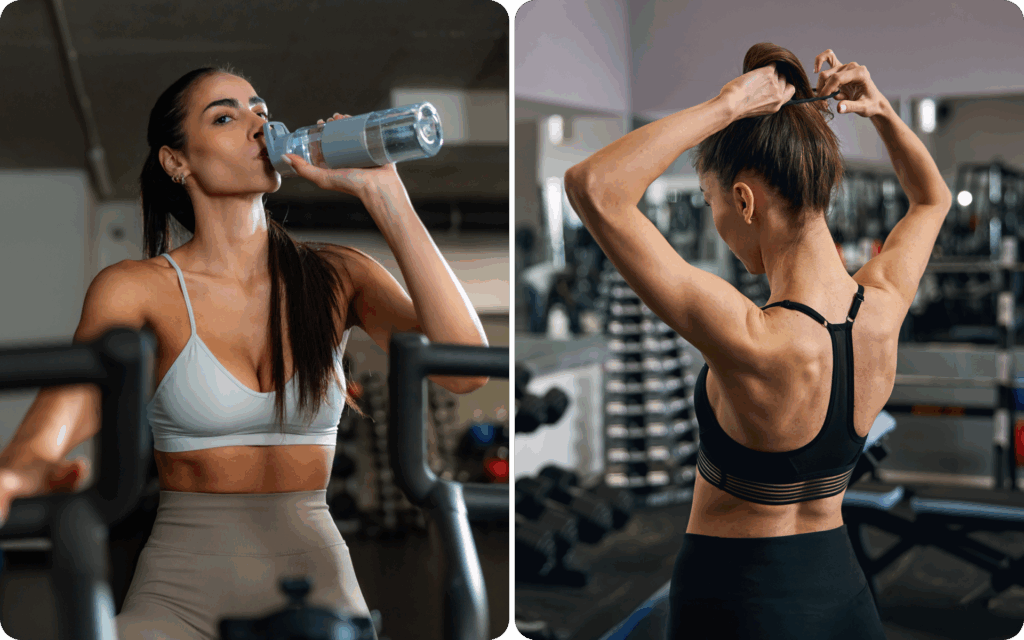
What Is a Realistic Six-Week Training Program for Weight Loss?
Below is a structured program designed to maximize fat oxidation while preserving lean muscle mass. This program assumes you have access to standard gym equipment.
Program Notes
- Tempo: Perform reps with a 2-0-2 cadence (2 seconds lowering, 0-second pause, 2 seconds lifting) unless otherwise noted.
- Rest: Rest 60-90 seconds between sets for strength work.
- Progression: Aim to increase weight or reps every week, but not both
The Weekly Schedule
| Day | Workout type | Focus | Duration |
|---|---|---|---|
| Monday | Full-Body A | Strength and hypertrophy | 45-60 mins |
| Tuesday | HIIT | Rowing ergometer | 20 mins |
| Wednesday | Active recovery | Walking/mobility | 30 mins |
| Thursday | Full-Body B | Strength and hypertrophy | 45-60 mins |
| Friday | HIIT | Rowing ergometer | 20 mins |
| Saturday | LISS | Incline walking/cycling | 45 mins |
| Sunday | Rest | Total rest | N/A |
Full-Body Workout A (Monday)
| Exercise | Sets | Reps | RPE (rate of perceived exertion) |
|---|---|---|---|
| Goblet squat | 3 | 10-12 | 7-8 |
| Dumbbell bench press | 3 | 10-12 | 7-8 |
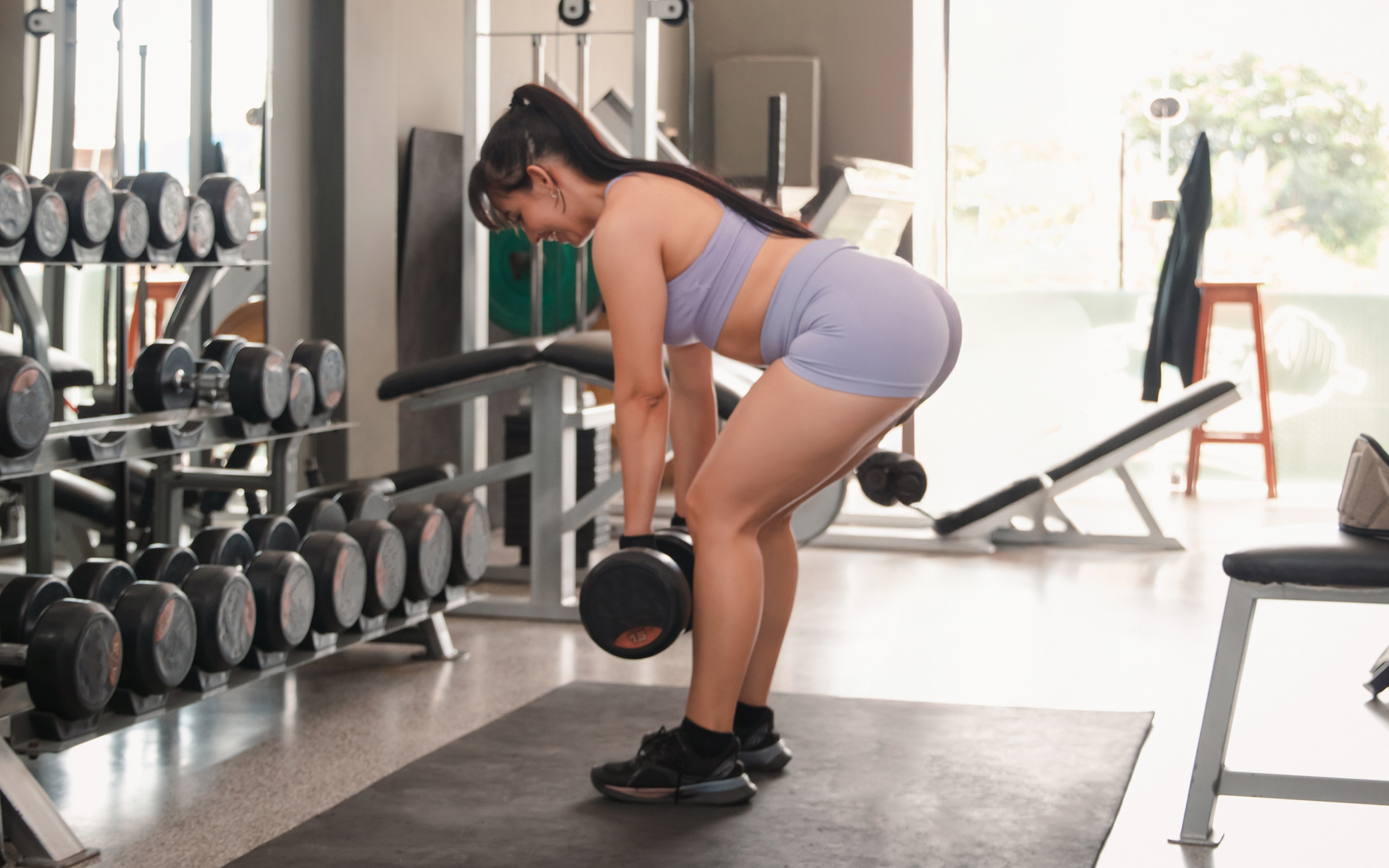
| Dumbbell Romanian deadlift | 3 | 10-12 | 7-8 |
| Single-arm dumbbell row | 3 | 10-12 | 7-8 |
| Plank | 3 | 30-45 sec | 8 |
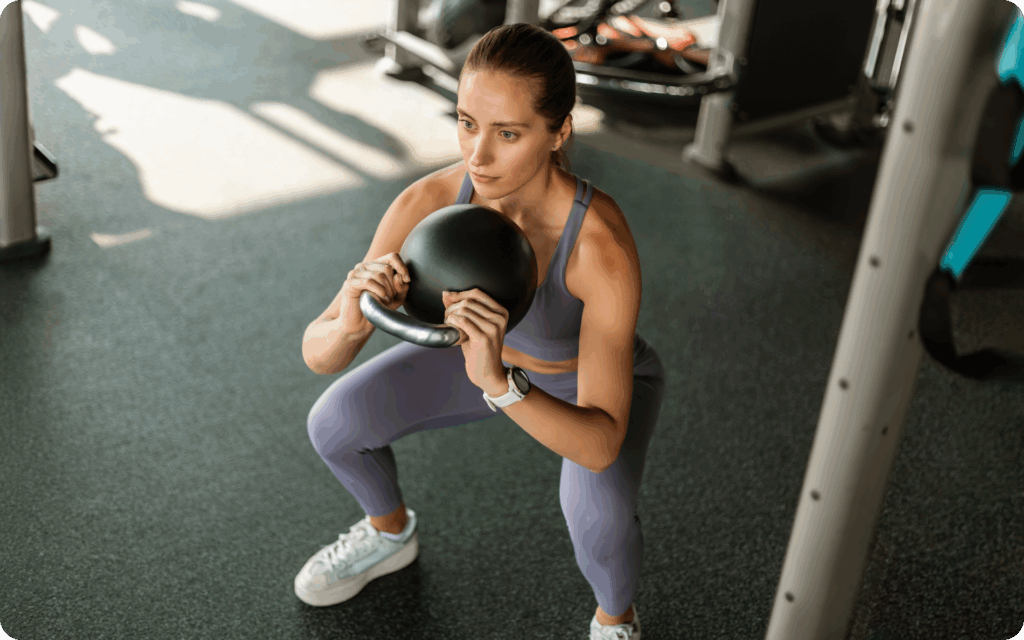
1. Goblet Squat
Steps:
- Hold a dumbbell vertically against your chest with both hands cupping the top end.
- Set your feet slightly wider than shoulder-width apart, your toes pointing slightly out (approx. 15-30 degrees).
- Inhale and brace your core.
- Lower your hips down and back, keeping your chest up and your elbows inside your knees.
- Descend until your thighs are at least parallel to the floor.
- Drive through your heels to return to the starting position, exhaling at the top.
2. Dumbbell Bench Press
Steps:
- Lie back on a flat bench with a dumbbell in each hand, resting on your thighs.
- Use your thighs to help kick the weights up to your chest as you lie back.
- Position the dumbbells to the sides of your chest with your upper arm at a 45-degree angle to your body (not flared out to 90 degrees).
- Press the weights up until your arms are fully extended, but not locked out.
- Lower the weights slowly and strictly to the starting position.
3. Dumbbell Romanian Deadlift (RDL)
Steps:
- Stand holding a dumbbell in each hand in front of your thighs, your palms facing your body.
- Keep a slight bend in your knees, but don’t squat.
- Hinge at your hips, pushing your glutes backward while keeping the dumbbells close to your legs.
- Lower until you feel a strong stretch in your hamstrings (usually mid-shin level). Keep your back flat.
- Squeeze your glutes to pull your torso back to the upright position.
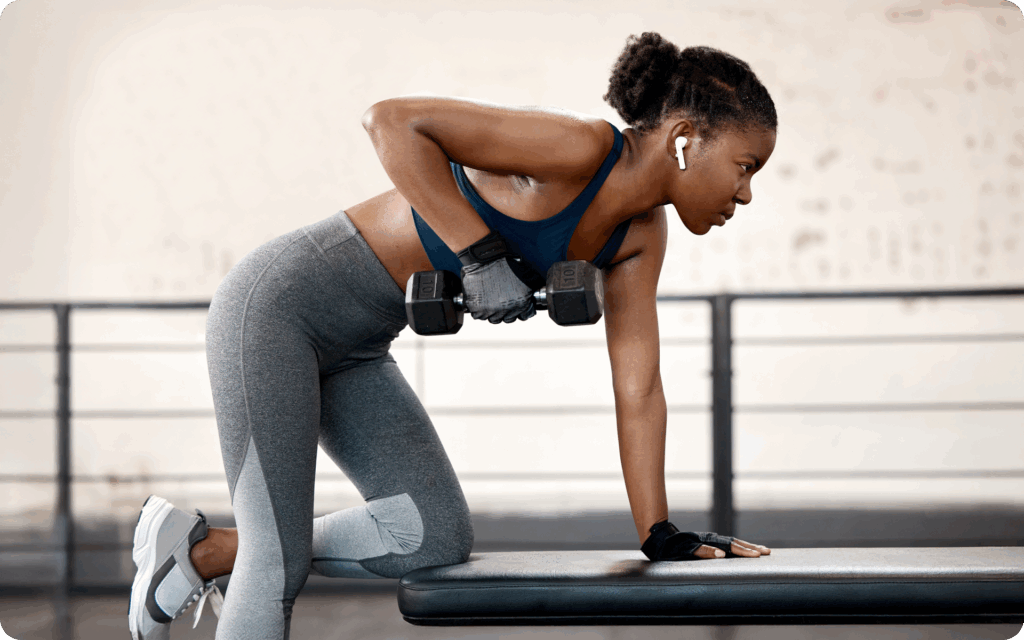
4. Single-Arm Dumbbell Row
Steps:
- Place your left knee and left hand on a bench for support. Your back should be flat, parallel to the ground.
- Hold a dumbbell in your right hand, your arm hanging straight down.
- Pull the dumbbell up toward your hip, keeping your elbow tucked close to your body.
- Squeeze your shoulder blade at the top.
- Lower the weight slowly to a full stretch.
5. Plank
Steps:
- Place your forearms on the floor and your elbows directly under your shoulders.
- Extend your legs behind you, resting on your toes.
- Engage your core, glutes, and quads to create a rigid straight line from your head to your heels.
- Hold this position without allowing your hips to sag or hike up.
Whether you’re a workout beast or just a beginner making your first foray into the world of fitness and dieting – BetterMe has a lot to offer to both newbies and experts! Install the app and experience the versatility first-hand!
Full-Body Workout B (Thursday)
| Exercise | Sets | Reps | RPE (rate of perceived exertion) |
|---|---|---|---|
| Goblet squat | 3 | 10-12 | 7-8 |
| Dumbbell bench press | 3 | 10-12 | 7-8 |
| Dumbbell Romanian deadlift | 3 | 10-12 | 7-8 |
| Single-arm dumbbell row | 3 | 10-12 | 7-8 |
| Plank | 3 | 30-45 sec | 8 |
1. Dumbbell Reverse Lunge
Steps:
- Stand tall, holding dumbbells at your sides.
- Step backward with your right foot, landing on the ball of your foot.
- Lower your hips until both knees form approximately 90-degree angles. The back knee should hover just above the floor.
- Push through your front heel to return to the standing position.
- Complete all reps on one leg before switching, or alternate legs.
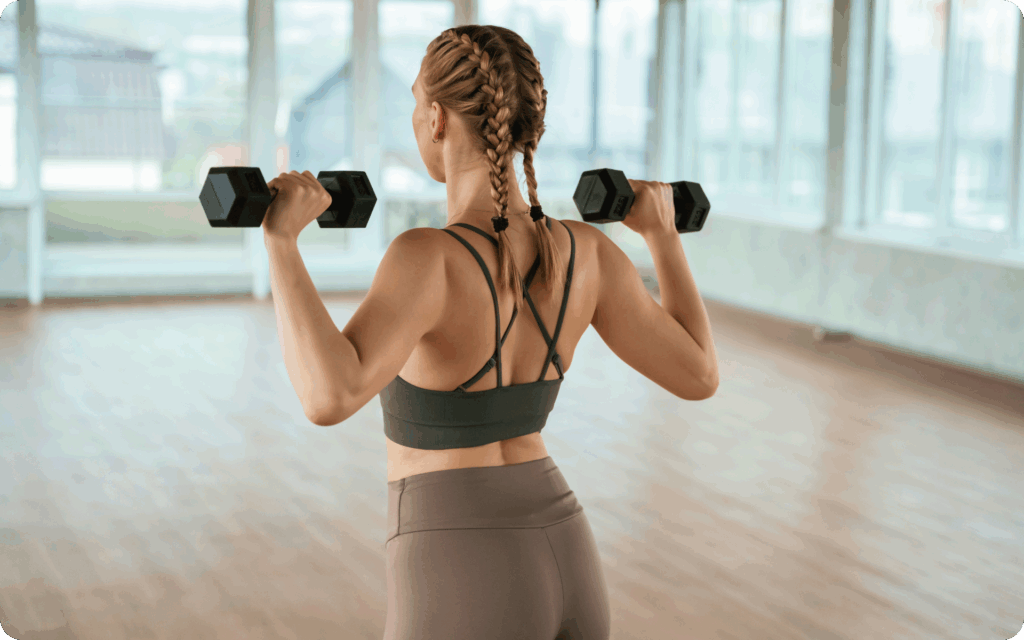
2. Overhead Dumbbell Press
Steps:
- Stand or sit with a dumbbell in each hand at shoulder height, your palms facing forward or neutral.
- Brace your core to prevent your lower back from arching excessively.
- Press the weights directly overhead until your arms are extended.
- Lower the weights back to shoulder height with control.
3. Lat Pulldown
Steps:
- Sit at a lat pulldown machine and adjust the thigh pad so your legs are secure.
- Grasp the bar with your hands slightly wider than shoulder-width apart.
- Lean your torso back slightly (approx. 10-15 degrees) and keep your chest lifted.
- Pull the bar down toward your upper chest, driving your elbows down and back.
- Slowly extend your arms to return the bar to the top.
4. Glute Bridge
Steps:
- Lie on your back with your knees bent and your feet flat on the floor, hip-width apart.
- Place your arms at your sides.
- Drive through your heels to lift your hips off the floor until your knees, hips, and shoulders form a straight line.
- Squeeze your glutes hard at the top for 1 second.
- Lower your hips back down with control.
5. Dead Bug
Steps:
- Lie on your back with your arms extended toward the ceiling and your legs in tabletop position (knees bent at 90 degrees).
- Press your lower back into the floor – there should be no gap.
- Slowly lower your right arm behind your head and extend your left leg straight out.
- Return to center and repeat with the opposite arm and leg.
Reasons why BetterMe is a safe bet: a wide range of calorie-blasting workouts, finger-licking recipes, 24/7 support, challenges that’ll keep you on your best game, and that just scratches the surface! Start using our app and watch the magic happen.
HIIT Sessions (Tuesday and Friday)
Equipment: Rowing machine (ergometer)
The rowing machine is superior for weight loss as it recruits 86% of the body’s musculature, which creates a high metabolic demand.
Protocol:
- Warm-up: 5 minutes at a comfortable pace.
- Intervals: 30 seconds max effort (should feel like a 9-10 RPE – maximum sustainable effort)/ 90 seconds active rest (very slow paddling).
- Rounds: Repeat for 6-8 rounds.
- Cool-down: 3-5 minutes easy rowing.
LISS Session (Saturday)
Protocol:
- Activity: Brisk walking on an incline treadmill (3-4 mph at 5-10% incline) or steady cycling.
- Duration: 45 minutes continuous.
- Intensity: Zone 2 heart rate (60-70% of max HR). You should be able to hold a conversation, but you would rather not.
Moving More Throughout The Day
A dedicated six-week training program works best when it’s combined with NEAT (non-exercise activity thermogenesis). This is the energy burned outside of sleeping, eating, and sports-like exercise.
- Park Further Away: An extra 2-minute walk twice a day adds up.
- Stand Up: If you have a desk job, stand up for 5 minutes every hour.
- Walk and Talk: Take phone calls while pacing or walking outside.
If you don’t have gym access, you can easily adapt this logic into a 6-week workout plan at home.
How Many Pounds Is It Realistic to Lose in 6 Weeks?
Setting realistic expectations prevents discouragement.
According to the Centers for Disease Control and Prevention (CDC), a safe and sustainable rate of weight loss is 1 to 2 pounds per week (10).
Therefore, in a 6-week period, a realistic weight loss goal is between 6 and 12 pounds.
Losing weight faster than this often indicates muscle loss or severe water dehydration, neither of which is beneficial for long-term health or aesthetics. Furthermore, rapid weight loss is statistically more likely to be regained (11).
Read more: Your Calisthenics 3-Month Transformation Guide
Is It Better to Do Cardio or Weights for a 6-Week Weight Loss Plan?
This is the most common comparative trap in fitness. The answer is not one or the other; it’s a synergistic combination of both.
The Case for Synergy
- Weights (Resistance Training): Increases resting metabolic rate (RMR). Muscle tissue is metabolically expensive – it costs the body more calories to maintain muscle than fat. By lifting weights, you’re building a larger engine that burns more fuel even when you are sleeping (2).
- Cardio (Aerobic Training): Burns more calories during the actual session than weight training typically does. It also improves capillary density and mitochondrial efficiency, which aids recovery from exercise-induced fatigue (12).
A six-week training program for female or male trainees should utilize both tools. Relying solely on cardio often results in a physique where weight is lost, but there’s less change in physique and no change in muscle size or hypertrophy. Relying solely on weights might not create the caloric deficit that’s required for significant fat loss in a short 6-week window without extremely strict dieting.
Conclusion: Do both. Use weights to shape the body and keep your metabolism high. Use cardio to deepen the caloric deficit and improve heart health.
For those who are interested in drastic changes, you can read more about 6-week body transformations.
Yes, losing 10 lbs in 6 weeks is achievable for many women, as it averages out to roughly 1.6 lbs per week. This falls within the safe guideline of 1-2 lbs per week. However, this requires strict adherence to a caloric deficit and a consistent six-week training program. Neither is inherently “better” for weight loss in isolation – the total volume and intensity matter most. However, using moderate to heavy weights (where you can perform 8-12 reps near failure) is generally superior for retaining muscle mass while in a calorie deficit (13). Retaining muscle keeps your metabolism higher, which helps with weight loss (2). Compound exercises that recruit the largest muscle groups burn the most energy (14). Exercises such as squats, deadlifts, lunges, and burpees require significant oxygen and energy. In addition, full-body movements on the rowing machine or assault bike are incredibly effective for high caloric expenditure per minute. If you only lift weights, you can still lose weight as long as you’re in a caloric deficit. However, you may miss out on the cardiovascular benefits, such as improved heart health and endurance (3). Your overall daily calorie burn might also be slightly lower compared to a program that includes active cardio sessions. The “best” cardio is the one you can do consistently without causing joint pain or excessive fatigue. However, strictly speaking, HIIT (high-intensity interval training) provides a higher calorie burn in a shorter time frame and can trigger EPOC (excess post-exercise oxygen consumption) (15), which keeps your metabolism elevated for hours after the workout.Frequently Asked Questions
Can I lose 10 lbs in 6 weeks as a female?
Are reps or weights better for weight loss?
What exercises burn the most fat?
What happens if you only lift weights and do no cardio?
What cardio is best for weight loss?
The Bottom Line
Embarking on a weight loss journey can feel overwhelming, but it doesn’t have to be complicated. By adhering to a structured, realistic plan that balances strength, cardio, and recovery, you’re setting yourself up for success that lasts far beyond 42 days.
Remember, the goal of these six weeks isn’t just to see a smaller number on the scale, but to build a stronger, more capable body. Trust the process, remain consistent with your inputs, and the outputs will be proof of your hard work.
DISCLAIMER:
This article is intended for general informational purposes only and does not serve to address individual circumstances. It is not a substitute for professional advice or help and should not be relied on for making any kind of decision-making. Any action taken as a direct or indirect result of the information in this article is entirely at your own risk and is your sole responsibility.
BetterMe, its content staff, and its medical advisors accept no responsibility for inaccuracies, errors, misstatements, inconsistencies, or omissions and specifically disclaim any liability, loss or risk, personal, professional or otherwise, which may be incurred as a consequence, directly or indirectly, of the use and/or application of any content.
You should always seek the advice of your physician or other qualified health provider with any questions you may have regarding a medical condition or your specific situation. Never disregard professional medical advice or delay seeking it because of BetterMe content. If you suspect or think you may have a medical emergency, call your doctor.
SOURCES:
- Resistance Training (n.d., taylorandfrancis.com)
- Effects of Skeletal Muscle Hypertrophy on Fat Mass and Glucose Homeostasis in Humans and Animals: A Narrative Review with Systematic Literature Search (2025, link.springer.com)
- Cardiovascular benefits of exercise (2012, pmc.ncbi.nlm.nih.gov)
- American College of Sports Medicine position stand. Progression models in resistance training for healthy adults (2009, pubmed.ncbi.nlm.nih.gov)
- Exploring the Science of Recovery (n.d., nasm.org)
- How Sleep Deprivation Affects Your Metabolic Health (2024, lifestylemedicine.stanford.ed)
- Fat Loss Depends on Energy Deficit Only, Independently of the Method for Weight Loss (2007, karger.com)
- Weight loss: 6 strategies for success (2024, mayoclinic.org)
- The knowns and unknowns of neural adaptations to resistance training (2020, link.springer.com)
- Protein timing and its effects on muscular hypertrophy and strength in individuals engaged in weight-training (2012, pmc.ncbi.nlm.nih.gov)
- Steps for Losing Weight (2025, cdc.gov)
- Maintenance of lost weight and long-term management of obesity (2019, pmc.ncbi.nlm.nih.gov)
- Effects of Exercise Training on Mitochondrial and Capillary Growth in Human Skeletal Muscle: A Systematic Review and Meta-Regression (2024, link.springer.com)
- Loading Recommendations for Muscle Strength, Hypertrophy, and Local Endurance: A Re-Examination of the Repetition Continuum (2021, mdpi.com)
- Full-body resistance training promotes greater fat mass loss than a split-body routine in well-trained males: A randomized trial (2024, pubmed.ncbi.nlm.nih.gov)
- 7 Things to Know About Excess Post-exercise Oxygen Consumption (EPOC) (2014, acefitness.org)
 By
By 
 Reviewed by
 Reviewed by