
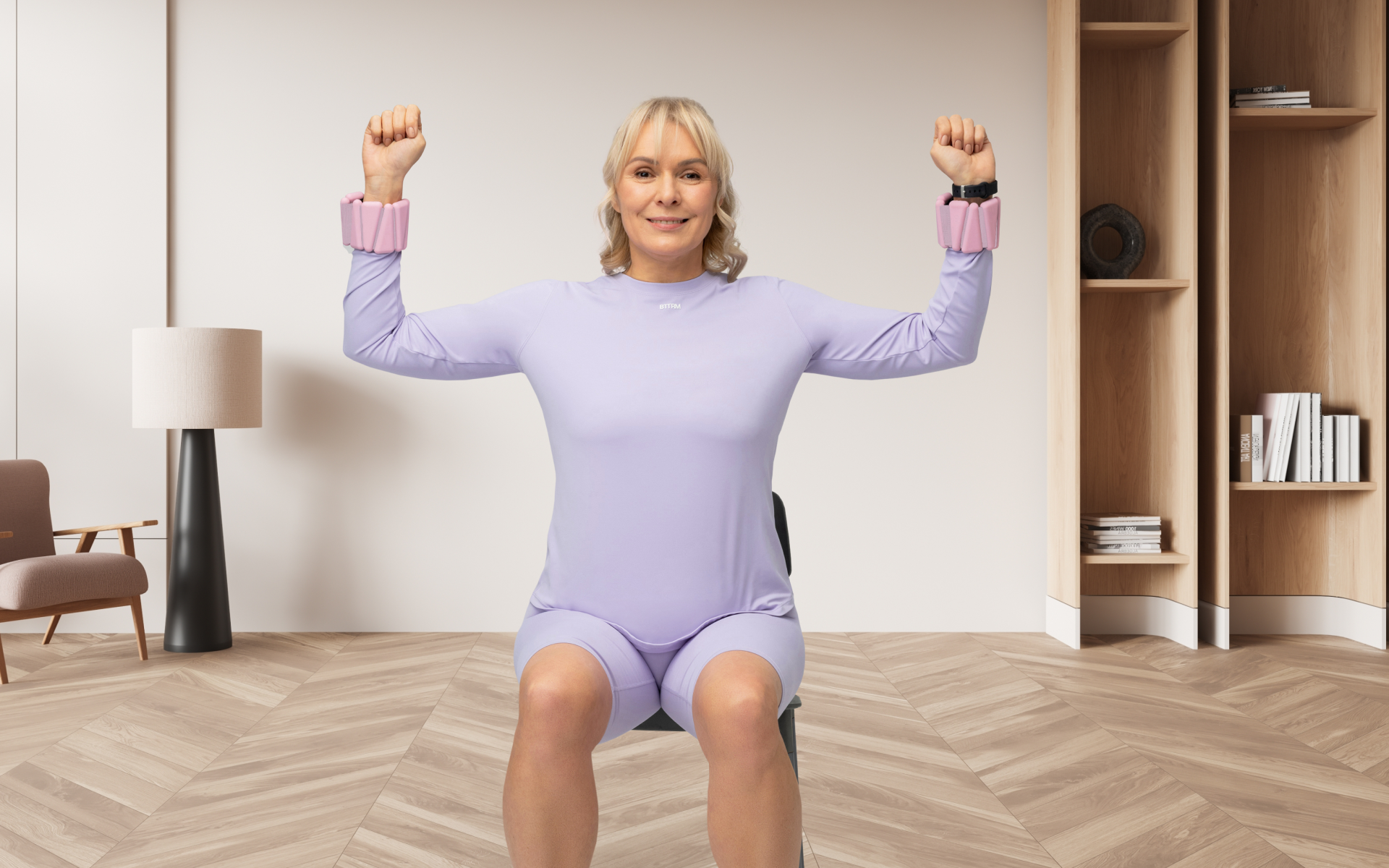
There are so many articles about the importance of consistency with exercise for health and performance. It follows that finding ways to integrate movement into your routine, regardless of your circumstances, is one of the most important things you can do for your well-being. While many programs focus on standing exercises, seated workouts offer a powerful and accessible alternative.
People may overlook seated exercises, assuming they are less effective. But what if that assumption is wrong? This guide will explore the logic and practical application of seated upper body training, showing you how to build strength and improve function right from your chair.
What Are Seated Upper Body Exercises?
Seated upper-body exercises are resistance-based movements performed while seated in a chair, on a bench, or on the floor. These exercises target the muscles of the chest, back, shoulders, arms, and core.
The primary benefit is the stability the seated position provides (1), which isolates the upper body muscles and allows for focused work without requiring support from the lower body.
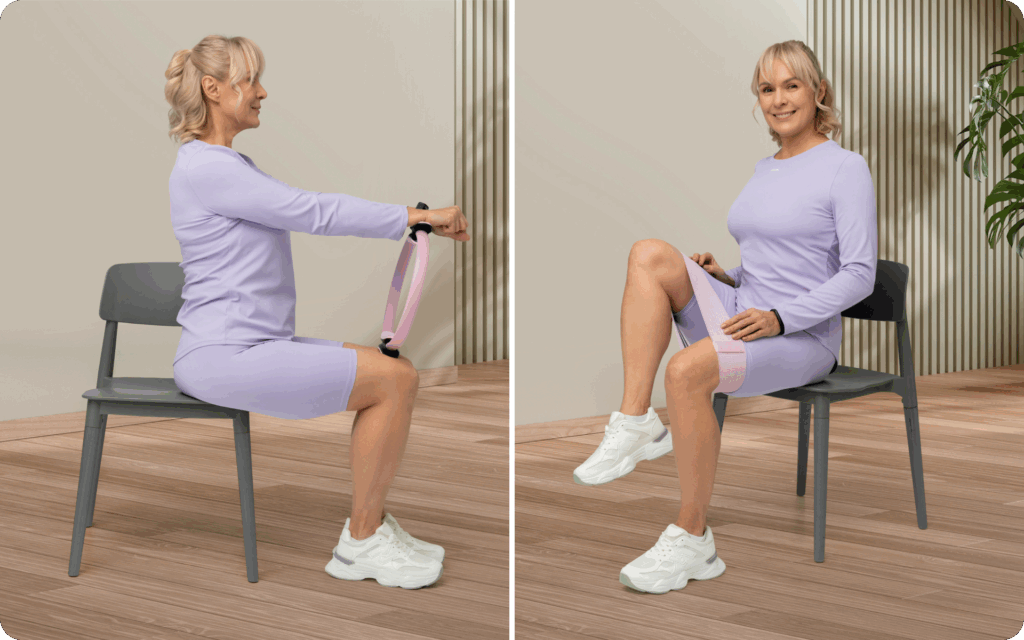
The accessibility factor makes seated upper body exercises an excellent option for a wide range of individuals, including:
- People with lower-body injuries or mobility limitations.
- Office workers who want to incorporate movement into their day.
- Individuals seeking to add variety to their training programs.
- Beginners who want to build foundational upper body strength with a controlled, beginner-friendly approach.
- Seated upper body exercises for seniors
- Seniors aiming to maintain muscle mass and functional independence.
By removing the need to stabilize with your legs, you can concentrate force production entirely on the targeted muscles. This can lead to significant gains in both strength and muscle size, also known as hypertrophy (2).
BetterMe: Health Coaching app helps you achieve your body goals with ease and efficiency by helping to choose proper meal plans and effective workouts. Start using our app and you will see good results in a short time.
Do Seated Exercises Really Work?
Yes, seated exercises are highly effective. The effectiveness of any exercise hinges on its ability to apply sufficient mechanical tension to the target muscles.
Mechanical tension, the force generated within a muscle when it’s stretched and contracted under load, is the primary driver of muscle growth (3). Seated exercises allow you to achieve this tension effectively.
When you sit, you create a stable base. This stability minimizes momentum and forces the upper body muscles to do all the work.
For example, performing a dumbbell shoulder press while seated prevents you from using your legs to “push” the weight up. This isolation can provide a stronger stimulus to the shoulder muscles than a standing version, where other body parts might assist.
Research consistently shows that we can drive muscular adaptations by bringing sets close to muscular failure (4), and seated exercises provide a controlled, stable setup to do just that.
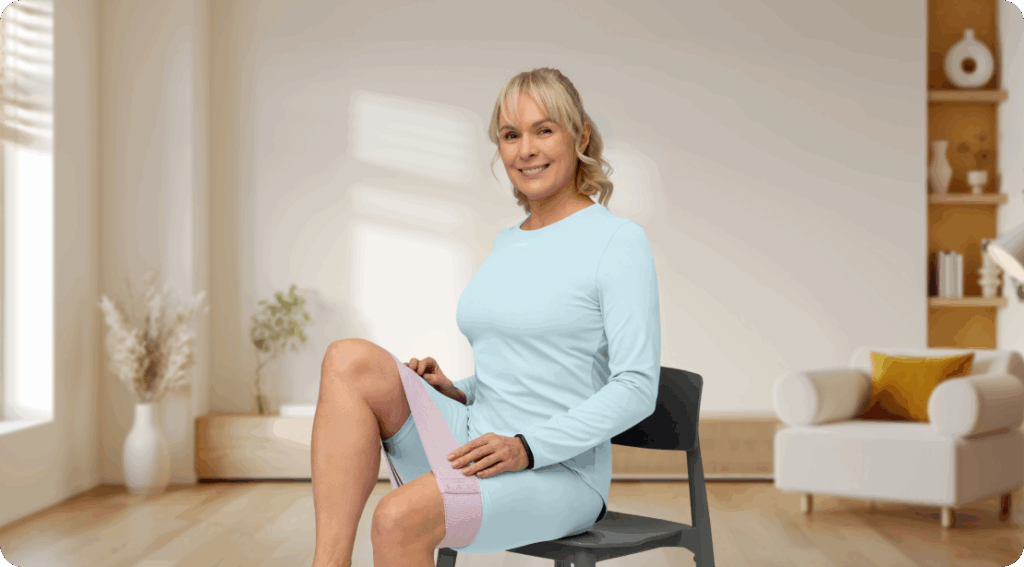
Can I Do Upper Body Sitting Down?
Absolutely. You can perform a comprehensive, effective upper-body workout while sitting.
A well-designed seated routine can target all major muscle groups of the upper body:
- Chest: Dumbbell presses, flyes.
- Back: Seated rows, bent-over rows (leaning forward from a chair).
- Shoulders: Overhead presses, lateral raises, front raises.
- Biceps: Bicep curls.
- Triceps: Overhead extensions, kickbacks.
With a pair of dumbbells and a sturdy chair, you can create a full seated upper-body workout that promotes both strength and muscle development.
These workouts are not only for beginners; advanced lifters can use seated exercises to isolate specific muscles and work around injuries.
The key is applying the principle of progressive overload–gradually increasing the weight, reps, or sets over time to continually challenge your muscles (5).
Read more: Chair Yoga Poses for Mental Health You Can Do Anywhere, Anytime
What Are The Best Seated Upper Body Exercises?
The “best” exercises are those that you can perform gently with correct form while effectively targeting your desired muscles. The following program offers a balanced selection of movements for complete seated upper-body exercises for beginners and intermediate lifters alike.
Program Notes
Glossary:
- 1RM: 1 Repetition Maximum, the maximum weight you can lift for a single repetition.
- RIR: “Reps in Reserve” means how many more reps you could have done at the end of a set. Aiming for 1-2 RIR means stopping just shy of failure.
- Equipment: A sturdy chair without armrests and a pair of dumbbells.
- Split Structure: This is a full upper-body workout. Perform it 2-3 times per week on non-consecutive days.
- Reps and Sets: The 8-15 rep range is effective for hypertrophy. Choose a weight that challenges you to complete the set with 1-2 RIR.
- Rest: Rest 60-90 seconds between sets to allow for adequate recovery.
Seated Upper Body Workout Program
| Exercise | Sets | Reps | Rest |
|---|---|---|---|
| Seated Dumbbell Shoulder Press | 3 | 8-12 | 90s |
| Seated Dumbbell Row | 3 | 10-15 | 90s |
| Seated Dumbbell Chest Press | 3 | 10-15 | 90s |
| Seated Lateral Raise | 3 | 12-15 | 60s |
| Seated Bicep Curl | 3 | 10-15 | 60s |
| Seated Overhead Triceps Extension | 3 | 10-15 | 60s |
| Seated Russian Twist | 3 | 15-20 (per side) | 60s |
| Seated Reverse Fly | 3 | 12-15 | 60s |
Exercise Instructions:
Seated Dumbbell Shoulder Press
- Sit upright on a chair or bench with your back firmly supported. Plant your feet flat on the floor.
- Hold a dumbbell in each hand at shoulder height, with your palms facing forward and elbows bent at a 90-degree angle.
- Press the dumbbells directly overhead until your arms are fully extended but not locked. Keep your core engaged to prevent your back from arching.
- Slowly lower the dumbbells back to the starting position at your shoulders.
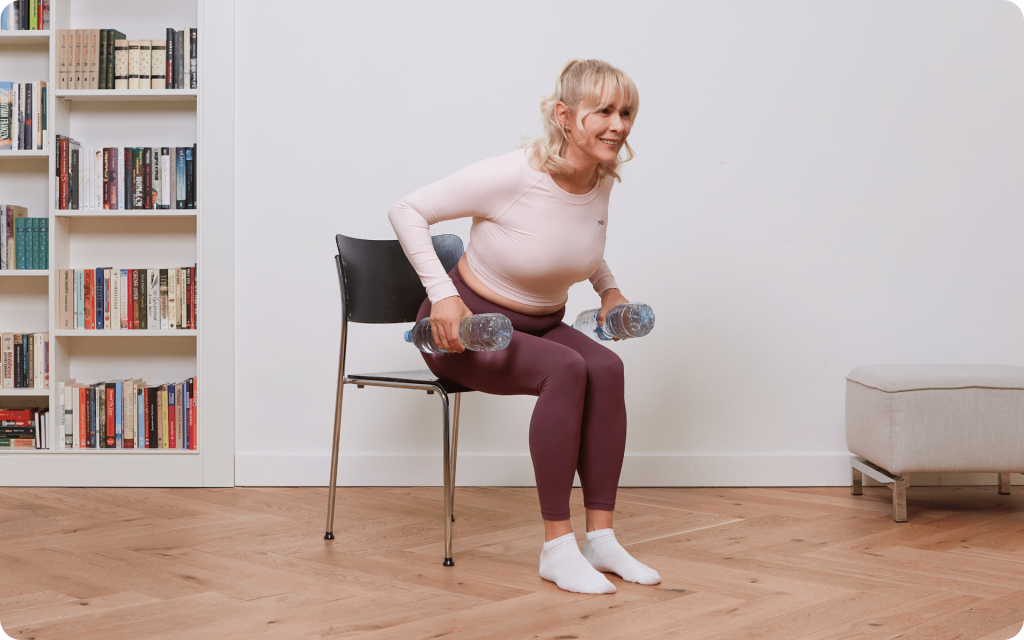
Seated Dumbbell Row
- Sit on the edge of a chair, with your feet flat on the floor, slightly wider than your hips.
- Hinge at your hips, keeping your back straight, until your torso is at about a 45-degree angle to the floor.
- Hold a dumbbell in each hand with your arms extended towards the floor, palms facing each other.
- Pull the dumbbells up towards your lower chest, squeezing your shoulder blades together. Keep your elbows close to your body.
- Lower the weights back to the starting position with control.
Reasons why BetterMe is a safe bet: a wide range of calorie-blasting workouts, finger-licking recipes, 24/7 support, challenges that’ll keep you on your best game, and that just scratches the surface! Start using our app and watch the magic happen.
Seated Dumbbell Chest Press
- Sit on a chair with your back supported. Hold a dumbbell in each hand, resting the dumbbells on your thighs.
- Carefully bring the dumbbells up to your chest, with your palms facing forward or neutral (facing each other).
- Press the dumbbells forward and slightly upward until your arms are extended.
- Slowly return the dumbbells to the starting position at your chest.
Seated Lateral Raise
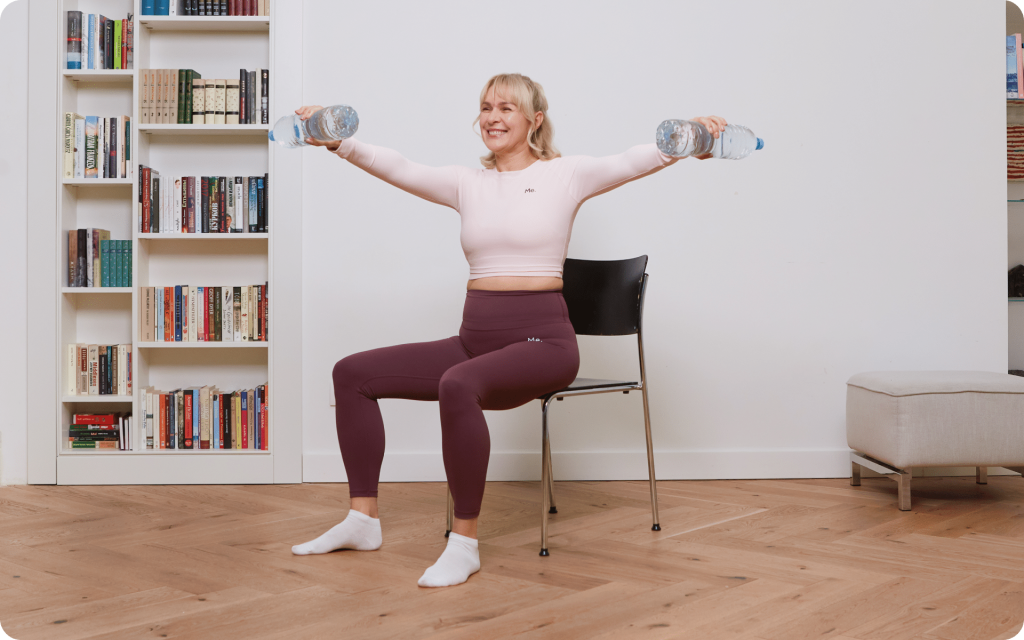
- Sit upright with your back straight and core engaged. Hold a dumbbell in each hand at your sides, palms facing your body.
- Keeping a slight bend in your elbows, raise your arms out to the sides until they are parallel to the floor.
- Pause briefly at the top, then slowly lower the dumbbells back to the starting position. Avoid using momentum.
Seated Bicep Curl
- Sit on the edge of a chair with your back straight. Hold a dumbbell in each hand with an underhand grip (palms facing forward).
- Let your arms hang down at your sides.
- Keeping your upper arms stationary, curl the dumbbells up towards your shoulders. Squeeze your biceps at the top of the movement.
- Lower the dumbbells back down with control until your arms are fully extended.
If you are looking for more upper-body exercises like this, check out our guide on the chair arm workout.
Seated Overhead Triceps Extension
- Sit upright with your back supported. Hold one dumbbell with both hands, cupping the top end of the weight.
- Raise the dumbbell directly overhead until your arms are fully extended.
- Keeping your elbows pointing forward, slowly lower the dumbbell behind your head until your elbows are at a 90-degree angle.
- Extend your arms to press the dumbbell back to the starting position.
Seated Russian Twist
- Sit on the edge of a chair and lean back slightly, engaging your core to keep your back straight. You can hold a light dumbbell or use just your bodyweight.
- Clasp your hands together or hold the weight in front of your chest.
- Twist your torso from side to side, moving your hands towards your hip on each side. Keep your lower body still.
- Move slowly and in a controlled manner to maximize core engagement.
To learn more about targeting your core from a seated position, you can review our chair ab workout.
Seated Reverse Fly
- Sit on the edge of a chair with your feet flat. Hinge forward at the hips with a flat back, similar to the seated row position.
- Hold light dumbbells with your arms extended towards the floor, palms facing each other.
- With a slight bend in your elbows, raise your arms out to the sides, squeezing your rear deltoids and upper back muscles.
- Lower the weights back down with control.
Do Quick Chair Workouts Really Work?
Yes, quick chair workouts can be surprisingly effective, especially when you prioritize consistency.
Even a 10-15-minute session of seated upper-body exercises at home can stimulate muscle protein synthesis, the process that leads to muscle growth (6). The key is intensity (7).
A short workout can be effective if you work with sufficient effort, meaning you take your sets close to failure (1-3 RIR) (8). You could perform 2–3 of the exercises listed above for a couple of sets each. This approach is far better than doing nothing. These micro-workouts accumulate over time, contributing to improved strength, muscle mass, and metabolic wellness (9).
For office workers, a quick chair workout can also help break up long periods of sitting (10).
You can learn more about structuring these quick sessions in our guide to chair workout exercises.
Read more: Chair Yoga to Lose Weight: Build a Gentle Yet Effective Routine
Is It Okay To Lift Weights Sitting Down?
It is perfectly okay, and often beneficial, to lift weights while sitting down. For many exercises, sitting provides a level of safety and stability that is ideal for beginners or those with balance issues.
It helps enforce proper form by preventing the use of momentum or lower-body assistance (11).
However, it is crucial to maintain a proper posture:
- Sit upright, with your neck between your shoulders.
- Keep your core engaged.
- Ensure your back is in a neutral position.
Slouching or rounding your back can place undue stress on your back (12). Always use a sturdy, stable chair, preferably one without wheels or armrests that could interfere with your movement.
Is It Better To Do Upper Body Sitting Or Standing?
Neither sitting nor standing is universally “better”; they simply offer different benefits and can suit different goals.
Sitting:
- Pros: Better isolation of upper-body muscles, increased stability, gentler for those with balance or lower-body issues, and great for focusing on strict form.
- Cons: Less engagement of core and stabilizer muscles; lower overall calorie burn than standing equivalents.
Standing:
- Pros: Engages the core and lower body for stabilization, improves intermuscular coordination, and generally burns more calories.
- Cons: Allows for more “cheating” with momentum, can be less stable, and may not be suitable for everyone.
The best approach is to incorporate both. Use seated exercises to isolate specific muscles and build foundational strength with strict form. Use standing exercises to improve full-body coordination and functional strength.
The choice depends on your goals, experience level, and physical condition.
A program that includes both seated upper body exercises with weights and standing movements will provide a well-rounded stimulus for optimal development.
Yes, seated exercises work very well for building muscle and strength and are great for older adults (13). They provide stability that helps isolate the target muscles, allowing you to apply focused tension, which is the key driver of muscle growth (3). When performing seated upper-body exercises, you primarily work the muscles of your chest (pectoralis), back (latissimus dorsi, rhomboids), shoulders (deltoid), and arms (biceps, triceps). Your core muscles also work to stabilize your torso. Yes, you can get a great arm workout while sitting. Exercises like seated bicep curls, overhead triceps extensions, and concentration curls are highly effective for targeting the biceps and triceps. Absolutely. Seated bicep curls are a classic exercise for isolating the biceps. Sitting prevents you from using your back or hips to swing the weight up, forcing the biceps to perform all the work. Yes, you can build muscle while sitting, provided you apply the principles of progressive overload. This means consistently challenging your muscles by increasing the weight, repetitions, or sets over time and working with high effort and proper form (5).Frequently Asked Questions
Do seated exercises really work?
Which muscles work when sitting?
Can I workout my arms while sitting?
Can I do bicep curls sitting down?
Can you build muscle while sitting?
The Bottom Line
Training doesn’t have to be an all-or-nothing endeavor confined to a traditional gym setting. Seated upper body exercises offer a versatile, effective, and accessible path to building a stronger, more resilient upper body. Whether you’re working, seeking to add variety to your routine, or just starting your fitness journey, these movements provide a solid foundation for progress.
By focusing on proper form, consistent effort, and gradual progression, you can achieve significant results right from your chair.
DISCLAIMER:
This article is intended for general informational purposes only and does not serve to address individual circumstances. It is not a substitute for professional advice or help and should not be relied on for making any kind of decision-making. Any action taken as a direct or indirect result of the information in this article is entirely at your own risk and is your sole responsibility.
BetterMe, its content staff, and its medical advisors accept no responsibility for inaccuracies, errors, misstatements, inconsistencies, or omissions and specifically disclaim any liability, loss or risk, personal, professional or otherwise, which may be incurred as a consequence, directly or indirectly, of the use and/or application of any content.
You should always seek the advice of your physician or other qualified health provider with any questions you may have regarding a medical condition or your specific situation. Never disregard professional medical advice or delay seeking it because of BetterMe content. If you suspect or think you may have a medical emergency, call your doctor.
SOURCES:
- The Effect of Chair-Based Exercise on Physical Function in Older Adults: A Systematic Review and Meta-Analysis (2025, mdpi.com)
- The Mechanisms of Muscle Hypertrophy and Their Application to Resistance Training (2010, journals.lww.com)
- Anabolic signals and muscle hypertrophy – Significance for strength training in sports medicine (2025, sciencedirect.com)
- Intensity of effort and momentary failure in resistance training: Are we asking a binary question for a continuous variable? (2022, sciencedirect.com)
- Intensification Methods for Progressive Overload (n.d., us.humankinetics.com)
- Making Sense of Muscle Protein Synthesis: A Focus on Muscle Growth During Resistance Training in (2021, journals.humankinetics.com)
- Muscle protein synthesis in response to nutrition and exercise (2012, pmc.ncbi.nlm.nih.gov)
- The effects of resistance training to near failure on strength, hypertrophy, and motor unit adaptations in previously trained adults (2023, physoc.onlinelibrary.wiley.com)
- The influence of resistance exercise training prescription variables on skeletal muscle mass, strength, and physical function in healthy adults: An umbrella review (2024, sciencedirect.com)
- Effectiveness of Chair Yoga on Improving Quality of Life Among the Office Workers with Back Pain – An Experimental Study (2025, researchgate.net)
- Do Chair-Based Exercises Help in Improving Balance, Physical Fitness, and Quality of Life in Various Populations? A Systematic Review (2024, researchgate.net)
- Good posture and how it can be achieved (n.d., musculoskeletalkey.com)
- The Effect of Chair-Based Exercise on Physical Function in Older Adults: A Systematic Review and Meta-Analysis (2021, mdpi.com)
 Reviewed by
 Reviewed by
 Reviewed by