
The concepts of “pear” and “hourglass” body shapes are everywhere in fitness media, often paired with promises of transforming one into the other. But how much of this is based on physiological reality, and what is simply marketing?
The truth is, your body shape is influenced by a complex interaction of skeletal structure, genetics, and where your body preferentially stores fat. While you can’t fundamentally change your bone structure, you can strategically build muscle and manage body composition to enhance your natural physique.
This guide will move past the oversimplified advice and provide a nuanced, evidence-based approach to training. We’ll explore how to work with your body, not against it, to build strength, improve health, and achieve results that are both sustainable and realistic. Let’s break down the science behind body shapes and how you can apply it to your fitness journey.
What Is the Difference Between Pear vs Hourglass Body Shapes?
Understanding the distinction between these common classifications is the first step. It’s less about simple measurements and more about the underlying factors that create your unique silhouette.
- Skeletal Structure: This is your body’s non-negotiable framework. It includes the width of your shoulders (biacromial width), the width of your pelvis, and the length of your limbs. A wider pelvic structure is a key determinant of both pear and hourglass shapes. The primary skeletal difference often lies in the ratio between the pelvis and the shoulders.
- Fat Distribution: This is largely directed by your genetics and hormones, particularly estrogen (1). Gynoid fat distribution, which is common in pre-menopausal women, refers to the tendency to store fat in the hips, thighs, and buttocks (2). This pattern is characteristic of both pear and hourglass shapes. The pear vs hourglass female distinction often comes down to where fat is stored on the upper body. Hourglass figures tend to have more balanced fat distribution across the bust and hips, while pear shapes carry less fat on the upper body.
- Muscle Mass: Your baseline muscle mass and your potential for muscle growth (hypertrophy) are also genetically influenced (3). However, this is the most modifiable component of your body composition. How you train can significantly alter the size and definition of your muscles (4), thereby influencing your overall shape.
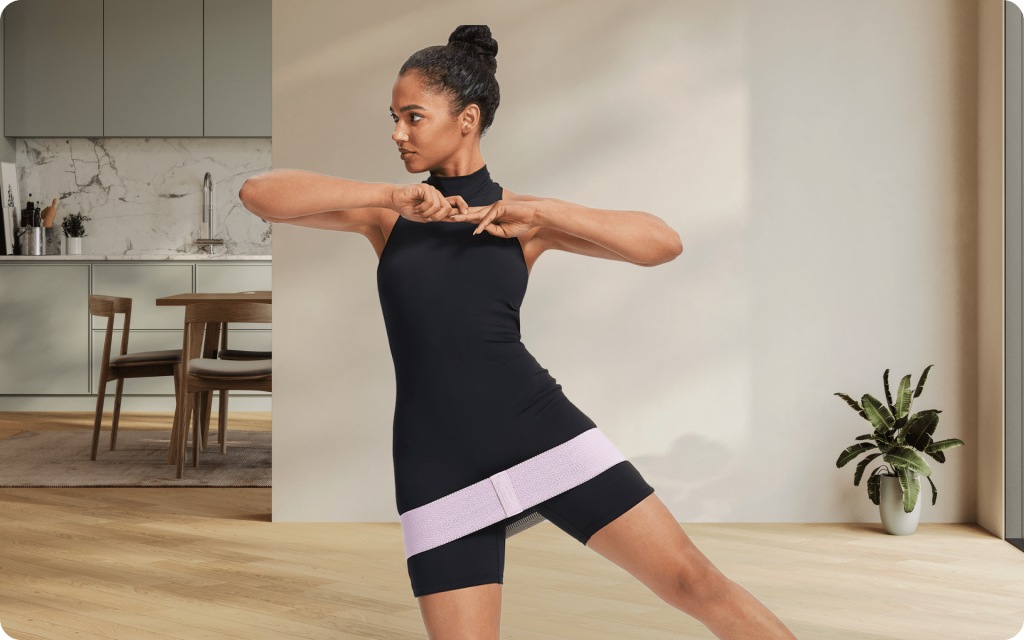
Here’s a simple breakdown (5):
| Feature | Pear Shape | Hourglass Shape |
|---|---|---|
| Shoulders | Narrower than the hips | Roughly the same width as the hips |
| Waist | Typically well-defined | Typically well-defined and narrower than bust/hips |
| Hips & Thighs | Wider than the upper body; where fat is primarily stored | Wide and proportional to the bust |
| Fat Storage | Concentrated on the lower body (hips, thighs, buttocks) | More evenly distributed between the upper and lower body |
Ultimately, the pear shape vs hourglass discussion highlights differences in proportion. Neither shape is inherently superior, and both are products of your unique genetic makeup.
Read more: Does Pilates Help Lose Belly Fat? The Truth About This Viral Exercise Routine
What Muscles Should Pear vs Hourglass Bodies Focus On?
The idea that you “should” focus on specific muscles implies there is a correct or incorrect way to train based on your shape. This isn’t accurate.
According to the Centers for Disease Control and Prevention (CDC), adults should aim to perform muscle-strengthening activities that involve all major muscle groups on 2 or more days a week (6). This ensures balanced development, functional strength, and overall health.
However, you can tailor your routine to emphasize certain areas if your goal is to create a more balanced aesthetic. This is a matter of personal preference, not a physiological requirement. A well-structured program hits every muscle group while allowing for extra attention where you want it.
Here’s an example of a weekly split that targets all major muscles but leaves room for specialization:
- Day 1: Full Body Strength A (Focus on compound movements)
- Day 2: Active Recovery or Cardio (e.g., brisk walking, light cycling)
- Day 3: Full Body Strength B (Focus on different compound movements)
- Day 4: Active Recovery or Cardio
- Day 5: Specialization Day (Optional: Focus on a muscle group you wish to enhance, like glutes or shoulders)
- Day 6 & 7: Rest
Example Specialization Focus
- For a Pear Shape: You might use your specialization day to focus on building your upper back and shoulders. This can create the illusion of a more balanced hourglass vs pear body shape by widening your upper frame. Exercises could include overhead presses, lateral raises, and various rows.
- For an Hourglass Shape: You might use this day for core-focused work or full-body metabolic conditioning to maintain your proportions while enhancing overall tone.
This approach ensures you meet health guidelines while still personalizing your training to your aesthetic goals.
If your primary goal is building a stronger, healthier physique, you may be interested in exploring options for toned body goals female.
BetterMe: Health Coaching app helps you achieve your body goals with ease and efficiency by helping to choose proper meal plans and effective workouts. Start using our app and you will see good results in a short time.
What Workouts Work Best for Pear vs Hourglass Bodies?
There is no single “best” workout. The optimal routine depends on your goals, fitness level, available equipment, and personal enjoyment.
The Centers for Disease Control (CDC) recommends that adults get at least 150 minutes of moderate-intensity aerobic activity or 75 minutes of vigorous-intensity activity per week, along with the two days of strength training (6). How you meet these guidelines is flexible.
The most effective strategy is to build a program around the core principles of exercise science (7), not around a specific body shape.
Here is a foundational, non-prescriptive full-body strength program that can be adapted for anyone. The key to making it “work” for your body is adjusting volume and intensity based on your personal goals.

Full-Body Strength Program
Program Notes:
- Glossary: RIR stands for Reps in Reserve, which is how many more reps you could have done before reaching muscular failure. 1RM means One-Rep Max, the maximum weight you can lift for a single repetition.
- Equipment: Barbell, dumbbells, pull-up bar (or lat pulldown machine), bench.
- Split: Perform Workout A and Workout B on non-consecutive days (e.g., Monday and Thursday).
- Sets & Reps: The goal is to train with high effort. Whether you use a lighter load for 15-20 reps or a heavier load for 6-8 reps, you should aim to finish each set with about 2 RIR. This ensures you are creating enough mechanical tension to stimulate muscle growth.
- Rest: Rest 60-90 seconds between sets.
Workout A
| Exercise | Sets | Reps | RIR |
|---|---|---|---|
| Barbell Back Squats | 3 | 8-12 | 2 |
| Dumbbell Bench Press | 3 | 8-12 | 2 |
| Bent-Over Rows | 3 | 10-15 | 2 |
| Dumbbell Lateral Raises | 3 | 10-15 | 2 |
| Plank | 3 | 30-60 sec hold | 2 |
| Exercise | Sets | Reps | RIR |
|---|---|---|---|
| Barbell Romanian Deadlifts | 3 | 8-12 | 2 |
| Overhead Press | 3 | 8-12 | 2 |
| Lat Pulldowns or Pull-Ups | 3 | 10-15 | 2 |
| Bulgarian Split Squats | 3 | 10-15 per leg | 2 |
| Russian Twists | 3 | 15-20 per side | 2 |
Exercise Instructions
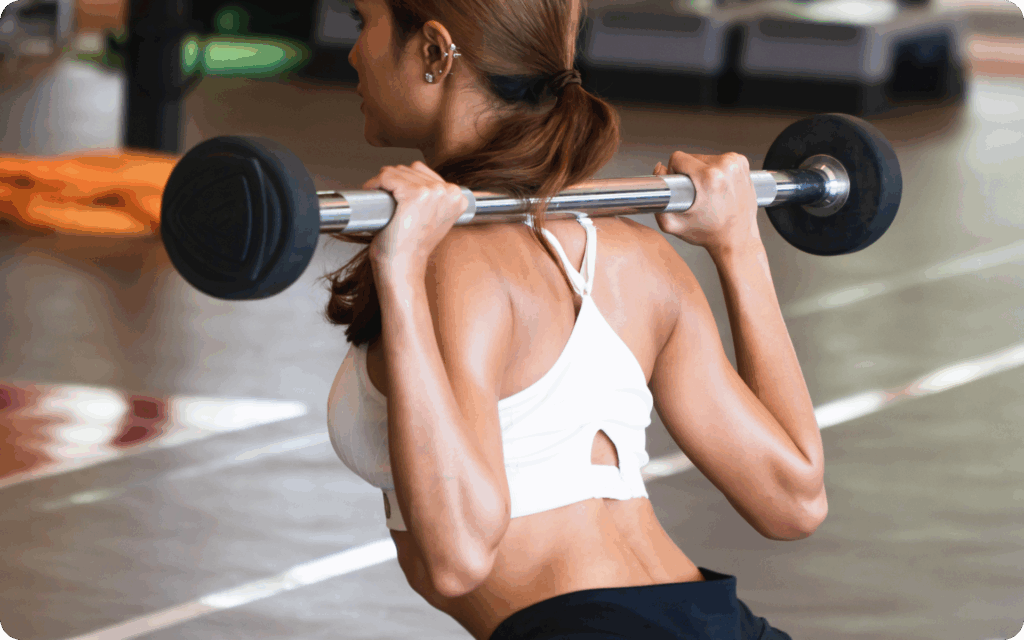
Barbell Back Squats
- Position a barbell on a squat rack at shoulder height.
- Step under the bar and rest it across your upper back (trapezius muscles), not on your neck.
- Grip the bar with hands slightly wider than your shoulders and lift it off the rack. Take two steps back.
- Stand with your feet shoulder-width apart, toes pointing slightly outward.
- Keeping your chest up and core braced, initiate the movement by pushing your hips back and then bending your knees.
- Lower yourself until your thighs are at least parallel to the floor.
- Drive through your heels to return to the starting position, squeezing your glutes at the top.
Dumbbell Bench Press
- Lie on a flat bench with a dumbbell in each hand, resting on your thighs.
- Kick the dumbbells up to your chest one at a time, positioning them at the sides of your chest with palms facing forward.
- Brace your core and press your feet firmly into the floor.
- Push the dumbbells upward until your arms are fully extended but not locked.
- Slowly lower the dumbbells back to the starting position.
Bent-Over Rows
- Stand with your feet shoulder-width apart, holding a barbell with an overhand grip.
- Hinge at your hips, keeping your back straight, until your torso is nearly parallel to the floor. Allow the barbell to hang in front of you.
- Squeeze your shoulder blades together and pull the barbell up towards your lower chest.
- Pause briefly at the top, then slowly lower the weight back down.
Dumbbell Lateral Raises
- Stand with your feet shoulder-width apart, holding a dumbbell in each hand at your sides with palms facing in.
- Keeping a slight bend in your elbows, raise the dumbbells out to your sides until they are at shoulder level.
- Your body should form a “T” shape. Avoid shrugging your shoulders.
- Slowly lower the dumbbells back to the starting position.
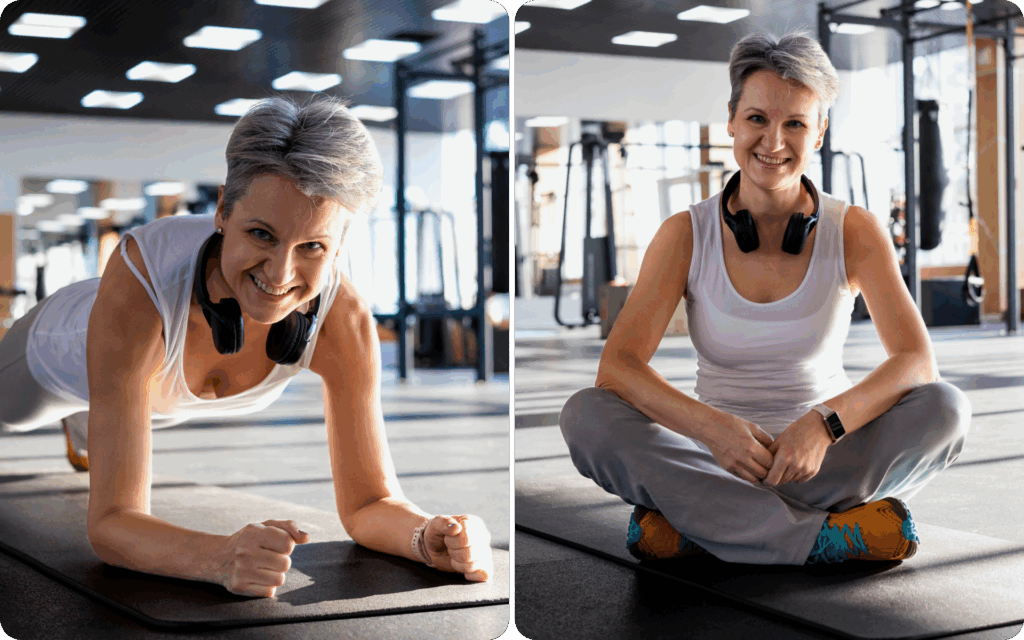
Plank
- Start in a push-up position, then lower yourself onto your forearms.
- Your body should form a straight line from your head to your heels.
- Engage your core and glutes to prevent your hips from sagging.
- Hold this position for the designated time.
Barbell Romanian Deadlifts (RDLs)
- Stand with your feet hip-width apart, holding a barbell with an overhand grip in front of your thighs.
- Keeping your back straight and a slight bend in your knees, hinge at your hips, pushing them backward.
- Lower the barbell down the front of your legs until you feel a deep stretch in your hamstrings.
- Drive your hips forward to return to the starting position, squeezing your glutes at the top.
Overhead Press
- Sit or stand with a dumbbell in each hand at shoulder height, palms facing forward.
- Brace your core and press the dumbbells directly overhead until your arms are fully extended.
- Slowly lower the dumbbells back to the starting position.
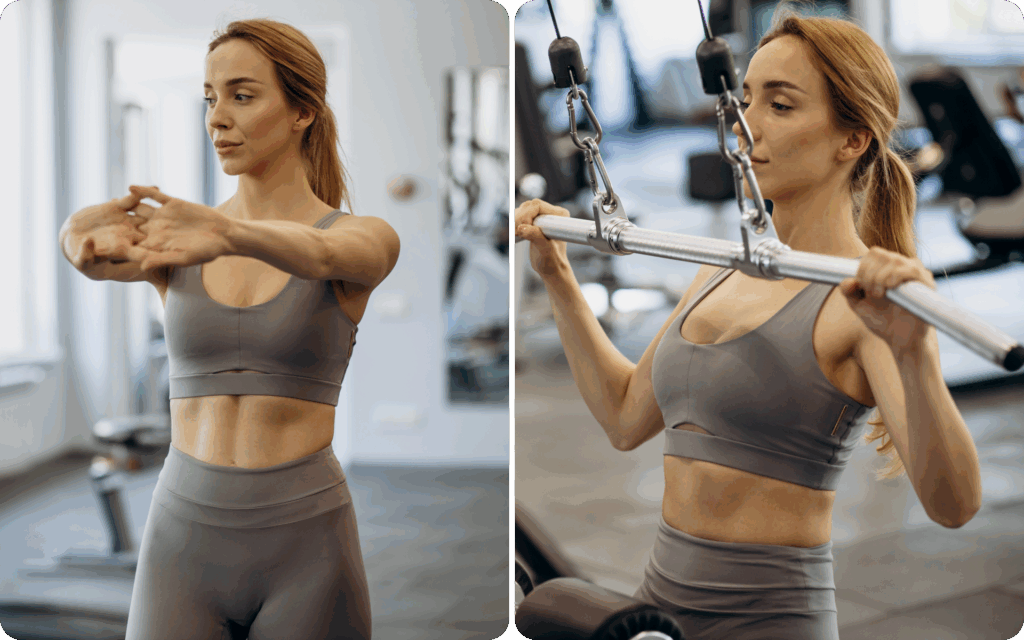
Lat Pulldowns
- Sit at a lat pulldown machine and adjust the knee pad to secure your legs.
- Grab the bar with a wide, overhand grip.
- Keeping your chest up, pull the bar down to your upper chest.
- Squeeze your lats at the bottom of the movement.
- Slowly return the bar to the starting position.
Bulgarian Split Squats
- Stand a few feet in front of a bench. Place the top of one foot on the bench behind you.
- Hold dumbbells in each hand at your sides.
- Lower your hips until your front thigh is parallel to the floor.
- Drive through your front heel to return to the start. Complete all reps on one side before switching.
Russian Twists
- Sit on the floor with your knees bent and feet slightly elevated.
- Lean back to a 45-degree angle, keeping your back straight.
- Clasp your hands or hold a weight in front of your chest.
- Twist your torso from side to side, touching the weight to the floor beside you on each rep.
For those whose main goal involves managing weight, understanding the principles of pear shaped body weight loss can provide additional context.
BetterMe will shake off your mental funk, rid you of your energy-zapping habits, and help you sculpt the body of your dreams. Intrigued? Hurry up and change your life for the better!
What Strength Training Differences Matter for Each Body Type?
From a physiological standpoint, there are no inherent differences in how muscle tissue responds to training based on your body shape.
The mechanisms of muscle hypertrophy—specifically mechanical tension, muscle damage, and metabolic stress—are universal. Progressive overload is the key variable that drives muscle growth for everyone (8).
Where the “differences” emerge is in the application of training to achieve a specific aesthetic goal. This is about perception and proportion.
- Training for a Pear Shape: If the goal is to create a more balanced silhouette, the focus might be on adding more training volume (sets x reps) to the upper body, particularly the deltoids (shoulders) and latissimus dorsi (back). This can create a wider upper frame, if that’s your goal. This doesn’t change your bone structure but alters the muscular envelope around it.
- Training for an Hourglass Shape: If the goal is to maintain proportions while enhancing curves, the focus would be on a balanced program that applies equal volume to both the upper and lower body. Emphasis might be placed on compound movements like squats and deadlifts for the lower body and presses and rows for the upper body.
It’s crucial to understand that these are choices, not rules. Your muscles will grow in response to sufficient stimulus, regardless of your body shape.
Read more: Beginner Calisthenics Workout at Home: Your Ultimate Guide
What Cardio Approaches Suit Pear vs Hourglass Shapes?
Cardiovascular exercise is essential for heart health and energy expenditure (calorie burning) (9, 10), but no specific type of cardio can target fat loss from a particular area. Your body loses fat systemically based on its genetic blueprint.
The “best” cardio is the one you enjoy and can perform consistently.
Here are a few approaches for different goals:
High-Intensity Interval Training (HIIT)
HIIT involves short bursts of all-out effort (e.g., 30 seconds) followed by brief recovery periods (e.g., 60 seconds). It is highly efficient for burning calories in a short amount of time and can boost your metabolic rate for hours post-exercise (11).
- Best For: Individuals short on time who want to maximize calorie burn. It’s an excellent tool for anyone aiming to reduce overall body fat.
- Example: Sprinting, cycling intervals, or burpees.
Low-Intensity Steady-State (LISS)
LISS involves performing cardio at a low-to-moderate intensity for a sustained period (e.g., 30-60 minutes) (12). This could be a brisk walk at 3-4 mph or a steady session on the elliptical.
- Best For: Active recovery, stress reduction, and building an aerobic base. It is less taxing on the body than HIIT and can be performed more frequently.
Your diet plays a significant role alongside cardio and strength training. For those looking to refine their shape, learning about an hourglass figure diet may be a helpful next step.
What Results Can You Expect from Body-Type-Focused Workouts?
It’s time for a reality check. Workouts designed for a specific body type cannot change your fundamental skeletal structure or your genetic pattern of fat storage. A pear glass body shape will not transform into an hourglass through exercise alone.
Here’s what you can realistically expect:
- Improved Body Composition: You can decrease your overall body fat percentage and increase your lean muscle mass (13). This will lead to a more toned and defined physique, regardless of your starting shape.
- Enhanced Proportions: You can build muscle in specific areas to create the illusion of different proportions. For example, building your glutes can enhance curves, and building your shoulders can make your waist appear smaller.
- Increased Strength and Health: The most important result is a stronger, healthier, and more functional body. Consistent training improves cardiovascular health, bone density, and metabolic function (14).
- Improved Confidence: Learning to work with your body and celebrating its strength is far more empowering than chasing an unattainable ideal.
The goal should be to become the strongest, healthiest version of yourself, not to fit into a predefined category.

The hourglass figure, defined by a narrow waist with bust and hip measurements that are roughly equal, is often cited as one of the rarer body shapes. However, there’s no reliable data on how many females have a specific body type. Fundamentally, yes. Effective workouts are based on universal principles of exercise science, such as progressive overload (7), not body shapes. Both pear and hourglass figures benefit from a balanced routine of full-body strength training and cardiovascular exercise. The only difference would be in the optional “specialization” work an individual might choose to do based on their personal aesthetic goals. Absolutely. Exercises like squats, deadlifts, overhead presses, and rows are foundational movements that are beneficial for everyone. They target major muscle groups, build functional strength, and are essential components of any well-rounded fitness program (15), regardless of body shape. To an extent, yes. While you cannot change your bone structure, you can change your muscular proportions. For instance, a person with a pear shape can build their shoulder and back muscles to create a more balanced upper-to-lower-body ratio. This is a change in muscular size, not a change in the underlying skeletal frame.Frequently Asked Questions
What is the rarest female body shape?
Are pear vs hourglass workouts the same?
Can the same exercises work for both body shapes?
Can body-type workouts help change proportions?
The Bottom Line
Navigating the world of fitness can be confusing, especially with the amount of conflicting information about body types. A sustainable approach is to shift your focus from chasing an idealized shape to building a strong, functional, and healthy body.
Your unique physique is determined by factors largely outside of your control, but your strength, endurance, and well-being are not. Embrace an evidence-based training approach, celebrate what your body can do, and pursue goals that empower you.
DISCLAIMER:
This article is intended for general informational purposes only and does not serve to address individual circumstances. It is not a substitute for professional advice or help and should not be relied on for making any kind of decision-making. Any action taken as a direct or indirect result of the information in this article is entirely at your own risk and is your sole responsibility.
BetterMe, its content staff, and its medical advisors accept no responsibility for inaccuracies, errors, misstatements, inconsistencies, or omissions and specifically disclaim any liability, loss or risk, personal, professional or otherwise, which may be incurred as a consequence, directly or indirectly, of the use and/or application of any content.
You should always seek the advice of your physician or other qualified health provider with any questions you may have regarding a medical condition or your specific situation. Never disregard professional medical advice or delay seeking it because of BetterMe content. If you suspect or think you may have a medical emergency, call your doctor.
SOURCES:
- Determinants of body fat distribution in humans may provide insight about obesity-related health risks (2019, jlr.org)
- Diagnostic and prognostic value of adipose tissue content and distribution indicators for normal weight obesity in young women (2025, nature.com)
- Load-induced human skeletal muscle hypertrophy: Mechanisms, myths, and misconceptions (2026, sciencedirect.com)
- Maximizing Muscle Hypertrophy: A Systematic Review of Advanced Resistance Training Techniques and Methods (2019, mdpi.com)
- A Study on Category of Female Body Shapes and their Clothing (2016, researchgate.net)
- What Counts as Physical Activity for Adults (2023, cdc.gov)
- Exercise progressions and regressions in sports training and rehabilitation (2024, sciencedirect.com)
- Improving muscle size with Weider’s principle of progressive overload in non-performance athletes (2021, researchgate.net)
- Effects of Exercise to Improve Cardiovascular Health (2019, frontiersin.org)
- Aerobic Exercise and Weight Loss in Adults: A Systematic Review and Dose-Response Meta-Analysis (2024, jamanetwork.com)
- Evidence-Based Effects of High-Intensity Interval Training on Exercise Capacity and Health: A Review with Historical Perspective (2021, mdpi.com)
- Comparative Effects of High-Intensity Interval Training and Low-Intensity Steady-State Exercise on Anthropometric Outcomes and Psychophysical Well-Being: A Pilot Study (2026, mdpi.com)
- Body Composition Changes in Weight Loss: Strategies and Supplementation for Maintaining Lean Body Mass, a Brief Review (2018, mdpi.com)
- Exercise sustains the hallmarks of health (2023, sciencedirect.com)
- Selecting Resistance Training Exercises for Novices: A Delphi Study with Expert Consensus (2022, pmc.ncbi.nlm.nih.gov)

 Reviewed by