
If you want to be good at your favorite exercise activities, there’s little room for improvisation. A structured approach rooted in science is far more effective than simply showing up and doing what feels right. This is particularly true when your goal is to build muscle and strength efficiently.
A well-designed workout plan acts as your roadmap, guiding you through the complexities of resistance training. It helps you manage variables like volume, intensity, and frequency to ensure you’re providing the right stimulus for growth without overtraining.
This guide will break down the science behind muscle group workouts, helping you build an effective plan tailored to your goals.
What Is a Muscle Group Workout Plan?
A muscle group workout plan, often called a “training split”, is a schedule that organizes your resistance training sessions by targeting specific muscles or muscle groups on different days. Instead of working out your entire body in every session, you divide your routine to allow for focused effort and adequate recovery for every part of your body.
The goal is to maximize the training stimulus for each muscle group while giving it enough time to repair and grow stronger before the next session.
This method is based on the principle of progressive overload, which involves gradually increasing the stress placed on your muscles over time (1). By dedicating specific days to certain muscle groups, you can increase the total training volume – the total amount of work performed, calculated as sets x reps x weight – for each muscle, which is a key driver of hypertrophy (muscle growth) (2).
Research supports this structured approach. For example, a review in Journal of Sport and Health Science highlighted that the effectiveness of a resistance training program depends on manipulating acute variables such as:
- Exercise selection
- Exercise order
- Training frequency (3).
A split routine is simply a practical way to manage these variables.
BetterMe: Health Coaching app helps you achieve your body goals with ease and efficiency by helping to choose proper meal plans and effective workouts. Start using our app and you will see good results in a short time.
Common types of splits include:
- Upper/Lower Split: Dividing workouts between the upper and lower body.
- Push/Pull/Legs: Grouping muscles based on their function – pushing movements (chest, shoulders, triceps), pulling movements (back, biceps), and leg exercises.
- Body Part Splits: Training one or two muscle groups per session, which is common among bodybuilders (e.g. chest day, back day).
The right split for you will depend on your training experience, goals, and how many days a week you can commit to training.
Read more: Best Gym Schedule: A Science-Backed Guide for Peak Results
How Do I Grow Muscles Fast?
Muscle growth, or hypertrophy, is a complex biological process, but the stimulus for it is surprisingly straightforward. It is driven by three primary mechanisms, as identified by Dr. Brad Schoenfeld (4), a leading researcher in the field.
- Mechanical Tension
This refers to the force that is generated within a muscle when it’s stretched and contracted under load. Lifting heavy weights creates high mechanical tension, which is considered the most important factor for stimulating muscle protein synthesis (MPS) – the process of building new muscle proteins (4, 5).
When you lift a weight that challenges you, you recruit a large number of motor units, including the high-threshold motor units linked to fast-twitch muscle fibers, which have the greatest potential for growth (4, 6). To maximize mechanical tension, you should focus on loads that are at least 65% of your one-repetition maximum (1RM), which typically corresponds to a rep range of 6-12 (7).

- Muscle Damage
This is the micro-trauma that occurs in muscle fibers during intense exercise, particularly from the eccentric (lowering) phase of a lift. This damage triggers an inflammatory response and releases growth factors that signal satellite cells to repair the injured tissue (5).
As the muscle fibers are repaired, they become larger and more resilient. You’ve likely felt this as delayed onset muscle soreness (DOMS) a day or two after a tough workout (5). While some damage will likely occur, excessive damage can hinder recovery and impede progress (8).
- Metabolic Stress
This is the buildup of metabolic byproducts of reactive oxygen species (ROS) and hydrogen ions within the muscle during exercise that relies on anaerobic glycolysis for energy. It’s the “burn” you feel during high-rep sets or when rest periods are short (5).
Metabolic stress can promote hypertrophy through cell swelling (the “pump”), which places pressure on the cell walls and may signal a growth response. To effectively induce metabolic stress, use:
- Moderate loads (60-75% 1RM)
- Higher repetitions (15-25)
- Shorter rest periods (30-60 seconds) (5)
To grow muscle “fast”, your program should effectively incorporate all three mechanisms. This doesn’t mean every workout has to target all three. Instead, you can structure your training over a week, month, or year to emphasize different mechanisms. This is called periodization (9).
For example, you might have a heavy day focused on mechanical tension and a lighter, higher-rep day focused on metabolic stress.

- Nutrition: Calories and Protein
To maximize muscle growth, your training stimulus must be matched by proper nutrition. First, you need to be in a slight caloric surplus – aim to consume about 5-15% more calories than you burn each day – to provide energy for recovery and muscle synthesis (10).
Equally important is protein intake – research has consistently shown that you should aim for 1.6-2.2 grams of protein per kilogram of body weight per day (11). This range ensures your body has enough building blocks to repair and grow muscle tissue after resistance training.
Without enough calories and protein, even the best training plan will fall short.
Which Muscles Are Best Trained Together?
The best muscle group combinations depend on your training frequency, recovery capacity, and specific goals. The idea is to pair muscles in a way that’s synergistic and allows for optimal performance and recovery.
Here are some of the best muscle group combinations to work out together:
Chest, Shoulders, and Triceps (Push Day)
These muscles all work together during pressing movements. For example, during a bench press, the chest is the primary mover, but the shoulders (anterior deltoids) and triceps are key synergists (12).
Grouping them allows you to train them all with compound movements such as the bench press and overhead press, followed by isolation exercises for each muscle.
Back and Biceps (Pull Day)
Similar to the push day logic, the back and biceps work together in pulling movements (13). When you perform rows or pull-ups, your back muscles (lats, rhomboids, traps) are the primary movers, while your biceps act as secondary movers. This combination allows for efficient training.
Legs and Core
This is a classic pairing. Leg days, featuring heavy compound lifts such as squats and deadlifts, are incredibly demanding. They also heavily engage the core for stabilization (14). Combining them ensures your core gets a significant workout while also allowing you to dedicate a full session to your lower body.
Upper Body and Lower Body (Upper/Lower Split)
This is a highly effective split for those training four days a week. It allows you to hit each muscle group twice per week, which research has suggested may be optimal for hypertrophy.
A 2016 meta-analysis published by the Journal of Sports Medicine found that training a muscle group twice a week produced superior hypertrophic outcomes compared to once a week (15).
How Should a Workout Be Structured?
When structuring your workouts, a common and effective strategy is to perform large, multi-joint compound exercises first, followed by smaller, single-joint isolation exercises.
This approach is supported by research, including a review in the Journal of Sports Science and Medicine, which suggested that exercising larger muscle groups first provides a greater overall training stimulus (16).
Would you like to learn more about the optimal volume for muscle growth? Read our guide to how many exercises per muscle group you should be doing.
Which Muscle Groups Shouldn’t Be Combined?
While there are no strict rules, some muscle group combinations can be less effective or even counterproductive. The main principle is to avoid pairing muscles in a way that causes one to fatigue and limit the performance of another in a subsequent exercise.
Here are some pairings you should be cautious about:
Large Muscle Groups on the Same Day
Training two major muscle groups like legs and back on the same day can be extremely fatiguing. Both require a significant amount of energy and neural drive. Doing this may mean you don’t have the capacity to train the second muscle group with sufficient intensity.
Shoulders Before Chest
Your shoulders, particularly the front deltoids, are heavily involved in most chest pressing exercises. If you fatigue them with a heavy overhead press before moving to the bench press, your bench press performance will likely suffer. Unless overhead pressing is the primary movement, it’s generally better to prioritize the larger muscle group (chest) first or train them on separate days.
Triceps Before Chest or Shoulders
Your triceps are the primary movers in elbow extension isolation exercises, but are essential synergists in all pressing movements. Fatiguing them with triceps extensions before you bench press or overhead press will create a weak link and limit the amount of weight you can lift, which reduces the stimulus for your chest and shoulders.
Forearms or Grip-Intensive Exercises Before Back Day
Many back exercises, such as deadlifts, rows, and pull-ups, are limited by grip strength. If you perform forearm-specific exercises before your back workout, your grip may fail before your back muscles are fully stimulated.
Ultimately, program design is about managing fatigue. If a certain combination of exercises leaves you feeling too tired to complete your workout with good form and high intensity, it’s not an optimal pairing for you.
What Is a Good Muscle Group Workout Plan?
A good workout plan is one you can stick to consistently and that is aligned with your schedule and goals. For intermediate lifters who are looking to build muscle and strength, a 4-day upper/lower split is an excellent choice. It allows you to train each muscle group twice a week with a good balance of volume and recovery.
Here’s an example of a 4-day upper/lower split program.
Program Notes
- Key Terms:
- 1RM: One-repetition maximum, the most weight you can lift for a single repetition.
- RIR: Reps in reserve. An RIR of 2 means you stop the set when you feel you could have completed two more reps with good form.
- Equipment Needed: Barbell, dumbbells, pull-up bar, cable machine, leg press machine, bench.
- Split Structure:
- Day 1: Upper body (strength focus)
- Day 2: Lower body (strength focus)
- Day 3: Rest
- Day 4: Upper body (hypertrophy focus)
- Day 5: Lower body (hypertrophy focus)
- Days 6 and 7: Rest or active recovery (e.g. light cardio, stretching).
- Reps and Sets: Strength days focus on lower reps with heavier weight (around 80-85% of 1RM). Hypertrophy days use higher reps with moderate weight (around 65-75% of 1RM). Aim for an RIR of 2-3 on strength days and 1-2 on hypertrophy days.
- Rest: Rest 2-3 minutes between sets on strength days and 60-90 seconds on hypertrophy days.
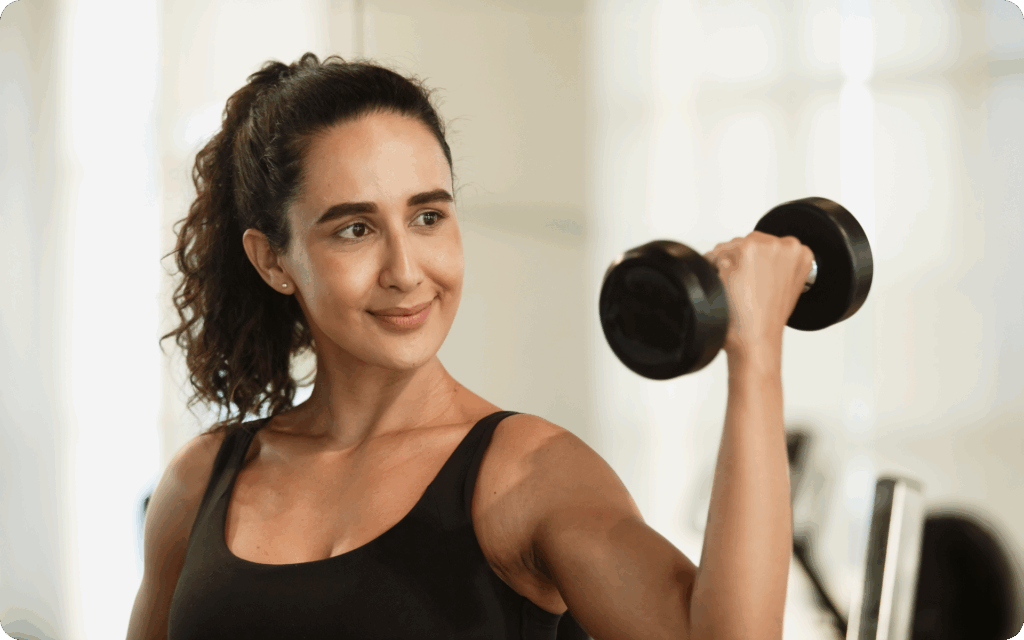
4-Day Upper/Lower Split Program
| Day 1: Upper body (strength) | Sets | Reps | Rest |
|---|---|---|---|
| Barbell bench press | 4 | 5-8 | 2-3 mins |
| Bent-over barbell row | 4 | 5-8 | 2-3 mins |
| Seated dumbbell shoulder press | 3 | 6-10 | 2 mins |
| Pull-ups (or lat pulldowns) | 3 | 6-10 | 2 mins |
| Dumbbell bicep curls | 3 | 8-12 | 90 secs |
| Triceps pushdowns | 3 | 8-12 | 90 secs |
| Day 1: Upper body (strength) | Sets | Reps | Rest |
|---|---|---|---|
| Barbell back squat | 4 | 5-8 | 2-3 mins |
| Romanian deadlift | 4 | 6-10 | 2-3 mins |
| Leg press | 3 | 8-12 | 2 mins |
| Seated calf raises | 4 | 8-12 | 90 secs |
| Hanging leg raises | 3 | 10-15 | 90 secs |
| Day 1: Upper body (strength) | Sets | Reps | Rest |
|---|---|---|---|
| Incline dumbbell press | 4 | 8-12 | 90 secs |
| Seated cable row | 4 | 10-15 | 90 secs |
| Dumbbell lateral raise | 3 | 12-15 | 60 secs |
| Face pulls | 3 | 15-20 | 90 secs |
| Preacher curls | 3 | 10-15 | 60 secs |
| Overhead triceps extension | 3 | 10-15 | 60 secs |
| Day 1: Upper body (strength) | Sets | Reps | Rest |
|---|---|---|---|
| Leg press | 4 | 10-15 | 90 secs |
| Leg curls | 4 | 12-15 | 90 secs |
| Dumbbell lunges | 3 | 10-15 per leg | 90 secs |
| Standing calf raises | 4 | 15-20 | 60 secs |
| Ab crunches | 3 | 15-20 | 60 secs |
Exercise Instructions
Barbell Bench Press
- Lie flat on the bench, your feet planted securely on the floor.
- Grip the bar with your hands slightly wider than shoulder-width apart, your wrists stacked directly above your elbows.
- Unrack the bar and stabilize it over your chest with your arms extended.
- Lower the bar with control until it touches your mid-chest, your elbows tracking at about a 45-degree angle.
- Press the bar upward while exhaling, keeping your shoulder blades retracted.
- Lock your arms out at the top without allowing your shoulders to rise off the bench.
Bent-Over Barbell Row
- Stand with your feet shoulder-width apart and grip the barbell with an overhand grip, just outside your knees.
- Hinge at your hips with a slight knee bend, keeping your back straight and your chest up until your torso is nearly parallel to the floor.
- Brace your core and pull the barbell toward your lower chest, keeping your elbows close to your body.
- Squeeze your shoulder blades together at the top.
- Lower the bar to full arm extension with control and repeat.
Seated Dumbbell Shoulder Press
- Sit on a bench with back support, your feet flat on the ground.
- Hold a dumbbell in each hand at shoulder height, your palms facing forward.
- Press both dumbbells directly overhead until your arms are fully extended, but not locked out.
- Lower the weights back to shoulder height with control.
- Maintain an upright torso and avoid arching your lower back throughout the movement.
Pull-Ups (or Lat Pulldowns)
- Pull-Up: Grab a pull-up bar with your palms facing away from you, your hands slightly wider than shoulder-width apart.
- Hang fully extended, then pull your chest toward the bar by engaging your back and arms.
- Keep your body straight and lead with your chest – your chin should clear the bar at the top.
- Lower to a full hang with control.
- Lat pulldown: Sit at the machine, grip the bar wide, pull the bar to your upper chest while squeezing your shoulder blades, then release slowly.
Dumbbell Bicep Curls
- Stand upright with a dumbbell in each hand, your arms extended at your sides and your palms facing forward.
- Keep your upper arms stationary and bend your elbows to curl the weights up to shoulder height.
- Squeeze your biceps, then lower the dumbbells back down slowly.
- Keep your core braced and avoid swinging your body.

Triceps Pushdowns
- Stand facing a cable machine, your feet hip-width apart.
- Grasp a straight or angled bar with an overhand grip, your hands shoulder-width apart.
- Keeping your elbows close to your torso, push the bar down until your arms are fully extended.
- Pause, then return slowly to the starting position, your elbows stationary.
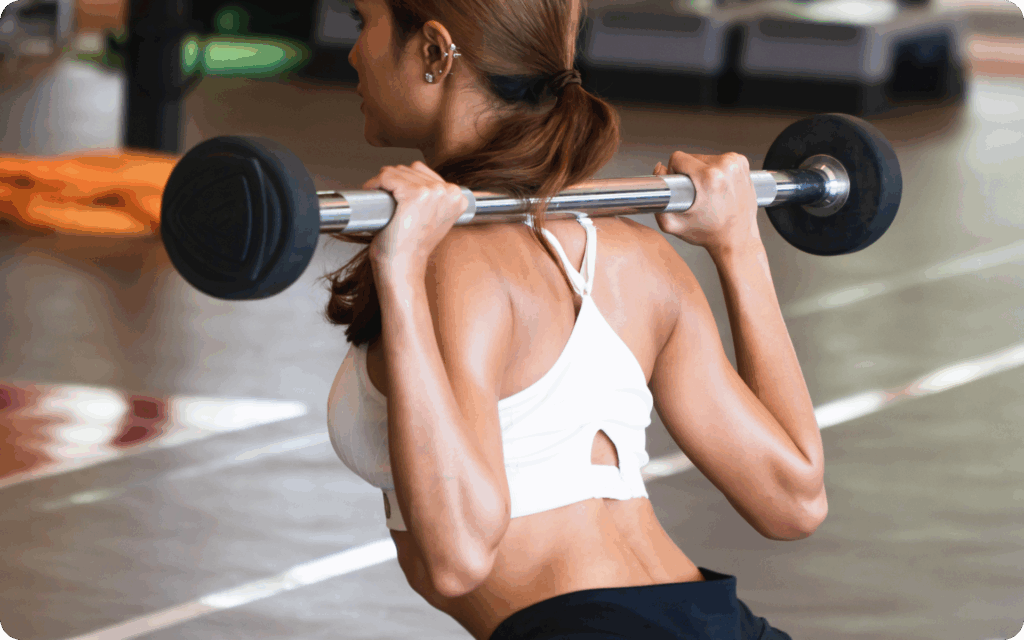
Barbell Back Squat
- Position the barbell on your upper traps, your grip slightly wider than shoulder-width.
- Step back, keeping your feet shoulder-width apart and your toes turned slightly outward.
- Inhale, brace your core, and bend your hips and knees to lower yourself until your thighs are at least parallel to the floor.
- Drive through your heels to stand, fully extending your hips and knees.
- Keep your chest up and your knees tracking over your toes throughout.
Romanian Deadlift
- Stand with your feet hip-width apart, a barbell in front of you held with an overhand grip.
- Keep your knees soft and hinge at your hips to lower the bar down your thighs.
- Maintain a flat back and lower until you feel a stretch in your hamstrings (just below your knees or mid-shin).
- Drive your hips forward to stand tall, keeping the bar close to your body throughout.
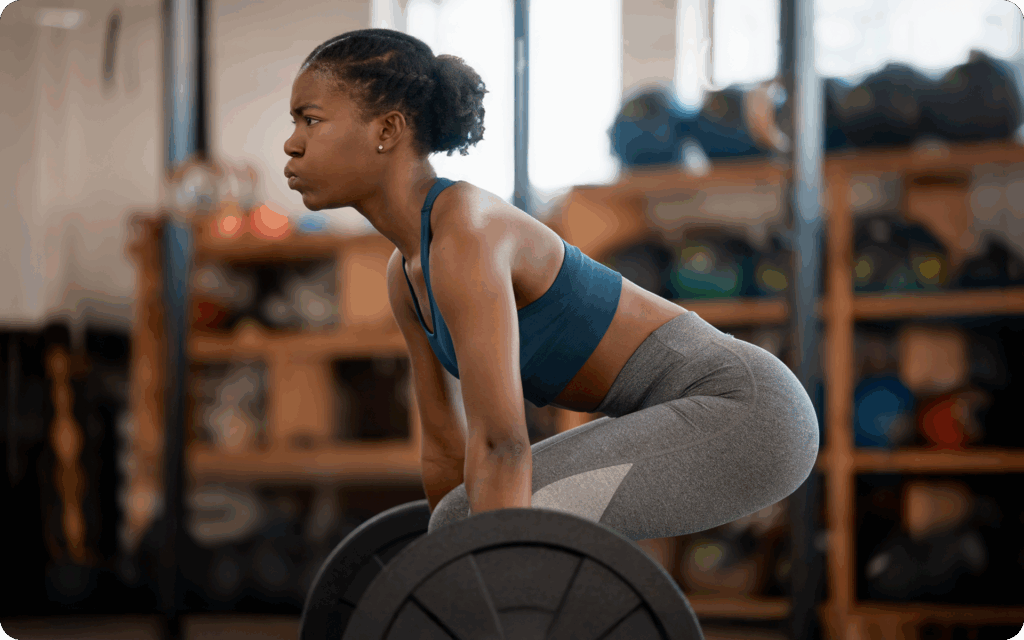
Leg Press
- Sit on the leg press machine, your feet hip-width apart on the platform.
- Unrack the carriage, lower it toward your chest by bending your knees and hips to at least 90 degrees.
- Press the platform away by extending your knees and hips fully (avoid locking your knees).
- Control the descent and repeat.
Seated Calf Raises
- Sit on a calf raise machine, the balls of your feet on the footplate.
- Release the safety and lower your heels as far as is comfortable.
- Press through the balls of your feet to lift the weight as high as possible.
- Pause at the top, then lower slowly.
Hanging Leg Raises
- Hang from a pull-up bar with your arms fully extended and your legs straight.
- Brace your core and lift your legs by flexing at the hips, keeping your legs straight or slightly bent, raising them to hip height or higher.
- Lower your legs under control back to the start position.
Incline Dumbbell Press
- Lie on an incline bench, dumbbells at shoulder height, your palms facing forward.
- Press the weights upward above your chest, your elbows extended, but not locked.
- Lower the dumbbells to your upper chest with control.
- Keep your feet flat and maintain contact with the bench throughout.
Seated Cable Row
- Sit at a cable row station, your feet secured against the platform.
- Grip the handle with your arms extended and your torso upright.
- Pull the handle toward your torso, your elbows tracking close to your body.
- Squeeze your shoulder blades together at the end range.
- Extend your arms fully to return to the start.

Dumbbell Lateral Raise
- Stand tall with a dumbbell in each hand at your sides, your palms facing in.
- Raise both dumbbells outward horizontally to shoulder height, your elbows slightly bent.
- Pause, then lower the weights with control.
- Avoid shrugging your shoulders or swinging the weights.
Face Pulls
- Attach a rope to a high cable pulley.
- Grasp the rope ends with both hands and step back to create tension.
- Pull the rope toward your upper chest and face, your elbows flared out.
- Squeeze your upper back and rear delts at the end.
- Return to the start with control.
Preacher Curls
- Sit at a preacher curl bench, your upper arms resting on the pad.
- Hold a straight bar or dumbbells with an underhand grip.
- Curl the weight toward your shoulders, keeping your upper arms fixed.
- Squeeze your biceps, then lower the weight until your elbows are nearly extended.
Overhead Triceps Extension
- Sit or stand, holding a dumbbell with both hands overhead (grip one end).
- Keep your elbows close to your head and your arms vertical.
- Lower the dumbbell behind your head by flexing your elbows.
- Extend your elbows to return to the start, keeping your upper arms stationary.
Leg Curls
- Adjust a lying or seated leg curl machine to fit your height.
- Position your legs under the pad, your knees aligned with the pivot point.
- Flex your knees to pull the pad toward your glutes.
- Lower the weight under control to full extension.
Dumbbell Lunges
- Stand upright, holding a dumbbell in each hand at your sides.
- Step forward with one leg and lower your body until your front thigh is parallel to the ground and your rear knee almost touches the floor.
- Press through your front heel to return to standing.
- Alternate legs for each rep.
Standing Calf Raises
- Stand with your feet hip-width apart on a calf raise machine or step, the balls of your feet on the platform.
- Lower your heels below the step for a full stretch.
- Push through your forefeet, rising onto your toes as high as possible.
- Pause briefly, then lower slowly.
Ab Crunches
- Lie on your back, your knees bent and your feet flat on the floor.
- Cross your arms over your chest or lightly touch your temples.
- Engage your core and lift your upper back off the floor, moving your ribcage toward your pelvis.
- Pause, then lower yourself back down with control.
If you’re curious about different ways to group your workouts, check out our article on what muscle groups to work out together.

Which Muscles Should You Train Every Day?
For most people, it’s not advisable to train the same major muscle groups every day. Muscles grow during recovery, and daily training prevents this process from occurring effectively. Constant training can lead to:
- Overtraining
- Increased injury risk
- Diminished returns
However, there are exceptions:
The Core
Your core muscles (abdominals, obliques, lower back) are endurance-based and recover relatively quickly (17, 18). They are designed to provide stability throughout the day. Performing a few sets of core exercises daily or every other day is generally safe and effective. A comprehensive core program is an excellent supplement to any training plan.
Calves
As with the core, the calves are composed of a high percentage of slow-twitch, endurance-oriented muscle fibers (19). They’re used to carrying your body weight all day and can handle higher training frequency. Training them 3-4 times a week could possibly be more effective than once or twice (20).
Skill-Based Practice
For beginners, strength is largely a skill. Practicing a movement such as the squat with very light weight or just your body weight every day can help improve neuromuscular coordination and technique without causing excessive fatigue (21).
For hypertrophy of larger muscle groups such as the chest, back, and quads, training them 2-3 times per week with at least 48 hours of rest could allow a great amount of quality volume (17).
Read more: 2 Full-Body Workouts a Week: The Definitive Science-Backed Guide
What’s a Good Workout Schedule to Build Muscle?
A good workout schedule for building muscle balances training frequency, volume, and recovery. The optimal schedule depends heavily on your lifestyle and experience.
3-Day Full-Body Routine
This is ideal for beginners or those with limited time. It involves training your entire body three times a week on non-consecutive days (e.g. Monday, Wednesday, Friday). This frequency is enough to stimulate growth while providing ample recovery. A full-body circuit workout is an excellent option here.
4-Day Upper/Lower Split
A great option for intermediate lifters. You train your upper body twice a week and your lower body twice a week (e.g. Mon: upper, Tues: lower, Thurs: upper, Fri: lower). This allows for more volume per muscle group than a full-body routine.

5-Day Body Part Split
It’s common among advanced lifters and bodybuilders. Each day is dedicated to one or two muscle groups (e.g. day 1: chest, day 2: back, day 3: legs, day 4: shoulders, day 5: arms). This allows for maximum volume and intensity for each muscle group, but requires more recovery time between sessions for the same muscle.
6-Day Push/Pull/Legs (PPL) Split
This is for advanced trainees who can recover quickly. The schedule is push, pull, legs, rest, and then repeat. This hits each muscle group twice a week with high volume. This is one of the best muscle group combinations to work out together 6-day programs.
What’s The Best Muscle Split?
Remember, the “best” schedule is the one you can adhere to. Consistency is more important than finding the “perfect” split. Listen to your body – if you feel constantly fatigued, sore, or your performance is declining, you may need more rest days.
To learn more about the best pairings, read our guide to muscle groups to work together.

Objectively, there isn’t a “hardest” muscle group, as difficulty is subjective. However, many people find their calves and forearms challenging to grow due to their high composition of slow-twitch muscle fibers, which may have a lower ceiling for muscle hypertrophy. (22). Large muscle groups such as the legs can also be considered “hard” to train due to the high systemic fatigue generated by compound exercises such as squats and deadlifts. Research has suggested that these muscles respond best to a range of loads. If your goal is simply to maximize overall muscle mass, exercise prescriptions should include training across a wide spectrum of repetition ranges. Higher-intensity exercise seems necessary to fully stimulate fast-twitch fiber growth, while lower-intensity exercise preferentially enhances hypertrophy in slow-twitch fibers. A periodized approach combining high- and low-intensity training may help ensure an optimal hypertrophic response in the full continuum of fiber types. Yes, you can train chest and biceps together. This is a common pairing in body-part splits, often referred to as a “push-pull” variation within the same session or for aesthetic reasons (getting a pump in the arms after training the chest). As the biceps aren’t heavily involved in most chest exercises (12), pre-fatiguing one won’t significantly impact the other. Muscles with a higher proportion of slow-twitch fibers, including the calves and forearms, often take longer to show significant growth than muscles with more fast-twitch fibers (22), such as the hamstrings or chest. In addition, large and complex muscle groups such as the back may seem to take longer to develop as they consist of many individual muscles that all need to be targeted for a well-rounded look. Larger muscle groups that are subjected to the most mechanical damage and neural demand during heavy compound lifting tend to recover the slowest. The muscles of the lower back, glutes, and hamstrings, which are heavily taxed during deadlifts and squats, often require more recovery time than smaller muscle groups such as the biceps or deltoids. Research indicates that the lower limbs generally experience more fatigue and take longer to recover than the upper limbs (20).Frequently Asked Questions
What is the hardest muscle group to train?
Can I train my chest and biceps together?
Which muscles take the longest to grow?
Which muscles recover the slowest?
The Bottom Line
Ultimately, designing a muscle group workout plan is both a science and an art. The scientific principles of progressive overload, fatigue management, and stimulus specificity provide the foundation. The art lies in tailoring these principles to your unique body, lifestyle, and goals. Start with a structured plan, track your progress, and don’t be afraid to adjust as you learn what works best for you.
DISCLAIMER:
This article is intended for general informational purposes only and does not serve to address individual circumstances. It is not a substitute for professional advice or help and should not be relied on for making any kind of decision-making. Any action taken as a direct or indirect result of the information in this article is entirely at your own risk and is your sole responsibility.
BetterMe, its content staff, and its medical advisors accept no responsibility for inaccuracies, errors, misstatements, inconsistencies, or omissions and specifically disclaim any liability, loss or risk, personal, professional or otherwise, which may be incurred as a consequence, directly or indirectly, of the use and/or application of any content.
You should always seek the advice of your physician or other qualified health provider with any questions you may have regarding a medical condition or your specific situation. Never disregard professional medical advice or delay seeking it because of BetterMe content. If you suspect or think you may have a medical emergency, call your doctor.
SOURCES:
- Effects of Resistance Training Overload Progression Protocols on Strength and Muscle Mass (2024, pubmed.ncbi.nlm.nih.gov)
- A Systematic Review of the Effects of Different Resistance Training Volumes on Muscle Hypertrophy (2022, jhk.termedia.pl)
- The influence of resistance exercise training prescription variables on skeletal muscle mass, strength, and physical function in healthy adults: An umbrella review (2024, sciencedirect.com)
- The Mechanisms of Muscle Hypertrophy and Their Application to Resistance Training (2010, journals.lww.com)
- The six best strength training techniques to increase mechanisms of muscle hypertrophy (2023, us.humankinetics.com)
- 10 Things to Know About Muscle Fibers (2015, acefitness.org)
- Loading Recommendations for Muscle Strength, Hypertrophy, and Local Endurance: A Re-Examination of the Repetition Continuum (2021, mdpi.com)
- Pathophysiology of Exercise-Induced Muscle Damage and Its Structural, Functional, Metabolic, and Clinical Consequences (2020, pmc.ncbi.nlm.nih.gov)
- Modified Daily Undulating Periodization Model Produces Greater Performance Than a Traditional Configuration in Powerlifters (2016, journals.lww.com)
- Effect of Small and Large Energy Surpluses on Strength, Muscle, and Skinfold Thickness in Resistance-Trained Individuals: A Parallel Groups Design (2023, pubmed.ncbi.nlm.nih.gov)
- International Society of Sports Nutrition Position Stand: protein and exercise (2017, pubmed.ncbi.nlm.nih.gov)
- Comparison of muscle activities during bench press at different angles in beginners (2025, researchgate.net)
- Comparative electromyographical investigation of the biceps brachii, latissimus dorsi, and trapezius muscles during five pull exercises (2005, researchgate.net)
- Trunk muscle activation during dynamic weight-training exercises and isometric instability activities (2007, pubmed.ncbi.nlm.nih.gov)
- Effects of Resistance Training Frequency on Measures of Muscle Hypertrophy: A Systematic Review and Meta-Analysis (2016, link.springer.com)
- Influence of Exercise Order on Maximum Strength and Muscle Thickness in Untrained Men (2010, pmc.ncbi.nlm.nih.gov)
- Fibre types in human abdominal muscles (1979, wiley.com)
- The influence of muscle fiber size and type distribution on electromyographic measures of back muscle fatigability (1998, pubmed.ncbi.nlm.nih.gov)
- Muscle fibre type populations of human leg muscles (1975, pubmed.ncbi.nlm.nih.gov)
- Recoverability of large vs small muscle groups (2020, scholarworks.uni.edu)
- Effects of strength training on neuromuscular adaptations in the development of maximal strength: a systematic review and meta-analysis (2025, nature.com)
- The Role of Fiber Types in Muscle Hypertrophy Implications for Loading Strategies (2014, journals.lww.com)

 Reviewed by
 Reviewed by