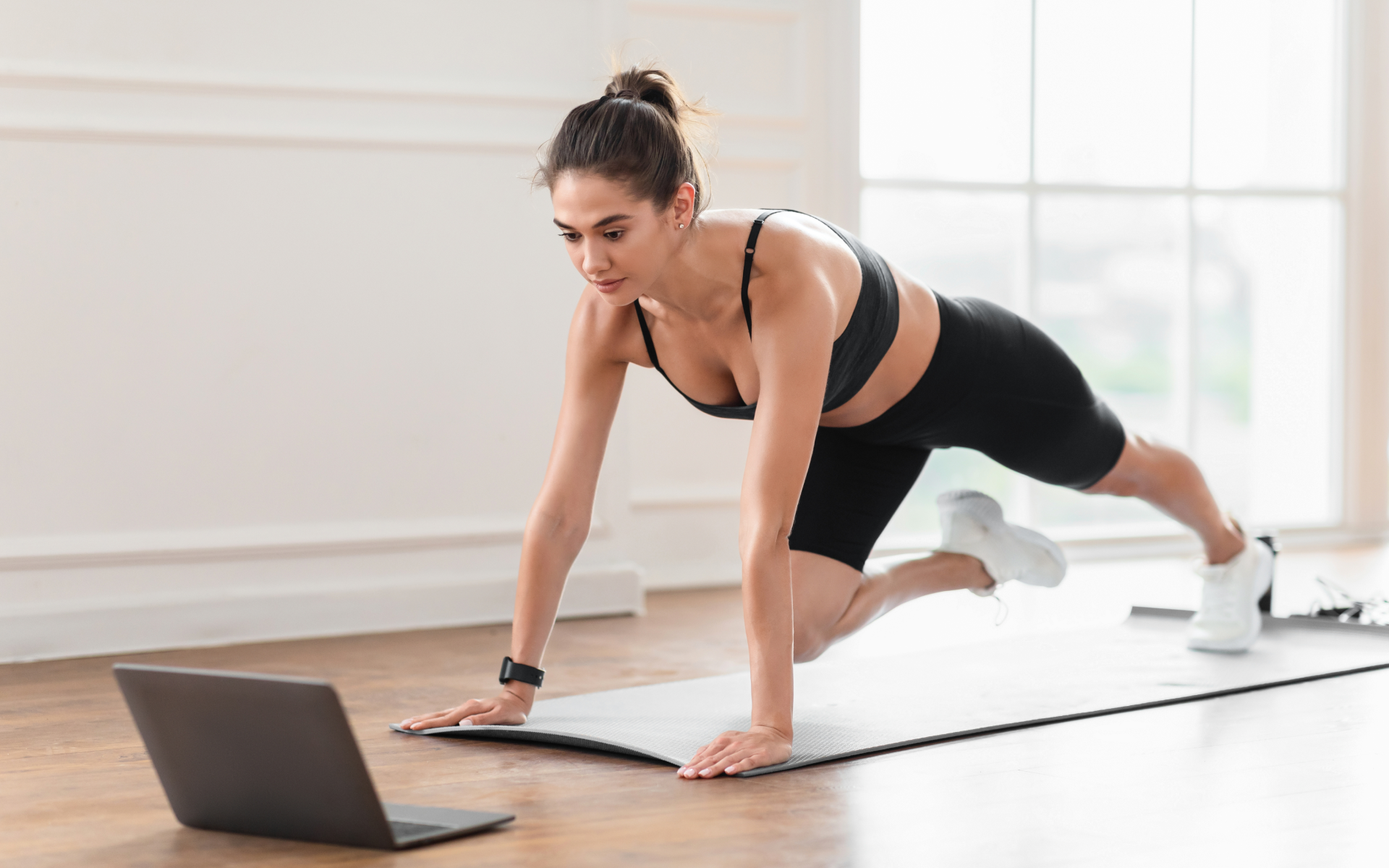
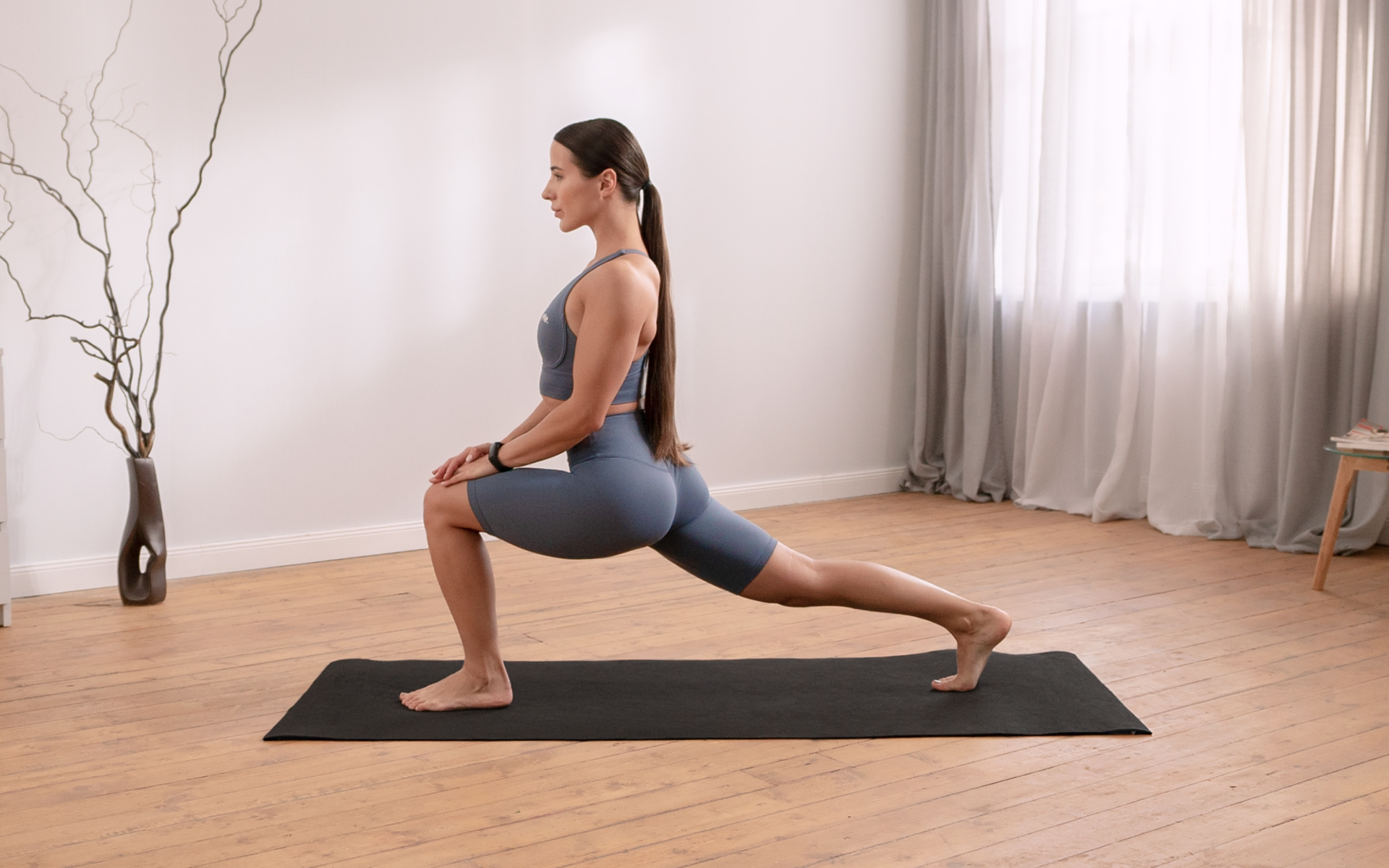
Building an effective fitness routine does not require a gym membership or expensive equipment. A well-designed home exercise plan, grounded in sports science principles, can deliver significant gains in strength, muscle mass, and overall health.
This guide explains how to build a results-driven plan from the ground up, starting with the fundamentals and progressing to a complete, actionable routine.
We will break down the science of home training into simple, practical steps.
You will learn how to structure your workouts, select the right exercises, and progress over time to keep seeing results. The goal is to provide you with the knowledge to create a sustainable fitness habit that fits your life.
Why Choose Home Workouts Over Gym Workouts?
Choosing where to train is a decision that affects consistency, the most critical factor for long-term success. While gyms offer a wide array of equipment, they also come with logistical challenges like travel time, membership fees, and crowded spaces.
A home workout setup eliminates these barriers.
The convenience of training at home means you are more likely to stick with your program. Instead of dedicating a 2-hour block to travel and train, you can perform a practical 45-minute session in your living room. This accessibility makes it easier to integrate fitness into a busy schedule, transforming exercise from a chore into a seamless part of your daily life.
What Are The Clear Benefits Of Working Out At Home?
Training at home offers distinct advantages that extend beyond simple convenience.
The controlled environment allows for intense focus without the distractions of a commercial gym, leading to higher-quality training sessions (1).
You have complete authority over your workout, from the music you play to the exact timing of your rest periods.
Financially, the benefits are clear.
The recurring cost of a gym membership, which can range from $40 to over $100 per month (2), is nonexistent. This lower cost factor saves you hundreds or even thousands of dollars annually.
BetterMe: Health Coaching app helps you achieve your body goals with ease and efficiency by helping to choose proper meal plans and effective workouts. Start using our app and you will see good results in a short time.
Furthermore, research increasingly shows that home-based training is highly effective.
A 2025 meta-analysis confirmed that structured resistance training, whether at home or in a gym, significantly improves key health markers (3). This opportunity means you can achieve your goals without a hefty price tag.
Privacy is another key benefit. For many, especially those just starting, the thought of exercising in front of others can be intimidating.
A home setting provides a judgment-free zone where you can focus on learning proper form and pushing your limits without feeling self-conscious. This comfort can be a powerful motivator, especially for a home exercise plan for beginners.
Read more: 30-Day Home Workout with Dumbbells for Beginners Guide
How Can You Design A Home Exercise Plan Step‑By‑Step?
Creating a plan that produces results requires a structured, evidence-based approach.
It is not enough to simply perform random exercises and hope for the best.
By following established programming principles, you can systematically drive progress.
Here is how to do it:
1. Define Your Weekly Training Volume and Frequency
Training volume–the total number of hard sets you perform for a muscle group per week–is the primary driver of muscle growth and strength gains (4).
Research consistently shows that a weekly volume of 12–20 sets per muscle group is optimal for most individuals (5).
Beginners should start at the lower end of this range, around 10–12 sets, while more advanced trainees may need closer to 20.
Your training frequency, or how many days you work out per week, is secondary to total volume (4).
A 2018 meta-analysis found that, when weekly volume is equal, training 2 days per week can produce strength gains similar to those from training 3 or more days per week (6).
The best frequency for you is one that you can consistently maintain. A good starting point is 2–4 sessions per week.
2. Apply the Principle of Progressive Overload
For your muscles to adapt and grow stronger, you must continually challenge them with a stimulus greater than what they are accustomed to. This is the principle of progressive overload (7).
At home, you can apply this in several ways, and you do not necessarily need to lift heavier weights constantly.
Focus on these methods of progression (8, 9):
- Increase Repetitions: Add 1-2 reps to each set until you reach the top of your target rep range (e.g., 15 reps). Once you can complete all sets at the target, it is time to make the exercise harder.
- Improve Tempo: Control the speed of each repetition. For example, slow down the lowering (eccentric) phase of a movement to 3–5 seconds to increase time under tension.
- Enhance Range of Motion (ROM): Increase the range of motion of the muscle during an exercise. For instance, perform push-ups with your hands on blocks to lower your chest.
- Decrease Rest Periods: Gradually reduce your rest time between sets from 90 seconds to 60 seconds to increase workout density.
- Choose Harder Variations: Progress to more challenging versions of an exercise, such as moving from a standard squat to a split squat.
3. Train with Sufficient Intensity (Proximity to Failure)
Intensity is not about how heavy you lift, but how hard you work. To stimulate muscle growth, you need to perform sets close to muscular failure–the point where you cannot complete another repetition with good form.
A valuable tool for measuring this is Reps in Reserve (RIR) (10).
RIR is the number of reps you have “left in the tank” at the end of a set.
For most of your work, you should aim for a 1–3 RIR.
This phrase means you stop the set feeling you could have done 1 to 3 more reps. This level of effort ensures you recruit enough muscle fibers to trigger adaptation (11).
4. Structure Your Warm-up and Cool-down
A proper warm-up prepares your body for the demands of the workout, increasing blood flow, activating key muscles, and reducing injury risk (12).
Dedicate 5–10 minutes to this before every session.
A simple warm-up structure includes:
- Light Cardio (2–3 minutes): Jumping jacks, high knees, or light jogging to raise your core temperature.
- Dynamic Mobility (3–4 minutes): Movements like leg swings, arm circles, and torso twists to prepare your joints.
- Activation Drills (2–3 minutes): Exercises like glute bridges and band pull-aparts to “wake up” the muscles you plan to train.
After your workout, a 5-minute cool-down with light stretching can aid recovery and improve flexibility (13).
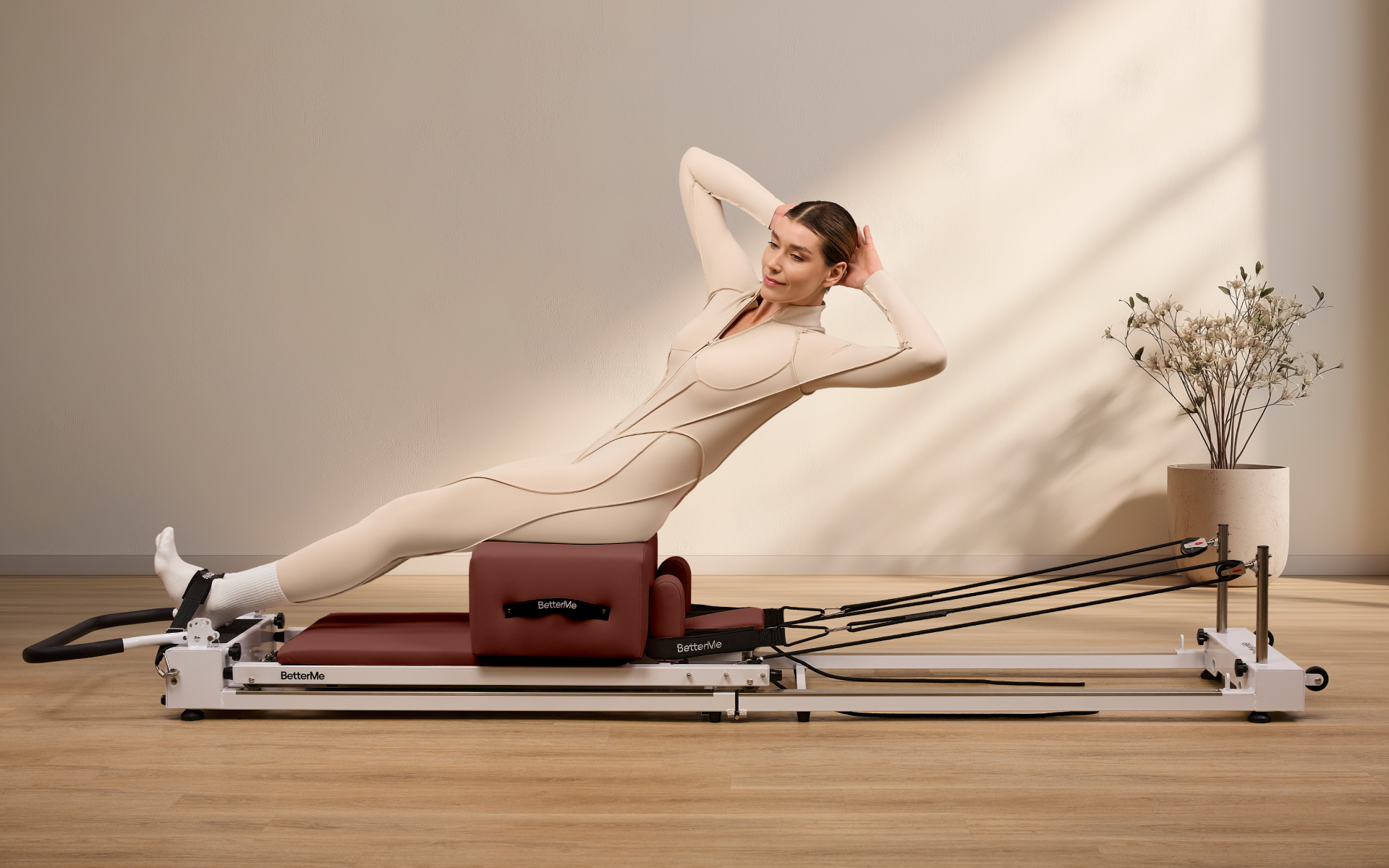
For those looking to integrate different types of home workouts, Pilates can be a great complement to strength training. The BetterMe Home Pilates Kit is a great tool to have.
What Key Moves Should A Home Workout Plan Include?
A balanced plan should target all major muscle groups by including movements that cover fundamental human patterns (14).
A workout at home without equipment is entirely possible by focusing on bodyweight exercises and their variations.
Here are key exercises to build your program around. These are a great starting point for anyone looking for daily movement. Rest days are essential, so please listen to your body before you follow plans like “7 exercises to do every day”:
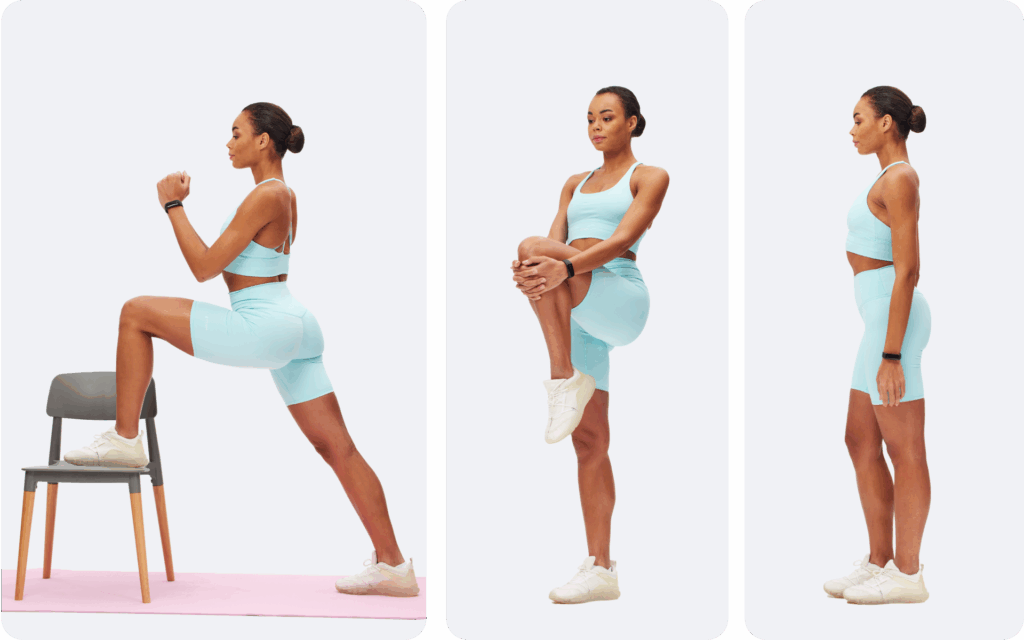
1. Knee-Dominant Movement: Rear-Foot Elevated Split Squat
This exercise targets the quadriceps and glutes while improving balance.
- Stand about 2–3 feet in front of a sturdy chair or bench.
- Place the top of one foot on the surface behind you. Your front foot should be flat on the floor.
- Keeping your torso upright, lower your body until your front thigh is parallel to the floor. Your front knee should track in line with your foot.
- Drive through your front foot to return to the starting position. Complete all reps on one side before switching.
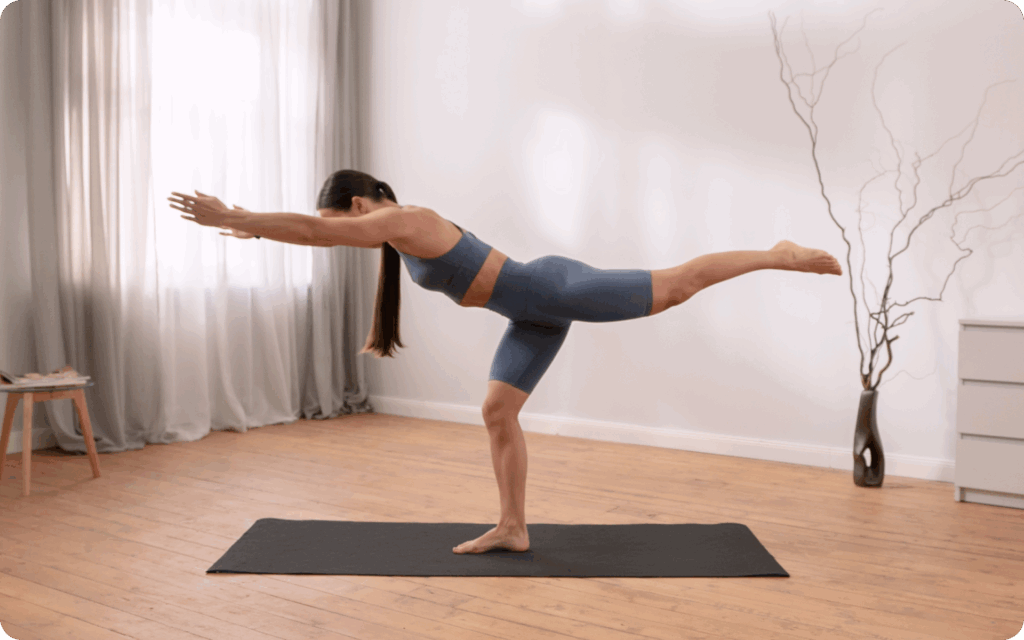
2. Hip-Dominant Movement: Single-Leg Romanian Deadlift (RDL)
This move strengthens the hamstrings, glutes, and lower back, while challenging your stability
- Stand on one leg, holding a light weight (or no weight) in the opposite hand.
- Keeping a slight bend in your standing knee, hinge at your hips, and lower your torso toward the floor. Extend your non-standing leg straight behind you for balance.
- Lower until you feel a deep stretch in your hamstring, or until your torso is parallel to the floor. Keep your back flat.
- Engage your glutes and hamstrings to pull yourself back up to the starting position.
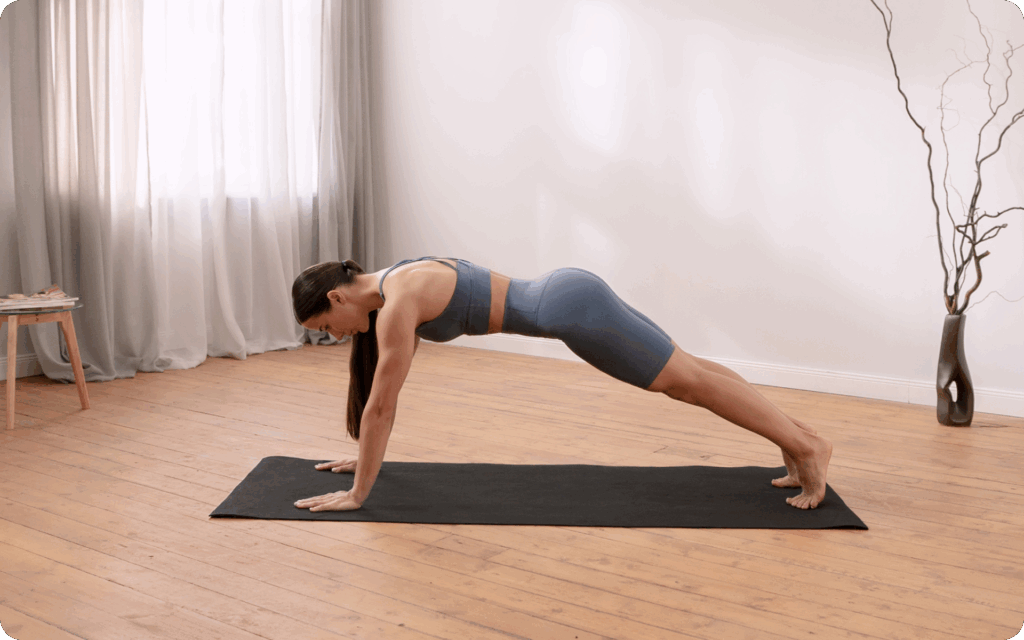
3. Horizontal Push: Push-Up
The classic push-up is a phenomenal exercise for the chest, shoulders, and triceps.
- Start in a high plank position with your hands slightly wider than your shoulders. Your body should form a straight line from your head to your heels.
- Lower your body by bending your elbows, keeping them tucked at a 45-degree angle to your body.
- Continue down until your chest is an inch or two from the floor.
- Press firmly into the ground to push your body back to the starting plank position.
4. Horizontal Pull: Inverted Row
You can perform this pulling exercise using a sturdy table or two chairs with a broomstick across them. It targets the back and biceps.
- Lie on your back underneath a sturdy table or bar. Grip the edge with both hands, slightly wider than your shoulders.
- Keeping your body in a straight line, pull your chest up toward the table. Squeeze your shoulder blades together at the top.
- Lower your body back down with control. To make it easier, bend your knees.
5. Vertical Push: Pike Push-Up
This variation targets the shoulders more directly than a standard push-up.
- Start in a downward dog pose, with your hips high and your body forming an inverted “V.”
- Bend your elbows and lower the top of your head toward the floor.
- Press back up to the starting position.
- To increase the difficulty, elevate your feet on a chair or step.
Reasons why BetterMe is a safe bet: a wide range of calorie-blasting workouts, finger-licking recipes, 24/7 support, challenges that’ll keep you on your best game, and that just scratches the surface! Start using our app and watch the magic happen.
6. Vertical Pull: Band Pulldown
If you have a resistance band, you can mimic a lat pulldown to train your upper back.
- Anchor a resistance band to a high point, like the top of a door.
- Kneel or sit facing the anchor, holding the band with both hands.
- Keeping your chest up, pull the band down and back, driving your elbows toward your hips.
- Squeeze your shoulder blades together at the bottom of the movement, then slowly return to the start.
7. Core Anti-Movement: Dead Bug
This exercise trains your core to resist unwanted motion, a crucial factor in spinal stability.
- Lie on your back with your arms extended toward the ceiling and your knees bent at 90 degrees over your hips.
- Press your lower back into the floor to engage your core. This is your starting position.
- Slowly lower your opposite arm and leg toward the floor, moving only as far as you can without your lower back arching.
- Return to the start with the control, then repeat on the other side.
Finding time to exercise can be challenging, but there are plans tailored to specific needs and schedules, like this at home workouts for moms.
Read more: 30-Day Home Workout with Dumbbells for Beginners Guide
What Is An Effective Home Workout Routine For Real Results?
What is an effective home exercise plan?
Now, let’s combine these principles and exercises into one of the best workout routines you can do from home.
This 3-day-per-week full-body program can build muscle and strength efficiently. It’s an excellent home exercise plan for beginners, but can be scaled for intermediate trainees.
Weekly Schedule:
- Day 1: Full Body Workout A
- Day 2: Rest or Active Recovery (e.g., 20-minute walk, light cardio)
- Day 3: Full Body Workout B
- Day 4: Rest or Active Recovery
- Day 5: Full Body Workout C
- Day 6 & 7: Rest
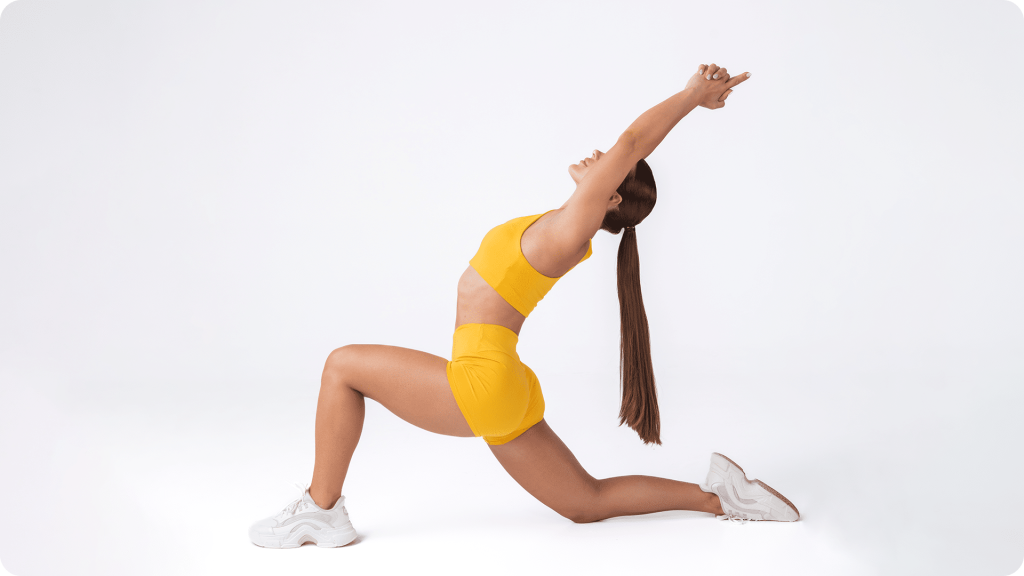
Workout Structure:
- Sets and Reps: Perform 3 sets of each exercise. Aim for the specified rep range, stopping at a 1-2 RIR.
- Rest: Rest 60-90 seconds between sets.
- Progression: Once you can hit the top end of the rep range for all 3 sets, progress to a more difficult variation or add a tempo challenge.
Workout A
- Rear-Foot Elevated Split Squat: 3 sets of 8-12 reps per side
- Push-Up: 3 sets of 8-15 reps (modify by elevating hands or knees if needed)
- Inverted Row: 3 sets of 8-12 reps
- Pike Push-Up: 3 sets of 6-10 reps
- Plank: 3 sets, hold for 30-60 seconds
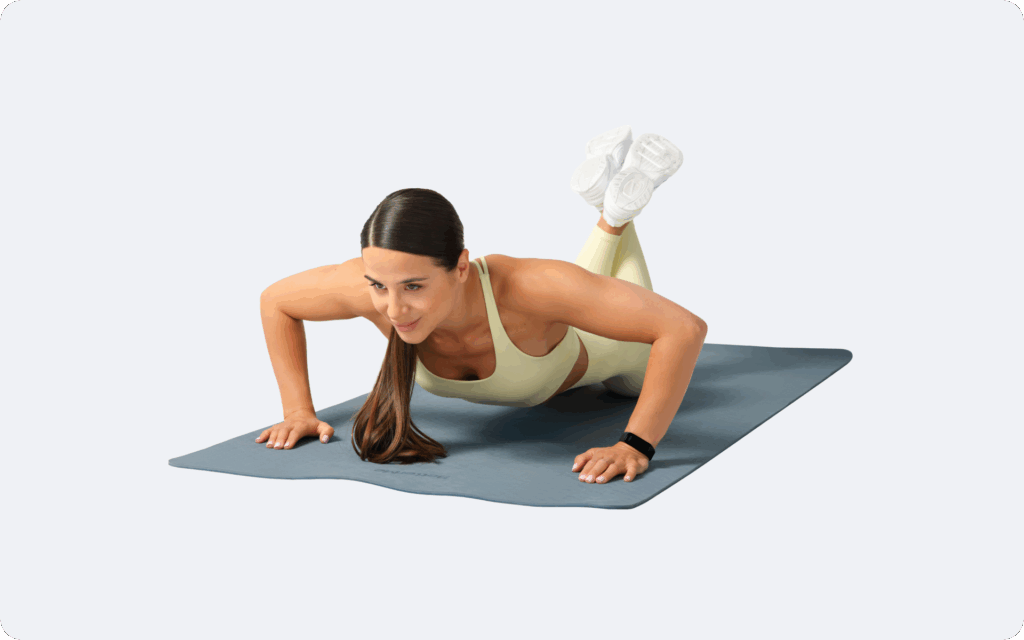
Workout B
- Bodyweight Squat or Goblet Squat: 3 sets of 12-20 reps (hold a weight if available)
- Single-Leg Romanian Deadlift (RDL): 3 sets of 10-15 reps per side
- Decline Push-Up (feet elevated): 3 sets of 8-12 reps
- Band Pulldown or Pull-Apart: 3 sets of 12-20 reps
- Dead Bug: 3 sets of 10-12 reps per side
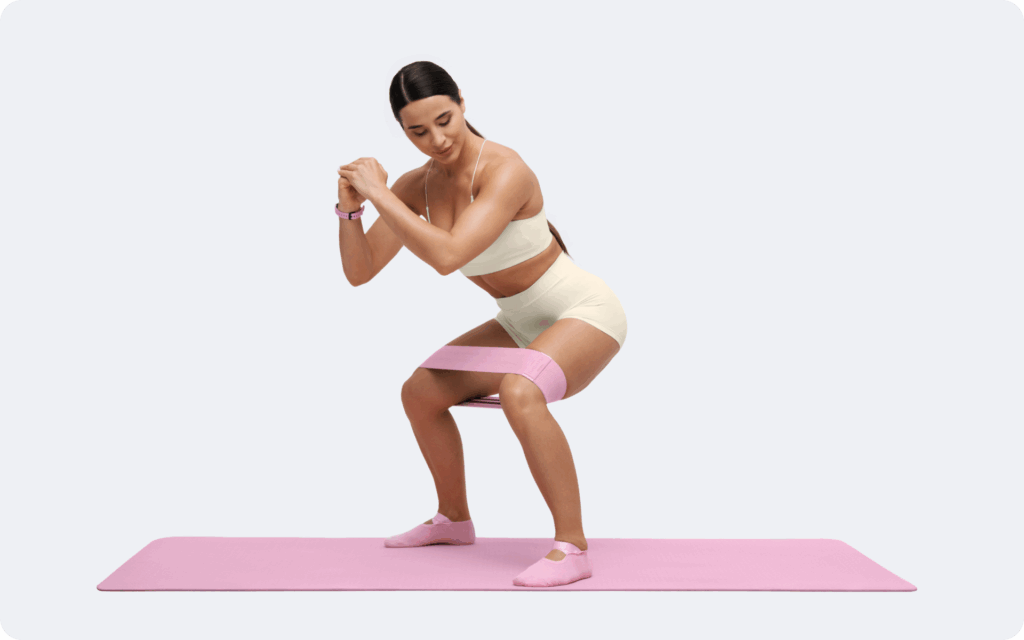
Workout C
- Glute Bridge (or Single-Leg Glute Bridge): 3 sets of 15-25 reps
- Lunge: 3 sets of 10-15 reps per side
- Dips (using a chair or bench): 3 sets of 8-15 reps
- Band Row: 3 sets of 12-20 reps
- Side Plank: 3 sets, hold for 30-45 seconds per side
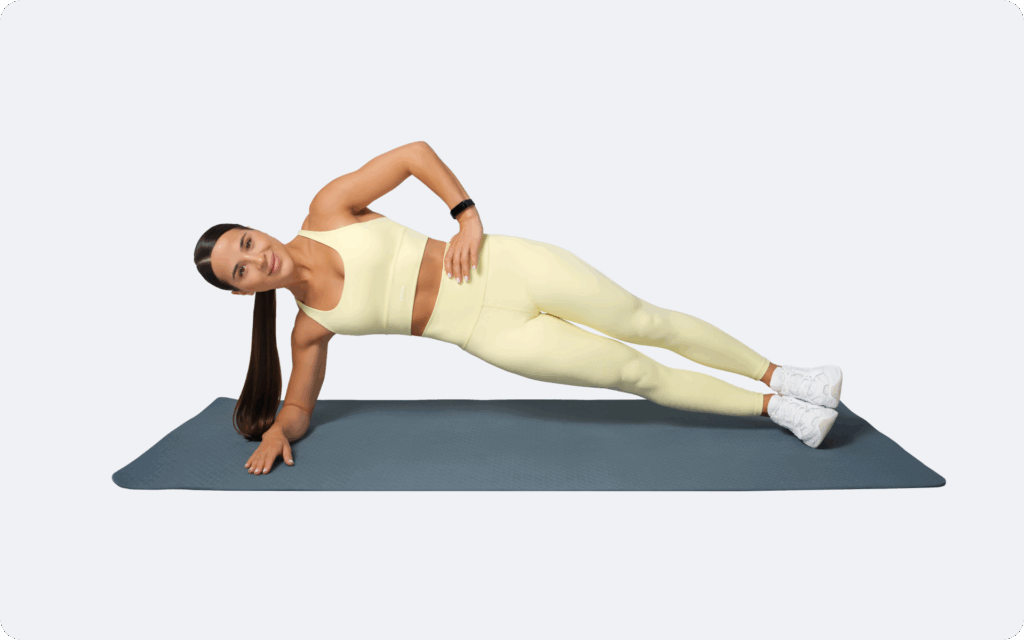
This routine can be adapted to different fitness levels and goals, making it a flexible workout for women at home.
How To Support A Home Exercise Plan With Proper Nutrition?
Nutrition and exercise are 2 sides of the same coin.
Your diet provides the fuel for your workouts and the building blocks for muscle repair and growth. Without proper nutrition, even the best workout routines will fall short.
- Prioritize Protein
Protein is essential for repairing the muscle tissue that is broken down during resistance training.
Aim for a daily protein intake of 1.6–2.0 grams per kilogram of body weight.
Distribute this intake across 3-5 meals throughout the day (15). Good protein sources include lean meats, poultry, fish, eggs, dairy, legumes, and tofu.
- Fuel with Complex Carbohydrates
Carbohydrates are your body’s primary energy source. They replenish muscle glycogen stores that are depleted during exercise (16).
Focus on complex carbohydrates like oats, brown rice, quinoa, and vegetables, as they provide sustained energy. Time your carbohydrate intake around your workouts to maximize performance and recovery.
- Don’t Forget Healthy Fats
Healthy fats are crucial for hormone production, including hormones that regulate muscle growth and metabolism. Include sources like avocados, nuts, seeds, and olive oil in your diet. Aim for fats to make up 20-30% of your total daily calories (17).
- Hydration is Key
Water is involved in nearly every metabolic process in your body (18). Dehydration can significantly impair performance and recovery (19). Aim to drink at least 2-3 liters of water per day, and more if you are exercising intensely or in a hot environment.
Yes, absolutely. Research, including numerous controlled trials, confirms that structured home-based resistance training can produce significant improvements in muscle strength, body composition, and metabolic health (20, 21, 22). The key is consistency and applying principles like progressive overload. No, equipment is not a necessity. An effective workout at home without equipment is achievable by using bodyweight exercises and their many variations. Adding inexpensive tools like resistance bands can expand your exercise options, but they are not required to see results. An effective home workout can last anywhere from 30 to 60 minutes. The duration is less important than the quality of the session. A focused, 45-minute workout where you perform 10-15 hard sets with good form is more productive than a distracted 90-minute session. Yes, home exercise plans can be adapted for individuals of all ages and fitness levels. By choosing appropriate exercises and modifying their difficulty, anyone from a young adult to a senior can benefit from a structured home fitness routine.Frequently Asked Questions
Can a home exercise plan really get results?
Do I need equipment for a home exercise plan?
How long should a home workout last?
Are home exercise plans suitable for all ages?
The Bottom Line
A home exercise plan is a powerful tool for achieving your fitness goals.
By applying the scientific principles of training volume, intensity, and progressive overload, you can design a program that is both effective and sustainable.
Consistency is the true secret to success, and the convenience of training at home removes one of the most significant barriers to achieving it. Start with a structured plan, focus on your nutrition, and listen to your body to build lasting health and strength.
DISCLAIMER:
This article is intended for general informational purposes only and does not serve to address individual circumstances. It is not a substitute for professional advice or help and should not be relied on for making any kind of decision-making. Any action taken as a direct or indirect result of the information in this article is entirely at your own risk and is your sole responsibility.
BetterMe, its content staff, and its medical advisors accept no responsibility for inaccuracies, errors, misstatements, inconsistencies, or omissions and specifically disclaim any liability, loss or risk, personal, professional or otherwise, which may be incurred as a consequence, directly or indirectly, of the use and/or application of any content.
You should always seek the advice of your physician or other qualified health provider with any questions you may have regarding a medical condition or your specific situation. Never disregard professional medical advice or delay seeking it because of BetterMe content. If you suspect or think you may have a medical emergency, call your doctor.
SOURCES:
- Advantages of working out at home – Human Kinetics (n.d., us.humankinetics.com)
- U.S. Fitness Facility Memberships Reach the Highest Level Ever as Dues Rise (2024, healthandfitness.org)
- Effects of home- and gym-based resistance training on glycemic control in patients with type 2 diabetes mellitus—a systematic review and meta-analysis (2025, biomedcentral.com)
- Resistance Training Variables for Optimization of Muscle Hypertrophy: An Umbrella Review (2010, frontiersin.org)
- A Systematic Review of The Effects of Different Resistance Training Volumes on Muscle Hypertrophy (2022, pmc.ncbi.nlm.nih.gov)
- Weekly Training Frequency Effects on Strength Gain: A Meta-Analysis (2018, sportsmedicine-open.springeropen.com)
- Progressive Overload Explained: Grow Muscle & Strength Today (n.d, blog.nasm.org)
- Exercise progression and regression (n.d., us.humankinetics.com)
- Complexity: A Novel Load Progression Strategy in Strength Training (2019, frontiersin.org)
- The effects of resistance training to near failure on strength, hypertrophy, and motor unit adaptations in previously trained adults (2023, physoc.onlinelibrary.wiley.com)
- Reps in Reserve (RIR): What You Need to Know (n.d., blog.nasm.org)
- Revisiting the ‘Whys’ and ‘Hows’ of the Warm-Up: Are We Asking the Right Questions? (2024, link.springer.com)
- Do We Need a Cool-Down After Exercise? A Narrative Review of the Psychophysiological Effects and the Effects on Performance, Injuries and the Long-Term Adaptive Response (2018, link.springer.com)
- Progression Models in Resistance Training for Healthy Adults (2009, journals.lww.com)
- International Society of Sports Nutrition Position Stand: protein and exercise (2017, jissn.biomedcentral.com)
- Exercise and Regulation of Carbohydrate Metabolism (2015, pmc.ncbi.nlm.nih.gov
- Current knowledge about sports nutrition (2011, pmc.ncbi.nlm.nih.gov)
- Narrative Review of Hydration and Selected Health Outcomes in the General Population (2019, pmc.ncbi.nlm.nih.gov)
- Hydration to Maximize Performance and Recovery: Knowledge, Attitudes, and Behaviors Among Collegiate Track and Field Throwers (2021, pmc.ncbi.nlm.nih.gov)
- The effects of a home-based resistance training programme on body composition and muscle function during weight loss in people living with overweight or obesity: a randomised controlled pilot trial (2025, nutritionandmetabolism.biomedcentral.com)
- Effects of an 8-week minimal-dose home-based eccentric exercise program on physical health and exercise adherence (2025, link.springer.com)
- The effect of home‐based resistance exercise training in people with type 2 diabetes: A randomized controlled trial (2023, onlinelibrary.wiley.com)
 Reviewed by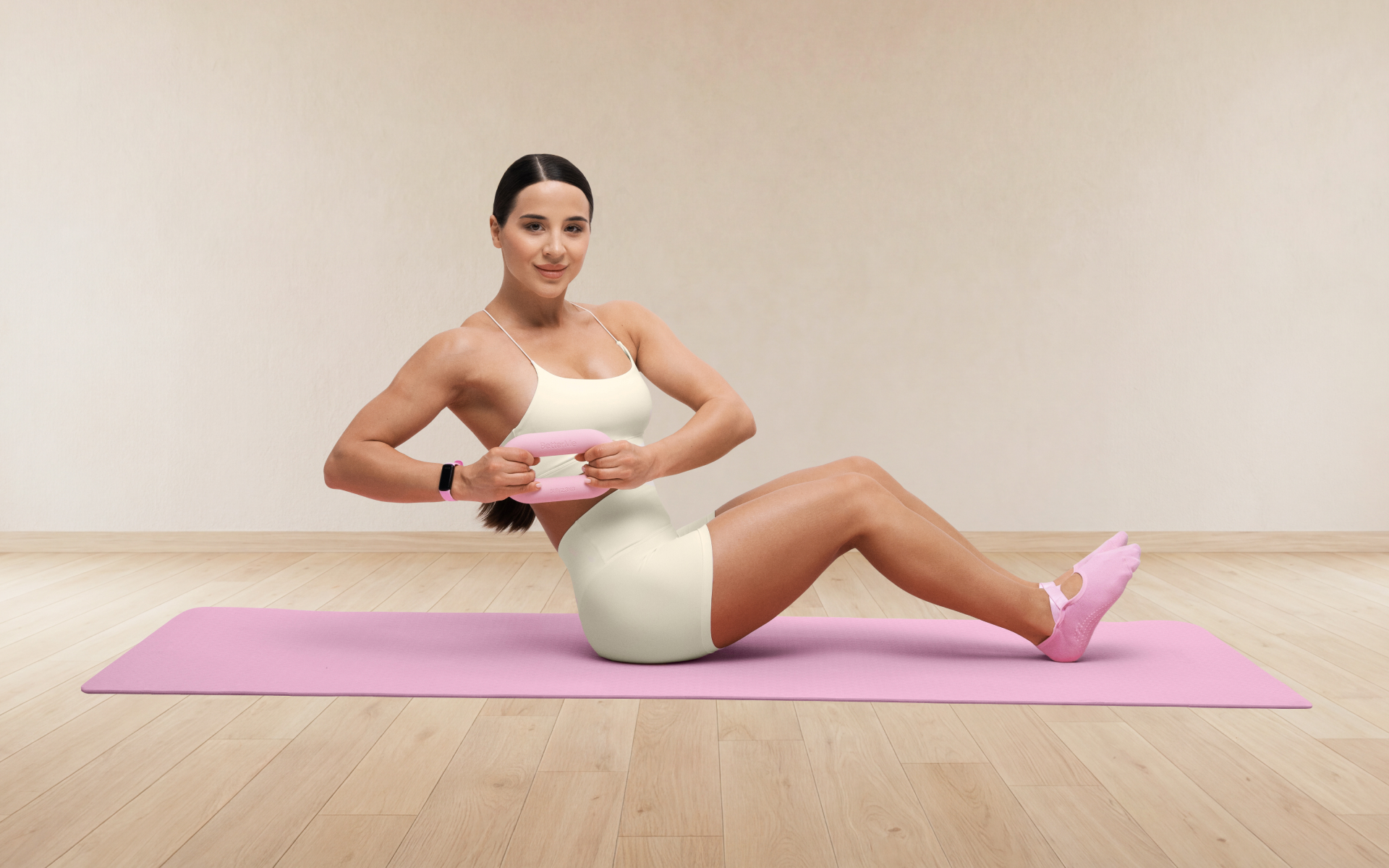
 Reviewed by