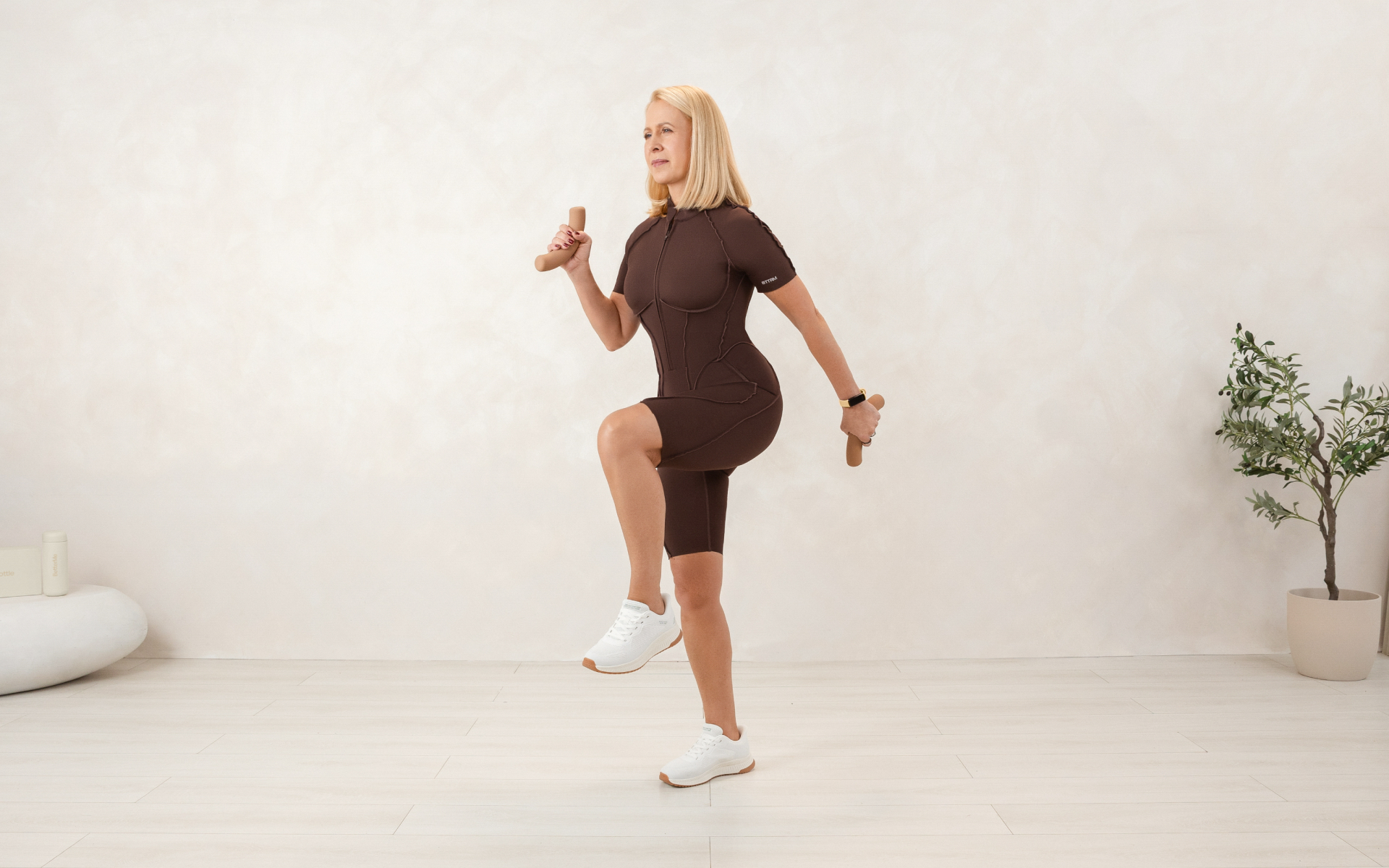
Aging changes the body in quiet but noticeable ways. Your muscles may feel softer, joints can stiffen after sitting too long, and even everyday tasks such as carrying groceries, climbing stairs, or getting up from a chair can require a bit more effort than they once did. Staying active is thought to be one of the most reliable ways to undo the effects of age and support strength, balance, and independence as the years pass by. This is where dumbbell exercises for seniors can make a meaningful difference.
Unlike large gym machines, free weights such as dumbbells are simple, adaptable, and easy to control. They allow you to make small, steady movements which build strength without overwhelming the body (1).
According to organizations such as the Centers for Disease Control and Prevention (CDC) and the National Institute on Aging, muscle-strengthening activities at least twice a week can help older adults maintain muscle mass, support bone health, and improve balance. These benefits are closely linked to a lower risk of falls and better overall mobility (2, 3, 4).
What makes dumbbells particularly appealing is their flexibility. They can be used while sitting or standing, at home or in a fitness center, and adjusted to match changing energy and strength levels. When approached thoughtfully, dumbbell exercises for seniors offer a practical, steady way to keep the body engaged and help them feel capable while doing it!
So, let’s dive into all the benefits of dumbbell exercises for seniors.
What Are Gentle Dumbbell Exercises for Seniors?
Not every workout needs to leave you gasping for air. In fact, when it comes to exercises for seniors, gentler techniques often work better than intense, all-out bursts. The goal isn’t to lift the heaviest weight in the room, it’s to move with control, feel the muscle working, and finish a session feeling stronger, not drained.
Gentle dumbbell movements focus on slow, steady strength building. They protect the joints, support balance, and help maintain daily function. Such exercises can be classified as light-moderate-intensity strength exercises.
This usually means (2):
- Light to moderate weights
- Controlled tempo
- Stable positions (standing with support or seated)
- Simple movement patterns that are applicable in everyday life
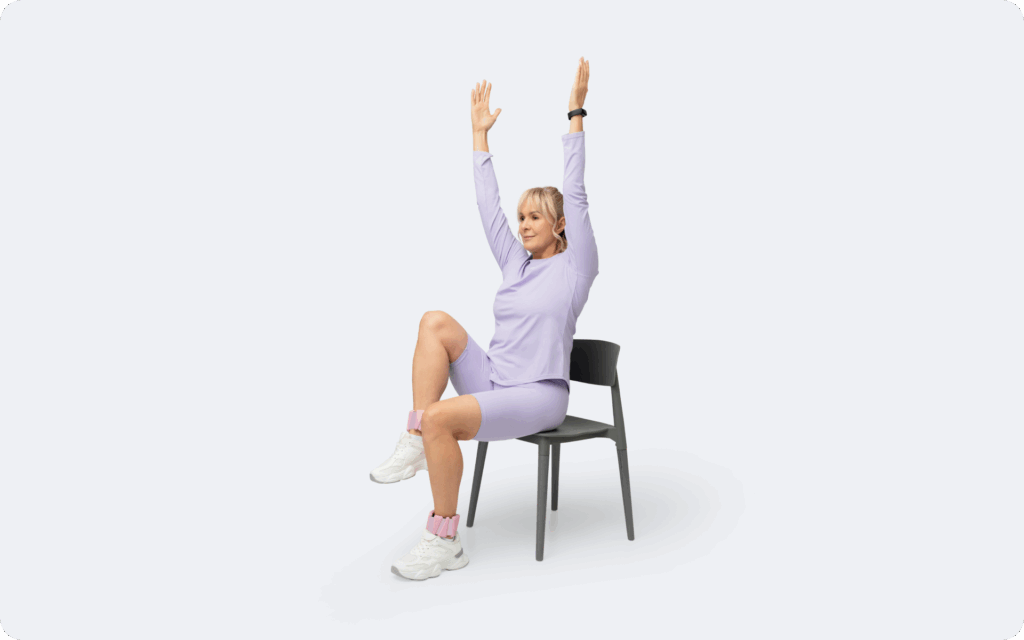
They can include (5):
- Seated dumbbell curls – strengthening the arms while being seated for added stability
- Supported shoulder presses – performed with a backrest or wall support
- Chair-assisted squats holding light dumbbells – helping maintain lower-body strength
- Standing calf raises with light weights – improving ankle strength and balance
Gentle doesn’t mean ineffective. In fact, small, consistent efforts can protect mobility over time (2). Movements such as these fall under hand weight exercises for seniors due to their necessity to grip dumbbells and can also be considered part of broader weight-bearing exercises for seniors, which are important for supporting bone strength as we age (6).
For individuals who are in their seventies and beyond, including those who are looking for dumbbell exercises for seniors over 70, seated or supported variations often provide the safest starting point. These seated dumbbell exercises for seniors reduce strain while still encouraging the muscles to stay active.
The key is intention – lift with awareness, lower slowly, rest when needed.
And perhaps most importantly, choose movements that feel doable in the long term. Fitness at this stage of life isn’t about pushing limits, it’s about preserving independence, confidence, and the quiet strength that makes everyday living easier.
Read more: Chair Workout Plan for Seniors to Lose Belly Fat
Are Dumbbell Exercises Good for Seniors?
The short answer? They can be, particularly when chosen thoughtfully and performed with care and intention.
Strength naturally changes with age. Muscle mass tends to decline gradually over the years, and with that can come reduced stability, slower movement, and greater effort required for everyday tasks (7). This is where dumbbell exercises for seniors can play a meaningful role – not as a dramatic fix, not as a performance goal, but as steady support.
Here’s why they can be beneficial, in practical, everyday terms:
• They help maintain functional strength
Strength isn’t just about muscles looking firm, it’s about being able to:
- Stand up without pushing off the armrest
- Carry a bag without straining the shoulders
- Climb stairs without gripping the railing tightly
Dumbbells allow for movements that mimic these tasks. When strength is practiced in patterns similar to daily life, the carryover tends to feel more natural (8).
Whether you’re a workout beast or just a beginner making your first foray into the world of fitness and dieting – BetterMe has a lot to offer to both newbies and experts! Install the app and experience the versatility first-hand!
- They allow controlled resistance
Unlike machines that lock the body into one fixed path, dumbbells move freely. This means:
- Smaller stabilizing muscles are gently engaged (9)
- Posture awareness becomes part of the exercise (10)
- Weight can be adjusted in small increments
This flexibility makes them suitable for gradual progression, which is particularly important in strength exercises for older adults (11).
- They support bones through resistance
Bones respond to load. When muscles pull against bone during resistance training, this creates mechanical stress that helps maintain bone strength over time. This is why many weight-bearing exercises for seniors include resistance training as part of a broader plan (12). The key is moderate load and not maximal effort.
- They can be adapted to many settings
One of the most practical advantages of using dumbbells is accessibility. Many movements can be performed:
- Seated
- Standing with support
- In small spaces
That makes dumbbell exercises for seniors at home a realistic option, not just a gym-based routine.
- They encourage balance and coordination
When holding weights in standing positions, the body has to subtly stabilize. This engagement of the hips, core, and ankles can complement structured balance work. In a nutshell, holding weights in a standing position adds a postural challenge, which may support balance when strength training is practiced consistently (10).
- They are not the same as high-load lifting
It’s important to distinguish moderate resistance training from maximal lifting approaches such as powerlifting for seniors. The goals differ. For most older adults, the focus is controlled movement, joint comfort, and sustainable effort – not peak performance.
So, are dumbbell exercises for seniors good?
They can be a practical tool for maintaining strength, mobility, and independence. When they are scaled appropriately, performed with good form, and balanced with rest, the outcome is beneficial for seniors. The benefit lies not in intensity, but in consistency. And over time, consistency is often what makes the difference!
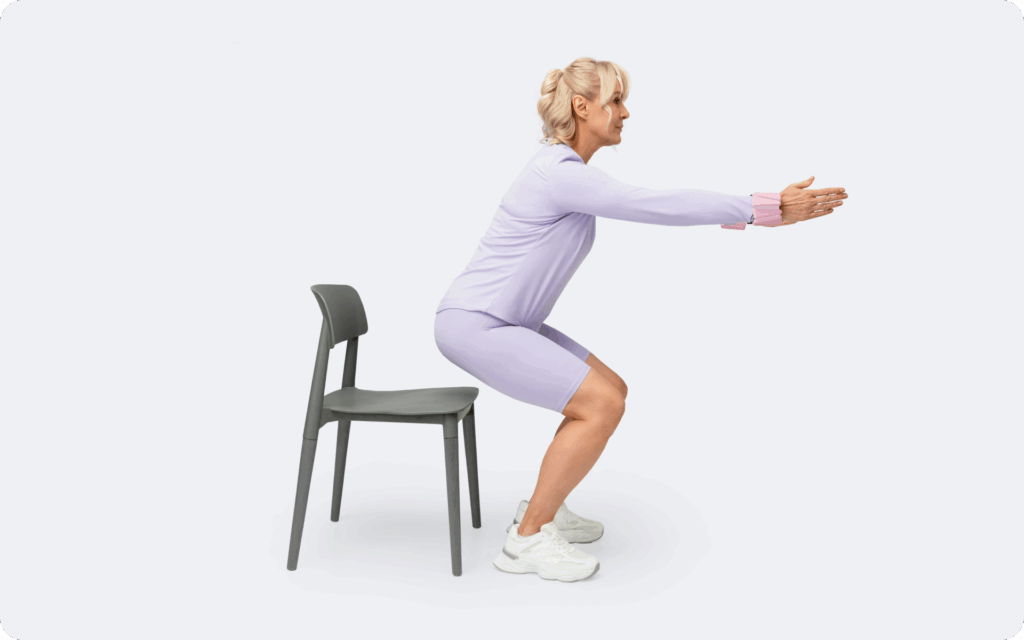
5 Dumbbell Exercises for Seniors
This is where things get practical.
The best dumbbell exercises for seniors don’t need to be flashy. They can be steady, grounded, and designed to support the movements people rely on every single day – standing up, reaching overhead, carrying objects, and keeping balance while walking.
Below are five exercises that are aligned with established resistance training principles for older adults (5, 13). Each one can be modified based on your comfort and experience level.
- Seated Dumbbell Biceps Curl
Why it matters:
Arm strength supports everyday tasks such as lifting groceries, holding railings, or carrying a bag.
How to do it:
- Sit upright in a sturdy chair with your feet flat on the floor.
- Hold a light dumbbell in each hand, your arms by your sides.
- Slowly bend your elbows to lift the weights toward your shoulders.
- Lower with control.
What it supports:
- Upper-arm strength
- Grip endurance
- Controlled movement patterns
This is one of the most accessible seated dumbbell exercises for seniors, particularly for those who prefer extra stability.
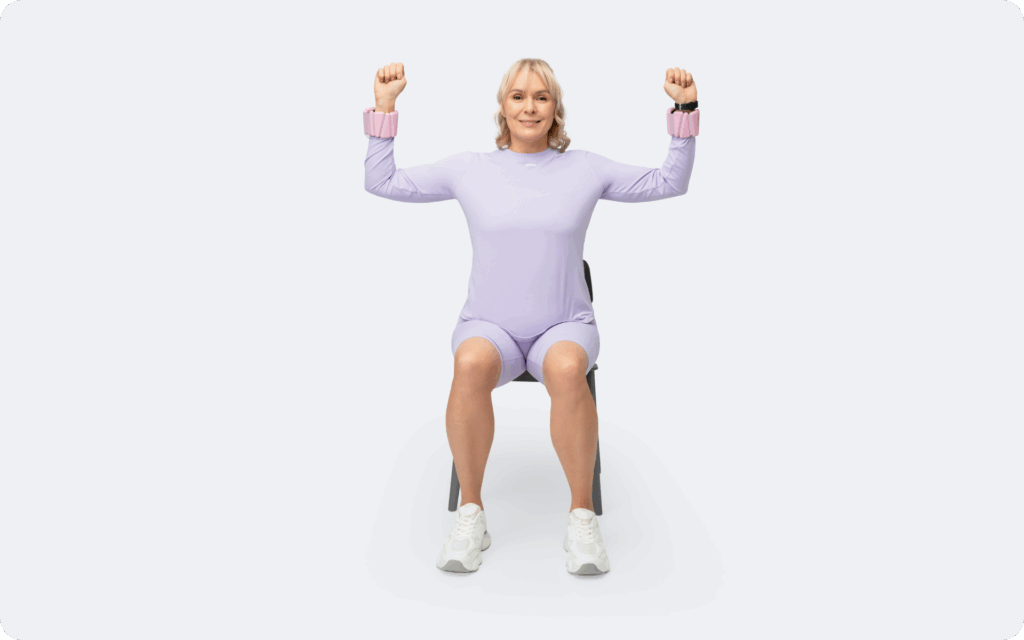
- Dumbbell Chair Stand
Why it matters:
Standing up from a seated position is one of the clearest markers of functional independence.
How to do it:
- Sit on the edge of a chair with your feet hip-width apart.
- Hold light dumbbells at your sides.
- Lean slightly forward and stand up.
- Slowly sit back down with control.
What it supports:
- Thigh and hip strength
- Functional lower-body power
- Everyday mobility
This movement fits naturally into broader weight exercises for seniors as it mirrors real-life activity.
- Standing Dumbbell Shoulder Press
Why it matters:
Reaching overhead requires coordinated strength in the shoulders and upper body.
How to do it:
- Stand with your feet shoulder-width apart.
- Hold dumbbells at shoulder height.
- Press upward slowly.
- Lower back down in a controlled manner.
If balance feels uncertain, perform this seated with back support.
What it supports:
- Shoulder strength
- Postural control
- Upper-body endurance
This is part of many strength exercises for older adults as it reinforces overhead function.
Reasons why BetterMe is a safe bet: a wide range of calorie-blasting workouts, finger-licking recipes, 24/7 support, challenges that’ll keep you on your best game, and that just scratches the surface! Start using our app and watch the magic happen.
- Dumbbell Heel Raise
Why it matters:
Lower-leg strength contributes to walking stability.
How to do it:
- Stand behind a chair for support.
- Hold light dumbbells at your sides.
- Slowly lift your heels off the floor.
- Lower with control.
What it supports:
- Calf strength
- Ankle stability
- Walking mechanics
Movements like this are often included in weight-bearing exercises for seniors due to the standing position and gravitational load.
- Dumbbell Row (Supported)
Why it matters:
Pulling strength supports posture and reduces the tendency to round the shoulders.
How to do it:
- Place one hand on a chair or sturdy surface for support.
- Hold a dumbbell in the opposite hand.
- Pull your elbow back toward your hip.
- Lower slowly.
What it supports:
- Upper-back strength
- Postural endurance
- Balanced muscle development
This movement pairs well with core exercises for seniors, as maintaining a stable torso is part of the action.
A Note on Progression
These exercises can be adapted for different ages and ability levels, including dumbbell exercises for seniors over 70. The focus should remain on:
- Light to moderate weight
- Slow, controlled movement
- Steady breathing
- Gradual progression
These aren’t extreme routines, they’re practical, sustainable weightlifting exercises for seniors and are designed to maintain strength over time. Consistency matters more than intensity.
Read more: The Ultimate Guide to Resistance Exercises for Seniors
What Weight of Dumbbells Should a Senior Use?
This is one of the most common questions. And honestly, one of the most misunderstood.
There isn’t a universal “right” weight. The correct starting point depends on current strength, balance, joint comfort, and previous experience with resistance training. Two people of the same age may need completely different loads – that’s normal.
Instead of focusing on numbers, it’s more helpful to think in terms of effort and control.
Start With a Weight That Feels Manageable, but Not Effortless
A practical guideline used in resistance training research is choosing a weight that allows (11):
- About 8-12 controlled repetitions
- Mild to moderate fatigue by the final few repetitions
- No loss of form
If you can lift the weight 20 times easily, it may be too light to stimulate strength. On the other hand, if you cannot complete at least 6-8 repetitions with controlled form, the load may be too heavy for your liking.
For beginners, this usually means starting with a light weight which allows 8-12 smooth, steady repetitions while feeling moderate effort toward the final few reps. The exact number on the dumbbell will vary from person to person, but what matters most is controlled movement and appropriate challenge, not a specific pound amount.
The “Form First” Rule
With dumbbell exercises for seniors, technique matters more than the load. A lighter weight performed with control is more beneficial than a heavier weight lifted with momentum.
Look for:
- Smooth, steady lifting
- Controlled lowering (no dropping the weight)
- Stable posture
- Comfortable breathing
If balance feels challenged during standing movements, performing the exercise seated is a smart modification.
Progress Gradually
Strength improves through progressive overload, which simply means gradually increasing the challenge over time (14).
Progression can happen in small ways:
- Add 1-2 lbs
- Add 1-2 repetitions
- Slow the lowering phase
- Increase from one set to two
This gradual approach is particularly important in dumbbell exercises for seniors over 70, where joint sensitivity and recovery time may differ from younger populations.
Pay Attention to Recovery
Mild muscle soreness the next day can be normal, but sharp pain in joints is not.
Allow at least one day of rest between working the same muscle groups. Recovery is part of adaptation.
When to Seek Guidance
Before starting new weightlifting exercises for seniors, it may be helpful to:
- Speak to a healthcare professional if there are existing mobility concerns
- Work with a certified trainer familiar with strength exercises for older adults
- Begin with supervised sessions to learn proper form
The right weight is that which challenges the muscle while still feeling controlled and sustainable.
What Dumbbell Exercises Should Seniors Avoid?
Not every movement is the right fit for every body. This is true at any age, but it becomes particularly important later in life, when joints may be more sensitive and balance may require greater attention.
When discussing dumbbell exercises for seniors, the focus should stay on control, stability, and sustainability. Exercises that compromise those principles may not be appropriate for everyone.
Below are general categories to approach with caution.
- Fast, Explosive Lifting
Rapid, jerky movements with weights increase joint stress and reduce control. High-velocity lifts – particularly those performed overhead or while balancing – may raise the risk of losing stability.
For most older adults, slow and controlled repetitions are generally safer and more effective than sloppy explosive patterns.
- Very Heavy, Low-Rep Lifting
Lifting near-maximal weights for very few repetitions (such as 1-3 reps) places high stress on joints and connective tissue (11). Moderate loads with consistent form are typically more appropriate.
- Unsupported Overhead Movements With Poor Balance
Overhead pressing while standing on an unstable surface, or using weights that feel difficult to control, may increase fall risk.
If balance is uncertain:
- Perform overhead movements seated
- Use back support
- Reduce the load
Safety should always take priority over intensity.
- Deep Forward Bending With Weights
Holding dumbbells while bending deeply at the waist, particularly with a rounded back, may strain the lower back. Hip hinging is safe when performed correctly, but it requires good form awareness. Beginners may do better by learning the pattern without weight first.
- Exercises That Cause Joint Pain
Mild muscle fatigue is expected. Sharp or persistent joint discomfort is not.
If an exercise causes:
- Pinching in the shoulder
- Knee discomfort during squats
- Strain in the lower back
then it may need modification, lighter weight, or replacement.
A Better Way to Think About It
Instead of asking “Which exercises are bad?” it may be more helpful to ask:
- Does this movement feel controlled?
- Can I maintain steady breathing?
- Do I feel stable throughout the motion?
- Can I stop the movement at any point without losing balance?
If the answer is yes, the exercise is likely appropriate.
The goal of dumbbell exercises for seniors isn’t intensity for its own sake, it’s steady strength, reliable balance, and confidence in everyday movement. When in doubt, scale down. Progression is always possible, but safety should always come first.
It’s generally recommended that a 70-year-old choose weights that allow for 8-12 controlled repetitions with moderate effort and good form – the exact number varies by individual strength and experience. Yes, older adults can rebuild muscle through consistent resistance training. However, progress may be gradual and requires regular effort. Walking helps maintain muscle endurance and supports lower-body function. However, it’s generally not enough to significantly increase muscle mass on its own. Brisk walking challenges the muscles more than slow walking, but neither typically provides enough resistance to substantially build muscle mass compared to other resistance-based exercises. Walking is excellent for heart health and mobility, but adding strength exercises can better support muscle, balance, and long-term independence. We advise utilizing both in a well-rounded fitness plan for seniors.Frequently Asked Questions
What weight dumbbells should a 70-year-old use?
Can a 70-year-old regain muscle mass?
Can walking build muscle mass?
Is it better to walk fast or slow to build muscle?
Is it okay if walking is your only exercise?
The Bottom Line
Aging doesn’t mean stepping away from strength, it means approaching it with better intention and planning.
Throughout our guide, we’ve looked at how dumbbell exercises for seniors can support functional strength, balance, and confidence in everyday activities – not through extreme effort, not through heavy and maximal lifting, but through steady, controlled resistance that meets the body where it is.
A few themes that stand out are:
- Consistency matters more than intensity. Moderate weights performed with control can help maintain muscle and support mobility over time, instead of stressing out over how heavy the weights need to be.
- Form comes first. Smooth, steady repetitions are more valuable than heavier loads lifted with strain.
- Standing movements add a postural challenge. When appropriate, they may contribute to balance-related benefits.
- Progression should be gradual. Small increases in load or repetitions are enough to continue adapting safely.
- Not every exercise suits every person. Movements should feel stable, controlled, and sustainable.
Whether someone is exploring dumbbell exercises for seniors at home, adding them to a broader routine for older adults, or simply just adding light resistance to support daily functioning, the goal remains the same – to preserve independence.
Strength at this stage of life isn’t about performance metrics, it’s about being able to rise from a chair without hesitation, carry groceries without strain, walk with steadiness, maintain posture, and feel capable.
The value of dumbbell exercises for seniors lies in their simplicity – a pair of manageable weights, a stable surface, and a few controlled movements practiced regularly. Over time, these small efforts can add up in a meaningful way.
DISCLAIMER:
This article is intended for general informational purposes only and does not serve to address individual circumstances. It is not a substitute for professional advice or help and should not be relied on for making any kind of decision-making. Any action taken as a direct or indirect result of the information in this article is entirely at your own risk and is your sole responsibility.
BetterMe, its content staff, and its medical advisors accept no responsibility for inaccuracies, errors, misstatements, inconsistencies, or omissions and specifically disclaim any liability, loss or risk, personal, professional or otherwise, which may be incurred as a consequence, directly or indirectly, of the use and/or application of any content.
You should always seek the advice of your physician or other qualified health provider with any questions you may have regarding a medical condition or your specific situation. Never disregard professional medical advice or delay seeking it because of BetterMe content. If you suspect or think you may have a medical emergency, call your doctor.
SOURCES:
- Feasibility of a machine vs free weight strength training program and its effects on physical performance in nursing home residents: a pilot study (2017, pubmed.ncbi.nlm.nih.gov)
- Physical Activity Guidelines for Americans, 2nd Edition (2018, health.gov)
- Physical Activity Benefits for Adults 65 or Older (2025, cdc.gov)
- How can strength training build healthier bodies as we age? (2022, nia.nih.gov)
- Exercise & Physical Activity: Your Everyday Guide (2015, pennmemorycenter.org)
- The Effectiveness of Physical Exercise on Bone Density in Osteoporotic Patients (2018, pmc.ncbi.nlm.nih.gov)
- The impact of muscle mass, strength, and physical functioning on postural balance in older adults with sarcopenia (2025, sciencedirect.com)
- Efficacy of 12-Week Handgrip Strength Training Program Amongst Older Adults: A Pilot Study (n.d., thesportsjournal.org)
- A comparison of free weight squat to Smith machine squat using electromyography (2009, pubmed.ncbi.nlm.nih.gov)
- Muscle activity of the core during bilateral, unilateral, seated and standing resistance exercise (2011, researchgate.net)
- Resistance Training for Older Adults: Position Statement From the National Strength and Conditioning Association (2019, journals.lww.com)
- Effect of different types of exercise on bone mineral density in postmenopausal women: a systematic review and network meta-analysis (2025, nature.com)
- Dose-response relationship of resistance training in older adults: a meta-analysis (2010, pubmed.ncbi.nlm.nih.gov)
- Progressive overload without progressing load? The effects of load or repetition progression on muscular adaptations (2022, pmc.ncbi.nlm.nih.gov)