Maintaining muscle and strength as you age is not just about looking good; it’s a cornerstone of health, independence, and overall quality of life. Research consistently shows that resistance training helps older adults (1):
- maintain bone density,
- improve balance,
- reduce the risk of falls, and
- manage chronic conditions.
While the thought of a gym can be intimidating, you don’t need heavy weights or complex machinery to achieve these benefits. Your own body can be the most effective tool you have.
This guide is designed to provide a clear, science-backed approach to bodyweight training for seniors. We will cut through the misinformation and focus on what truly matters: safe, effective exercises you can do at home. We’ll explore how to perform them correctly, how to structure a program, and what you can realistically expect from your efforts.
What Are Safe Bodyweight Exercises for Seniors?
Safe bodyweight exercises for seniors are movements that use your own body as resistance to challenge your muscles. The focus is on controlled, stable movements that improve functional strength–the strength you need for daily activities like getting up from a chair, carrying groceries, or climbing stairs.
A key principle of safety is starting with a physical readiness assessment. Before beginning any new exercise regimen, it’s recommended to consult a doctor or physical therapist, especially if you have pre-existing health concerns like cardiovascular disease, osteoporosis, or severe arthritis.
The Physical Activity Readiness Questionnaire (PAR-Q) is a simple tool that can help you determine if a medical consultation is necessary (2).
Safe exercises should:
- Be low-impact, minimizing stress on joints like the knees, hips, and spine.
- Allow for modifications to match your current fitness level. For example, a squat can be done with support from a chair or countertop.
- Focus on proper form over the number of repetitions. Quality of movement is always more important than quantity.
- Exclude high-risk movements like jumping or exercises that require extreme flexibility or balance, unless you have progressed to that level under guidance.
Is Bodyweight Training Effective for Seniors?
Yes, bodyweight training is effective for seniors to improve both health and fitness. Regularly practicing bodyweight exercises can lead to (3, 4) :
- Increased muscle strength and endurance
- Improved cardiovascular health
- Enhanced flexibility and joint mobility
- Better balance and coordination, reducing fall risk
- Improved posture and core stability
- Greater bone density and joint resilience
- Reduced risk of chronic diseases such as type 2 diabetes, osteoporosis, and cardiovascular disease
- Enhanced ability to perform daily activities independently
In this article, we’re focusing on how seniors can use bodyweight exercises primarily to build muscle and by extension, enjoy the health benefits that come with improved body composition. Many of the benefits listed above are guaranteed by such a consistent routine.
BetterMe will shake off your mental funk, rid you of your energy-zapping habits, and help you sculpt the body of your dreams. Intrigued? Hurry up and change your life for the better!
Can You Really Build Muscle with Bodyweight Exercises?
Absolutely. The process of building muscle, known as hypertrophy, is driven by creating sufficient mechanical tension and metabolic stress within the muscle fibers (5).
- Mechanical Tension refers to the force generated within a muscle when it is stretched and contracted under load.
- Metabolic Stress is the buildup of byproducts like lactate within the muscle during sustained effort, often felt as a “burning” sensation.
Bodyweight exercises, when performed with high effort, can generate significant amounts of both. For example, performing squats to the point of near failure challenges the quadriceps, glutes, and hamstrings, creating both tension and metabolic stress that signal the body to adapt by building bigger, stronger muscle fibers.
Research confirms that hypertrophy can occur across a wide spectrum of loading ranges, from heavy weights for low reps to lighter loads–including bodyweight–for higher reps (6). The key variable is effort. As long as sets are taken close to muscular failure, muscle growth can be achieved (7).
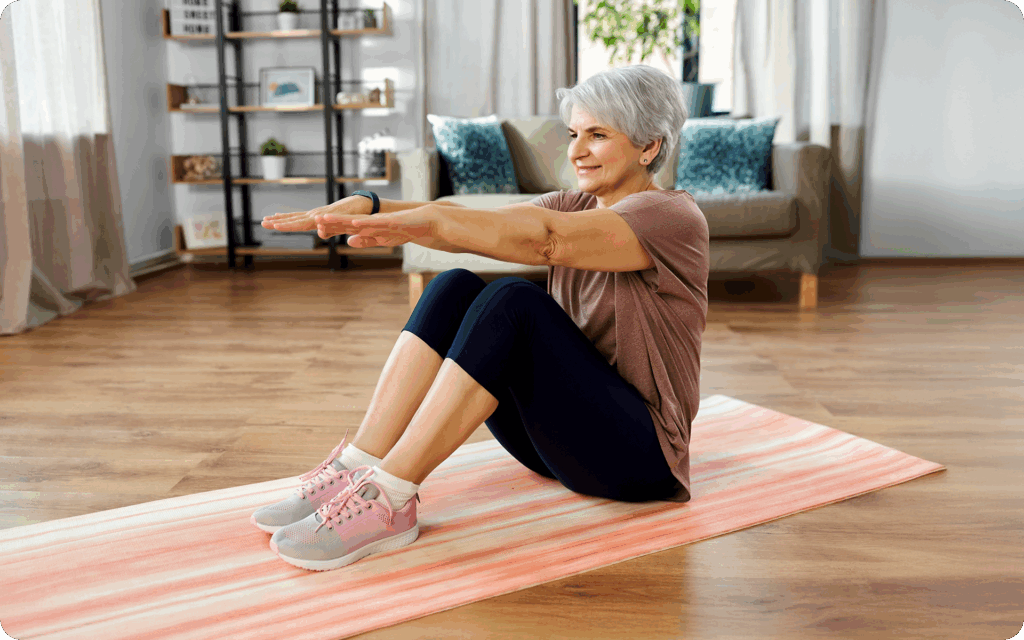
For many seniors, especially those new to strength training, bodyweight exercises provide more than enough resistance to trigger this adaptive response. A challenging set of wall push-ups can be just as potent for muscle growth as a bench press for someone at the beginning of their fitness journey.
The effectiveness of any resistance training program also hinges on a principle called progressive overload. This means that for muscles to grow stronger, they must be challenged with a stimulus greater than what they are accustomed to (8). While many associate this with lifting heavier weights, overload can also be achieved by:
- Increasing repetitions: Performing more reps of an exercise.
- Increasing sets: Doing more rounds of an exercise.
- Decreasing rest time: Reducing the rest period between sets to increase metabolic demand.
- Improving technique: Performing the exercise through a fuller range of motion.
- Increasing time under tension: Slowing down the movement to keep the muscle working longer.
Studies have shown that when taken close to muscular failure–the point where you cannot complete another repetition with good form–bodyweight exercises can stimulate muscle protein synthesis, the process responsible for muscle growth (9).
For older adults, this is particularly beneficial as it provides the necessary stimulus for strength and muscle maintenance without the risks associated with handling heavy loads. This makes bodyweight exercises for seniors at home a practical and powerful option.
Read more: Chair Stretches for Seniors: A Gentle Way to Improve Flexibility
What Are the Most Beneficial Bodyweight Exercises for Seniors?
The most beneficial exercises are compound movements that engage multiple muscle groups simultaneously. These exercises mimic everyday movements, building functional strength that translates directly to improved daily living. Below is a full-body workout program designed for beginners.
Program Notes
- Glossary:
- Rep (Repetition): One complete execution of an exercise.
- Set: A group of repetitions performed without rest.
- RPE (Rate of Perceived Exertion): A scale of 1-10 to measure how hard you feel you are working. Aim for an RPE of 7-8, which means you could do 2-3 more reps if you had to, but the set feels challenging.
- Equipment Needed: A sturdy chair and a wall.
- Frequency: Perform this workout 2-3 times per week on non-consecutive days (e.g., Monday, Wednesday, Friday) to allow for adequate recovery.
- Rest: Rest for 60-90 seconds between sets.
Beginner Full-Body Bodyweight Program
| Exercise | Sets | Reps | RPE |
|---|---|---|---|
| Chair Squat | 2-3 | 8-12 | 7-8 |
| Wall Push-Up | 2-3 | 8-12 | 7-8 |
| Glute Bridge | 2-3 | 10-15 | 7-8 |
| Step-Up (using a low, sturdy step) | 2-3 | 8-12 per leg | 7-8 |
| Bird-Dog | 2-3 | 8-12 per side | 7-8 |
| Toe Stand | 2-3 | 10-15 | 7-8 |
This program offers a great starting point for weight training for seniors at home, using only bodyweight. You can find more advanced programs using a bodyweight workout app.
Exercise Instructions
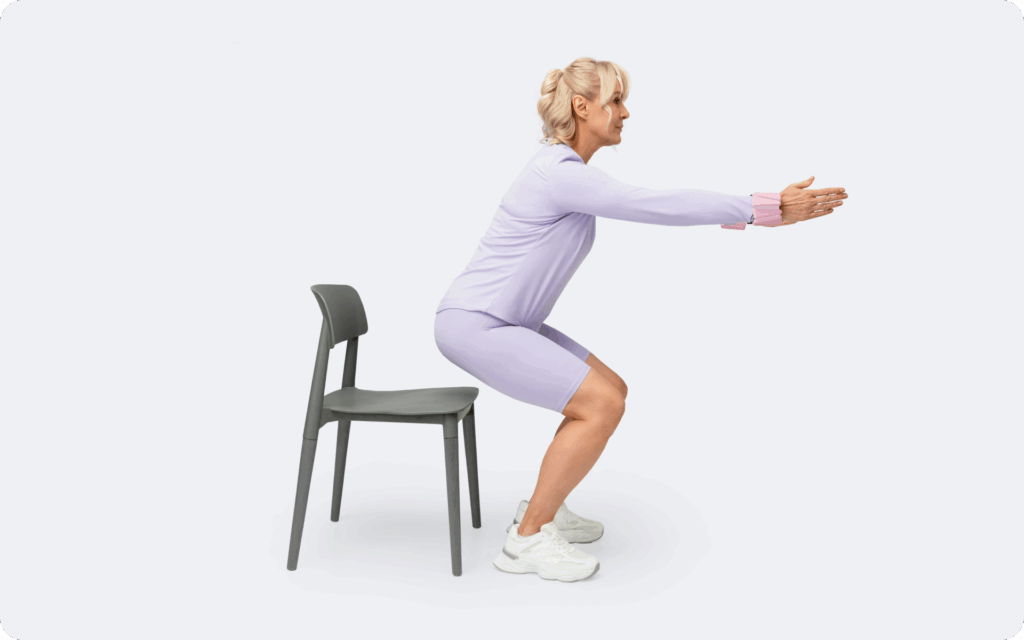
Chair Squat
This exercise strengthens the legs and glutes, which are crucial for walking, climbing stairs, and getting up from a seated position.
- Stand in front of a sturdy chair with your feet shoulder-width apart and your toes pointing slightly outward.
- Keeping your chest up and back straight, hinge at your hips and bend your knees as if you are about to sit down.
- Lower yourself in a controlled manner until your buttocks lightly touch the chair. Do not fully sit or rest.
- Push through your heels to return to the starting position, squeezing your glutes at the top.
Wall Push-Up
A safe and effective way to build upper body and core strength, targeting the chest, shoulders, and triceps.
- Stand facing a wall, about arm’s length away.
- Place your palms on the wall, slightly wider than your shoulders, at shoulder height.
- Keeping your body in a straight line from your head to your heels, bend your elbows and lean your body toward the wall.
- Lower yourself until your nose is close to the wall, then push back to the starting position.
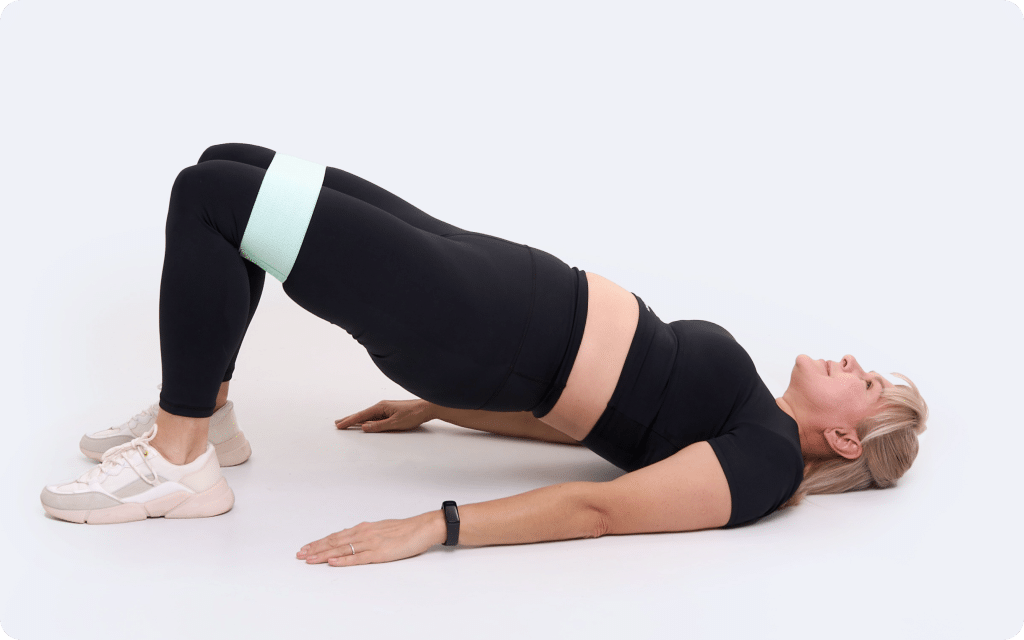
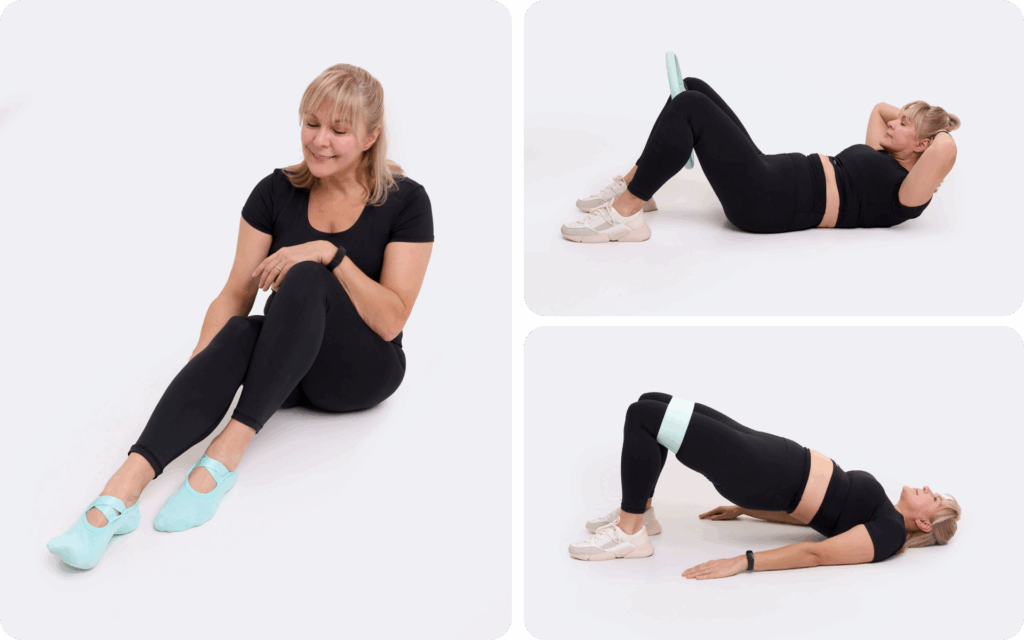
Glute Bridge
This exercise isolates the gluteal muscles and hamstrings, which are important for hip stability and lower back health.
- Lie on your back with your knees bent, feet flat on the floor about hip-width apart, and your arms by your sides with palms down.
- Engage your core and glutes, then lift your hips off the floor until your body forms a straight line from your shoulders to your knees.
- Squeeze your glutes at the top of the movement. Avoid arching your lower back.
- Slowly lower your hips back to the starting position.
Step-Up
This is a functional exercise that improves single-leg strength, balance, and coordination.
- Stand in front of a low, sturdy step or stair.
- Place your entire right foot firmly onto the step.
- Push through your right heel to lift your body up, bringing your left foot to meet your right on the step.
- Step back down with your left foot, followed by your right foot, returning to the starting position.
- Complete all reps on one leg before switching to the other.
Bird-Dog
An excellent exercise for improving core stability, balance, and coordination. It strengthens the muscles that support the spine.
- Start on all fours with your hands directly under your shoulders and your knees directly under your hips. Keep your back flat.
- Engage your core to keep your torso stable.
- Simultaneously extend your right arm straight forward and your left leg straight back, keeping both parallel to the floor.
- Hold for a moment, focusing on not letting your hips rock from side to side.
- Slowly return to the starting position and repeat on the other side (left arm, right leg). That is one repetition.
Whether you’re a workout beast or just a beginner making your first foray into the world of fitness and dieting – BetterMe has a lot to offer to both newbies and experts! Install the app and experience the versatility first-hand!
Toe Stand
This movement targets the calf muscles, which are important for ankle stability and balance.
- Stand with your feet hip-width apart, holding onto a chair or wall for balance if needed.
- Slowly rise onto the balls of your feet, lifting your heels as high as you can.
- Hold for a moment at the top.
- Slowly lower your heels back to the floor.
If you enjoy these movements, you may find that exploring different forms of calisthenics for seniors offers more variety.
What Are Common Exercise Mistakes Seniors Make?
Avoiding common mistakes is crucial for staying safe and making progress. Here are some pitfalls to watch out for:
- Ignoring the Warm-Up and Cool-Down: A warm-up, such as 5-10 minutes of light walking or marching in place, prepares your muscles and joints for exercise. A cool-down involving gentle stretching helps improve flexibility and aids recovery (10).
- Using Momentum: Swinging or using momentum to complete a repetition reduces the effectiveness of the exercise and increases the risk of injury. Each movement should be slow and controlled.
- Holding Your Breath: It’s a common tendency to hold your breath during exertion, which can cause a spike in blood pressure (11). Remember to breathe continuously: exhale during the most difficult part of the movement (e.g., pushing up from a squat) and inhale during the easier part.
- Poor Form: Prioritizing quantity over quality is a frequent mistake. It’s better to do fewer reps with perfect form than many reps with poor technique. If you’re unsure, consider watching videos from reputable sources or working with a professional.
- Doing Too Much, Too Soon: Enthusiasm is great, but overdoing it can lead to excessive soreness or injury. Stick to the recommended sets and reps, and progress gradually.
If you find yourself struggling with back pain, consider adding specific core exercises for seniors to strengthen the muscles that support your spine.
How Long Does It Take to See Results from Bodyweight Exercises?
Consistency is the most critical factor in seeing results. While every individual is different, you can expect to notice changes within a few weeks of starting a consistent program.
- 2-4 Weeks: You will likely feel stronger. Neurological adaptations are the first to occur; your brain becomes more efficient at recruiting muscle fibers, making you stronger even before your muscles have grown significantly in size. Daily tasks may start to feel easier (12).
- 4-8 Weeks: Visible changes in muscle tone may start to become apparent. You’ll notice an improvement in your muscular endurance, allowing you to complete more repetitions or sets (13).
- 3-6 Months: With consistent training and adequate nutrition, you can expect measurable increases in muscle mass and significant improvements in overall strength and functional ability (13).
Remember, progress isn’t always linear. Some weeks you’ll feel stronger than others. The key is to stick with it. Tracking your workouts–noting the sets, reps, and how you felt–can be a great way to monitor your progress and stay motivated.
Yes, you can improve muscle tone in your arms after 60. “Toning” is a result of building muscle and reducing body fat. Exercises like Wall Push-Ups, Chair Dips (if appropriate for your shoulder health), and resistance band curls can build muscle in the triceps and biceps, leading to a firmer appearance. No single food can burn belly fat. Fat loss is achieved by creating a sustained calorie deficit, meaning you burn more calories than you consume. A balanced diet rich in protein, fiber from vegetables and whole grains, and healthy fats is most effective for overall fat loss (14), including from the abdominal area. There is no single “normal” weight. A healthy weight is better determined by Body Mass Index (BMI) and waist circumference, but even these metrics have limitations in older adults. It is more important to focus on body composition (muscle-to-fat ratio), functional strength, and overall health markers as guided by a healthcare provider. Yes, a 70-year-old can regain some muscle tone. Numerous studies show that individuals in their 70s, 80s, and even 90s can build muscle and increase strength through consistent resistance training. The body’s ability to adapt to exercise persists throughout life (1). Some research suggests that being slightly overweight (a BMI of 25-29.9) in older adulthood may be associated with a lower risk of mortality, a concept known as the “obesity paradox (15).” However, this is still a topic of debate, and it’s crucial to distinguish this from obesity, which is linked to negative health outcomes. A healthcare provider can offer personalized advice based on your individual health profile. Your “true” weight is an average over time, but for consistency, it is best to weigh yourself first thing in the morning after using the restroom and before eating or drinking anything. Your weight can fluctuate by several pounds throughout the day due to food intake, fluid shifts, and activity (16).Frequently Asked Questions
Can flabby arms be toned after 60?
What is the number one food that burns belly fat?
What is the normal weight for a 70 year old?
Can a 70 Year Old Regain Muscle Tone?
Should seniors carry a little extra weight?
Is your true weight in morning or night?
The Bottom Line
Starting a strength training journey at any age is a powerful investment in your future. By focusing on safe, effective, and consistent full body weight exercises for seniors, you are taking a proactive step toward maintaining your independence, vitality, and health for years to come. The movements outlined here are just the beginning, check out our blog for more insights on elevating your workouts.
DISCLAIMER:
This article is intended for general informational purposes only and does not serve to address individual circumstances. It is not a substitute for professional advice or help and should not be relied on for making any kind of decision-making. Any action taken as a direct or indirect result of the information in this article is entirely at your own risk and is your sole responsibility.
BetterMe, its content staff, and its medical advisors accept no responsibility for inaccuracies, errors, misstatements, inconsistencies, or omissions and specifically disclaim any liability, loss or risk, personal, professional or otherwise, which may be incurred as a consequence, directly or indirectly, of the use and/or application of any content.
You should always seek the advice of your physician or other qualified health provider with any questions you may have regarding a medical condition or your specific situation. Never disregard professional medical advice or delay seeking it because of BetterMe content. If you suspect or think you may have a medical emergency, call your doctor.
SOURCES:
- Muscle Mass and Strength Gains Following Resistance Exercise Training in Older Adults 65–75 Years and Older Adults Above 85 Years (2023, journals.humankinetics.com)
- 2020 PAR-Q+ (2020, eparmedx.com)
- Effects of bodyweight and traditional resistance training on the functionality of elderly people: a randomized clinical trial (2020, researchgate.net)
- Benefits of Bodyweight Training (2025, humankinetics.me)
- Anabolic signals and muscle hypertrophy – Significance for strength training in sports medicine (2025, sciencedirect.com)
- Loading Recommendations for Muscle Strength, Hypertrophy, and Local Endurance: A Re-Examination of the Repetition Continuum (2021, mdpi.com)
- FOR BIGGER MUSCLES PUSH CLOSE TO FAILURE, FOR STRENGTH, MAYBE NOT (2024, fau.edu)
- Effects of Resistance Training Overload Progression Protocols on Strength and Muscle Mass (2024, pubmed.ncbi.nlm.nih.gov)
- Resistance training‐induced changes in integrated myofibrillar protein synthesis are related to hypertrophy only after attenuation of muscle damage (2016, pmc.ncbi.nlm.nih.gov)
- Warm Up, Cool Down (2024, heart.org)
- Influence of exercise using the Valsalva maneuver on vital signs in young adults (2024, pubmed.ncbi.nlm.nih.gov)
- Resistance training-induced adaptations in the neuromuscular system: Physiological mechanisms and implications for human performance (2025, physoc.onlinelibrary.wiley.com)
- Load-induced human skeletal muscle hypertrophy: Mechanisms, myths, and misconceptions (2025, sciencedirect.com)
- Tips for Healthy Eating for a Healthy Weight (2025, cdc.gov)
- The weight-loss paradox in older adults: balancing fat loss with muscle preservation (2025, link.springer.com)
- The Best Time To Weigh Yourself (and How Often You Should Step on the Scale) (2023, link.springer.com)
 Reviewed by