

Deciding how to structure your workouts can feel like a complex puzzle, particularly when you’re just starting. With so much information available, it’s easy to get lost in debates about the “best” way to train. However, one of the most effective and straightforward methods for beginners is the upper/lower split.
This guide will break down everything you need to know about the beginner upper/lower split. We’ll explore what it is, why it works so well for building foundational strength and muscle, and how to structure a program that delivers results. You’ll get a clear, science-backed roadmap to start your fitness journey with confidence.
What Is a Beginner Upper/Lower Split Workout?
A beginner upper/lower split workout is a training system that divides your exercises into two distinct categories: upper-body days and lower-body days.
On upper-body days, you train muscles in your:
- Chest
- Back
- Shoulders
- Arms
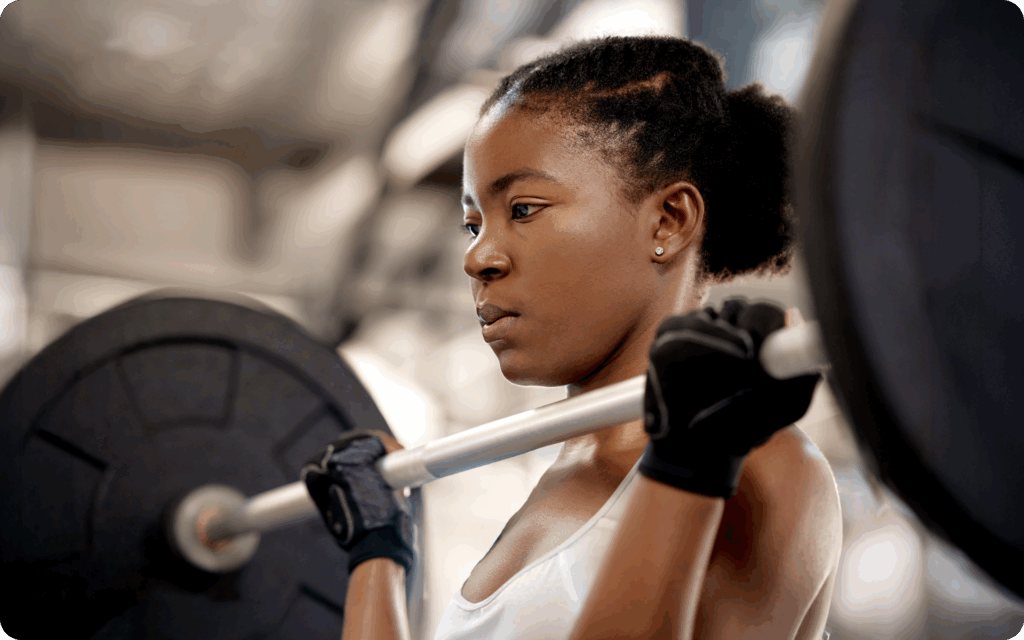
On lower-body days, you focus on your:
- Quadriceps
- Hamstrings
- Glutes
- Calves
This structure ensures that you train your entire body over the course of the week, typically across four training sessions.
The primary goal of this split is to allow for a higher training frequency for each muscle group compared to some other splits. By training each muscle group twice per week, you provide a consistent stimulus for growth and strength adaptation (1). At the same time, it gives each half of your body ample time to recover (2). For example, after an upper-body day, those muscles get at least 48 hours of rest before they’re trained again.
This approach is particularly beneficial for beginners as it:
- Is relatively simple to follow
- Promotes balanced development
- Manages fatigue effectively
This allows you to learn proper exercise form without feeling overwhelmed.
Whether you’re a workout beast or just a beginner making your first foray into the world of fitness and dieting – BetterMe has a lot to offer to both newbies and experts! Install the app and experience the versatility first-hand!
Which Split Is Best for Beginners?
The search for the “best” workout split is common, but the truth is that no single split is universally superior for everyone. The ideal split will depend on your individual context, including your schedule, recovery capacity, and personal goals.
Let’s look at a few scenarios to understand this better.
The Time-Constrained Beginner
If you can only make it to the gym two or three times per week, a full-body routine may be more practical. Training your entire body in each session ensures that every muscle group gets stimulated frequently enough to drive progress, even with fewer workout days. An upper/lower split in this context would mean each muscle group is only trained once a week, which may not be optimal.
The Beginner Focused on Recovery
For those who are new to lifting, delayed onset muscle soreness (DOMS) can be intense (3). An upper/lower split can be quite effective here. By splitting the body in half, you’re not overwhelming your system in a single session. This allows for better recovery between workouts, as your upper body rests while you train your lower body, and vice versa.

The Aspiring Bodybuilder
A beginner with ambitions for bodybuilding might find a body-part split (such as a “bro split”) appealing, where each day is dedicated to one or two muscle groups (e.g. chest day, back day). However, for a true beginner, this often results in training each muscle only once per week.
Research has suggested that a higher training frequency – training each muscle group at least twice per week – is generally more effective for muscle growth (4). This makes the upper/lower split a more productive choice early on.
Ultimately, consistency is the most critical factor. The best split for you is one you can stick with consistently over time. The beginner upper/lower split often hits the sweet spot between training frequency, recovery, and manageable session volume.
If you’re interested in exploring how different splits can impact your results, you can learn more about the best workout split for muscle gain.
Read more: Beginner Shoulder Workout Plan: Exercises, Tips, and FAQs
Is an Upper/Lower Split Good for Beginners?
Yes, an upper/lower split is an excellent choice for beginners for several key, research-supported reasons. It provides a balanced framework for developing foundational strength and muscle without being overly complex or taxing.
- Optimal Training Frequency
One of the most significant advantages is its effect on training frequency. Most upper/lower split programs, such as an upper/lower split 4-day routine, have you training each muscle group twice per week.
A 2016 meta-analysis concluded that training muscles twice a week produces superior hypertrophic outcomes compared to once-a-week training (4). This frequency provides a repeated stimulus for muscle protein synthesis, the process your body uses to repair and build muscle tissue, which leads to more consistent growth over time.
- Enhanced Recovery
By dividing workouts between the upper and lower body, you allow for substantial recovery.
While your upper body is recovering from its session, you can train your lower body without causing additional fatigue to the muscles that are trying to repair. This structure helps manage systemic fatigue, which is the overall exhaustion you feel, and local fatigue within the muscles themselves. Better recovery means that you can approach each workout with more energy and intensity, leading to higher quality sets and reps.

- Manages Volume Effectively
For beginners, workout volume – the total amount of work performed (sets x reps x weight) – is a key driver of progress (5). However, too much volume in a single session can be counterproductive, leading to excessive muscle damage and poor recovery (2).
An upper/lower split distributes your total weekly volume for each muscle group across two sessions. This makes each workout more manageable and allows you to maintain better form, which is essential for preventing injury and ensuring the target muscles are doing the work.
- Focus on Compound Movements
A basic upper/lower split is built around major compound exercises such as squats, deadlifts, bench presses, and rows. These movements are incredibly efficient as they engage multiple muscle groups simultaneously (6). For a beginner, mastering these foundational lifts is the fastest way to build a strong base, improve coordination, and stimulate overall muscle growth.
If you’re curious about how to pair different muscle groups effectively in your training, you may find it helpful to read about which muscle groups to work together.
What Is a Moderate Beginner Upper/Lower Split?
A moderate beginner upper/lower split is a structured training plan that’s designed to build foundational strength and muscle without being overly demanding. It typically involves four training days per week, alternating between upper- and lower-body workouts. This schedule allows for optimal training frequency while ensuring adequate rest.
Here’s a sample upper/lower split example you can follow.
Program Notes
- Glossary:
- RPE (Rate of Perceived Exertion): A scale from 1-10 to measure how hard a set feels. An RPE of 8 means you feel you could have done two more reps with good form.
- 1-Rep Max (1RM): The maximum amount of weight you can lift for a single repetition of an exercise.
- Equipment Needed: Barbell, dumbbells, weight plates, bench, pull-up bar, cable machine, leg press machine.
- Split Structure: The program is a 4-day upper/lower split. A common schedule is:
- Monday: Upper-body 1
- Tuesday: Lower-body 1
- Wednesday: Rest
- Thursday: Upper-body 2
- Friday: Lower-body 2
- Saturday/Sunday: Rest
- Sets and Reps: The program uses a variety of rep ranges to stimulate different pathways for muscle growth. Aim for the prescribed reps, focusing on progressive overload – gradually increasing the weight, reps, or sets over time.
- Loading: For strength-focused lifts (5-8 reps), use a weight that is around 75-85% of your 1RM, or an RPE of 8-9. For hypertrophy-focused lifts (8-15 reps), use a lighter load, around 65-75% of your 1RM, or an RPE of 7-8. The key is to take sets close to muscular failure.
- Rest: Rest 2-3 minutes between sets on heavy compound lifts and 60-90 seconds on isolation exercises.
Reasons why BetterMe is a safe bet: a wide range of calorie-blasting workouts, finger-licking recipes, 24/7 support, challenges that’ll keep you on your best game, and that just scratches the surface! Start using our app and watch the magic happen.
Beginner Upper/Lower Split Program
| Exercise | Sets | Reps | Rest |
|---|---|---|---|
| Day 1: Upper-body strength focus | |||
| Bench press | 3 | 5-8 | 2-3 mins |
| Barbell row | 3 | 5-8 | 2-3 mins |
| Overhead press | 3 | 6-10 | 2 min |
| Lat pulldown | 3 | 8-12 | 90 secs |
| Dumbbell bicep curls | 2 | 10-15 | 60 secs |
| Tricep pushdowns | 2 | 10-15 | 60 secs |
| Day 2: Lower-body strength focus | |||
| Barbell back squat | 3 | 5-8 | 2-3 mins |
| Romanian deadlift | 3 | 6-10 | 2 mins |
| Leg press | 3 | 8-12 | 90 secs |
| Walking lunges | 3 | 10-12 per leg | 90 secs |
| Seated calf raises | 4 | 10-15 | 60 secs |
| Day 3: Rest | |||
| Day 4: Upper-body hypertrophy focus | |||
| Incline dumbbell press | 3 | 8-12 | 90 secs |
| Seated cable row | 3 | 8-12 | 90 secs |
| Dumbbell lateral raises | 3 | 12-15 | 60 secs |
| Pull-ups (or assisted) | 3 | As many as possible | 2 mins |
| Hammer curls | 3 | 10-15 | 60 secs |
| Overhead triceps extension | 3 | 10-15 | 60 secs |
| Day 5: Lower-body hypertrophy focus | |||
| Leg press | 3 | 10-15 | 90 secs |
| Lying leg curls | 3 | 12-15 | 60 secs |
| Goblet squat | 3 | 10-15 | 90 secs |
| Glute bridges | 3 | 15-20 | 60 secs |
| Standing calf raises | 4 | 15-20 | 60 secs |
| Days 6 and 7: Rest |
Exercise Execution Guide
Bench Press
- Lie flat on the bench with your feet firmly on the floor and your eyes directly under the barbell.
- Grip the bar with your hands slightly wider than shoulder-width apart. Squeeze your shoulder blades together and arch your lower back slightly.
- Unrack the bar and hold it over your chest with your arms locked out.
- Lower the bar in a controlled manner to mid-chest, keeping your elbows at a 45-degree angle.
- Press the bar back up to the start position, driving through your chest and triceps.
Barbell Row
- Approach the barbell with your feet hip-width apart and mid-foot under the bar.
- Hinge at the hips, keeping a flat back, and grasp the bar with an overhand grip just wider than shoulder-width.
- Pull the bar up toward your lower chest, squeezing your shoulder blades together.
- Lower the bar back down under control without rounding your back.
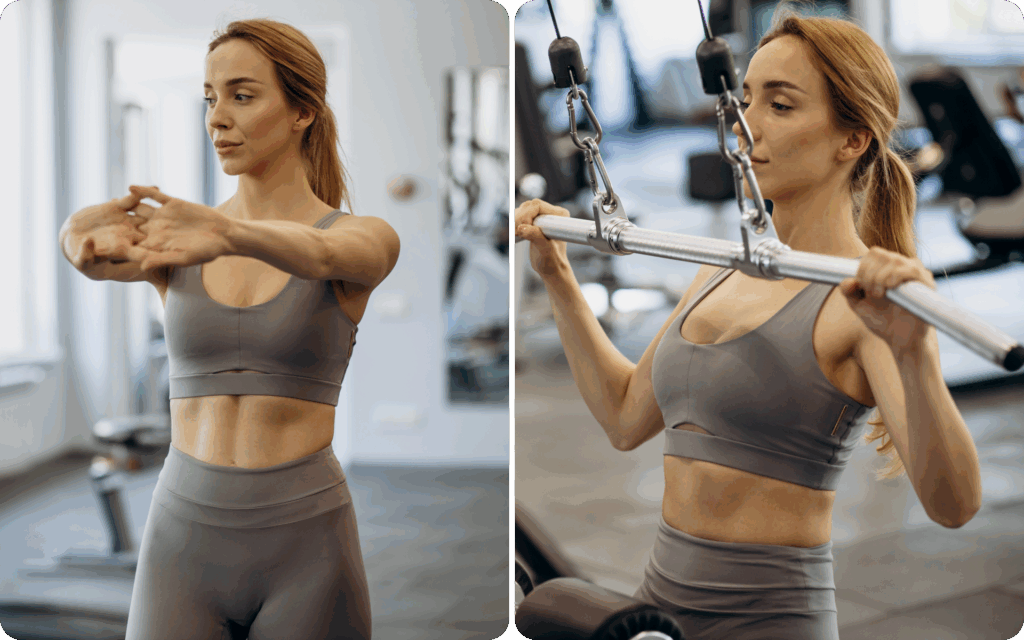
Overhead Press
- Stand with your feet shoulder-width apart, holding the barbell at shoulder level with your palms facing forward.
- Brace your core, pinch your glutes, and press the bar straight overhead until your arms are fully extended.
- Avoid arching your lower back as you press. Keep your ribs down.
- Slowly lower the barbell back to your shoulders.
Lat Pulldown
- Adjust the thigh pad and sit at the pulldown machine.
- Use a wide overhand grip on the bar.
- Lean back slightly, pull the bar down to your upper chest, and squeeze your back muscles.
- Extend your arms back up in a controlled manner, feeling a gentle stretch in your lats.
Dumbbell Bicep Curls
- Stand upright, holding a dumbbell in each hand, your arms extended at your sides.
- Rotate your palms forward and curl the weights up toward your shoulders, keeping your elbows close to your sides.
- Squeeze at the top, then slowly lower back down without swinging.
Tricep Pushdowns
- Stand facing a cable machine with a rope or straight bar attached overhead.
- Grip the attachment with both hands and pull your elbows close to your torso.
- Push the bar or rope down until your arms are fully extended, focusing on squeezing your triceps.
- Return to the starting position under control.
Incline Dumbbell Press
- Sit on an incline bench set at 30-45 degrees, holding dumbbells at chest level.
- Press the dumbbells upward, extending your arms until they are straight over your chest.
- Lower the weights slowly back to the starting position with your elbows at a 45-degree angle.
Seated Cable Row
- Sit at the cable row machine with your knees slightly bent and your feet braced.
- Grab the handle with both hands, keep your torso upright, and pull the handle to your midsection, squeezing your shoulder blades back.
- Slowly extend your arms forward without leaning or rounding the back.
Dumbbell Lateral Raises
- Stand upright with a dumbbell in each hand at your sides, your palms facing inward.
- Raise your arms out to the sides until they reach shoulder height, your elbows slightly bent.
- Pause, then lower back to your sides in a controlled motion.
Pull-Ups (or Assisted)
- Grab the pull-up bar with a grip just wider than shoulder-width.
- Hang with your arms extended, then pull yourself up until your chin is above the bar.
- Lower yourself down in a controlled motion to full extension.

Hammer Curls
- Hold dumbbells at your sides with palms facing your torso (neutral grip).
- Curl the weights up while keeping your upper arms stationary.
- Squeeze at the top, then lower them back down under control.
Overhead Tricep Extension
- Sit or stand holding a dumbbell with both hands, your arms extended overhead.
- Lower the weight behind your head by bending your elbows, keeping your upper arms stationary.
- Extend your elbows to raise the weight back overhead.
Barbell Back Squat
- Set the barbell at shoulder height and step under it, resting it across your upper back.
- Grip the bar, brace your core, and lift the bar out of the rack.
- Step back and position your feet shoulder-width apart, your toes slightly out.
- Lower your body by bending your hips and knees, reaching at least parallel to the floor.
- Push through your heels to return to standing.

Romanian Deadlift
- Stand with your feet hip-width apart and a barbell in front of your thighs.
- With a slight knee bend, hinge forward at the hips, keeping your back flat and the bar close to your legs.
- Lower until you feel a stretch in your hamstrings, then drive your hips forward to stand up.
Leg Press
- Sit on the leg press machine with your feet shoulder-width apart on the platform.
- Unlatch the safety, brace your core, and lower the platform by bending your knees to at least 90 degrees.
- Press the platform back up by driving through your heels.
Walking Lunges
- Stand holding dumbbells at your sides (optional) and step forward with one leg.
- Lower your body until both knees are at 90 degrees.
- Push through the front foot to stand and step forward with the opposite leg. Repeat on the other side.
Seated Calf Raises
- Sit on the machine with the balls of your feet on the platform and your knees under the pad.
- Lower your heels as far as possible, then press through the balls of your feet to raise your heels up.
- Pause at the top, then lower under control.
Incline Dumbbell Press (repeated above)
See “Incline Dumbbell Press” above for instructions.
Lying Leg Curls
- Lie face down on the leg curl machine with your ankles under the pad.
- Curl your legs up as far as possible, squeezing your hamstrings.
- Lower the pad back down slowly.
Goblet Squat
- Hold a dumbbell or kettlebell close to your chest with both hands.
- Stand with your feet shoulder-width apart.
- Squat down by hinging at your hips and bending your knees, keeping your chest up.
- Lower to at least parallel, then push through your heels back to standing.

Glute Bridges
- Lie flat on your back with your knees bent and your feet flat on the floor, hip-width apart.
- Push through your heels to lift your hips up, squeezing your glutes at the top.
- Lower back to the ground with control.
Standing Calf Raises
- Stand on a calf raise machine or a platform with your toes on the edge and your heels hanging off.
- Lower your heels below the platform, then rise onto your toes by contracting your calves.
- Hold briefly at the top, then lower back down.
This upper/lower split program is a great starting point. Remember to focus on your form before increasing the weight.
Read more: 8 Forearm Dumbbell Exercises to Improve Grip Strength
Can You Get Big with an Upper/Lower Split?
Absolutely. An upper/lower split is a highly effective way to build muscle, or “get big”. Muscle hypertrophy (the scientific term for muscle growth) is driven primarily by creating sufficient mechanical tension (7), and an upper/lower split is perfectly designed to achieve this.
Recent research has clarified that training volume – specifically, the number of hard sets taken close to muscular failure per muscle group per week – is the most important variable for hypertrophy (8).
A 2017 meta-analysis published in the Journal of Sports Sciences found a dose-response relationship between volume and muscle growth, which suggests that more sets lead to more muscle, up to a certain point (9). The current consensus is that 12-20 hard sets per muscle group per week is an optimal range for most individuals (10).
An upper/lower split allows you to easily achieve this volume target. By training each muscle group twice a week, you can split the volume into manageable sessions. For example, you could perform 6-8 sets for your chest on your first upper-body day and another 6-8 sets on your second, hitting a total of 12-16 sets for the week. This is far more manageable and likely more effective than trying to cram all the sets into a single workout.
Furthermore, training with sufficient effort is key. You can build muscle across a wide spectrum of loading ranges, from heavy weights for low reps to light weights for high reps, as long as you take your sets close to failure (around 1-3 reps in reserve) (11).
An upper/lower split allows for this variety, incorporating both heavy, strength-focused days and lighter, hypertrophy-focused days to stimulate all pathways for muscle growth.

Is Upper/Lower Better than Full-Body?
Neither an upper/lower split nor a full-body routine is inherently “better”. The effectiveness of a training program is determined by its ability to adhere to the core principles of muscle growth – primarily progressive overload and managing training volume – not by the specific way it splits up the exercises.
Research comparing different training splits has consistently found no significant difference in muscle growth or strength gains when weekly volume is equated.
For example, a 2022 study directly compared a 4-day upper/lower split to a 4-day full-body routine with matched volumes. After 8 weeks, both groups experienced similar increases in muscle mass and strength (12).
The choice between the two often comes down to personal preference and logistics:
- Full-Body Workouts are great for those with limited days to train (2-3 times per week). They ensure each muscle is stimulated frequently. However, sessions can become long and fatiguing as you become stronger and need to add more volume.
- Upper/Lower Splits are ideal for those who can train 4 or more days a week. They allow for more focused volume per muscle group in each session and can feel less systemically fatiguing than a long full-body workout. Some people also enjoy the psychological benefit of focusing on just half of their body. For example, you could even structure a 5-day upper/lower split by adding a third upper- or lower-body day.
The bottom line is that as long as your total weekly volume and effort are sufficient, both approaches will deliver results. Choose the one that fits your schedule and that you enjoy the most, as that’s the program you will stick with in the long term.
For those who want to experiment with a higher frequency split, a 5-day workout split may be an option to explore later on your training journey.

The best split for fat loss is the one that helps you maintain muscle while in a calorie deficit. Fat loss is primarily dictated by nutrition – you must consume fewer calories than you burn (13). Any resistance training split, whether it’s an upper/lower, full-body, or body-part split, will help preserve lean muscle mass, which is essential for keeping your metabolism elevated. Some people find that adding conditioning or high-intensity interval training (HIIT) to their rest days on an upper/lower split can help increase calorie expenditure and accelerate fat loss (15). The muscles that are “hardest to grow” can vary greatly from person to person due to genetics and individual biomechanics. However, some muscle groups are commonly cited as being less receptive to growth for many people. These often include the calves, forearms, and sometimes the upper chest or rear deltoids. This difficulty can be due to fiber type composition (calves are often dominated by slow-twitch fibers) or the challenge of establishing a strong mind-muscle connection (15). Building muscle becomes progressively more challenging with age, a phenomenon known as anabolic resistance (16). After the age of 30, most adults start to experience a gradual decline in muscle mass (sarcopenia), and the body becomes less sensitive to the stimuli that trigger muscle growth, such as protein intake and resistance training (17). While it’s certainly not impossible to build muscle in your 40s, 50s, and beyond, it typically requires more effort, more attention to diet (particularly protein), and smarter recovery strategies. Yes, sleep is crucial for muscle growth (18). During deep sleep, your body releases human growth hormone (HGH), which is essential for tissue repair and growth (19). A lack of sleep can increase cortisol levels (a stress hormone that can break down muscle tissue) and decrease muscle protein synthesis (20). Aiming for 7-9 hours of quality sleep per night is one of the most effective things you can do to optimize your recovery and maximize your gains from training.Frequently Asked Questions
Which split is best for fat loss?
Which muscle is hardest to grow?
What is the hardest age to build muscle?
Is sleep important for muscle growth?
The Bottom Line
Embarking on a strength training journey is a powerful step toward transforming your health and physique. The beginner upper/lower split provides a logical, effective, and sustainable path to building foundational strength and muscle. It balances training frequency with recovery, which allows you to make consistent progress without feeling burnt out. Remember that the “perfect” program is one you can adhere to.
DISCLAIMER:
This article is intended for general informational purposes only and does not serve to address individual circumstances. It is not a substitute for professional advice or help and should not be relied on for making any kind of decision-making. Any action taken as a direct or indirect result of the information in this article is entirely at your own risk and is your sole responsibility.
BetterMe, its content staff, and its medical advisors accept no responsibility for inaccuracies, errors, misstatements, inconsistencies, or omissions and specifically disclaim any liability, loss or risk, personal, professional or otherwise, which may be incurred as a consequence, directly or indirectly, of the use and/or application of any content.
You should always seek the advice of your physician or other qualified health provider with any questions you may have regarding a medical condition or your specific situation. Never disregard professional medical advice or delay seeking it because of BetterMe content. If you suspect or think you may have a medical emergency, call your doctor.
SOURCES:
- Progression Models in Resistance Training for Healthy Adults (2009, journals.lww.com)
- The Importance of Recovery in Resistance Training Microcycle Construction (2024, pmc.ncbi.nlm.nih.gov)
- Advances in Delayed-Onset Muscle Soreness (DOMS): Part I: Pathogenesis and Diagnostics (2018, thieme-connect.com)
- Effects of Resistance Training Frequency on Measures of Muscle Hypertrophy: A Systematic Review and Meta-Analysis (2016, link.springer.com)
- Resistance Training Variables for Optimization of Muscle Hypertrophy: An Umbrella Review (2010, frontiersin.org)
- Compound Exercises (n.d., physio-pedia.com)
- The Mechanisms of Muscle Hypertrophy and Their Application to Resistance Training (2010, journals.lww.com)
- The influence of resistance exercise training prescription variables on skeletal muscle mass, strength, and physical function in healthy adults: An umbrella review (2024, sciencedirect.com)
- Dose-response relationship between weekly resistance training volume and increases in muscle mass: A systematic review and meta-analysis (2017, pubmed.ncbi.nlm.nih.gov)
- A Systematic Review of The Effects of Different Resistance Training Volumes on Muscle Hypertrophy (2022, pmc.ncbi.nlm.nih.gov)
- Loading Recommendations for Muscle Strength, Hypertrophy, and Local Endurance: A Re-Examination of the Repetition Continuum (2021, pmc.ncbi.nlm.nih.gov)
- A randomized trial on the efficacy of split-body versus full-body resistance training in non-resistance trained women (2022, link.springer.com)
- Optimal Diet Strategies for Weight Loss and Weight Loss Maintenance (2021, pmc.ncbi.nlm.nih.gov)
- Evidence-Based Effects of High-Intensity Interval Training on Exercise Capacity and Health: A Review with Historical Perspective (2021, pmc.ncbi.nlm.nih.gov)
- What Muscle Is the Hardest to Grow and Why? (2026, biologyinsights.com)
- Age-related muscle anabolic resistance: inevitable or preventable? (2023, pubmed.ncbi.nlm.nih.gov)
- Sarcopenia: Aging-Related Loss of Muscle Mass and Function (2017, journals.physiology.org)
- Sleep and muscle recovery: endocrinological and molecular basis for a new and promising hypothesis (2011, pubmed.ncbi.nlm.nih.gov)
- Sleep, circadian biology and skeletal muscle interactions: Implications for metabolic health (2022, sciencedirect.com)
- The effect of acute sleep deprivation on skeletal muscle protein synthesis and the hormonal environment (2021, physoc.onlinelibrary.wiley.com)

 Reviewed by
 Reviewed by