

Cross-training for runners involves incorporating different types of workouts—like strength training, mobility, and low-impact cardio—into your routine to support your running goals. This approach helps build balanced muscle development, improves single-leg stability, and targets areas that running alone may miss. By adding cross-training exercises for runners at home, you can easily build a well-rounded routine that encourages better movement variety and overall running economy.
Running is an excellent form of cardiovascular exercise. However, doing only one repetitive motion can sometimes lead to muscle imbalances over time. Learning how to cross-train for running offers a practical way to support your body. It allows you to focus on targeted strength work, especially in your hips and core, without needing a gym membership.
A consistent home workout for runners can make a noticeable difference in how you feel on the pavement or the trail. Whether you are prepping for a 5K or looking into cross-training for distance runners, mixing up your routine tends to yield positive results. Keep reading to explore a practical guide for runner strength training at home, complete with activation drills, targeted exercises, and a manageable weekly schedule.
Why Runners Need More Than Running
Running primarily moves you forward in a straight line (1). Over time, this repetitive forward motion can lead to a lateral movement deficit, meaning the muscles responsible for side-to-side stability may become underused (2). Incorporating movement variety through a well-rounded routine can help bridge this gap.
Relying solely on adding more miles can eventually offer diminishing returns. When you focus entirely on logging miles, you may miss out on balanced muscle development. Adding targeted strength work helps support the muscles and joints that handle the impact of each stride (3).
Comparing a running-only routine to a mixed routine can highlight the benefits of variety.
| Focus Area | Running Only | Running + Cross-Training |
|---|---|---|
| Movement Plane | Forward motion only | Forward, lateral, and rotational |
| Muscle Development | Can lead to imbalances | Supports balanced muscle development |
| Overall Routine | High repetitive impact | Mixes high-impact with low-impact mobility |
What Makes Good Cross-Training for Runners
Effective cross-training for runners focuses on the specific demands of the sport. The most beneficial routines prioritize hip strength for runners, as strong hips and glutes help stabilize the pelvis during the running stride (3).
Single-leg stability is another crucial component especially for postural stability (4). Since running is essentially a series of single-leg hops, training one leg at a time builds the coordination and strength needed for a smooth stride. Core stability also plays a major role, helping you maintain an upright posture and maximize force generation (5).
Finally, low-impact mobility and portable training options make it easy to stay consistent. You do not need heavy equipment to see progress. Bodyweight routines can be highly effective and fit perfectly into a busy schedule.
5-Minute Pre-Run Activation Routine
A dedicated pre-run warm-up is a great way to prepare your body for the work ahead (6). Glute activation and joint mobility can help your body transition from sitting to moving, supporting a better running economy.
| Exercise | Target Area | Duration/Reps |
|---|---|---|
| Monster Walk | Hips and glutes | 10 steps per side |
| Clamshell | Outer hips | 12 reps per side |
| Squat Pulse | Quads and glutes | 15 seconds |
| Ankle Circles | Ankle mobility | 10 circles per direction |
| Single-Leg Balance | Stability | 30 seconds per leg |
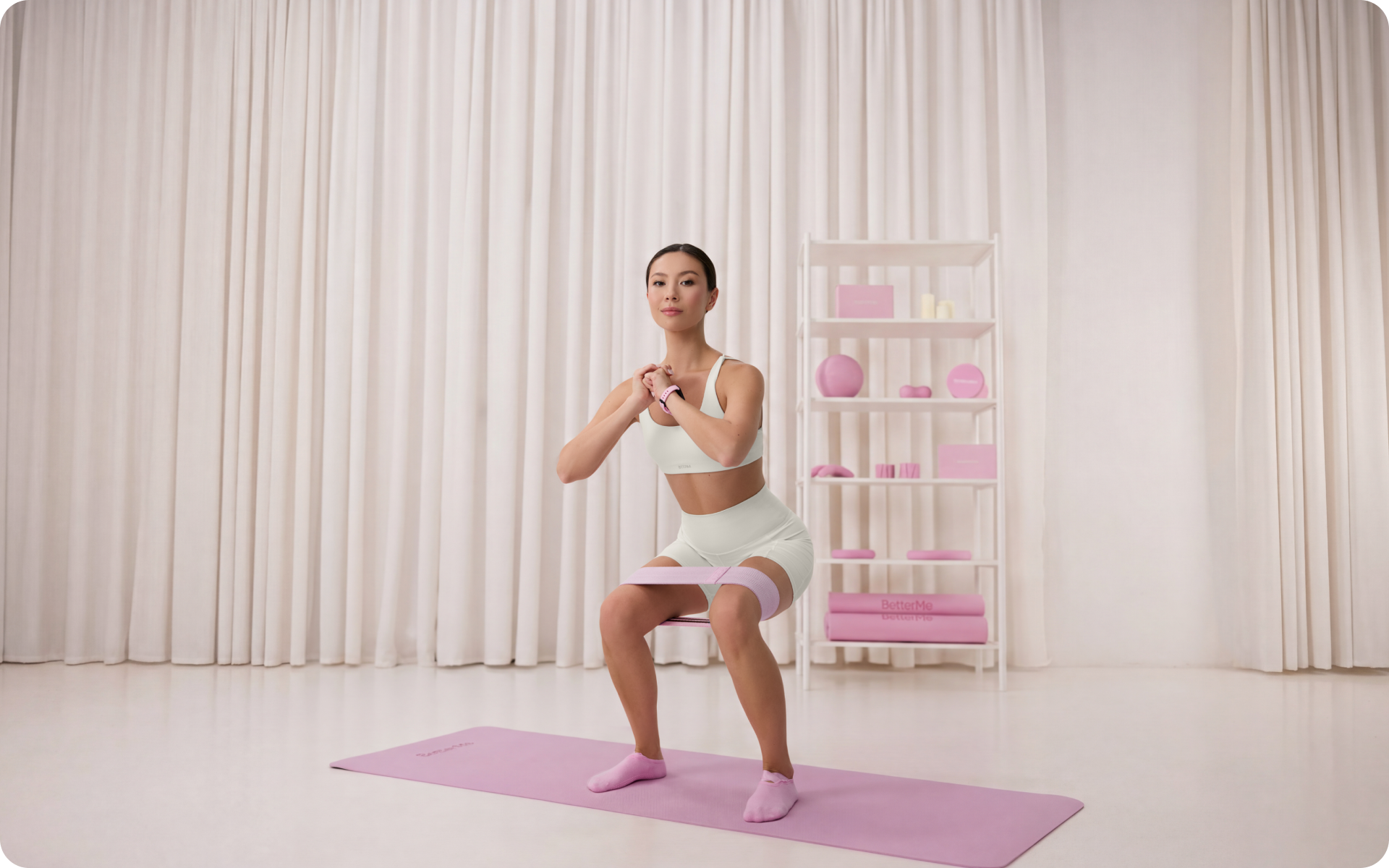
Monster Walk
- Place a loop resistance band just above your knees or ankles.
- Drop into a shallow squat and take a wide step forward and slightly out to the side.
- Follow with the other leg, keeping tension on the band.
- Walk forward for 10 steps, then backward for 10 steps.
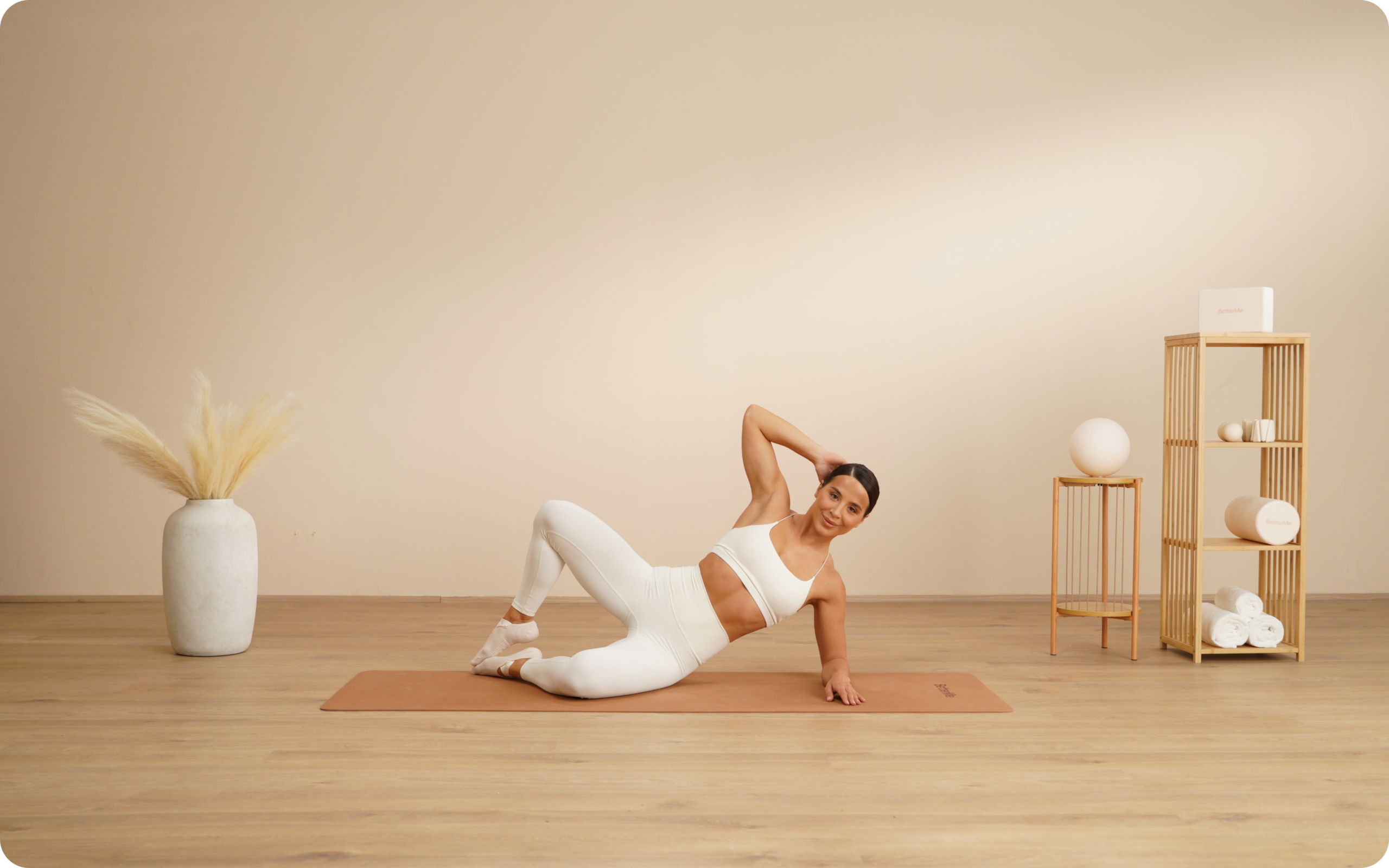
Clamshell
- Lie on your side with your knees bent and hips stacked.
- Loop a resistance band on your mid thigh
- Keep your feet together and slowly lift your top knee.
- Pause at the top, feeling the effort in your outer glute.
- Slowly lower your knee back to the start.
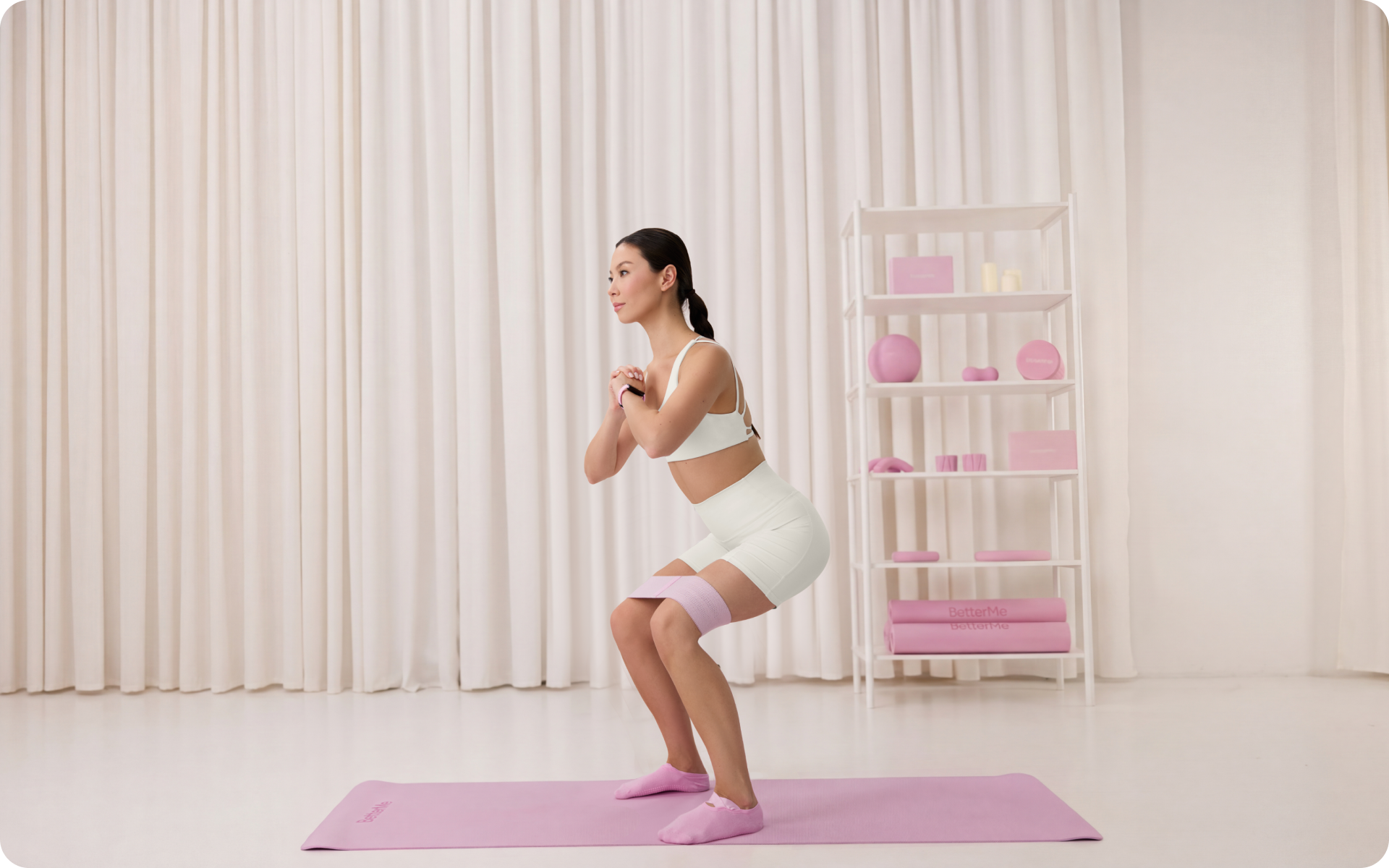
Squat Pulse
- Stand with your feet shoulder-width apart.
- Lower into a squat position, keeping your chest up.
- Instead of standing all the way up, pulse up and down a few inches.
- Maintain a steady rhythm for 15 seconds.
Ankle Circles
- Stand on one leg or sit on a chair.
- Lift one foot off the ground.
- Slowly rotate your ankle in a full circle.
- Complete 10 circles clockwise, then 10 counterclockwise.
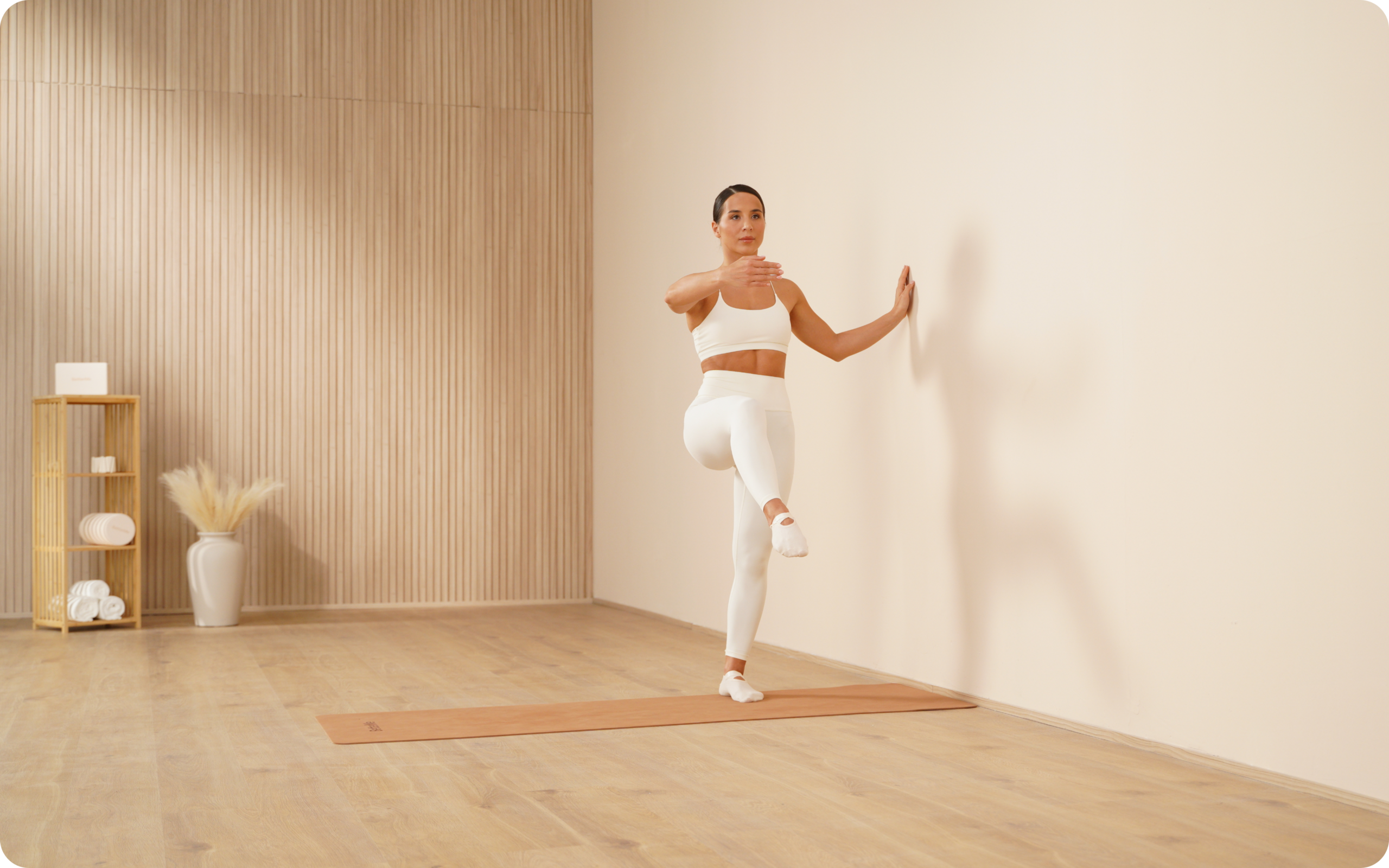
Single-Leg Balance
- Stand tall with your feet together.
- Lift one knee until your thigh is parallel to the ground.
- Engage your core and hold your balance.
- Keep your standing leg stable for 30 seconds before switching.
8 At-Home Cross-Training Exercises
These cross-training exercises for runners at home are designed to target the muscles you use most. This routine serves as a user-friendly runner strength training at home program. You’ll need an exercise mat for the floor drills.
Read more: HIIT Workouts at Home Without Equipment: Your Complete Guide
| Exercise | Primary Benefit | Sets/Reps |
|---|---|---|
| Single-Leg Bridge | Glute and hamstring strength | 3 sets of 10–12 per leg |
| Lateral Lunge | Side-to-side stability | 3 sets of 10 per leg |
| Crab Walk | Core and shoulder support | 3 sets of 20 seconds |
| Dead Bug | Core stability | 3 sets of 12 alternating |
| Bird-Dog | Back and core balance | 3 sets of 10 per side |
| Donkey Kick | Glute isolation | 3 sets of 15 per leg |
| Fire Hydrant | Hip mobility and strength | 3 sets of 12 per leg |
| Single-Leg Deadlift | Hamstring and balance focus | 3 sets of 10 per leg |
Single-Leg Bridge
- Lie on your back with your knees bent and feet flat on the floor.
- Extend one leg straight out.
- Press through your grounded heel to lift your hips toward the ceiling.
- Slowly lower your hips back to the floor.
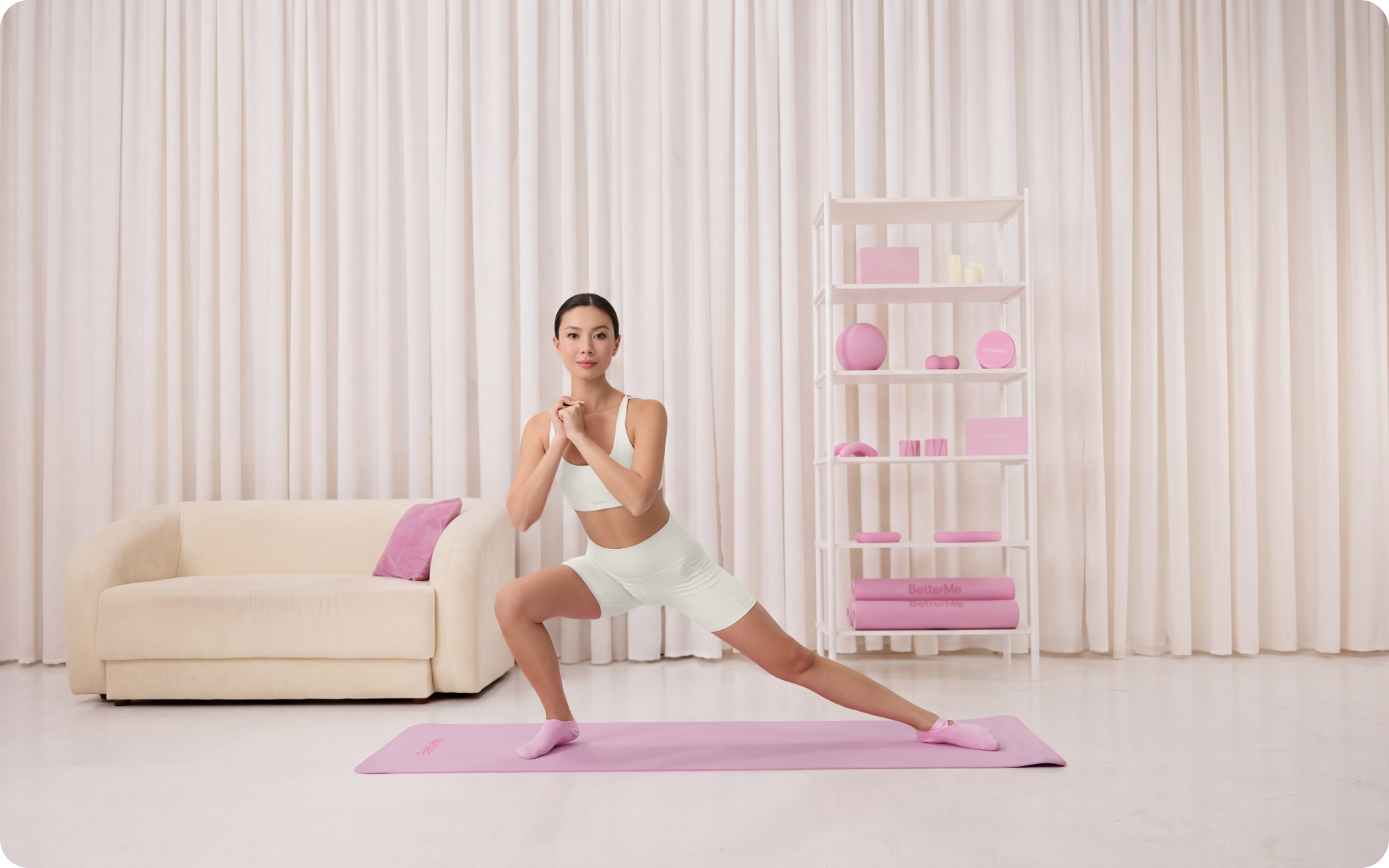
Lateral Lunge
- Stand tall with your feet together.
- Take a large step to the right, bending your right knee and pushing your hips back.
- Keep your left leg straight and your chest up.
- Push off your right foot to return to the starting position.
Crab Walk
- Sit on the floor with your knees bent and hands behind you.
- Lift your hips off the ground so your weight is on your hands and feet.
- Walk forward by moving your opposite hand and foot together.
- Keep your hips elevated throughout the movement.
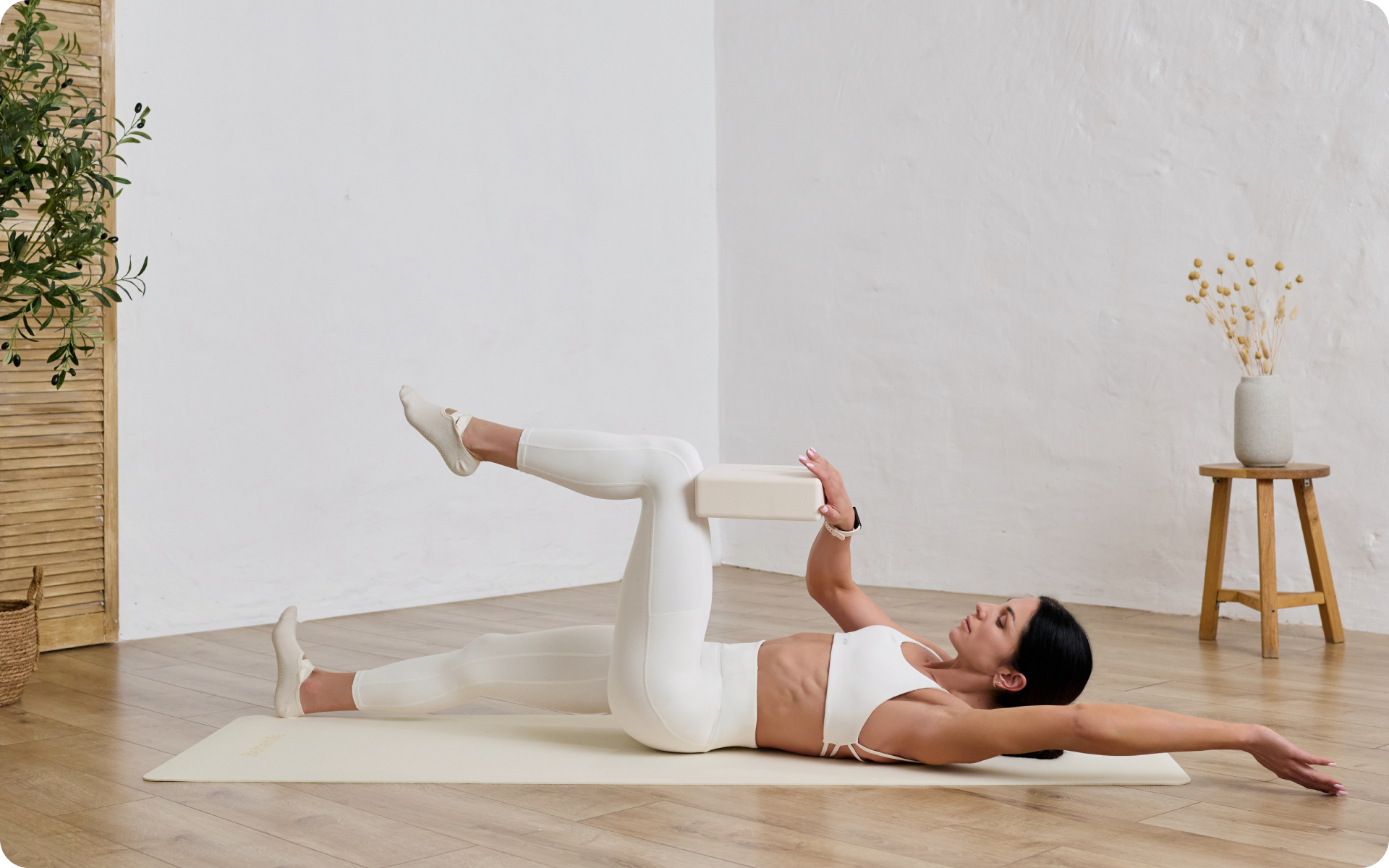
Dead Bug
- Lie on your back with your arms reaching up and your knees bent at 90 degrees.
- Press your lower back gently into the floor.
- Slowly extend your right arm behind you and your left leg straight out.
- Return to the center and switch sides.
Fire Hydrant
- Start on your hands and knees in a tabletop position.
- Keeping your knee bent, lift your right leg out to the side.
- Raise it as high as you comfortably can without rotating your back.
- Lower the leg with control.
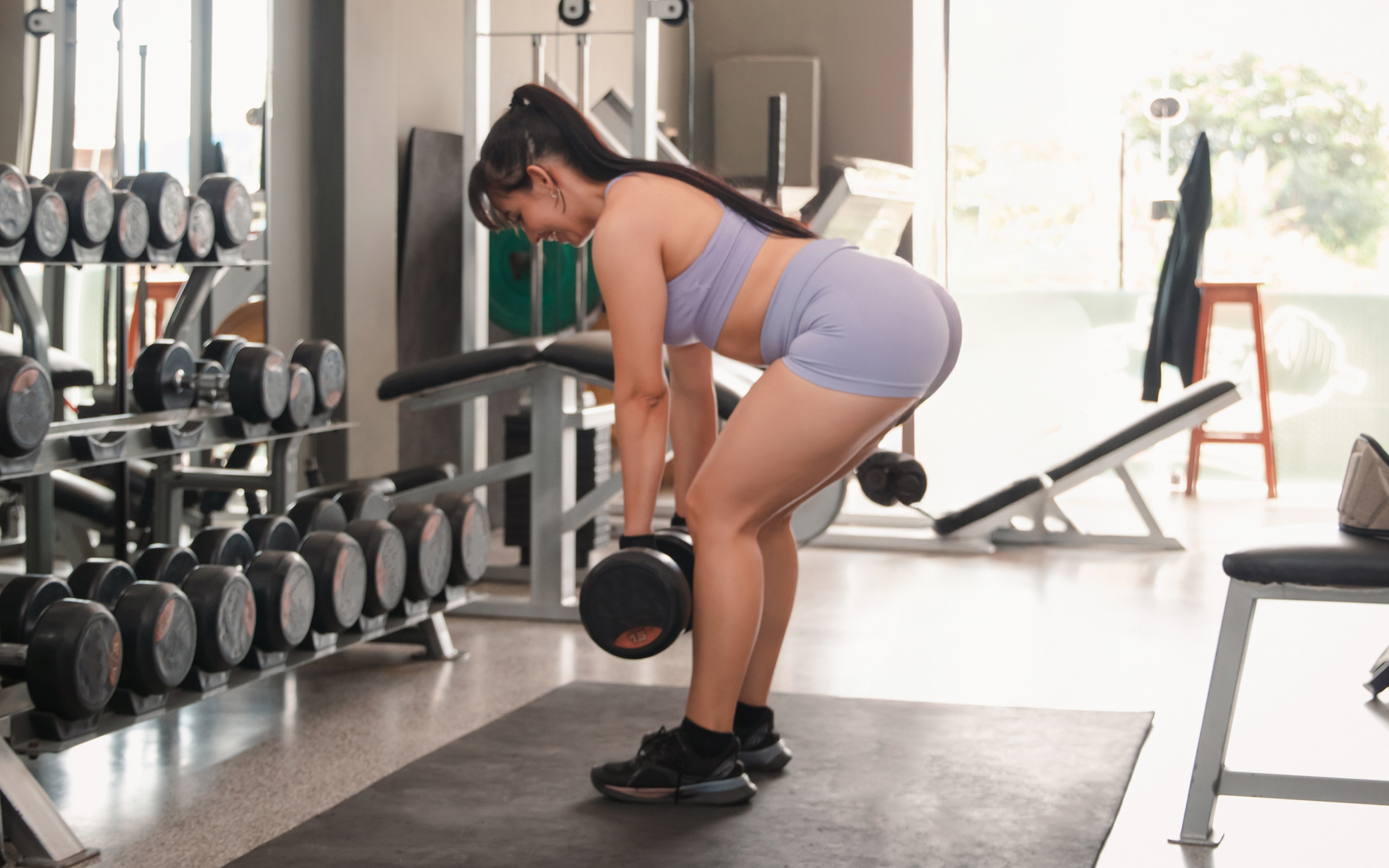
Single-Leg Deadlift
- Stand on your right leg with a slight bend in the knee.
- Hinge at your hips, extending your left leg straight behind you.
- Keep your back flat as your torso becomes parallel to the floor.
- Squeeze your right glute to stand back up.
Bird-Dog
- Start on your hands and knees with a flat back.
- Extend your right arm forward and your left leg backward simultaneously.
- Hold for a brief pause, keeping your hips level.
- Return to the starting position and switch sides.
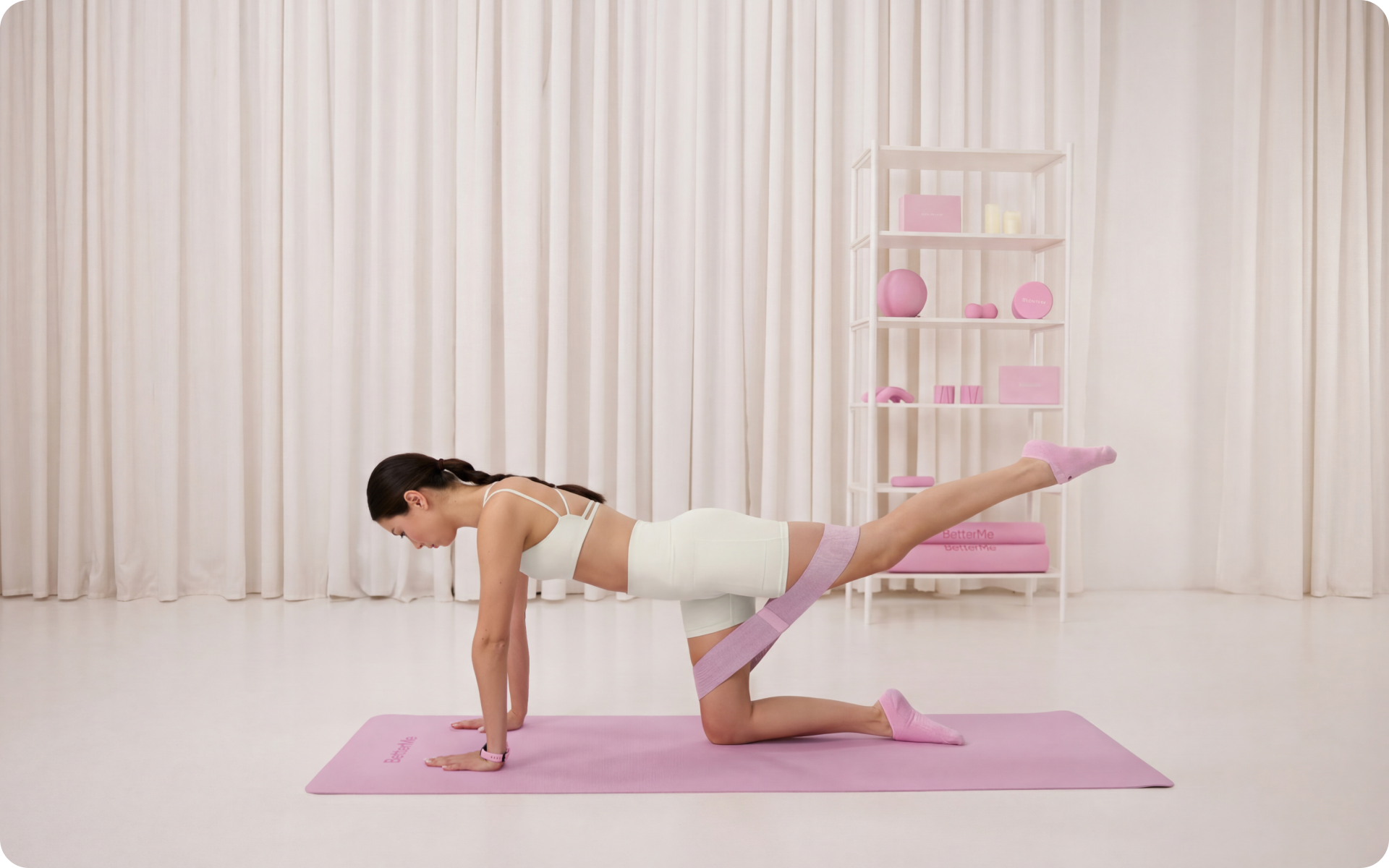
Donkey Kick
- Begin on all fours with your wrists under your shoulders.
- Keeping your knee bent at 90 degrees, lift your right heel toward the ceiling.
- Squeeze your glute at the top of the movement.
- Slowly lower your knee back to the floor.
Post-Run Recovery Routine
A mindful post-run recovery routine is a wonderful way to help your body transition to a resting state. Taking time for gentle stretching can support flexibility, ease tension, and promote relaxation after your workout (7). Since some of these stretches require you to be on the floor, having a Pilates Power Mat is highly recommended.
- Hamstring Stretch: Sit on the floor with one leg extended and the other bent inward. Hinge forward from your hips, reaching toward your toes until you feel a gentle stretch in the back of your leg. Hold for 30 seconds.
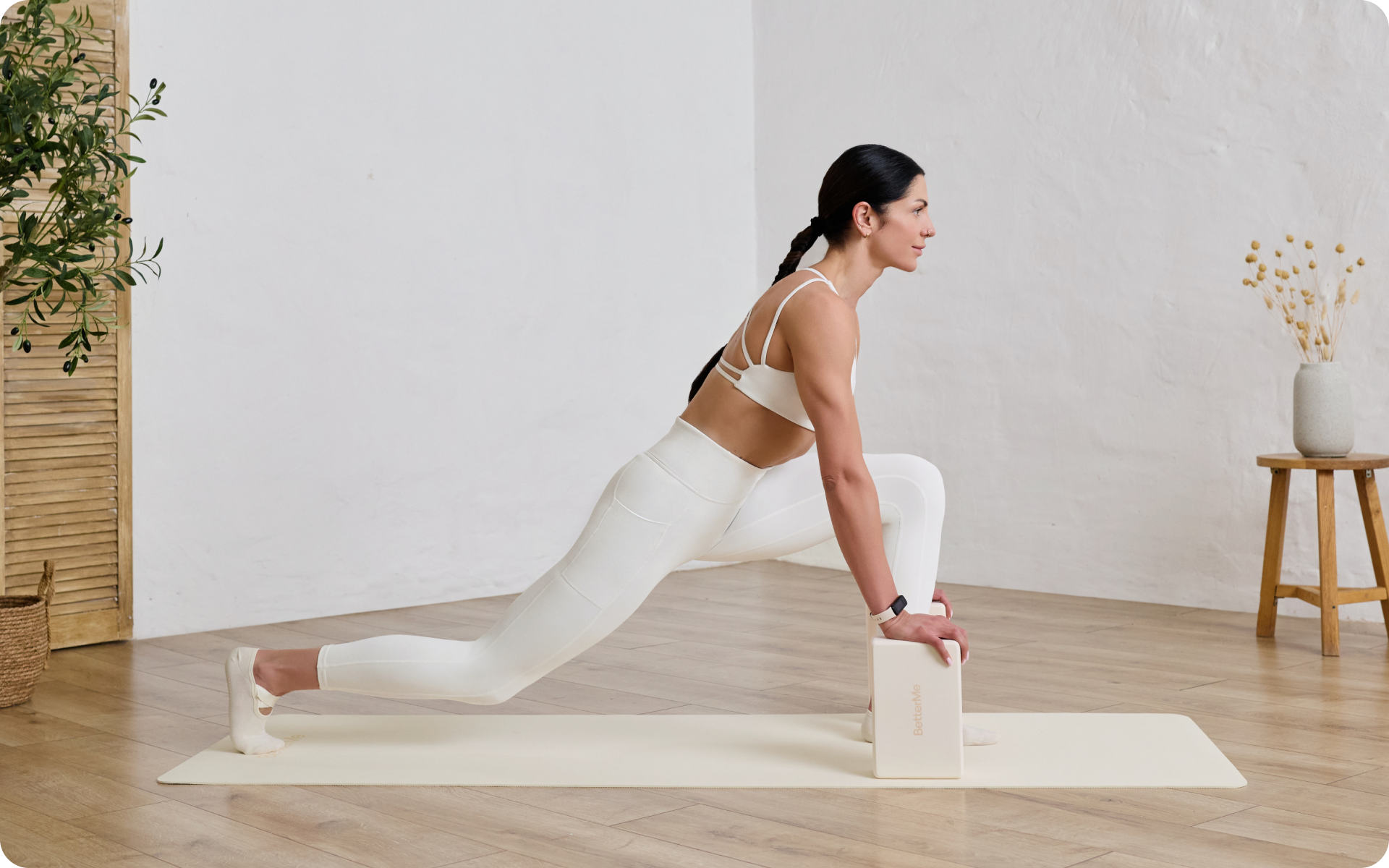
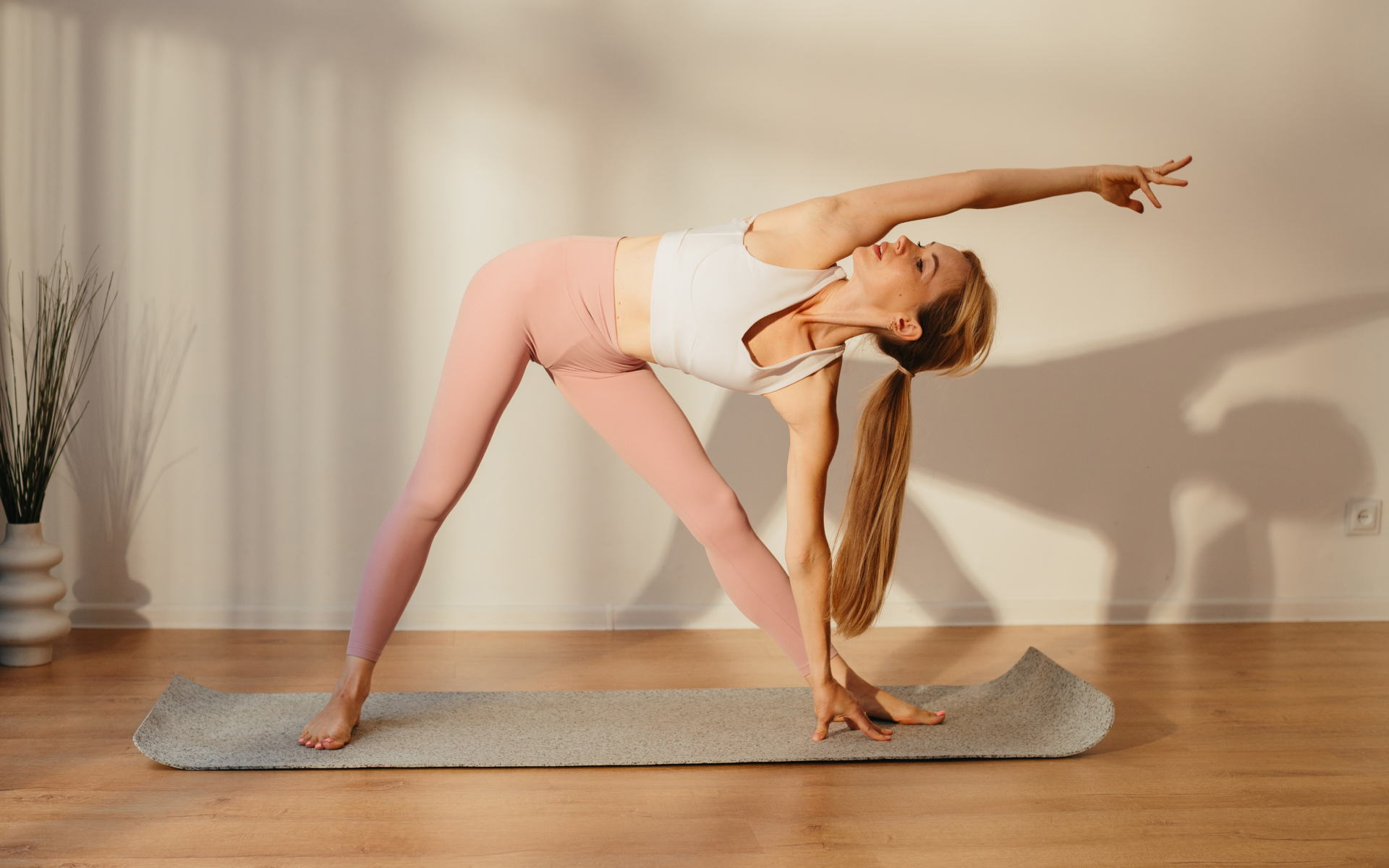
- Hip Flexor Stretch: Kneel on one knee with the other foot flat in front of you. Gently press your hips forward while keeping your torso upright. Hold for 30 seconds per side.
- Quad Stretch: Stand tall and grab your right ankle, pulling it gently toward your glutes. Keep your knees close together and hold for 30 seconds before switching legs.
- Calf Stretch: Stand facing a wall, placing your hands against it for support. Step one foot back, keeping the leg straight and pressing the heel into the floor. Hold for 30 seconds.
- Thoracic Rotation: Start on all fours. Place your right hand behind your head, then gently rotate your elbow up toward the ceiling. Slowly twist back down, pointing your elbow toward the floor. Repeat 10 times per side.
Sample Weekly Schedule
Fitting a cross-training routine into a busy week can be simpler than you might think. This sample schedule illustrates how to balance running, strength, and rest for someone running 3–4 days a week.
Read more: Bodyweight Core Exercises: A Simple Way to Build Strength
| Day | Activity Focus | Duration |
|---|---|---|
| Monday | Easy Run + Core Work | 45–60 minutes |
| Tuesday | Runner Strength Training | 30 minutes |
| Wednesday | Interval Run or Hill Work | 45 minutes |
| Thursday | Low-Impact Cross-Training (e.g., cycling) | 30–45 minutes |
| Friday | Rest or Gentle Yoga | 20 minutes |
| Saturday | Long Run | 60+ minutes |
| Sunday | Active Recovery (Walking) | 30 minutes |
Intense sweat sessions, working weight loss tips, lip-smacking recipes come in one package with the BetterMe: Health Coaching app—all at your fingertips, start transforming your life now!
Frequently Asked Questions
How many days per week should runners cross-train?
Runners can benefit from incorporating cross-training 2–3 days per week. This frequency allows you to build strength and maintain mobility without overburdening your body or taking away from your running goals. You can schedule these sessions on your non-running days or combine a short strength routine with an easy run.
Can cross-training replace a running day?
Yes, replacing a running day with cross-training is a common and practical approach. If your body needs a break from repetitive impact, activities like cycling, swimming, or bodyweight strength can maintain your fitness while giving your joints a rest. Many runners find this supports their overall consistency and energy levels.
Is Pilates good cross-training for runners?
Pilates is an excellent cross-training option for runners. It focuses heavily on core stability, hip strength, and flexibility (8), which are all vital for maintaining good running form. The mindful, controlled movements in Pilates also encourage a strong mind-body connection, helping you become more aware of your posture on the run (9).
What low-impact exercises work well for runner cross-training?
Cycling, swimming, and rowing are highly popular low-impact exercises for runners. These activities support cardiovascular fitness (10) while offering a break from the constant pounding of running. Gentle yoga and dedicated mobility flows also serve as fantastic, low-stress options for your active recovery days (11, 12).
The Bottom Line
Cross-training for runners is a practical way to build a well-rounded fitness routine that supports your main goals. By adding targeted strength exercises and prioritizing rest, you can encourage better movement patterns, making every run feel a little smoother. Remember to start small, listen to your body, and enjoy the varied benefits of a balanced approach.
DISCLAIMER:
This article is intended for general informational purposes only and does not serve to address individual circumstances. It is not a substitute for professional advice or help and should not be relied on for making any kind of decision-making. Any action taken as a direct or indirect result of the information in this article is entirely at your own risk and is your sole responsibility.
BetterMe, its content staff, and its medical advisors accept no responsibility for inaccuracies, errors, misstatements, inconsistencies, or omissions and specifically disclaim any liability, loss or risk, personal, professional or otherwise, which may be incurred as a consequence, directly or indirectly, of the use and/or application of any content.
You should always seek the advice of your physician or other qualified health provider with any questions you may have regarding a medical condition or your specific situation. Never disregard professional medical advice or delay seeking it because of BetterMe content. If you suspect or think you may have a medical emergency, call your doctor.
SOURCES:
- The biomechanics of running and running styles: a synthesis (2021, tandfonline.com)
- Acute effects of lower limb wearable resistance on horizontal deceleration and change of direction biomechanics (2024, journals.plos.org)
- Resistance Exercise for Improving Running Economy and Running Biomechanics and Decreasing Running-Related Injury Risk: A Narrative Review (2022, mdpi.com)
- Single-Leg Balance and Lower Limb Strength: Quantitative Analysis with the Balance Master System (2024, mdpi.com)
- Exploring the role of the core in sports performance: a systematic review of the effects of core muscle training (2025, frontiersin.org)
- Revisiting the ‘Whys’ and ‘Hows’ of the Warm-Up: Are We Asking the Right Questions? (2023, link.springer.com)
- Practical recommendations on stretching exercise: A Delphi consensus statement of international research experts (2025, sciencedirect.com)
- Effects of Pilates on health and well-being of women: a systematic review (2023, link.springer.com)
- The Impacts of Pilates and Yoga on Health-Promoting Behaviors and Subjective Health Status (2021, mdpi.com)
- Exercise training maintains cardiovascular health: signaling pathways involved and potential therapeutics (2022, nature.com)
- Yoga as Part of Sports Medicine and Rehabilitation (2023, pmc.ncbi.nlm.nih.gov)
- The Surprising Benefits of Performing Daily Mobility Exercises (2023, acefitness.org)
 Reviewed by
 Reviewed by