
Starting a strength training journey often feels like navigating a maze without a map. You know you need to lift weights to get stronger, build muscle, and improve your health, but the “how” can be confusing.
A well-structured plan is the difference between making consistent progress and just going through the motions. This guide provides a clear, science-backed weekly weight-lifting plan for beginners using only dumbbells.
We’ll break down why planning is crucial, how often you should train, and what a good program looks like. You’ll get a complete 3-day full-body dumbbell workout, detailed exercise instructions, and insights into recovery, nutrition, and tracking your progress.
Why Is Planning A Weekly Weight Lifting Schedule Important?
Simply showing up to the gym and doing random exercises might feel productive, but it’s an inefficient way to achieve your goals. A planned weekly weight-lifting schedule provides the structure needed to ensure you’re applying the right stimulus for growth and giving your body adequate time to recover and adapt.
Without a plan, you risk:
- Overtraining or Undertraining: You might work the same muscles too frequently without enough rest, or you might not train them often enough to cause adaptation (1).
- Muscle Imbalances: Favoring specific exercises or muscle groups can lead to imbalances, increasing your risk of injury (2).
- Lack of Progressive Overload: To get stronger, you must consistently challenge your muscles (3). A plan helps you systematically increase the difficulty of your workouts over time.
- Wasted Time: A clear plan eliminates guesswork, allowing you to walk into the gym with purpose and complete your workout efficiently.
A structured weekly weightlifting routine ensures every session builds upon the last, guiding you toward your goals safely and effectively.
How Often Should I Lift Weights Weekly For Best Results?
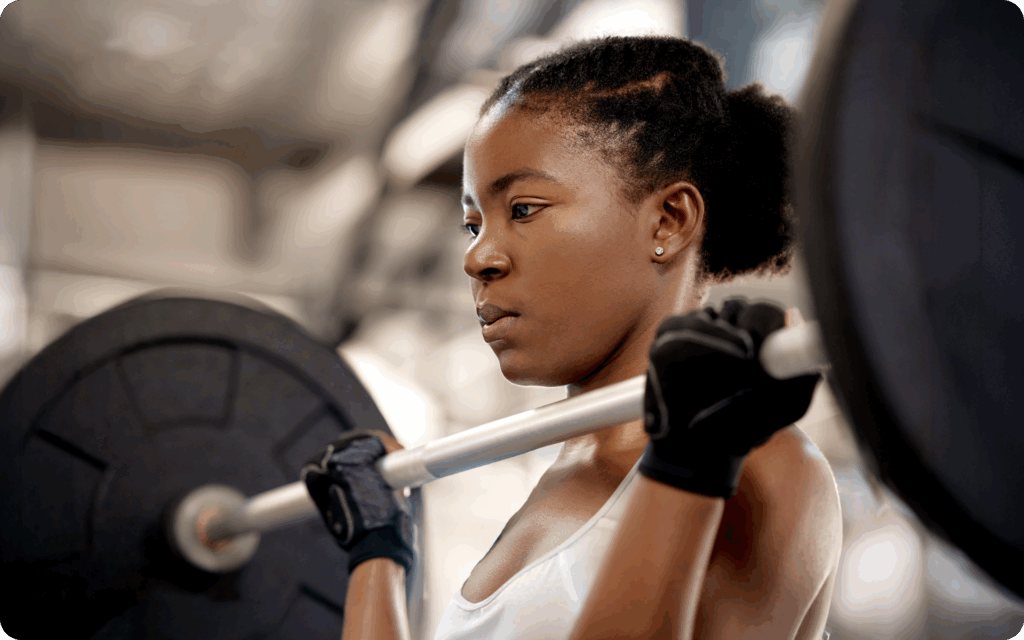
For beginners, the research states that you don’t need to live in the gym to see significant results.
Scientific studies consistently show that training 2-3 days per week is an effective frequency for those new to resistance training. This schedule provides sufficient stimulus to kick-start muscle growth and strength gains while allowing ample recovery (4).
A full-body training approach, where you work all major muscle groups in each session, is particularly beneficial for beginners. This method allows you to practice fundamental movement patterns more frequently, helping your nervous system become more efficient at recruiting muscle fibers (5). This neurological adaptation is a key component of early strength gains (6).
As a rule, you should allow at least 1 full day of rest between sessions that target the same muscle groups. If you train on Monday, your next session should be on Wednesday, not Tuesday. This frequency gives your muscles the time they need to repair and grow stronger (7).
BetterMe: Health Coaching app helps you achieve your body goals with ease and efficiency by helping to choose proper meal plans and effective workouts. Start using our app and you will see good results in a short time.
What Is A Good Weekly Weight Lifting Plan?
Everyone is wondering, “What is a balanced weekly weight-lifting plan?”
A good, balanced weekly weight-lifting plan for a beginner is simple, effective, and sustainable. Prioritizing compound exercises–movements that work multiple muscle groups at once–offers an efficient way to build strength and coordination across your body, especially in the early stages of training (5).
However, including some isolation exercises can also be beneficial, as these movements help address weaker areas and support balanced muscle development over time (8). This 3-day full-body dumbbell workout builds a strong foundation while encouraging well-rounded progress.
This program is a non-periodized plan, meaning you’ll perform the same workouts on each of the 3 training days. Your focus should be on mastering the form of each exercise and gradually increasing the weight you lift.
This approach is perfect for a weekly weight-lifting plan for women and men alike.

Program Notes
- Key Terms:
-
- Reps: A single repetition of an exercise.
- Sets: A group of repetitions.
- RPE (Rate of Perceived Exertion): A scale from 1-10 to measure intensity. RPE 7 means you could do 3 more reps if you had to. RPE 8 means 2 more reps in reserve.
- Equipment Needed: A set of dumbbells and a bench (or a sturdy chair/floor space).
- Split Structure: Full-body training, 3 days a week weight lifting routine on non-consecutive days (e.g., Monday, Wednesday, Friday).Sets and Reps: Aim for the provided rep ranges. The goal is to choose a weight that makes the last couple of reps of each set challenging (around an RPE of 7-8).
- Rest: Rest for 60-90 seconds between sets. This rest period gives your muscles enough time to recover for the next set without the session dragging on.
- Progressive Overload: Once you can comfortably complete all sets and reps for an exercise with good form, increase the weight by the smallest available increment (e.g., 2.5-5 lbs).
Beginner 3-Day A Week Weight Lifting Routine
| Exercise | Sets | Reps |
|---|---|---|
| Dumbbell Goblet Squat | 3 | 8-12 |
| Dumbbell Romanian Deadlift | 3 | 10-15 |
| Dumbbell Bench Press | 3 | 8-12 |
| Dumbbell Bent-Over Row | 3 | 8-12 |
| Dumbbell Overhead Press | 3 | 8-12 |
| Plank | 3 | 30-60 seconds |
Exercise Instructions:
Proper form is essential for preventing injury and maximizing results. Focus on executing each movement correctly before trying to lift heavier weights.
Dumbbell Goblet Squat
This exercise targets your quadriceps, glutes, and core.
- Stand with your feet slightly wider than shoulder-width apart, toes pointed slightly outward.
- Hold one dumbbell vertically against your chest with both hands, cupping the top head of the dumbbell.
- Keeping your chest up and your back straight, bend at your hips and knees to lower yourself down as if sitting in a chair.
- Lower until your thighs are at least parallel to the floor, keeping your elbows inside your knees.
- Push through your heels to return to the starting position, squeezing your glutes at the top.

Dumbbell Romanian Deadlift
This movement primarily works your hamstrings and glutes.
- Stand with your feet hip-width apart, holding a dumbbell in each hand in front of your thighs with your palms facing your body.
- Keep your legs almost straight, with only a slight bend in your knees.
- Hinge at your hips, pushing your butt back as you lower the dumbbells toward the floor. Keep your back flat and the dumbbells close to your legs.
- Lower the weights until you feel a good stretch in your hamstrings, typically when they are just below your knees.
- Drive your hips forward and squeeze your glutes to return to the starting position.
Dumbbell Bench Press
- This classic exercise builds your chest, shoulders, and triceps.
- Lie on a flat bench with your feet planted firmly on the floor. Hold a dumbbell in each hand and rest them on your thighs.
- Kick your knees up to help get the dumbbells into position, held just outside your chest with your palms facing forward.
- Press the dumbbells straight up until your arms are fully extended but not locked.
- Slowly lower the dumbbells back down to the starting position, just to the sides of your chest.
BetterMe will shake off your mental funk, rid you of your energy-zapping habits, and help you sculpt the body of your dreams. Intrigued? Hurry up and change your life for the better!
Dumbbell Bent-Over Row
- This exercise strengthens the muscles of your upper and mid-back.
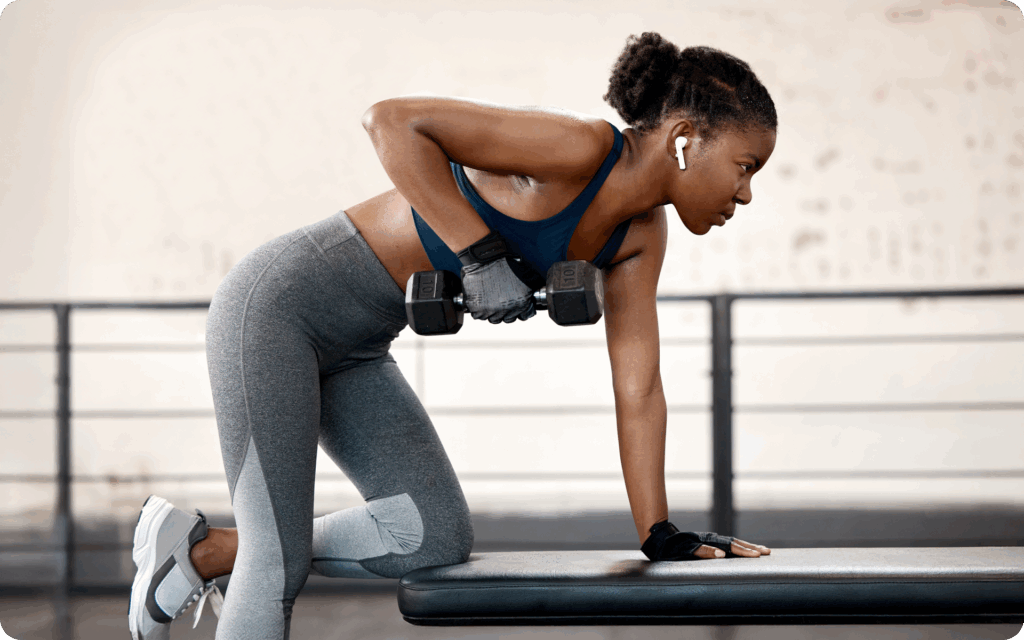
- Stand with your feet shoulder-width apart, holding a dumbbell in each hand, palms facing each other.
- Hinge at your hips and bend your knees slightly, lowering your torso until it’s nearly parallel to the floor. Keep your back straight.
- Let the dumbbells hang straight down with your arms extended.
- Pull the dumbbells up toward your chest, squeezing your shoulder blades together. Keep your elbows tucked in close to your body.
- Lower the dumbbells with control back to the starting position.
Dumbbell Overhead Press
- This move targets your shoulders (deltoids) and triceps.
- Sit on a bench with back support or stand with your feet shoulder-width apart.
- Hold a dumbbell in each hand at shoulder height, with your palms facing forward and your elbows bent at a 90-degree angle.
- Press the dumbbells straight overhead until your arms are fully extended.
- Slowly lower the dumbbells back to the starting position at your shoulders.
Plank
- The plank is an excellent core-strengthening exercise.
- Start in a push-up position, but with your weight resting on your forearms instead of your hands.
- Your body should form a straight line from your head to your heels.
- Engage your core and glutes to prevent your hips from sagging.
- Hold this position for the prescribed amount of time, breathing steadily.

To learn more about other effective programs, check out this guide to a gym workout plan for beginners.
Do Muscles Grow On Rest Days?
Muscle growth happens during rest, and several interrelated physiological mechanisms–set in motion by your training–will drive your muscle growth progress (7).
Recent research identifies that mechanical tension–created when you challenge your muscles with load through a full range of motion–acts as the primary growth stimulus (9).
Once this tension disrupts muscle fibers, your body responds with a cascade of repair processes during rest (7).
The most critical adaptation occurs through muscle protein synthesis (MPS), in which your body builds new muscle proteins to reinforce and enlarge fibers stressed during previous workouts.
A study in the Journal of Physiology found this synthesis is mainly active within 24–48 hours after resistance training and peaks when we balance rest with adequate dietary protein (10).
Notably, growth hormone and other anabolic hormones, such as IGF-1, show elevated activity during deep sleep and rest (11), further promoting muscle recovery and hypertrophy.
So yes, the fundamental drivers of improvement aren’t happening while you’re lifting, but rather while you’re sleeping, eating, and allowing your muscles to repair (12). Neglecting rest can blunt MPS rates, increase muscle breakdown, and limit gains.
Think of rest days as an integral part of any weekly weight lifting workout plan–not passive downtime but active windows where your training effort translates into tangible growth. Approaching recovery with the same intention as your workouts ensures you maximize the adaptive benefits of your training cycle (7).
What Should I Eat On A Rest Day For Muscle Growth?
Nutrition on your rest days is just as important as it is on your training days. Your body is in a prime state for muscle repair and growth, so you need to provide it with the right fuel.
Focus on these key nutritional components:
- Protein: Aim for 1.6–2.2 grams of protein per kilogram of body weight (about 0.7–1.0 grams per pound), divided evenly across meals. Protein sources include lean meats, poultry, fish, eggs, dairy, legumes, and protein supplements (13).
- Carbohydrates: Consume 3–5 grams of carbohydrates per kilogram of body weight daily (roughly 1.4–2.3 grams per pound), depending on activity level and training intensity (13). Opt for complex carbohydrates like oats, brown rice, quinoa, and sweet potatoes to support muscle glycogen replenishment.
- Healthy Fats: Target fat intake around 30% of total caloric intake (13), prioritizing unsaturated fats from foods like avocados, nuts, seeds, and olive oil to facilitate hormone balance and recovery.
- Hydration: Aim for roughly 0.04 liters of water per kilogram of body weight per day–about 2.5 to 3 liters for a 70-kg person (14)–increasing in hot climates or during intense exercise to optimize nutrient delivery and muscle function.
You don’t need to change your calorie intake for rest days. Your body’s metabolic rate remains elevated as it works to repair muscle tissue, so continue to eat a balanced diet to support the recovery process.
Read more: Meal and Workout Plan: Build Strength, Balance, and Consistency
How Do You Track Progress Throughout The Week?
Tracking your progress is motivating and provides objective data to ensure your plan is working. It helps you apply the principle of progressive overload systematically.
Here are the most effective ways to track your progress:
Keep a Training Log: For each workout, write down the exercises you performed, the weight you used, and the number of sets and reps you completed.
You can use a simple notebook or a smartphone app. This log is your roadmap, showing you precisely what you need to beat in your next session (especially when aiming for personal records).
Focus on Performance: The primary goal is to get stronger over time. Can you lift a little more weight than you did last week? Can you complete one more rep with the same weight? These minor improvements are clear signs of progress.
Take Progress Photos: The scale can be misleading, as you might gain muscle and lose fat simultaneously, resulting in little change in overall body weight.
Take photos from the front, side, and back every 4-6 weeks in the same lighting and pose. Visual changes are often more motivating than numbers on a scale.
Body Measurements: Use a tape measure to track changes in key areas, such as your chest, waist, hips, and arms. This measurement tracking provides another layer of data to complement your photos and training log.
For those interested in more advanced training splits, you can explore options like a 6-day gym workout schedule.
When Should You Adjust Your Weekly Lifting Plan For Continued Growth?
Your body is incredibly adaptive. After a specific period, the beginner program will become less challenging, and your progress may slow, which is a natural part of the training process and a sign that you’re ready for a change.
You should consider adjusting your weekly workout plan when:
You Hit a Plateau: If you’ve been stuck on the same weights for several weeks and are no longer making progress in your lifts, it might be time for a change.
Workouts Feel Too Easy: If you’re breezing through your sessions and no longer feel challenged (even after increasing the weight), your body has adapted.
You’ve Been Consistent for 3-6 Months: Beginners typically see rapid progress for the first few months. After this “newbie gains” phase, you may need a more advanced program to continue stimulating growth.
When you’re ready to adjust, you can introduce changes like:
Increasing Training Volume: This could mean adding an extra set to your main exercises.
Introducing New Exercises: Swapping out some exercises for new variations can provide a novel stimulus.
Changing Your Training Split: You might move from a 3-day full-body workout to a 4-day upper/lower split, allowing you to increase volume for each muscle group.
For those looking to maximize their time in the gym, a comprehensive 7-day gym workout plan could be the next step in your fitness journey.
Calves are notoriously difficult muscles to grow for many people. This challenge of growing calf muscles may be due to genetics; however, the research on this has been inconclusive. They are also a muscle group that is used to a high volume of work from daily activities like walking, making them resistant to growth without very targeted and intense training. Yes, for beginners, 3 sets of 8-12 reps is a highly effective range for stimulating muscle hypertrophy (growth) (15). The key is to select a weight that challenges you to complete those reps. If the last few reps of each set are difficult but possible with good form (around an RPE of 7-8), you are in an excellent zone for building muscle. It depends on the level of soreness. Mild muscle soreness is normal, and you can typically work through it. Light activity or training a different muscle group is fine. However, if you have severe pain that limits your range of motion, it’s best to take a rest day or engage in active recovery, such as light stretching or walking, to promote blood flow and healing. While no single fruit will magically build muscle, fruits that are rich in carbohydrates and antioxidants are beneficial. Bananas provide quick energy before a more intense cardio workout (16). Berries, like blueberries and cherries, are packed with antioxidants that can help reduce inflammation and improve recovery after a workout (17).Frequently Asked Questions
What is the hardest muscle to build?
Is 3 sets of 12 enough to build muscle?
Can I still workout when muscles are sore?
Which fruit is best for muscle gain?
The Bottom Line
Embarking on a strength training journey is a powerful step toward a healthier, stronger you. This weekly weight lifting plan gives you the structure and knowledge to start with confidence. Remember that consistency, proper form, and patience are your greatest allies. Focus on mastering the basics, listen to your body, and fuel it with good nutrition. The progress you make in the coming weeks and months will not only transform your physique but also build a foundation of discipline and resilience that extends far beyond the gym.
DISCLAIMER:
This article is intended for general informational purposes only and does not serve to address individual circumstances. It is not a substitute for professional advice or help and should not be relied on for making any kind of decision-making. Any action taken as a direct or indirect result of the information in this article is entirely at your own risk and is your sole responsibility.
BetterMe, its content staff, and its medical advisors accept no responsibility for inaccuracies, errors, misstatements, inconsistencies, or omissions and specifically disclaim any liability, loss or risk, personal, professional or otherwise, which may be incurred as a consequence, directly or indirectly, of the use and/or application of any content.
You should always seek the advice of your physician or other qualified health provider with any questions you may have regarding a medical condition or your specific situation. Never disregard professional medical advice or delay seeking it because of BetterMe content. If you suspect or think you may have a medical emergency, call your doctor.
SOURCES:
- Beyond physical exhaustion: Understanding overtraining syndrome through the lens of molecular mechanisms and clinical manifestation (2025, pmc.ncbi.nlm.nih.gov)
- Muscular Imbalances Increase Your Clients’ Risk for Injury (2013, acefitness.org)
- M. Suresh Kumar & K. Vinayakan, “The Science of Strength: Understanding the Principles of Effective Weight Training”, Indo American Journal of Multidisciplinary Research and Review, Volume 8, Issue 2, July – December, Page Number 149-159 (2024, researchgate.net)
- Effects of Resistance Training Frequency on Measures of Muscle Hypertrophy: A Systematic Review and Meta-Analysis (2016, link.springer.com)
- 5 Benefits of Compound Exercises (2016, acefitness.org)
- Neuromuscular adaptations to resistance training in elite versus recreational athletes (2025, frontiersin.org)
- The Importance of Recovery in Resistance Training Microcycle Construction (2024, pmc.ncbi.nlm.nih.gov)
- How to Add Isolation Exercises to Your Strength-Training Routine (Shape) (2022,acefitness.org)
- Maximizing Muscle Hypertrophy: A Systematic Review of Advanced Resistance Training Techniques and Methods (2019, mdpi.com)
- Resistance training‐induced changes in integrated myofibrillar protein synthesis are related to hypertrophy only after attenuation of muscle damage (2016, pmc.ncbi.nlm.nih.gov)
- Sleep and muscle recovery: Endocrinological and molecular basis for a new and promising hypothesis (2011, sciencedirect.com)
- The Interplay Between Physical Activity, Protein Consumption, and Sleep Quality in Muscle Protein Synthesis (2024, arxiv.org)
- Dietary Recommendations for Body Mass and Composition Manipulation in Male and Female Athletes: a Scoping Review of Consensus Statements, Position Stands and Practice Guidelines from International Expert Groups (2025, pubmed.ncbi.nlm.nih.gov)
- HYDRATION FOR HEALTH AND WELLNESS (2022, gssiweb.org)
- Loading Recommendations for Muscle Strength, Hypertrophy, and Local Endurance: A Re-Examination of the Repetition Continuum (2021, mdpi.com)
- Bananas as an Energy Source during Exercise: A Metabolomics Approach (2012, pmc.ncbi.nlm.nih.gov)
- Recent Research on the Health Benefits of Blueberries and Their Anthocyanins (2020, sciencedirect.com)

 Reviewed by
 Reviewed by
 By
By