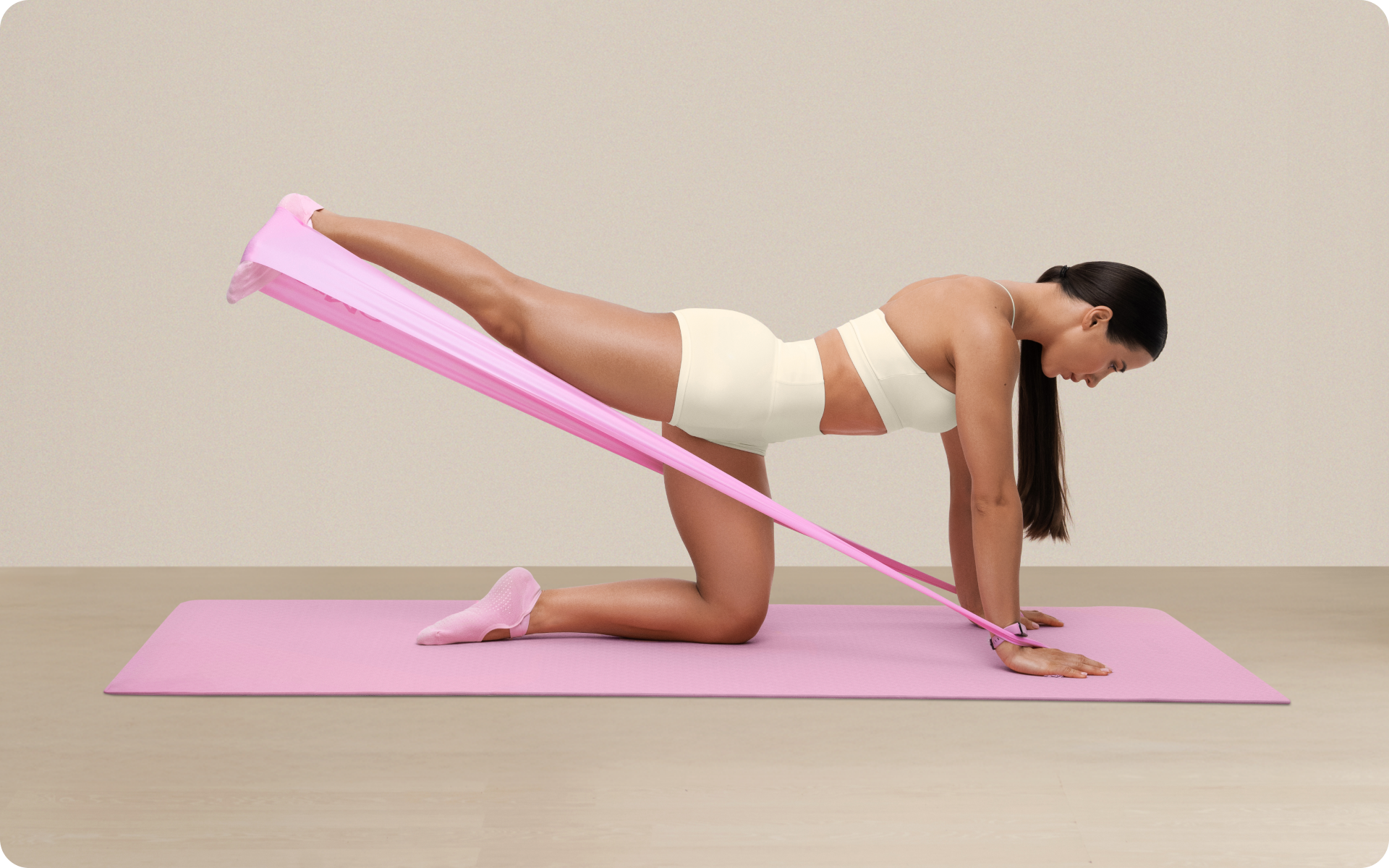
Pilates resistance bands exercises add elastic resistance to controlled movements for your upper body, hips, and trunk. Choose the band type before choosing the exercise. Begin with light tension, a secure grip, and a range you can repeat. The home band workout shows one way to organize a session.
Key takeaways
- Elastic resistance is a strength-training option across several studied programs (1).
- Inspect bands before use and control their return (2).
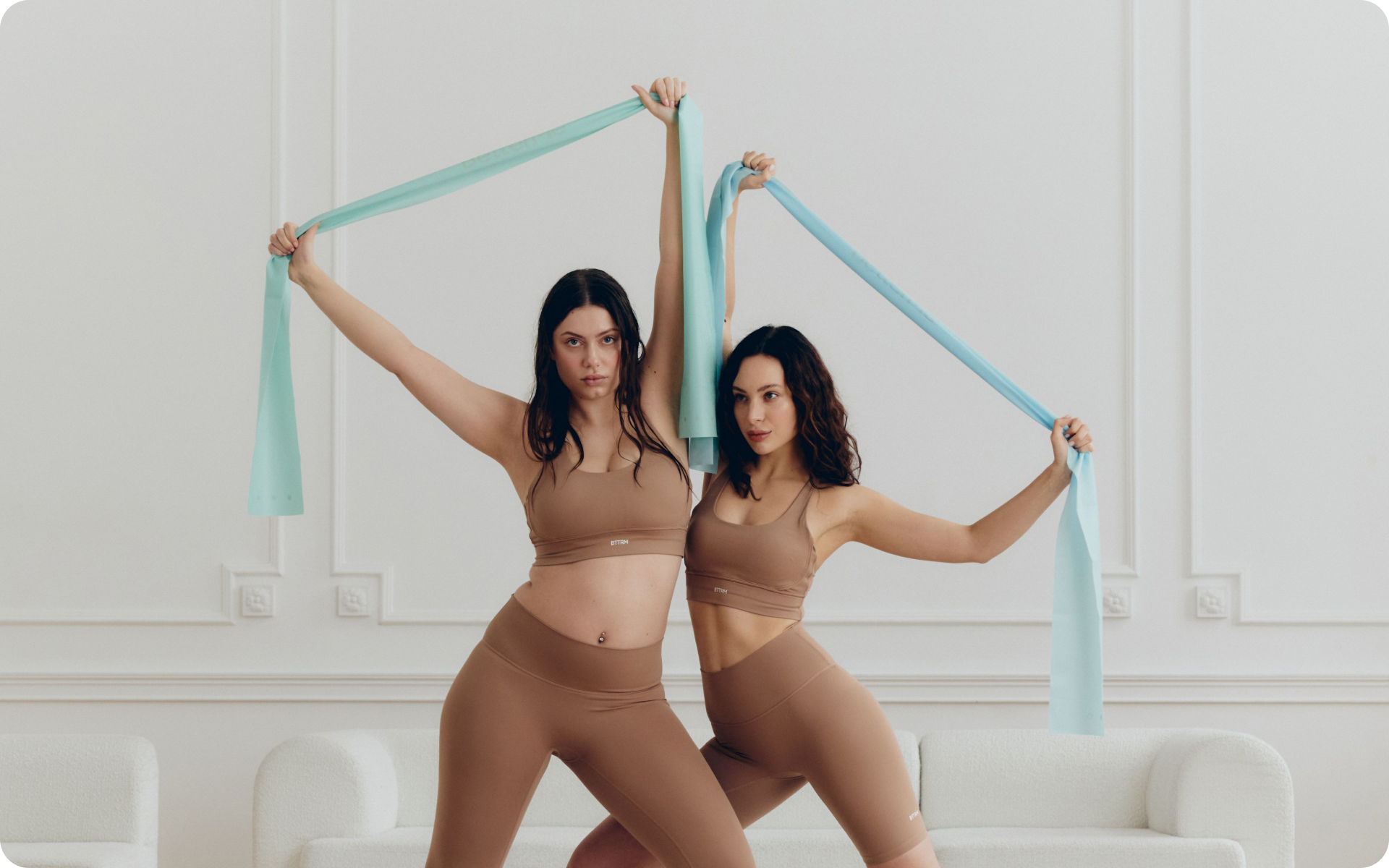
- Long bands suit rows and supported leg presses; short loops suit outward hip movements.
- The exercise examples include easier options when equipment placement or balance is unfamiliar.
- Sample circuits are editorial examples, with no guaranteed result or elapsed session time.
- A weekly activity plan also needs aerobic movement and coverage of major muscle groups (3).
Which Pilates resistance bands exercises should you learn first?
Learn movements that let you establish a secure band position and maintain control. A seated row, supported leg press, clamshell, and supported side lift cover several distinct actions. An unbanded chest-opening movement can complete the starting group.
Treat the band as part of the setup. A loop around your thighs cannot replace a long band held across your feet. A tied band may behave differently from a manufactured loop. Follow the equipment instructions rather than improvising a new attachment.
|
Exercise |
Band type |
Movement emphasis |
Easier version |
|---|---|---|---|
|
Seated row |
Long band |
Upper-body pulling |
Lighter resistance |
|
Supported leg press |
Long band |
Controlled knee extension |
Unbanded foot slide |
|
Chest opener |
Optional long band |
Shoulder movement |
No band |
|
Clamshell |
Short loop |
Outward hip rotation |
Remove the loop |
|
Standing side lift |
Short loop |
Outward hip movement |
Supported unbanded lift |
The names identify movement patterns, rather than guaranteed changes in individual muscles. Your position and band direction affect the task. If the band makes the exercise harder to understand, learn the unbanded movement first.
How do you perform a seated row?
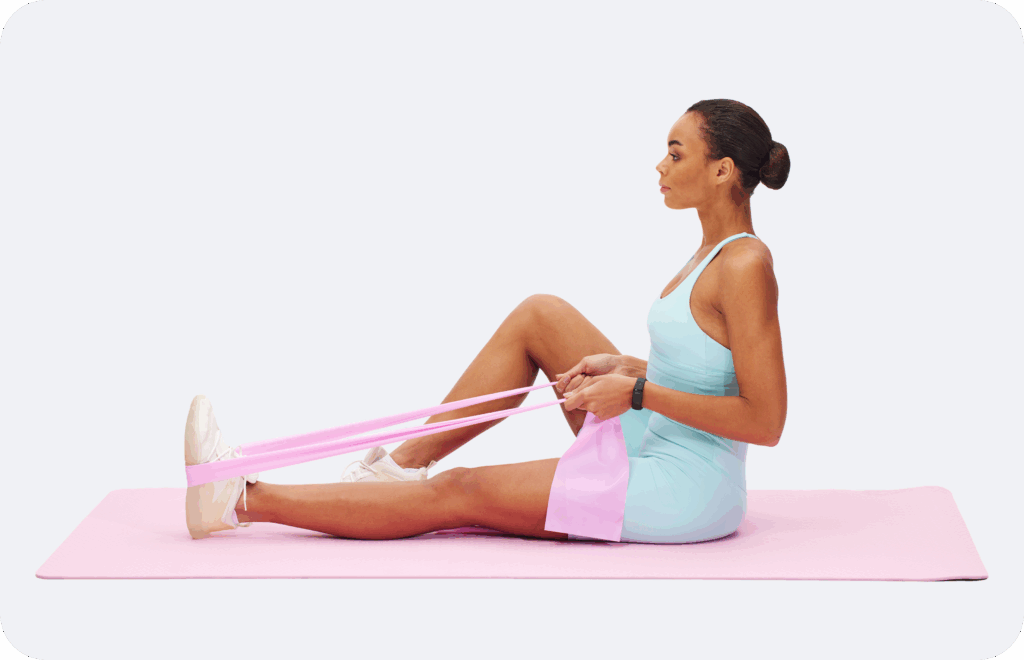
Perform the seated row by pulling a long band toward your sides while maintaining a steady seated position. Use the manufacturer’s foot-held setup if permitted. Avoid pulling toward your face.
- Sit with knees comfortably bent and feet supported.
- Position the band securely across both covered feet.
- Hold one end in each hand.
- Draw your elbows backward beside your body.
- Return your hands forward slowly.
- Release tension before removing the band.
The return is part of the repetition. Let your arms travel forward without the band pulling you suddenly. Keep your shoulders from rising toward your ears.
Choose a band length that allows a relaxed grip. Excessively shortening the band can make the start position awkward. If your trunk rocks with each pull, reduce tension or shorten the arm movement.
The row belongs to the pulling portion of a routine. A full-body session should also consider lower-body movement and a suitable pushing exercise. Repeating only rows does not cover every training need.
Whether you’re a workout beast or just a beginner making your first foray into the world of fitness and dieting – BetterMe has a lot to offer to both newbies and experts! Install the app and experience the versatility first-hand!
How do you perform a supported leg press?
Perform a supported leg press by extending one knee against a securely held long band. Keep your head and other foot supported. A foot slide is an alternative when band security is uncertain.
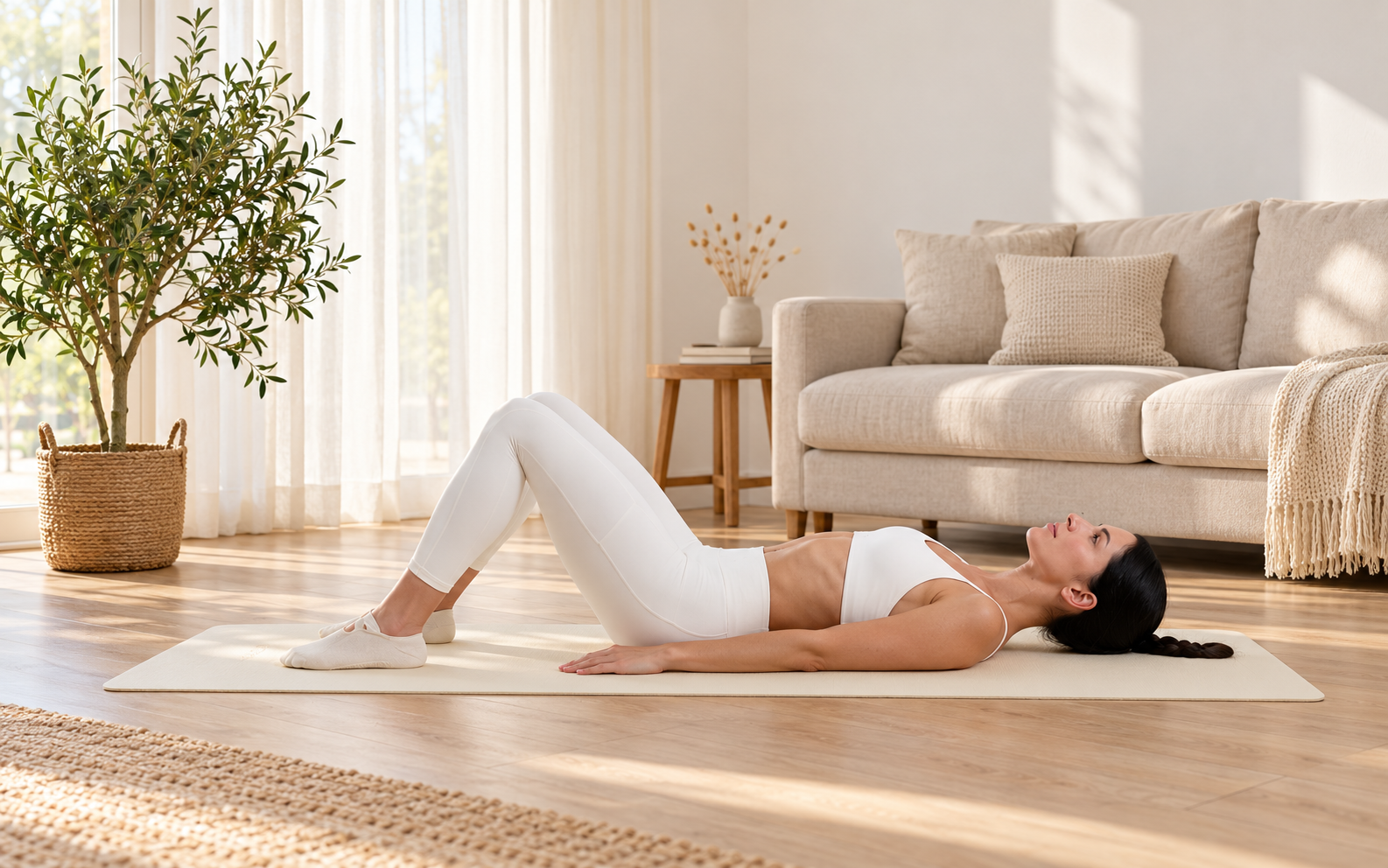
- Lie on your back with both knees bent.
- Position the band across one covered foot.
- Hold both ends beside your torso.
- Raise the working foot to a comfortable starting position.
- Extend the working knee through a small range.
- Bend the knee to return gradually.
- Release tension before changing sides.
Keep the band path away from your face. Move within a range that preserves your trunk position. Lowering the leg farther may increase the control demands, so start with a smaller action.
A banded leg press is different from stretching the back of your thigh. During the press, the knee bends and straightens against resistance. During an assisted stretch, the band mainly helps you position the leg.
Avoid combining those tasks during your first attempt. Finish the resistance set, release tension, and reset before flexibility work. Separating the tasks makes the instructions easier to follow.

How can you open your chest without overstretching the band?
Use a small arm-opening movement, with little or no band tension. The purpose is controlled shoulder movement. A forceful pull-apart is a different resistance exercise.
- Sit or stand with your arms comfortably forward.
- Hold a long band loosely between your hands.
- Move your hands apart a small distance.
- Return your hands toward the starting position.
- Lower your arms before releasing your grip.
Keep the movement below shoulder height if that feels more manageable. Avoid arching your back to create a larger opening. Remove the band when its resistance pulls your arms out of position.
Chest-opening movement should feel controlled rather than forced. A band cannot determine the range appropriate for your shoulders. If movement causes discomfort, stop and seek guidance before trying a harder variation.

How do you perform clamshells with a loop?
Perform clamshells by opening the upper knee while keeping your feet together and pelvis steady. A loop above the knees adds resistance. Begin without the loop if the movement is unfamiliar.
- Lie on your side with your head supported.
- Bend both knees into a comfortable position.
- Place the loop above your knees.
- Lift the upper knee a small distance.
- Lower the upper knee with control.
- Turn over and repeat on the other side.
Keep your trunk facing forward. Rolling your pelvis backward creates a larger-looking movement without preserving the same hip action. Limit the opening to the range you can repeat steadily.
A clamshell uses hip rotation with bent knees. A side-lying leg lift uses a different leg position and movement. Choose the exercise according to the action you want to practice.

How do you perform standing side leg lifts?
Perform standing side lifts by moving one leg outward while using a fixed support for balance. Start with the loop above your knees. An ankle-level loop can make the task more demanding.
- Stand beside a fixed counter or wall.
- Place the loop above your knees.
- Shift your weight onto the supporting leg.
- Lift the other leg a small distance sideways.
- Return the working foot to the floor.
- Change sides after your set.
Keep your trunk upright rather than leaning away from the moving leg. A lower lift may allow steadier control. Use an unbanded lift if the loop pulls your stance out of position.
Choose a support that cannot slide or tip. The support provides balance feedback, rather than an anchor for the band. If standing balance remains uncertain, use the side-lying version instead.

How can you build a circuit from these exercises?
Build a circuit by choosing a few distinct movements and leaving time to reset equipment. The sample circuits below are editorial options. Choose one circuit for a session rather than completing all three.
|
Circuit |
Exercise selection |
Optional starting amount |
Rest |
|---|---|---|---|
|
Lower-body practice |
Leg press, clamshell, side lift |
1 set of 6 to 8 per side |
30 to 60 seconds between exercises |
|
Hip-focused practice |
Unbanded bridge, clamshell, side lift |
1 set of 8 per side where applicable |
30 to 60 seconds between exercises |
|
Mixed practice |
Row, leg press, chest opener, clamshell |
1 set of 6 to 10 each |
30 to 60 seconds between exercises |
Warm up with easy walking and unbanded versions of the selected movements. Finish with easy movement. The number of repetitions is a starting example, with comfort and control guiding adjustments.
Place the long band and loop within reach before beginning. Complete both sides of a movement before changing equipment. Count each side separately so the last exercise does not receive an accidental extra set.
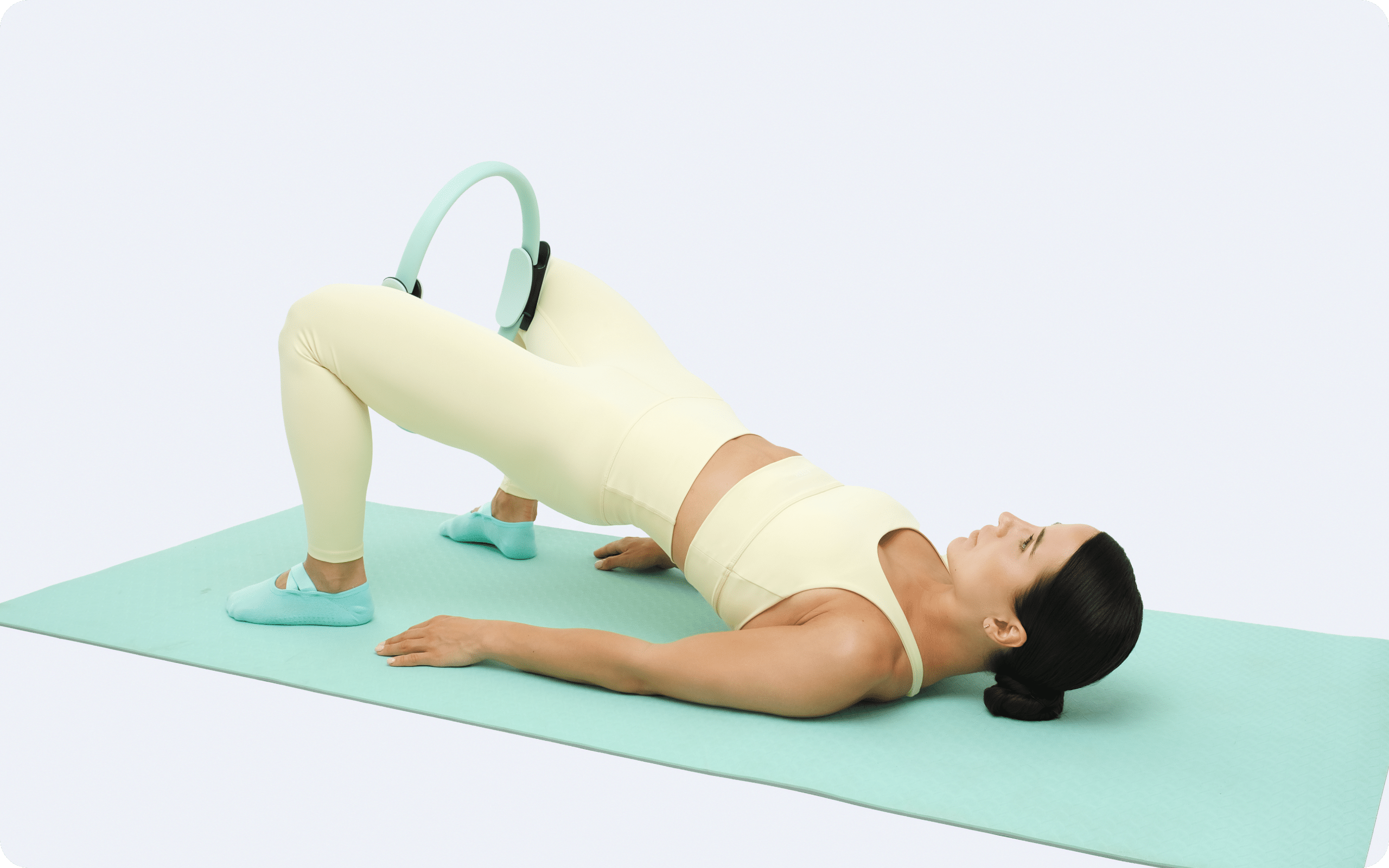
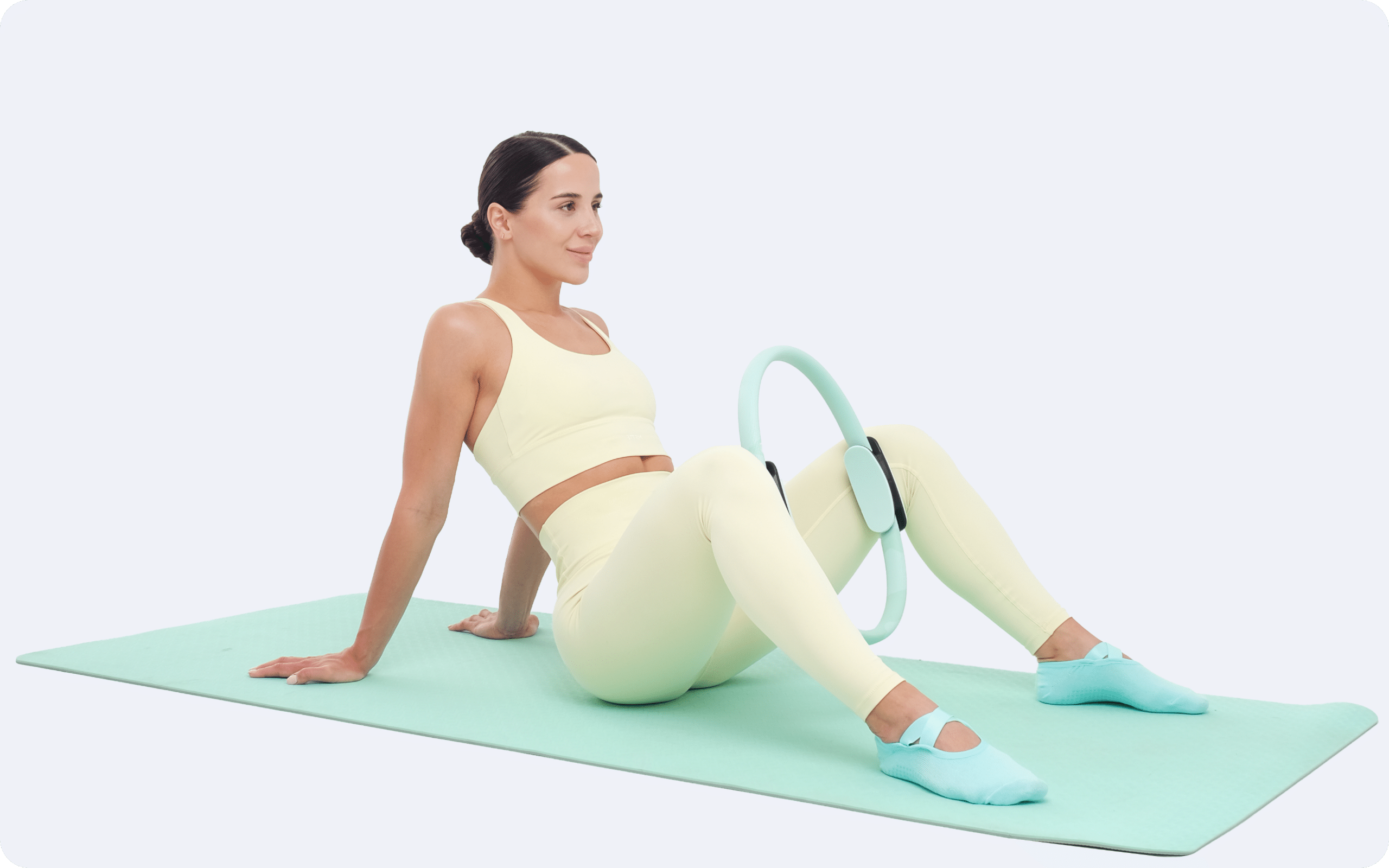
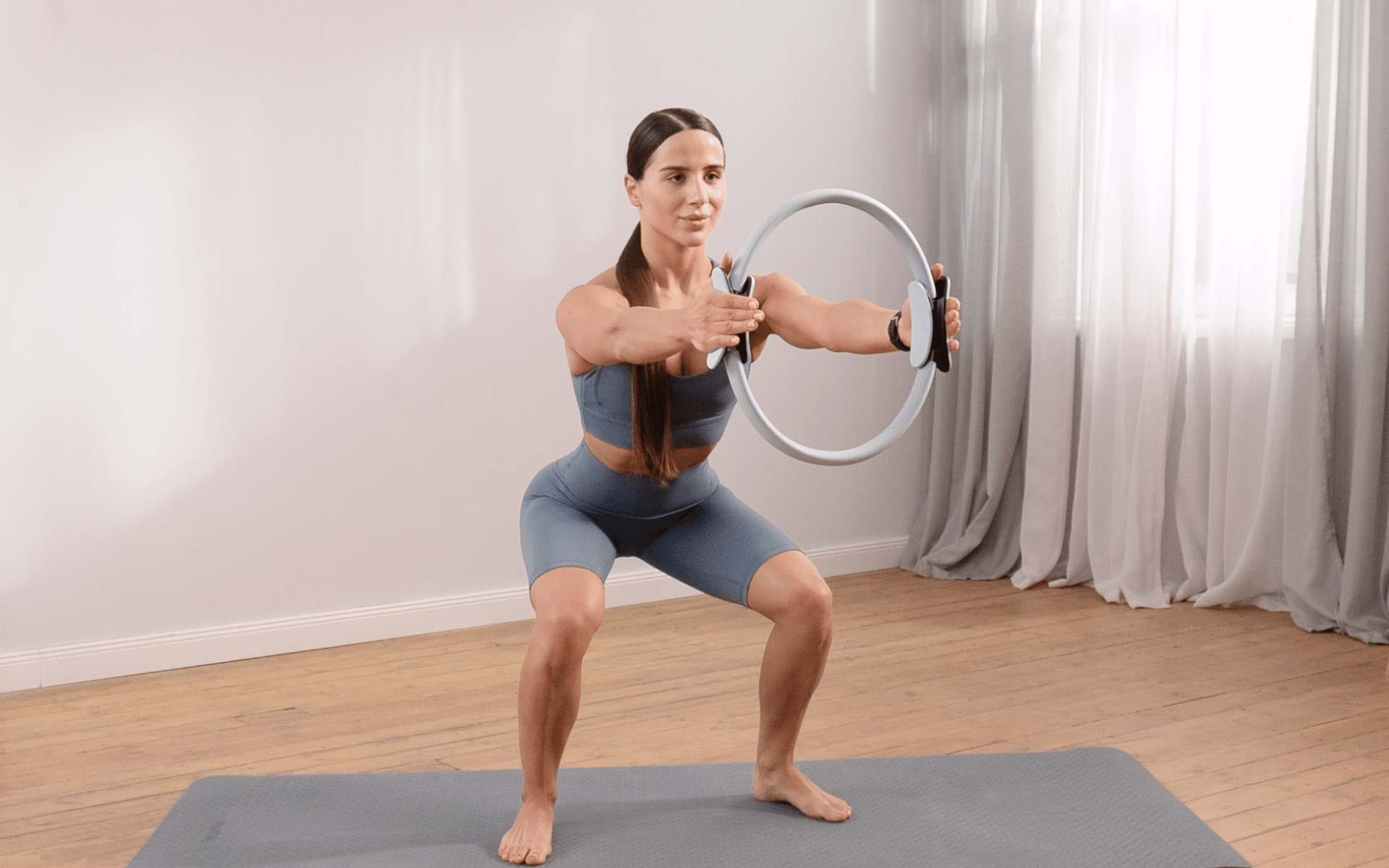
The ring exercise guide describes pressure-based prop work. Ring presses and band pulls are different tasks, even when both appear in a Pilates class.
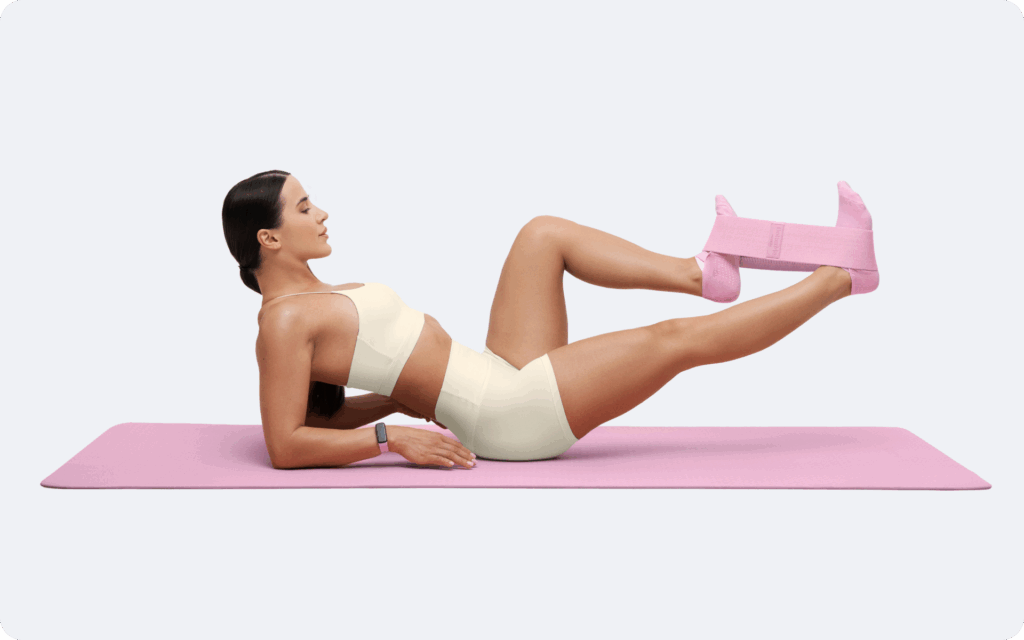
Can bands improve strength or Pilates control?
Bands can contribute to resistance training when the exercise provides a manageable muscular challenge. A 2026 review supports elastic-band and home-based resistance training as options (4). The finding does not verify every banded Pilates routine.
Pilates trials have measured improvements in abdominal endurance and flexibility among specific adult groups (5). Another trial measured changes in trunk-pelvic control (6). These findings concern the studied programs, rather than the circuits on this page.
Keep strength, skill, and flexibility separate in your training notes. Stronger resistance may indicate a changed load. A steadier pelvis may indicate improved execution. A longer stretch is a different observation again.
Avoid judging progress only by soreness or a burning sensation. Record whether you can complete the planned movements with the same equipment setup. That comparison is more useful than changing several variables each session.
How should you use a band for stretching?
Use a band to assist a comfortable position rather than pull your body farther by force. Read the band instructions first. Keep the band secure and away from your face.
For a supported leg stretch, begin with your knee slightly bent. Hold the band with enough slack to make small adjustments. Relax the tension if the stretch becomes uncomfortable.
An assisted stretch does not need the same band tension as a row. Avoid using a heavy loop simply because it was already in your hands. An unbanded stretch may be easier to regulate.
The beginner ring setup guide discusses another optional prop. Neither a ring nor a band is required to begin mat practice.

What mistakes should you watch for?
Watch for slipping equipment, rushed returns, and a band that dictates your body position. Stop and reset when those problems appear. A smaller range or lighter band may solve the immediate setup problem.
Inspect equipment before each session and follow the maker’s stretch limits (2). Avoid tying damaged sections together. A repair that changes the band surface can also change how the band grips.
For your weekly plan, include aerobic activity alongside muscle-strengthening work (3). A long list of band exercises does not automatically meet every recommendation. Consider which muscle groups and activity types your week actually covers.
Yes, if the shoes and band instructions allow a secure setup. Check that the band cannot slide toward your toes before adding tension. No, resistance colors are manufacturer-specific. Use the product label and your actual movement control when selecting a band. No, persistent pinching or pressure marks are reasons to stop and adjust the setup. Try a different placement, suitable size, or unbanded exercise.Frequently Asked Questions
Can I wear shoes for foot-held band exercises?
Do band colors mean the same resistance across brands?
Should a loop leave marks on my legs?
Find resistance bands for your Pilates routine at BetterMe Store.
The bottom line
Learn the row, leg press, clamshell, and side lift with manageable tension. Choose one sample circuit and record your band setup. Keep the unbanded options available when grip, balance, or movement control needs attention.
DISCLAIMER:
This article is intended for general informational purposes only and does not serve to address individual circumstances. It is not a substitute for professional advice or help and should not be relied on for making any kind of decision-making. Any action taken as a direct or indirect result of the information in this article is entirely at your own risk and is your sole responsibility.
BetterMe, its content staff, and its medical advisors accept no responsibility for inaccuracies, errors, misstatements, inconsistencies, or omissions and specifically disclaim any liability, loss or risk, personal, professional or otherwise, which may be incurred as a consequence, directly or indirectly, of the use and/or application of any content.
You should always seek the advice of your physician or other qualified health provider with any questions you may have regarding a medical condition or your specific situation. Never disregard professional medical advice or delay seeking it because of BetterMe content. If you suspect or think you may have a medical emergency, call your doctor.
SOURCES:
- Effects of training with elastic resistance versus conventional resistance on muscular strength: A systematic review and meta-analysis (2019, journals.sagepub.com)
- Using Resistance Bands for Strength Training (2022, health.clevelandclinic.org)
- Adult Activity: An Overview (2024, www.cdc.gov)
- American College of Sports Medicine Position Stand. Resistance Training Prescription for Muscle Function, Hypertrophy, and Physical Performance in Healthy Adults: An Overview of Reviews (2026, pmc.ncbi.nlm.nih.gov)
- Can a pilates exercise program be effective on balance, flexibility and muscle endurance? A randomized controlled trial (2016, pubmed.ncbi.nlm.nih.gov)
- Effects of Pilates Training on Lumbo-Pelvic Stability and Flexibility (2011, pmc.ncbi.nlm.nih.gov)
 Reviewed by
 Reviewed by