So much has been written on how to structure the perfect workout week. All a training plan really is is a collection of principles. So, it follows that getting the principles right is the only thing that truly matters.
When you have 5 days available for workouts, you have the opportunity to create a comprehensive, well-rounded training program. However, with so many options out there, it can be overwhelming to figure out what exactly to do each day. This is why we’ve created this ultimate science-backed guide for a 5-day workout routine for men.
Ahead, you will find all there is to know about creating a detailed training plan that works without leaving you burned out.
What Is a 5-Day Workout Routine for Men?
A 5-day workout routine is a training schedule that involves exercising five days per week. This frequency is common among intermediate to advanced lifters who have moved beyond the initial stages of training (1). For men, these routines are often designed to maximize muscle gain and strength.
One of the most popular ways to structure a 5-day routine is the “bro split”, which is also known as a body-part split. This method dedicates each of the five training days to a specific muscle group.
A typical bro split may look like this:
- Monday: Chest
- Tuesday: Back
- Wednesday: Legs
- Thursday: Shoulders
- Friday: Arms (biceps and triceps)
The core idea is to train each muscle group with high volume and intensity once per week. This allows you to focus all your energy on a single area, theoretically stimulating maximum growth before giving it a full week to recover. While this approach has been a staple in bodybuilding culture for decades, it’s worth examining its scientific merits and drawbacks.
Is a 5-Day Workout Plan Enough?
The question of whether a 5-day workout plan is “enough” depends entirely on your training goals, experience level, and ability to recover. For most people, training five days a week provides more than enough stimulus to drive significant progress in muscle size and strength.
The National Strength and Conditioning Association (NSCA) recommends the following training frequencies based on experience (1):
- Beginner (0-6 months): 2-3 sessions per week
- Intermediate (8-12 months): 3-4 sessions per week
- Advanced (≥1 year): 4-6 sessions per week
Based on these guidelines, a 5-day plan is best suited for advanced trainees. This frequency allows for a high total weekly training volume, which is a key driver of muscle hypertrophy. An intermediate lifter could also adopt a 5-day routine, but they must pay close attention to recovery to avoid overtraining. For a beginner, five days is likely excessive and could compromise recovery, hindering rather than helping progress (1).
BetterMe: Health Coaching app helps you achieve your body goals with ease and efficiency by helping to choose proper meal plans and effective workouts. Start using our app and you will see good results in a short time.
How to Divide a Workout in 5 Days
The “bro split” is just one way to organize a 5-day training week. There are several other effective methods, each of which has its own set of advantages. The best split for you depends on your goals, schedule, and personal preference.
The “Bro Split” (Body Part Split)
This is the classic 5-day split we mentioned earlier.
- Focus: Isolating one major muscle group per day.
- Pros: Allows for maximum volume and intensity for each muscle group. It’s simple to program and follow.
- Cons: Each muscle group is only stimulated once per week. This may be suboptimal for muscle protein synthesis (MPS), the process of building new muscle, which typically peaks around 24-48 hours post-exercise and returns to baseline shortly after. For experienced lifters, this window is even shorter – closer to 12-24 hours (2). Training a muscle only once a week means you may miss opportunities to stimulate growth.
Upper/Lower Split
This split divides your training into upper-body days and lower-body days.
- Structure:
- Day 1: Upper body
- Day 2: Lower body
- Day 3: Rest
- Day 4: Upper body
- Day 5: Lower body
- Day 6: Upper body (or rest)
- Day 7: Rest
- Pros: Each muscle group is trained 2-3 times per week, which aligns better with MPS timelines. This split is excellent for building both strength and muscle (3).
- Cons: With a 5-day schedule, the weekly structure can be unbalanced. You might end up training your upper body three times and your lower body twice one week, and vice versa the next.
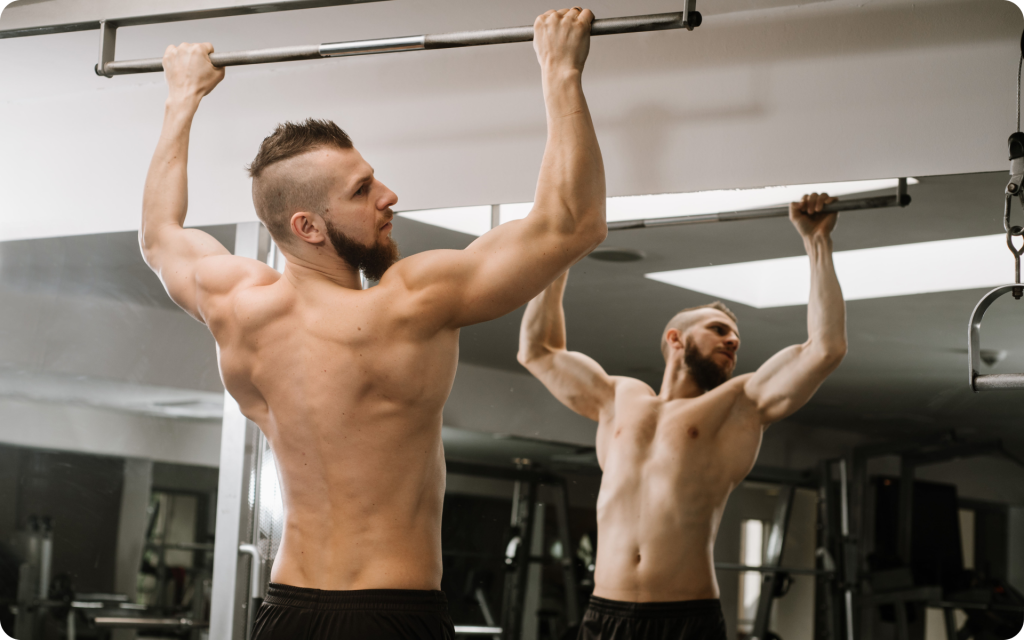
Push/Pull/Legs (PPL) Split
This is another highly popular and effective split that groups muscles by their movement pattern.
- Structure:
- Day 1: Push (chest, shoulders, triceps)
- Day 2: Pull (back, biceps)
- Day 3: Legs (quads, hamstrings, glutes, calves)
- Day 4: Push
- Day 5: Pull
- Day 6: Rest
- Day 7: Legs (start of next cycle)
- Pros: High frequency (each muscle group trained roughly every 3-4 days), logical muscle grouping, and allows for good recovery between sessions that target similar muscles.
- Cons: A traditional PPL routine is a 6-day cycle, so fitting it into a 5-day week requires modification. You might run it as PPL-Rest-PPL-Rest, which extends the cycle over more than one week.
Ultimately, the choice of split is a tool to organize your training. The key variables for success remain volume, intensity, and progressive overload.
If you’re looking for a workout you can do without equipment, here’s our guide to the best 5-day workout routine at home.
Read more: Weightlifting Routine for Men
What Is a Complete 5-Day Workout Routine for Men?
Here’s a complete 5-day “bro split” routine that’s designed for an intermediate-to-advanced lifter focused on building muscle. This plan provides high volume for each body part, ensuring you hit the muscles from multiple angles to stimulate growth.
Program Notes
- Key Terms:
- RPE: Rate of perceived exertion. A scale of 1-10 to measure how hard a set feels. An RPE of 8 means you could have done two more reps. An RPE of 10 is absolute failure.
- Progressive Overload: The principle of gradually increasing the demands on your muscles over time. This can be done by lifting more weight, doing more reps, or adding more sets.
- Equipment Needed: A standard gym with barbells, dumbbells, cables, and various machines.
- Split Structure: 5-day body part split.
- Rep and Set Scheme: The program uses a variety of rep ranges to target different mechanisms of hypertrophy. Aim for an RPE of 8-9 on most sets, which means you should finish each set with 1-2 reps left in the tank.
- Rest: Rest 60-90 seconds between sets for smaller muscle groups and isolation exercises. Rest 2-3 minutes for heavy compound lifts like squats and bench presses.
The 5-Day Bro Split Program
| Day | Muscle group | Exercise | Sets | Reps |
|---|---|---|---|---|
| Day 1 | Chest | Barbell bench press | 4 | 6-8 |
| Incline dumbbell press | 3 | 8-12 | ||
| Dumbbell flyes | 3 | 10-15 | ||
| Dips (chest-focused) | 3 | 12-15 | ||
| Cable crossovers | 3 | 12-15 | ||
| Day 2 | Back | Pull-ups (or lat pulldowns) | 4 | 8-12 |
| Barbell rows | 4 | 6-8 | ||
| T-bar rows | 3 | 8-12 | ||
| Seated cable rows | 3 | 10-15 | ||
| Dumbbell pullovers | 3 | 12-15 | ||
| Day 3 | Legs | Barbell back squats | 4 | 6-8 |
| Romanian deadlifts (RDLs) | 3 | 8-12 | ||
| Leg press | 3 | 10-15 | ||
| Leg extensions | 3 | 12-15 | ||
| Lying leg curls | 3 | 12-15 | ||
| Standing calf raises | 4 | 15-20 | ||
| Day 4 | Shoulders | Overhead press (barbell) | 4 | 6-8 |
| Dumbbell lateral raises | 4 | 10-15 | ||
| Seated dumbbell press | 3 | 8-12 | ||
| Face pulls | 3 | 15-20 | ||
| Dumbbell shrugs | 3 | 10-15 | ||
| Day 5 | Arms | Barbell curls | 3 | 8-12 |
| Skull crushers | 3 | 8-12 | ||
| Dumbbell hammer curls | 3 | 10-15 | ||
| Triceps pushdowns | 3 | 10-15 | ||
| Preacher curls | 3 | 12-15 | ||
| Overhead triceps extensions | 3 | 12-15 |
Exercise Instructions
Day 1: Chest
Barbell Bench Press
- Lie flat on a bench with your feet firmly on the floor. Grip the barbell with your hands slightly wider than shoulder-width apart.
- Unrack the bar and position it directly over your chest with your arms extended.
- Lower the bar slowly to your mid-chest, keeping your elbows tucked at a 45-75-degree angle.
- Press the bar back up to the starting position, driving through your chest, shoulders, and triceps.
Incline Dumbbell Press
- Set an adjustable bench to an incline of 30-45 degrees.
- Sit on the bench with a dumbbell in each hand, resting on your thighs. Kick the weights up to your shoulders.
- Press the dumbbells upward until your arms are fully extended, but not locked.
- Lower the dumbbells slowly and with control back to the sides of your chest.
Dumbbell Flyes
- Lie on a flat or incline bench with a dumbbell in each hand, your palms facing each other.
- With a slight bend in your elbows, lower the weights out to your sides in a wide arc until you feel a stretch in your chest.
- Squeeze your chest muscles to bring the dumbbells back to the starting position.
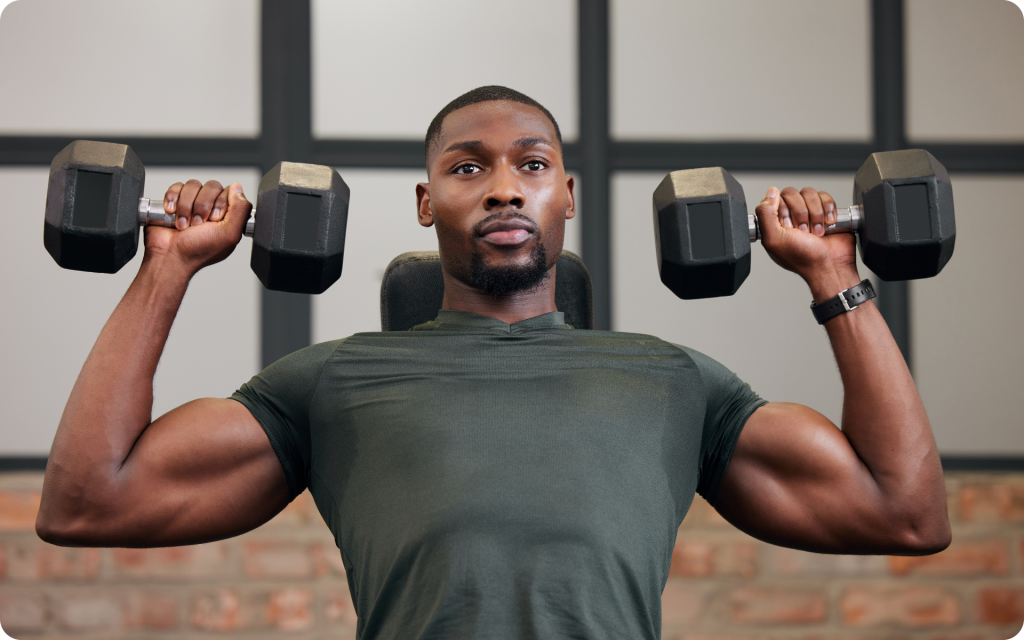
Dips (Chest-focused)
- Use parallel bars. Grip the bars and push yourself up until your arms are extended.
- Lean your torso forward slightly to emphasize the chest.
- Lower your body until your shoulders are below your elbows.
- Push back up to the starting position.
Cable Crossovers
- Set the pulleys on a cable machine to a high position.
- Grab the handles and step forward, keeping a slight bend in your elbows.
- Bring the handles down and across your body, squeezing your chest at the peak of the contraction.
- Slowly return to the starting position.
Day 2: Back
Pull-Ups
- Grab a pull-up bar with an overhand grip, slightly wider than your shoulders.
- Hang with your arms fully extended.
- Pull your body up until your chin is over the bar. Focus on driving your elbows down and back.
- Lower yourself back to the starting position with control.
Barbell Rows
- Stand with your feet shoulder-width apart, and bend at the hips until your torso is nearly parallel to the floor.
- Grip a barbell with an overhand grip, your hands just outside your knees.
- Pull the barbell up toward your lower chest, squeezing your back muscles.
- Lower the bar with control.
T-Bar Rows
- Stand over a T-bar row machine with your feet on the platform.
- Grip the handles and pull the weight up toward your chest.
- Squeeze your back at the top and lower the weight slowly.
Seated Cable Rows
- Sit at a cable row machine with your feet on the platform and your knees slightly bent.
- Grab the handle and pull it toward your abdomen, keeping your back straight.
- Squeeze your shoulder blades together at the end of the movement.
- Slowly extend your arms to return to the start.
Dumbbell Pullovers
- Lie perpendicular across a flat bench, with only your upper back supported.
- Hold one dumbbell with both hands over your chest.
- Keeping a slight bend in your elbows, lower the dumbbell in an arc behind your head.
- Pull the dumbbell back over your chest using your lats.
Whether you’re a workout beast or just a beginner making your first foray into the world of fitness and dieting – BetterMe has a lot to offer to both newbies and experts! Install the app and experience the versatility first-hand!
Day 3: Legs
Barbell Back Squats
- Place a barbell across your upper back. Stand with your feet shoulder-width apart, your toes pointing slightly out.
- Keeping your chest up and your back straight, descend by bending your knees and hips.
- Go down until your thighs are at least parallel to the floor.
- Drive through your heels to return to a standing position.
Romanian Deadlifts (RDLs)
- Hold a barbell with an overhand grip, your feet hip-width apart.
- Keeping your legs almost straight (a slight bend in the knees), hinge at your hips and lower the barbell.
- Lower the bar until you feel a deep stretch in your hamstrings.
- Squeeze your glutes and hamstrings to return to the starting position.
Leg Press
- Sit in a leg press machine with your feet shoulder-width apart on the platform.
- Push the platform away until your legs are extended, but not locked.
- Lower the platform with control until your knees are at a 90-degree angle.
- Press back to the start.
Leg Extensions
- Sit in a leg extension machine with the pad resting on your lower shins.
- Extend your legs until they’re straight.
- Squeeze your quads at the top, then lower the weight with control.
Lying Leg Curls
- Lie face down on a leg curl machine with the pad on the back of your ankles.
- Curl your legs up toward your glutes.
- Squeeze your hamstrings at the top, then lower the weight with control.
Standing Calf Raises
- Stand on a calf raise machine or a raised platform with the balls of your feet.
- Lower your heels as far as possible to stretch your calves.
- Push up onto your toes as high as you can.
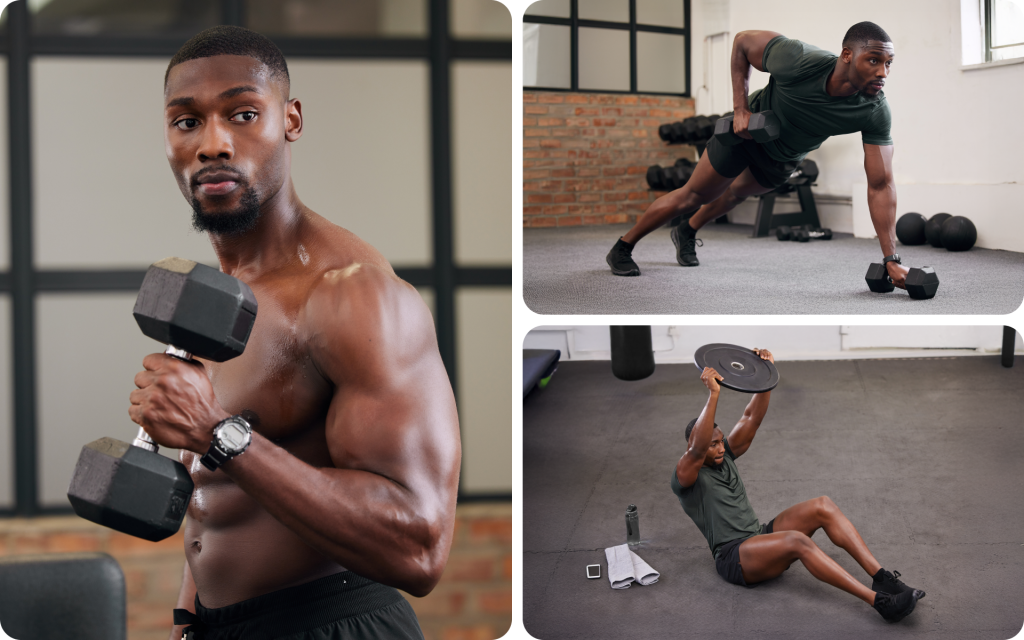
Day 4: Shoulders
Overhead Press (Barbell)
- Stand with a barbell racked at shoulder height. Grip it slightly wider than your shoulders.
- Press the barbell straight overhead until your arms are fully extended.
- Lower the bar with control back to your shoulders.
Dumbbell Lateral Raises
- Stand holding a dumbbell in each hand at your sides.
- With a slight bend in your elbows, raise the dumbbells out to your sides until they’re at shoulder height.
- Lower the weights with control.
Seated Dumbbell Press
- Sit on a bench with back support, holding a dumbbell in each hand at shoulder height.
- Press the dumbbells overhead until your arms are extended.
- Lower them slowly back to your shoulders.
Face Pulls
- Set a cable machine pulley at face height with a rope attachment.
- Grab the rope and pull it toward your face, separating your hands as you pull.
- Squeeze your rear deltoids and upper back.
- Return to the start with control.
Dumbbell Shrugs
- Stand holding a heavy dumbbell in each hand.
- Shrug your shoulders straight up toward your ears.
- Hold the contraction at the top, then lower slowly.
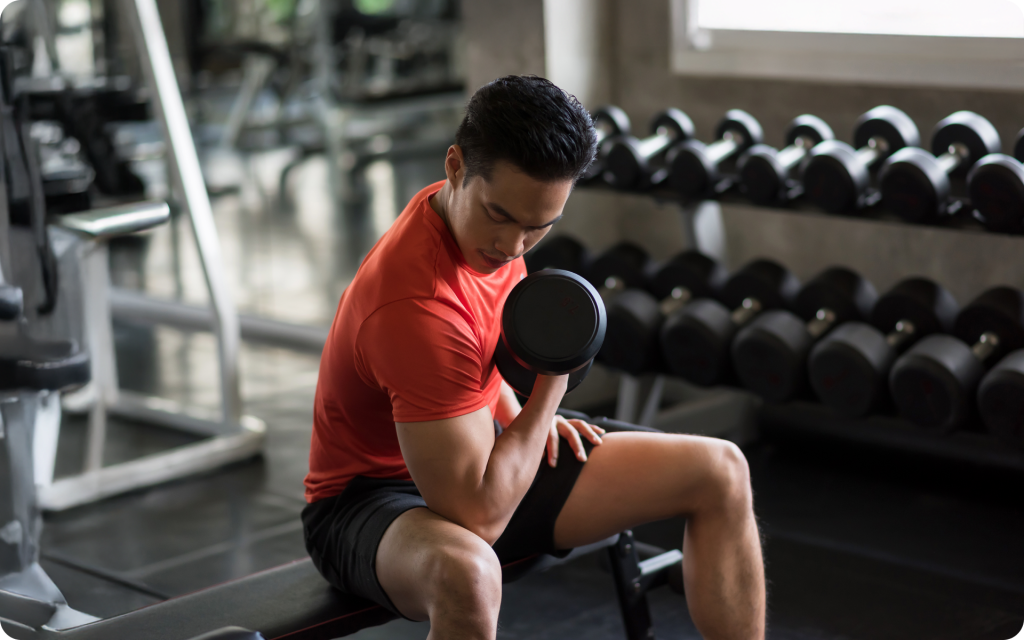
Day 5: Arms
Barbell Curls
- Stand holding a barbell with an underhand grip, your hands shoulder-width apart.
- Keeping your elbows pinned to your sides, curl the barbell up toward your shoulders.
- Squeeze your biceps at the top, then lower the bar with control.
Skull Crushers
- Lie on a flat bench, holding an EZ-bar or barbell with a narrow grip over your chest.
- Keeping your upper arms stationary, bend your elbows to lower the bar toward your forehead.
- Extend your arms to press the weight back up.
Dumbbell Hammer Curls
- Stand holding a dumbbell in each hand with a neutral (palms facing in) grip.
- Curl the dumbbells up, keeping your palms facing each other.
- Lower with control.
Triceps Pushdowns
- Attach a straight bar or rope to a high pulley.
- Grab the attachment and push it down until your arms are fully extended.
- Keep your elbows close to your body.
Preacher Curls
- Sit at a preacher curl bench, with your upper arms resting on the pad.
- Curl the weight up, squeezing your biceps.
- Lower it all the way down with control.
Overhead Triceps Extensions
- Sit or stand holding a single dumbbell with both hands over your head.
- Lower the dumbbell behind your head by bending your elbows.
- Extend your arms to lift the weight back to the starting position.
Do you want a routine that’s focused on hypertrophy? Here’s our favorite 7-day workout routine to build muscle.
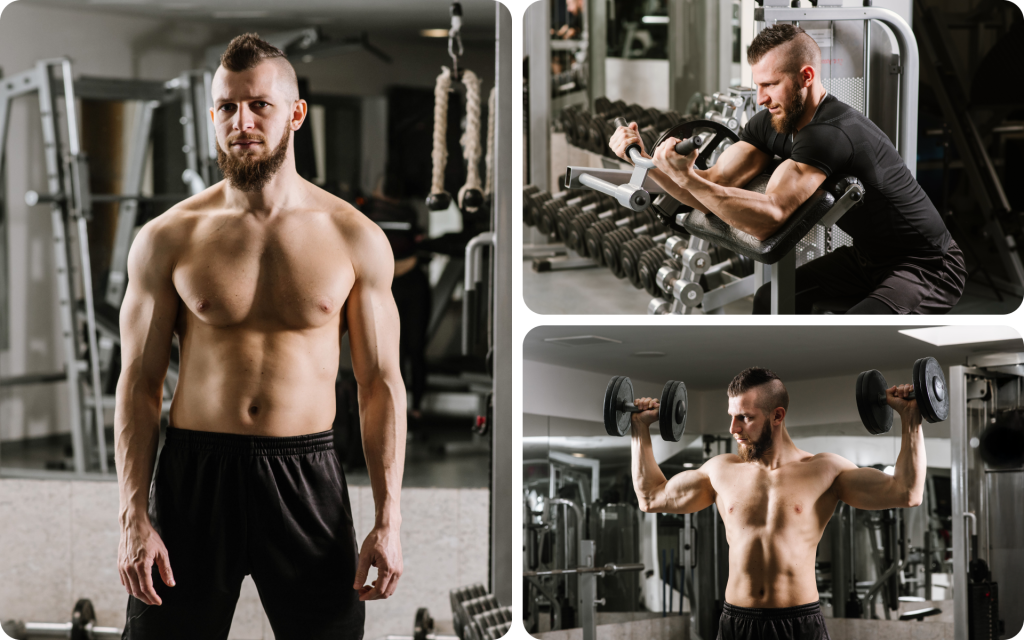
Will I Gain Muscle if I Work out 5 Days a Week?
Yes, you can absolutely gain muscle working out five days a week, as long as your training and nutrition are properly managed. In fact, a 5-day routine is often ideal for a 5-day workout split for muscle gain. The primary driver of muscle hypertrophy (growth) is total training volume – the total number of sets and reps you perform (4).
A 5-day split allows you to accumulate a high weekly volume for each muscle group.
A key 2021 study published in Einstein (São Paulo) compared a split workout (training muscles twice a week) to a full-body routine (training muscles four times a week). The researchers found that as long as the weekly volume of sets was equal, both groups made similar gains in muscle strength and hypertrophy (5). This reinforces the idea that volume is king.
However, a “bro split” trains each muscle only once per week. While the volume per session is high, the frequency is low. A 2016 meta-analysis in Sports Medicine suggested that training a muscle group at least twice per week is superior for hypertrophy (3).
This doesn’t mean that a bro split is ineffective. The high volume and intensity of a dedicated body-part day can create significant muscle damage and metabolic stress, two other factors that contribute to growth (6). For an advanced lifter who can generate tremendous intensity, a once-per-week session may be enough stimulus, particularly with a full week for recovery.
Read more: Skinny to Muscular Workout Plan: Tips, Tricks, and Training Essentials
How Long Does It Take to See Results from Working out 5 Days a Week?
Visible results from a consistent 5-day workout routine typically appear within 8-12 weeks (7). However, the timeline depends on several factors:
- Training Experience: Beginners often see faster initial gains (often called “newbie gains”) due to rapid neural adaptations and muscle sensitivity to training. An untrained individual can see noticeable strength increases in just a few weeks (8).
- Consistency: Adhering to your 5-day plan without missing workouts is essential.
- Nutrition: You must consume enough calories and protein to support muscle repair and growth. A caloric surplus (eating more calories than you burn) is generally required to build significant muscle mass (9).
- Recovery: Getting 7-9 hours of quality sleep per night is essential for hormone regulation and muscle recovery (10).
- Genetics: Individual genetic predispositions play a role in how quickly you build muscle (11).
A 2019 study in Archivos de Medicina del Deporte showed significant improvements in strength and body composition in untrained men after just eight weeks of training, regardless of whether or not they used a full-body or split routine. (12) This suggests that if you’re consistent, you can expect to see and feel a difference in about two months.
Are you looking for the ultimate program? Here’s our guide to the best 5-day workout you can follow.
Yes, working out for at least 30 minutes 5 days a week is considered highly active. It exceeds the general physical activity guidelines recommended by organizations such as the World Health Organization, which suggest at least 150 minutes of moderate-intensity aerobic activity or 75 minutes of vigorous-intensity activity per week, plus muscle-strengthening activities on two or more days (13). While you can do a full-body workout five days a week, it’s generally not recommended for most people. Training the same muscles on consecutive days can lead to inadequate recovery, which increases the risk of overtraining and injury. If you choose to do this, the volume and intensity of each session must be very low to allow for recovery. A more effective approach would be to alternate between different full-body workouts or to ensure at least one day of rest between sessions. Training 5 days a week isn’t inherently overtraining, but it can be if it’s not managed properly. Overtraining occurs when the total stress from training, work, and life exceeds your body’s ability to recover. Key factors to prevent overtraining on a 5-day plan include: The “best” time to exercise is the time that you can consistently stick to. Physiologically, there are minor differences. Some studies have suggested that strength and power output may be slightly higher in the late afternoon (14). However, the difference is small, and consistency is far more important for long-term results. Whether you prefer to train in the morning, at lunchtime, or in the evening, choose the time that best fits your schedule and energy levels.Frequently Asked Questions
Is working out 5 days a week considered active?
Can I do a full-body workout for 5 days?
Is 5 days overtraining?
When is the best time to exercise?
The Bottom Line
A 5-day workout routine for men, particularly the classic “bro split”, can be a powerful tool for building muscle and strength, particularly for lifters with a year or more of consistent training under their belt. It allows for high volume and focus on individual muscle groups.
However, it’s not the only way to train. Other splits such as upper/lower or PPL may offer superior frequency for muscle growth. The science is clear – as long as your total weekly volume is sufficient and you are progressively overloading your muscles, you’ll make progress. The best split is the one you can adhere to consistently and recover from effectively.
DISCLAIMER:
This article is intended for general informational purposes only and does not serve to address individual circumstances. It is not a substitute for professional advice or help and should not be relied on for making any kind of decision-making. Any action taken as a direct or indirect result of the information in this article is entirely at your own risk and is your sole responsibility.
BetterMe, its content staff, and its medical advisors accept no responsibility for inaccuracies, errors, misstatements, inconsistencies, or omissions and specifically disclaim any liability, loss or risk, personal, professional or otherwise, which may be incurred as a consequence, directly or indirectly, of the use and/or application of any content.
You should always seek the advice of your physician or other qualified health provider with any questions you may have regarding a medical condition or your specific situation. Never disregard professional medical advice or delay seeking it because of BetterMe content. If you suspect or think you may have a medical emergency, call your doctor.
SOURCES:
- Determination of Resistance Training Frequency (2017, nsca.com)
- Resistance training‐induced changes in integrated myofibrillar protein synthesis are related to hypertrophy only after attenuation of muscle damage (2016, pmc.ncbi.nlm.nih.gov)
- Effects of Resistance Training Frequency on Measures of Muscle Hypertrophy: A Systematic Review and Meta-Analysis (2016, link.springer.com)
- A Systematic Review of The Effects of Different Resistance Training Volumes on Muscle Hypertrophy (2022, pmc.ncbi.nlm.nih.gov)
- Split or full-body workout routine: which is best to increase muscle strength and hypertrophy? (2021, scielo.br)
- Anabolic signals and muscle hypertrophy – Significance for strength training in sports medicine (2025, sciencedirect.com)
- Adaptations to Endurance and Strength Training (2018, pmc.ncbi.nlm.nih.gov)
- Neuromuscular adaptations to resistance training in elite versus recreational athletes (2025, frontiersin.org)
- Editorial: Nutritional Strategies to Promote Muscle Mass and Function Across the Health Span (2020, frontiersin.org)
- Sleep and muscle recovery: Endocrinological and molecular basis for a new and promising hypothesis (2011, sciencedirect.com)
- An Integrative Review of Genetic and Non-Genetic Factors Influencing Human Skeletal Muscle Hypertrophy (2025, research-archive.org)
- Split versus full-body strength training workouts in untrained people. A randomised study (2019, archivosdemedicinadeldeporte.com)
- Physical activity (2024, who.int)
- Time of Day and Muscle Strength: A Circadian Output? (2020, pmc.ncbi.nlm.nih.gov)

 Reviewed by