Starting at the gym can seem like a tall order. With so many machines, free weights, and classes, it’s easy to feel overwhelmed and unsure of where to begin. The most common problem isn’t a lack of motivation, it’s a lack of direction. You show up ready to work, but what exactly should you do? How often? And for how long?
This guide is designed to cut through the noise. We’ll provide a structured, science-based approach to your first few months in the gym. By the end, you’ll have a clear understanding of the most effective workout programs for beginners, how to choose one that fits your goals, and what to expect along the way. This isn’t just about exercising, it’s about training with purpose.
What Workout Programs for Beginners Are There?
For a beginner, the primary goal is to build a solid foundation. This involves developing proficiency in fundamental movement patterns, increasing work capacity, and allowing your muscles and connective tissues to adapt to new stresses.
An effective program for a beginner is one that prioritizes consistency and proper form over complexity or extreme intensity.
According to the National Strength and Conditioning Association (NSCA), beginners should focus on building a strong foundation by starting with workouts that are designed to improve either stamina or muscle growth (1).
Here are five types of workout programs structured to help you do just that.
1. Full-Body Strength Training Program
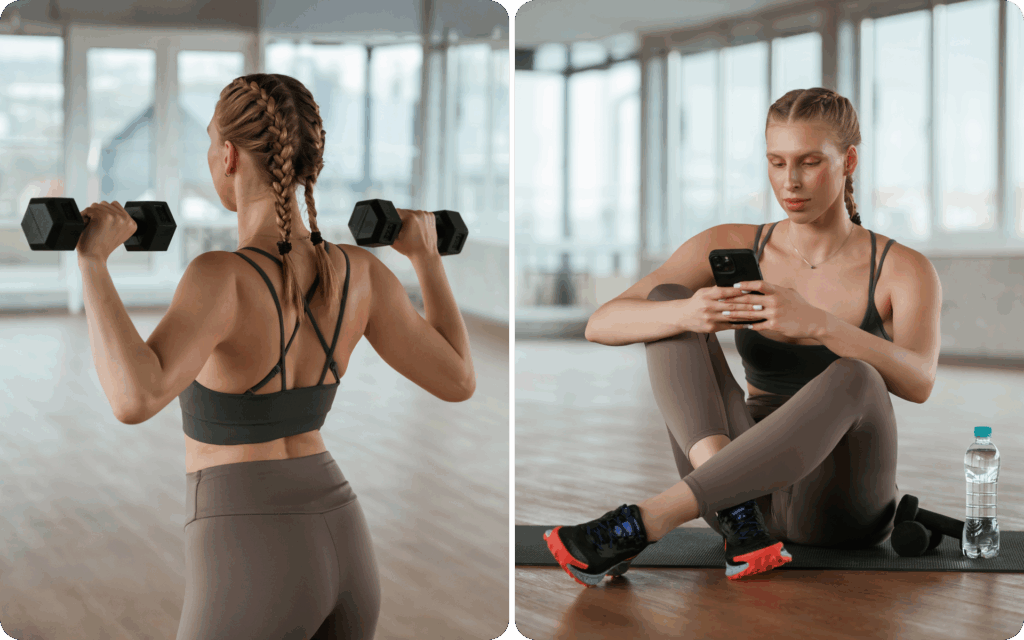
This is the most highly recommended starting point for beginners. A full-body program involves training all major muscle groups in a single session. This approach provides a high-frequency stimulus to each muscle group, which is crucial for motor learning – your brain’s ability to learn and master new movements (2, 3).
Program Details
This type of program is typically performed 2-3 times per week on non-consecutive days, such as Monday, Wednesday, and Friday. The focus is on compound exercises, which are movements that work multiple joints and muscle groups simultaneously (4).
Program Notes:
- Frequency: 2-3 times per week on non-consecutive days.
- Repetitions (Reps): 8-12 reps per set. This range is ideal for building both muscle endurance and size (hypertrophy).
- Sets: 2-3 sets per exercise.
- Rest: 60-90 seconds between sets. This allows for partial recovery without letting your heart rate drop completely.
- Load: Use a weight that feels challenging but allows you to complete all reps with good form. This typically corresponds to 65-75% of your one-repetition maximum (1RM) – the heaviest weight you can lift for one rep. As you won’t know your 1RM, think of it as a weight that leaves you feeling like you could have done 2-3 more reps if you had to.
Full-Body Workout Program for Beginners (3 Days/Week)
| Exercise category | Day 1 | Day 2 | Day 3 |
|---|---|---|---|
| Lower body (squat) | Goblet squat: 3 sets of 8-12 reps | Romanian deadlift: 3 sets of 8-12 reps | Walking lunges: 3 sets of 10-12 reps per leg |
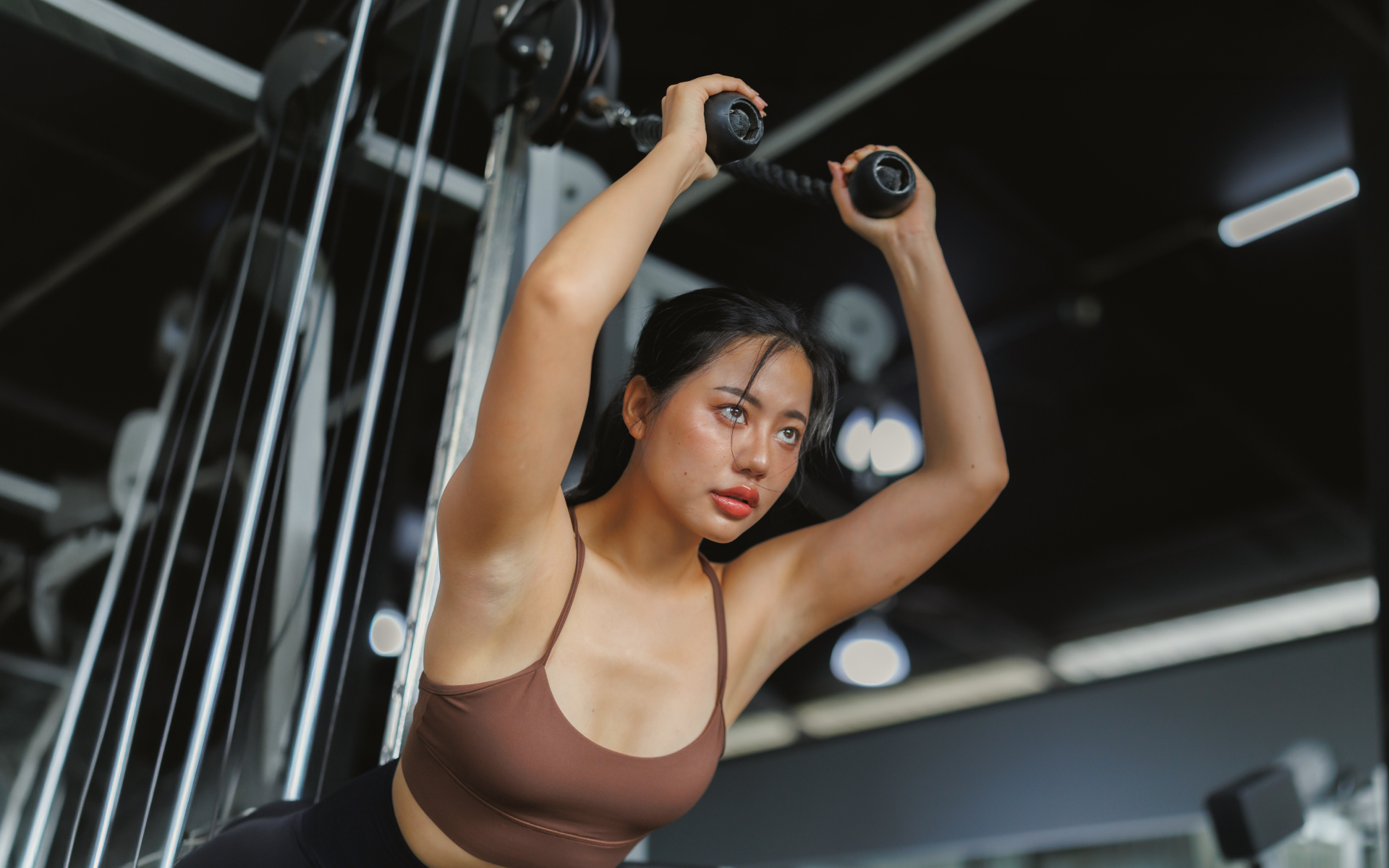
| Upper body (push) | Dumbbell bench press: 3 sets of 8-12 reps | Seated overhead press: 3 sets of 8-12 reps | Push-ups (on knees or toes): 3 sets to near failure |
| Upper body (pull) | Dumbbell row: 3 sets of 8-12 reps per arm | Lat pulldown: 3 sets of 8-12 reps | Seated cable row: 3 sets of 8-12 reps |
| Core | Plank: 3 sets, hold for 30-60 seconds | Leg raises: 3 sets of 10-15 reps | Bird dog: 3 sets of 10-12 reps per side |
Exercise Instructions
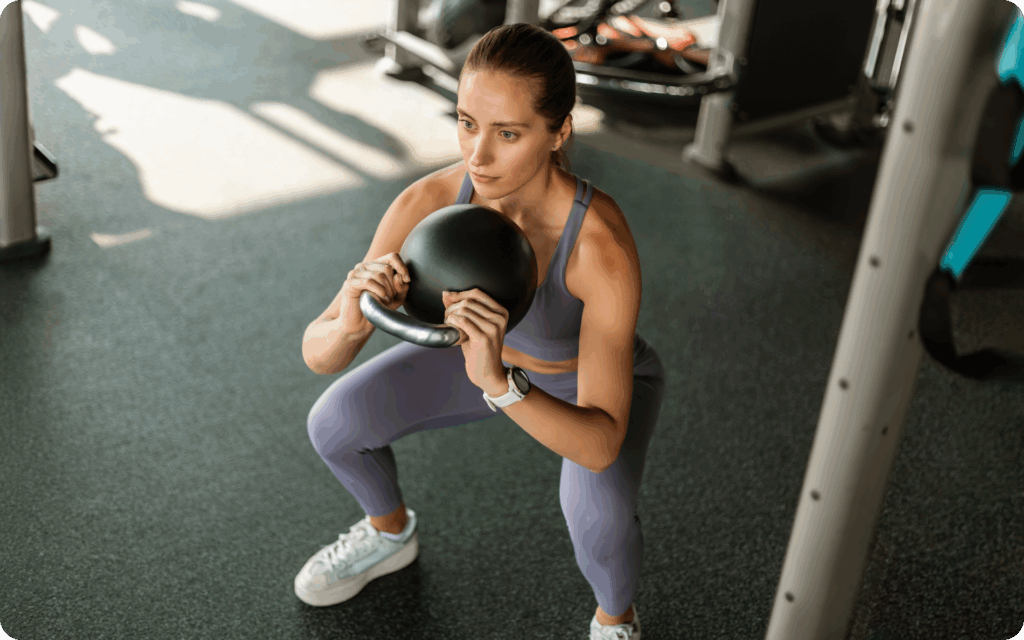
Goblet Squat
- Hold one dumbbell vertically against your chest with both hands, cupping the top head of the dumbbell.
- Stand with your feet slightly wider than shoulder-width apart, with your toes pointed slightly out.
- Keeping your chest up and back straight, push your hips back and bend your knees as if you’re sitting in a chair.
- Lower yourself until your thighs are parallel to the floor, or as low as you can comfortably go.
- Drive through your heels to return to the starting position, squeezing your glutes at the top.
Romanian Deadlift (RDL)
- Stand with your feet hip-width apart, holding a dumbbell in each hand in front of your thighs, your palms facing your body.
- Keeping your back straight and a slight bend in your knees, hinge at your hips and lower the dumbbells toward the floor.
- Lower the weights until you feel a stretch in your hamstrings, typically when the dumbbells are at mid-shin level.
- Drive your hips forward to return to the starting position, squeezing your glutes.
Walking Lunges
- Stand with your feet together, holding a dumbbell in each hand at your sides.
- Take a large step forward with your right leg, lowering your hips until both knees are bent at a 90-degree angle. Ensure your front knee is directly above your ankle.
- Push off your left foot and bring it forward to meet your right foot, returning to a standing position.
- Repeat the movement, this time stepping forward with your left leg. Continue alternating legs.
Dumbbell Bench Press
- Lie on a flat bench with your feet firmly on the floor. Hold a dumbbell in each hand at chest level, with your palms facing forward.
- Press the dumbbells upward until your arms are fully extended, but not locked.
- Slowly lower the dumbbells back to the starting position.
Seated Overhead Press
- Sit on a bench with back support, holding a dumbbell in each hand at shoulder height, your palms facing forward.
- Press the dumbbells directly overhead until your arms are fully extended.
- Slowly lower the dumbbells back to shoulder height.
Push-Ups
- Start in a plank position with your hands slightly wider than shoulder-width apart. Your body should form a straight line from your head to your heels.
- Lower your body until your chest is just above the floor.
- Push back up to the starting position. For a modification, perform the exercise with your knees on the floor.
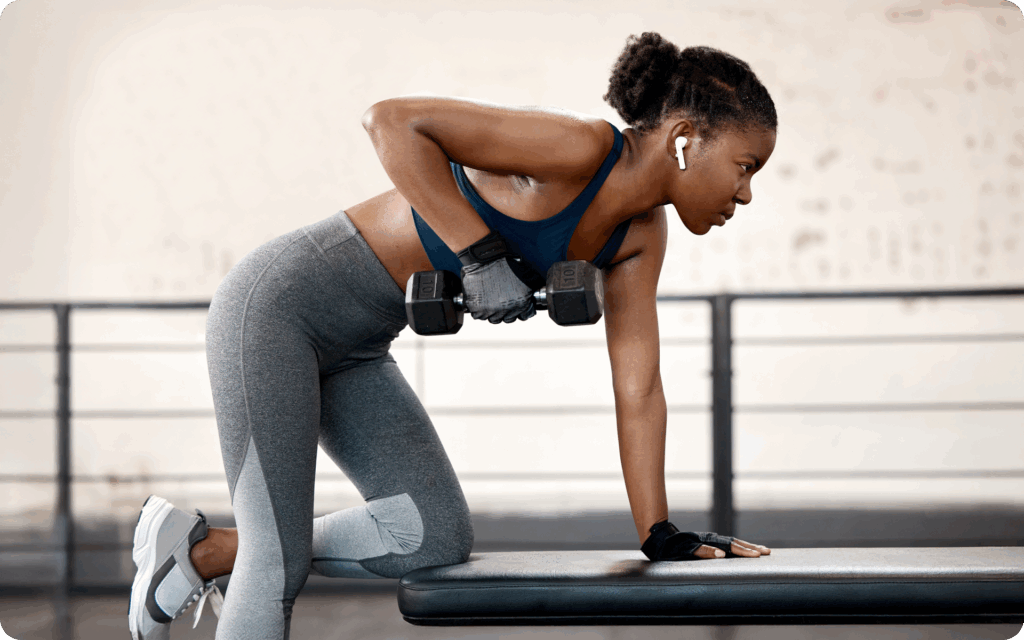
Dumbbell Row
- Place your left knee and left hand on a flat bench. Hold a dumbbell in your right hand with your arm extended toward the floor.
- Keeping your back flat, pull the dumbbell up toward your chest, squeezing your back muscles.
- Slowly lower the dumbbell back to the start. Complete all reps on one side before switching.
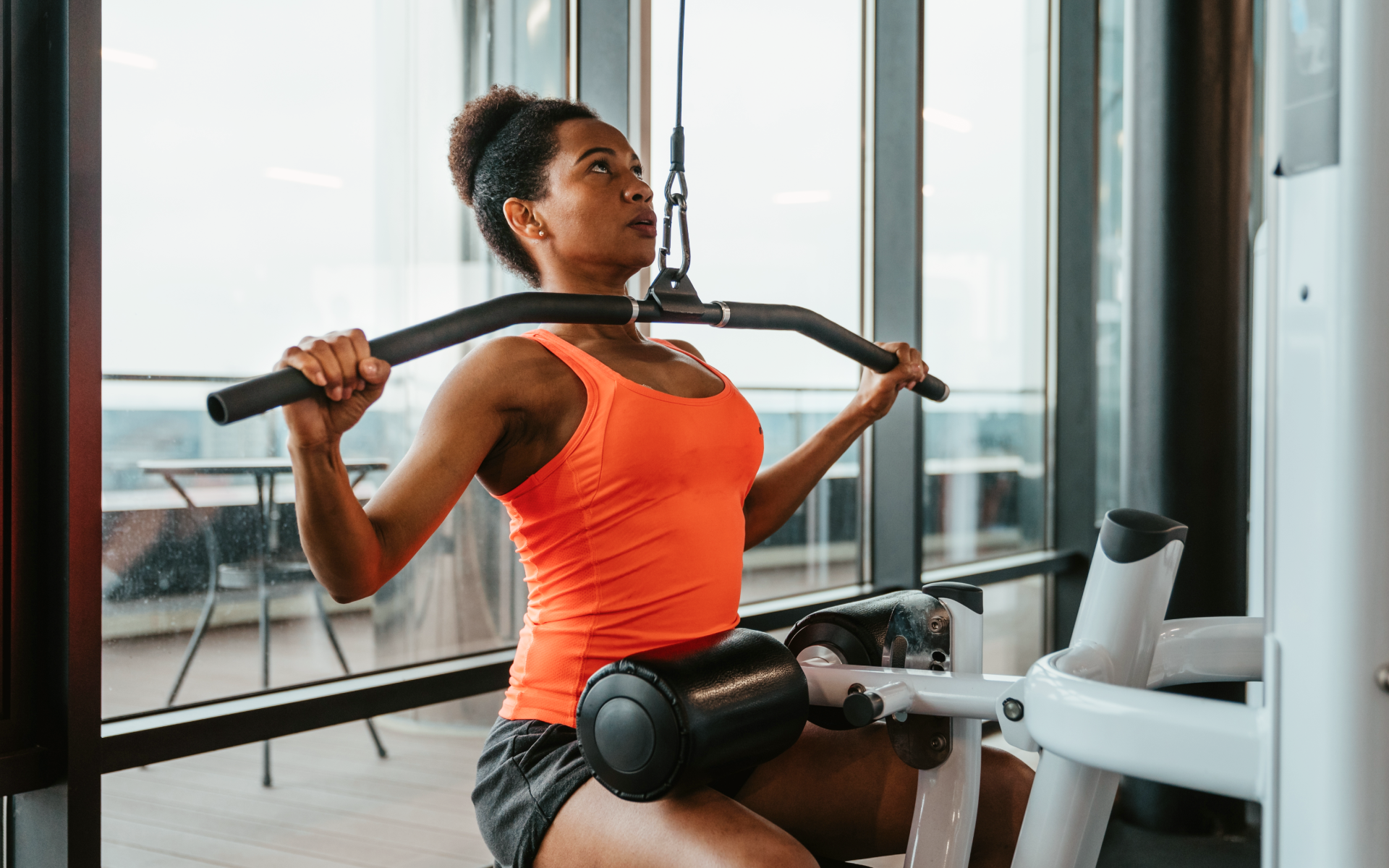
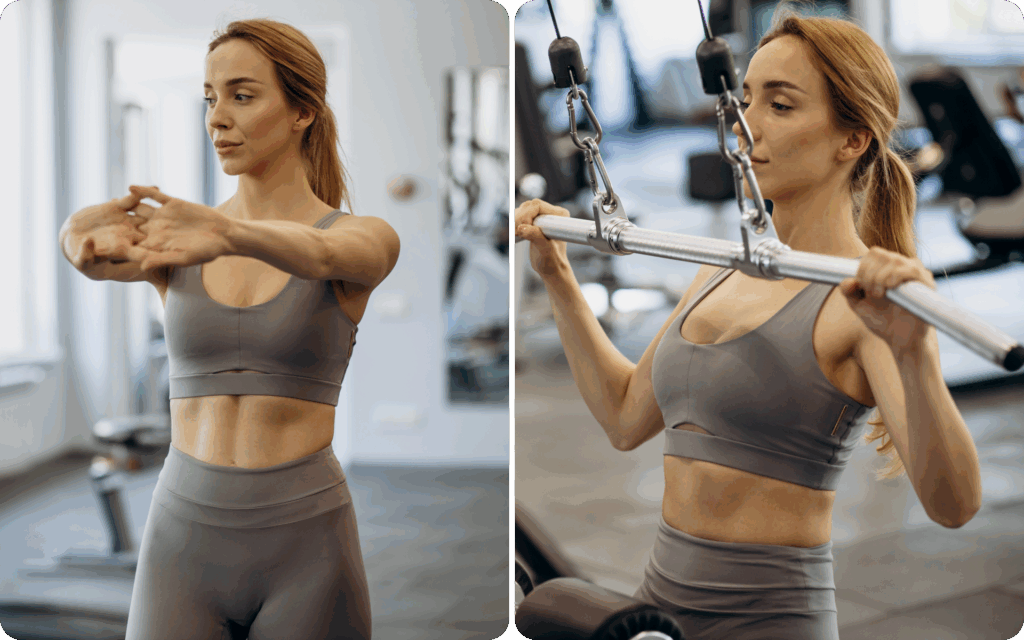
Lat Pulldown
- Sit at a lat pulldown machine and adjust the knee pad to secure your legs. Grasp the bar with a wide, overhand grip.
- Lean back slightly and pull the bar down to your upper chest.
- Slowly return the bar to the starting position.
Seated Cable Row
- Sit at a cable row machine with your feet on the platforms. Grasp the handle with both hands.
- Keeping your back straight, pull the handle toward your lower abdomen.
- Slowly extend your arms to return to the start.
Plank
- Position yourself on your forearms and toes, keeping your body in a straight line from your head to your heels.
- Engage your core and glutes. Hold the position without letting your hips sag.
Leg Raises
- Lie on your back with your legs straight. Place your hands under your lower back for support.
- Slowly raise your legs until they are perpendicular to the floor.
- Slowly lower your legs back down, stopping just before they touch the floor.
Bird-Dog
- Start on all fours, with your hands under your shoulders and knees under your hips.
- Extend your right arm forward and your left leg backward simultaneously, keeping your back flat.
- Return to the starting position and repeat on the other side.
Whether you’re a workout beast or just a beginner making your first foray into the world of fitness and dieting – BetterMe has a lot to offer to both newbies and experts! Install the app and experience the versatility first-hand!
2. The Upper/Lower Split Program
Once you’ve been training consistently for a few months (approximately 6 months), you may be ready to increase your training volume (1). An upper/lower split is an excellent way to do this. You’ll dedicate two days a week to your upper body and two days to your lower body, for a total of four training days.
This split allows you to perform more exercises for each muscle group, which can lead to greater gains in strength and hypertrophy.
Program Details
Program Notes:
- Frequency: 4 times per week. A common schedule is upper (Monday), lower (Tuesday), rest (Wednesday), upper (Thursday), lower (Friday).
- Reps: 6-10 reps for compound exercises, 10-15 reps for isolation exercises.
- Sets: 3-4 sets per exercise.
- Rest: 90-120 seconds for heavy compound lifts, 60 seconds for isolation movements.
- Load: For compound lifts, use a weight that is challenging for 6-10 reps (around 75-85% of 1RM). For isolation exercises, use a lighter load that allows for 10-15 reps.
Upper/Lower Split Program for Beginners (4 Days/Week)
| Day | Exercise | Sets and reps |
|---|---|---|
| Day 1: Upper-body strength | Barbell bench press | 3 sets of 6-8 reps |
| Bent-over row | 3 sets of 6-8 reps | |
| Overhead press | 3 sets of 8-10 reps | |
| Pull-ups (or lat pulldowns) | 3 sets of 8-10 reps | |
| Bicep curls | 2 sets of 10-15 reps | |
| Triceps pushdowns | 2 sets of 10-15 reps | |
| Day 2: Lower-body strength | Barbell back squat | 3 sets of 6-8 reps |
| Romanian deadlift | 3 sets of 8-10 reps | |
| Leg press | 3 sets of 10-12 reps | |
| Calf raises | 4 sets of 10-15 reps | |
| Day 3: Rest | ||
| Day 4: Upper-body hypertrophy | Incline dumbbell press | 3 sets of 8-12 reps |
| Seated cable row | 3 sets of 8-12 reps | |
| Dumbbell lateral raises | 3 sets of 12-15 reps | |
| Face pulls | 3 sets of 15-20 reps | |
| Dumbbell hammer curls | 2 sets of 12-15 reps | |
| Overhead triceps extension | 2 sets of 12-15 reps | |
| Day 5: Lower-body hypertrophy | Leg press | 3 sets of 10-15 reps |
| Leg curls | 3 sets of 12-15 reps | |
| Walking lunges | 3 sets of 10-12 reps per leg | |
| Glute bridges | 3 sets of 15-20 reps |
3. Bodyweight-Only Program
For those who are just starting or prefer a workout program for beginners at home, a bodyweight-only routine is highly effective.
Program Details
This program can be done 3 times a week and requires no equipment, which makes it a great gym workout plan for beginners male or female who want to lay a foundation before using weights.
Program Notes:
- Frequency: 3 times per week.
- Reps: Perform each exercise to near-failure, which means stopping 1-2 reps short of not being able to do another one.
- Sets: 3 sets per exercise.
- Rest: 90 seconds between sets.
Bodyweight Full-Body Workout Program for Beginners
| Exercise | Sets and reps |
|---|---|
| Bodyweight squats | 3 sets to near failure |
| Push-ups (on knees or toes) | 3 sets to near failure |
| Inverted rows (using a sturdy table or bars) | 3 sets to near failure |
| Glute bridges | 3 sets of 15-20 reps |
| Plank | 3 sets, hold for as long as possible |
| Jumping jacks | 3 sets of 60 seconds |
Are you ready to build strength without weights? Explore our complete calisthenics beginner program.
4. Machine-Based Circuit Program
Machines are great for beginners as they guide your movement, which reduces the risk of injury from improper form (5). A circuit-style program involves moving from one exercise to another with minimal rest, which keeps your heart rate up and is efficient on time (6).
Program Details
Program Notes:
- Frequency: 2-3 times per week.
- Exercises: 8-10 machine-based exercises.
- Reps: 12-15 reps per exercise.
- Rest: 15-30 seconds between exercises and 2-3 minutes between circuits.
- Circuits: Complete the full circuit 2-3 times.
Machine-Based Circuit Program
| Exercise | Sets | Reps |
|---|---|---|
| Leg press | 2-3 | 12-15 |
| Chest press machine | 2-3 | 12-15 |
| Seated row machine | 2-3 | 12-15 |
| Leg extension machine | 2-3 | 12-15 |
| Hamstring curl machine | 2-3 | 12-15 |
| Shoulder press machine | 2-3 | 12-15 |
| Lat pulldown machine | 2-3 | 12-15 |
| Abdominal crunch machine | 2-3 | 12-15 |
5. Dance and Combat-Inspired Cardio Programs
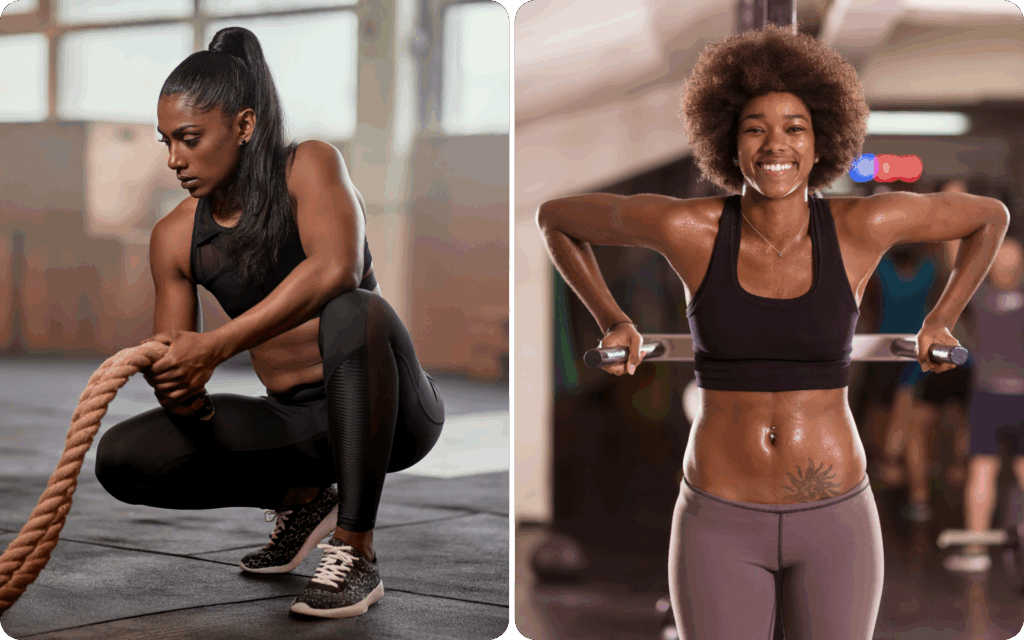
Workouts don’t have to be limited to lifting weights. Programs such as Zumba, Taebo, and boxing offer a fantastic blend of cardiovascular training, coordination, and fun. These are perfect for beginners who want to improve their fitness in a more dynamic, group-oriented setting.
Program Details
Program Notes:
- Frequency: 2-3 times per week.
- Duration: 45-60 minutes per class.
- Intensity: Varies, but generally moderate to high. The goal is to keep moving and follow the instructor.
- Types:
- Zumba: A Latin dance-inspired fitness class.
- Boxing/Kickboxing: A high-energy workout that combines punches, kicks, and cardio drills.
- Dance Aerobics: Choreographed routines set to music.
How to Choose the Best Exercise Program for Beginners
The “best” program is one you can stick with consistently. Here are three factors to consider:
- Your Goals: Are you aiming for muscle gain, fat loss, or general health? A strength-focused program is best for muscle, while circuits and HIIT are great for fat loss. A balanced program that incorporates both is ideal and excellent for overall health.
- Your Schedule: How many days can you realistically commit to the gym? If you only have 2-3 days, a full-body program is the most efficient. If you have 4 days, an upper/lower split is a great option.
- Your Preferences: Do you enjoy lifting weights, or do you prefer the energy of a group class? Choose activities you genuinely enjoy. Enjoyment is the single biggest predictor of long-term adherence.
Reasons why BetterMe is a safe bet: a wide range of calorie-blasting workouts, finger-licking recipes, 24/7 support, challenges that’ll keep you on your best game, and that just scratches the surface! Start using our app and watch the magic happen.
Should Beginners Focus on Cardio or Weights?
This is a classic question, and the science-backed answer is: focus on both, but prioritize weights.
Resistance training is essential for building muscle, which:
- Boosts your metabolism
- Improves bone density
- Enhances your body’s ability to handle daily physical tasks (7)
Cardio is essential for heart health and endurance (8).
For a beginner, the NSCA recommends starting with a resistance training program 2-3 times per week (1). You can add 20-30 minutes of moderate-intensity cardio, such as jogging or cycling, after your weight sessions or on your rest days. This combined approach delivers comprehensive health benefits without causing excessive fatigue.
Read more: Good Full-Body Workout: A Complete Guide with a Simple Plan
Can I Work Out Every Day as a Beginner?
Working out every day isn’t recommended for a beginner, particularly if you’re lifting weights. Your muscles grow and become stronger during periods of rest, not during the workout itself.
Without adequate rest – at least 48 hours for a given muscle group – you risk overtraining, which can lead to injury, fatigue, and stalled progress (9). A schedule of 3-4 training days per week is ideal.
On your “off” days, you can engage in active recovery, which includes light activities such as walking, stretching, or yoga. These activities promote blood flow and can help reduce muscle soreness without adding significant stress (10).
Are you looking for a routine you can do without leaving the house? We have a beginner workout at home without equipment just for you.
Is 30 Minutes of Exercise a Day Enough for Beginners?
Yes, 30 minutes of focused exercise can be very effective, particularly for beginners. The key is intensity and consistency. A 30-minute high-intensity interval training (HIIT) session or a well-structured circuit, for example, can be beneficial (11).
For a 30-minute session, prioritize compound movements that work multiple muscle groups (4). You could structure it as a circuit, performing one set of each exercise before moving to the next, and completing as many rounds as possible in 30 minutes.
This approach is perfect for busy schedules and is a great way to build the habit of daily movement. Even if you’re on a tight schedule, you can find effective workout programs for beginners, female or male.
Do you need help organizing your weekly workouts? Check out our guide to creating a workout schedule for beginners female.
Yoga can contribute to belly fat loss, but not directly. It helps by reducing stress, which lowers cortisol levels (a hormone linked to belly fat storage). However, targeted fat loss (“spot reduction”) is a myth (12). To lose belly fat, you need a combination of a calorie-controlled diet, resistance training, and cardiovascular exercise. Lifting weights without cardio will still yield significant benefits, including increased muscle mass, strength, and a higher metabolic rate. You’ll build a strong, capable physique (13). However, you may miss out on some of the cardiovascular-specific benefits, including improved heart efficiency and endurance. Your heart is a muscle, and cardio is the best way to train it (8). The best time to work out is whenever you can do it consistently. Some research has suggested that performance may be slightly better in the afternoon, but the difference is minimal for most people (14). If you work out in the morning, make sure you’re properly fueled and warmed up. A 5-10 minute dynamic warm-up is essential for preparing your body for exercise. After a workout, your body needs to replenish its glycogen (energy) stores and repair muscle tissue. The ideal post-workout meal contains both protein and carbohydrates. A good guideline is to consume 20-40 grams of protein and 40-80 grams of carbohydrates within an hour or two after your session (15). Examples include a protein shake with a banana, grilled chicken with sweet potatoes, or Greek yogurt with fruit.Frequently Asked Questions
Can I lose belly fat by doing yoga?
What happens if I just lift weights and do no cardio?
How soon after waking up should I work out?
What is the best food to eat after a workout?
The Bottom Line
The journey to fitness is a marathon, not a sprint. The most important step you can take is the first one, and the second most important is to keep showing up. Choose a program that excites you, commit to it for at least a few months, and focus on mastering the movements. The results – strength, confidence, and a healthier you – will follow.
DISCLAIMER:
This article is intended for general informational purposes only and does not serve to address individual circumstances. It is not a substitute for professional advice or help and should not be relied on for making any kind of decision-making. Any action taken as a direct or indirect result of the information in this article is entirely at your own risk and is your sole responsibility.
BetterMe, its content staff, and its medical advisors accept no responsibility for inaccuracies, errors, misstatements, inconsistencies, or omissions and specifically disclaim any liability, loss or risk, personal, professional or otherwise, which may be incurred as a consequence, directly or indirectly, of the use and/or application of any content.
You should always seek the advice of your physician or other qualified health provider with any questions you may have regarding a medical condition or your specific situation. Never disregard professional medical advice or delay seeking it because of BetterMe content. If you suspect or think you may have a medical emergency, call your doctor.
SOURCES:
- FOUNDATIONS OF FITNESS PROGRAMMING (2015, nsca.com)
- Effects of Training Frequency During a 6-Month Neuromuscular Training Intervention on Movement Competency, Strength, and Power in Male Youth (2021, journals.sagepub.com)
- Effects of strength training on neuromuscular adaptations in the development of maximal strength: a systematic review and meta-analysis (2025, nature.com)
- WHY REST DAYS ARE IMPORTANT FOR MUSCLE BUILDING (n.d., nasm.org)
- WHAT ARE COMPOUND EXERCISES? (2024, pmc.ncbi.nlm.nih.gov)
- 6 Benefits of Using Weightlifting Machines (2015, acefitness.org)
- Circuit Training (2020, sciencedirect.com)
- Resistance training – health benefits (2022, betterhealth.vic.gov.au)
- Exercise and cardiovascular health: A state-of-the-art review (2023, sciencedirect.com)
- Beyond physical exhaustion: Understanding overtraining syndrome through the lens of molecular mechanisms and clinical manifestation (2025, pmc.ncbi.nlm.nih.gov)
- Comparison of Different Recovery Strategies After High-Intensity Functional Training: A Crossover Randomized Controlled Trial (2022, frontiersin.org)
- HIIT (High Intensity Interval Training) (2021, nutritionsource.hsph.harvard.edu)
- Spot reduction: why targeting weight loss to a specific area is a myth (2023, sydney.edu.au)
- Resistance training – health benefits (2022, betterhealth.vic.gov.au)
- Time of Day and Muscle Strength: A Circadian Output? (2020, pmc.ncbi.nlm.nih.gov)
- From Food Supplements to Functional Foods: Emerging Perspectives on Post-Exercise Recovery Nutrition (2024, mdpi.com)
 Reviewed by
 Reviewed by