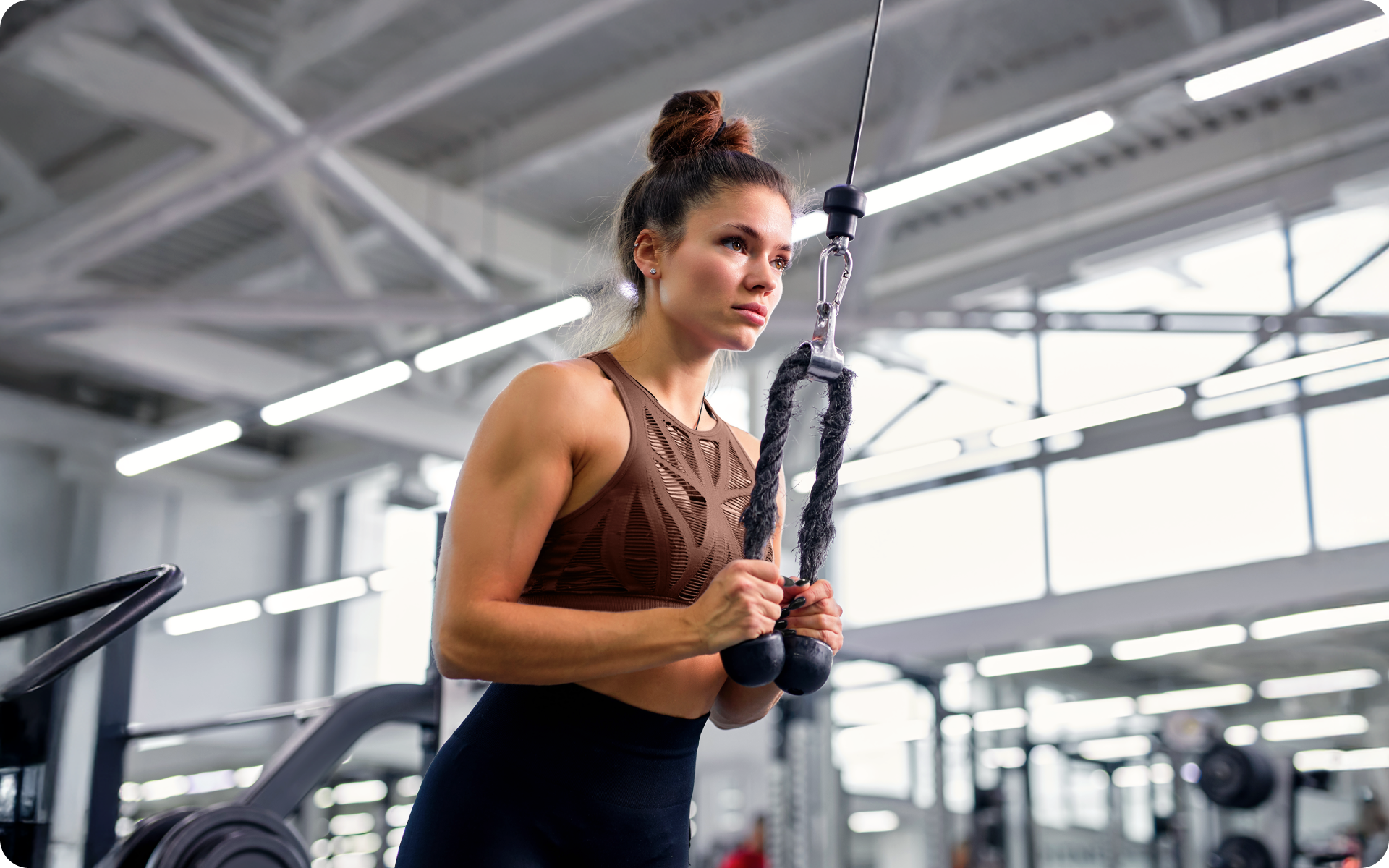

There’s no better feeling for a regular gym person than when someone appreciates their V-taper.
Sure, a massive chest or a wide back gets the glory, but what about the deltoids?
They’re the structural anchors that can make everything else look and perform better. And in addition to looking great in the mirror, you might love it even more when you’re performing everyday tasks such as easily tossing a suitcase into an overhead bin or pressing open a door.
However, a shoulder day at the gym or in a home workout session isn’t an easy feat. As the shoulder is the body’s most mobile joint, it can move in a variety of different planes of motion. This can increase your likelihood of injury, so you need to be extra careful when performing those moves. Focus on using correct form, but also challenge yourself enough so that you can build those iron-clad shoulders.
Here, we’ll discuss how to structure a fruitful shoulder day and shed some light on how soon you might see results. Let’s get to work!
What Is a Shoulder Day Workout?
A shoulder day workout is a focused training session that targets your deltoid muscles. These muscles have three distinct heads: anterior (front), lateral (middle), and posterior (rear) (1).
As the shoulder is a ball-and-socket joint with the greatest range of motion in the human body, these workouts prioritize a balance of hypertrophy (growth) and joint stability. But first, let’s understand the anatomy of the shoulder:
To train the shoulder effectively, you must target all three sections of the deltoid. Research has shown that specific movements are required to isolate these areas effectively (2):
- Anterior Deltoid: Primarily responsible for shoulder flexion (lifting the arm forward).
- Lateral Deltoid: Responsible for abduction (lifting the arm to the side), creating the width of the shoulder.
- Posterior Deltoid: Responsible for horizontal abduction and external rotation (pulling the arm back).
A study found the dumbbell overhead press to be the gold standard for anterior delt activation. However, for the lateral and posterior heads, the press falls short (3)(4).
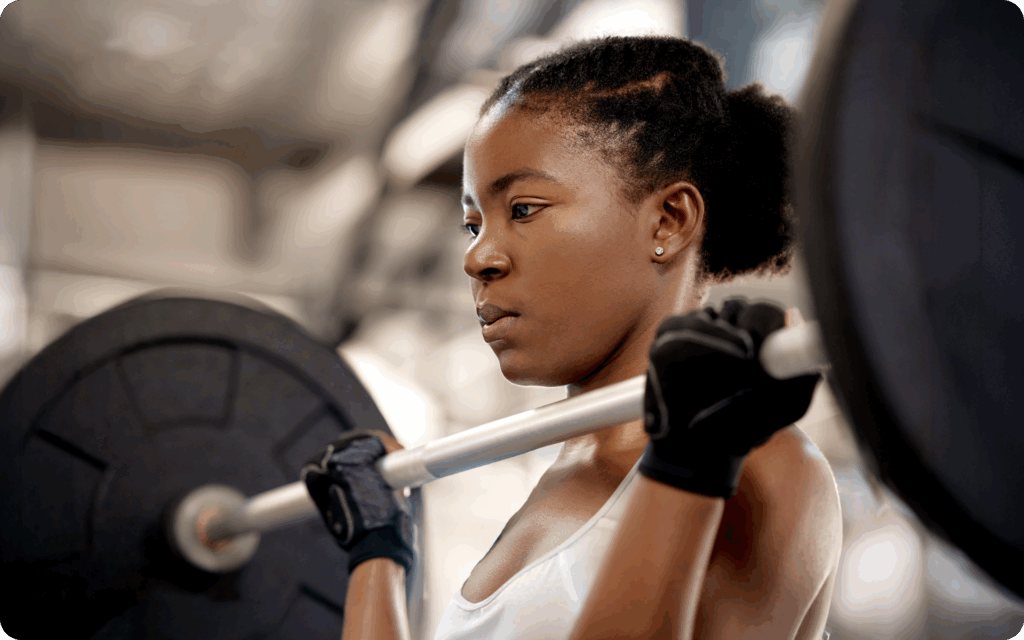
A 2024 scoping review of shoulder injuries among weightlifting and resistance-training athletes found that shoulder issues are common across all levels, with anterior instability and overuse injuries the most frequently reported (5).
The review identified key risk factors, including poor technique, vulnerable shoulder positioning during lifts, high training volume, and overtraining. Overall, the findings highlighted that shoulder injuries in strength athletes are multifactorial and that proper form and smart training management are essential for prevention.
Ultimately, an effective shoulder day is a strategic balance.
You must combine heavy compound presses for size with precise isolation exercises and joint care to ensure safety. When you target all three deltoid heads and prioritize stability, you can build impressive boulder shoulders.
Whether you’re a workout beast or just a beginner making your first foray into the world of fitness and dieting – BetterMe has a lot to offer to both newbies and experts! Install the app and experience the versatility first-hand!
Are Shoulders Hard to Grow?
Growing shoulders can feel like an uphill battle, but that doesn’t necessarily mean they’re stubborn. It’s quite likely that you’re making some mistakes while working on your shoulders:
- Treating them as an afterthought: Not prioritizing shoulders or only training them at the end of a workout when your energy is low.
- Using too much weight: Sacrificing form for heavy loads, which leads to using momentum rather than the actual deltoid muscles.
- Overworking the front (anterior) delts: Doing too many presses and front raises, which are already heavily involved in chest workouts and everyday movements.
- Poor muscle contraction: Rounded shoulders or a slouched posture can reduce muscle activation and limit your range of motion, which prevents the deltoids from working effectively.
- Reps are too low: Training only in very low rep ranges may limit overall volume. For optimal growth, combine moderate-to-heavy loads with higher-rep work and focus on progressive overload. High-rep sets can enhance the pump, but true muscle growth requires consistent overload and proper nutrition.
- Unbalanced exercise plan: Focusing heavily on presses while ignoring the rear (posterior) delts, which leads to muscle imbalances.
- Frequency is too low: Training the shoulders only once a week. Increasing frequency to twice a week can double the opportunities for growth.
The point is that starting your workouts with a high-volume shoulder workout may not be as effective. You need to take small steps until you feel ready for a well-rounded shoulder-calisthenics workout.

Read more: 8 Forearm Dumbbell Exercises to Improve Grip Strength
What Days Should I Work My Shoulders?
Deciding when to train your shoulders depends on your recovery and goals. As the deltoids are used in almost every upper-body lift, timing is everything to avoid burning out.
Here’s a simple, science-based breakdown for scheduling your sessions:
- The 2x per Week Rule
Research has shown that training a muscle twice a week is much better for growth than once a week (6).
Don’t limit yourself to one shoulder day – try to spread the work across two different days to keep your muscles in a building state more often.
Option A: The Dedicated Shoulder Day for Mass
If your shoulders are your main focus, give them their own day so you can hit them with 100% energy. Never do this the day before or after chest day. Your front delts help with bench pressing (7), so they need at least 48 hours of rest between these sessions.
Option B: The Shoulder-Leg Workout
Pairing shoulders with legs is a pro-level move for efficiency.
Science suggests that training a large muscle group, such as the legs, can boost growth hormones that support growth in smaller muscles (shoulders) (8). Also note that a shoulder leg workout saves time. You can perform lateral raises while your legs are resting between sets of squats.

- The Push Day Strategy
If you follow a push/pull/legs split, shoulders belong on push day. This groups all your pushing muscles (chest, shoulders, and triceps) together so they can all recover at the exact same time.
| If your goal is: | Try this schedule: |
|---|---|
| Maximum mass | A dedicated shoulder day for mass (spaced away from the chest) |
| Fat loss/efficiency | A combined approach of nutrition and full-body exercise |
| Overall balance | Add 2-3 shoulder exercises to every push day |
Don’t let your shoulder growth be a flop. Pick a day, stay consistent, and watch your physique go from just okay to a literal work of art!
What to Do on a Shoulder Day
Listed below are a few things you should do on a shoulder day:
Start with a Compound Press
Heavy standing overhead presses are one of the best ways to work the delts. Research published in the Journal of Strength and Conditioning Research showed that standing dumbbell presses produce greater shoulder activation than seated or barbell variations (9).
As you must stabilize your body while standing, the movement recruits all three deltoid heads together with additional stabilizing muscles throughout the core and upper body.
Perform 3 or 4 sets of 6-10 reps.
Isolate the Lateral Head for Width
As the lateral delt isn’t the prime mover in an overhead press, it could benefit from direct attention. A 2025 study published in Frontiers in Physiology (and similar findings reported in SportRxiv in late 2024) showed that both dumbbell and cable lateral raises are effective as they keep constant tension on the muscle throughout the movement (3).
Perform 3 sets of 12-15 reps.
Prioritize the Rear Delt
The rear delt is often the most neglected. Training this area is key to achieving a well-rounded shoulder look and offsetting the forward-hunched posture that can result from too much chest work.
Perform 3 sets of 15-20 reps.
Reasons why BetterMe is a safe bet: a wide range of calorie-blasting workouts, finger-licking recipes, 24/7 support, challenges that’ll keep you on your best game, and that just scratches the surface! Start using our app and watch the magic happen.
What Is the Best Shoulder Day Workout Plan?
If you’re dealing with skinny shoulders, the right shoulder workout routine can make all the difference. Here’s a simple, effective plan you can follow on your next shoulder day.
Standing Dumbbell Overhead Press
4 sets × 6-8 reps
- Stand tall with your feet shoulder-width apart.
- Hold a dumbbell in each hand at shoulder height, your palms facing forward.
- Brace your core and keep your chest up.
- Press the dumbbells overhead until your arms are fully extended.
- Slowly lower them back to shoulder level.
- Repeat for the required reps.

Cable Lateral Raises
3-4 sets × 12-15 reps
- Set the cable to the lowest position and attach a single handle.
- Stand sideways to the machine and hold the handle with your outer hand.
- Keep your arm slightly bent and your torso still.
- Raise your arm to shoulder height.
- Pause briefly, then lower it slowly.
- Complete the required number of reps, then switch sides.
Dumbbell Front Raises (Partial + Full Reps)
3 sets × 10-12 reps
- Hold a dumbbell in each hand with your arms in front of your thighs
- With both knuckles facing forward, engage your core and begin to raise the dumbbells to shoulder height.
- Keep your wrists neutral and avoid swinging.
- Lower the dumbbells slowly and with control.
- Repeat for all reps.
Face Pulls
3 sets × 12-15 reps
- Attach a rope to a cable machine at upper-chest or face height.
- Grab the rope with both hands, your palms facing each other.
- Step back and extend your arms fully.
- Pull the rope toward your face, separating your hands at the end.
- Squeeze your rear delts and upper back.
- Return slowly to the starting position.
To fix skinny shoulders, you need a smart shoulder workout routine that trains all three delt heads. Follow these steps consistently, increase the weight over time, and your shoulders may start to look more balanced.
What Should I Pair Shoulder Day with?
Shoulder day pairs best with arms or chest, depending on your goal.
Pairing shoulders with arms works well as the triceps and biceps are already warmed up without being overly fatigued. At the same time, pairing shoulders with chest makes sense if your workout includes heavy presses, as both muscle groups work together.
Avoid combining shoulder and back workouts on the same day. Pulling movements can tire out the rear delts and limit shoulder performance (10).
Read more: 6 Solid Exercises for a Biceps and Triceps Gym Workout
Can I Work Out My Shoulders Every Day?
Daily shoulder training isn’t ideal for muscle growth. From a strength and hypertrophy standpoint, daily shoulder training usually does more harm than good.
For starters, the first reason this daily training backfires is that shoulder growth happens during rest, not while lifting. When you train your shoulders daily, you interrupt this recovery process. This can lead to overreaching, where the muscles break down faster than they can rebuild.
In addition, the shoulders are frequently used in a majority of tasks that we perform daily. From pushing open a door to putting on your seatbelt, the shoulders are used constantly without you really putting any thought into it.
Furthermore, your shoulders (particularly the front delts) are heavily involved on chest day (bench press), triceps day (dips and close-grip presses), and back day (rear delt activation). This means that if you’re an experienced exerciser, your shoulders are likely indirectly trained 6-7 days a week. Adding direct shoulder isolation on top of that is often the tipping point for those previously mentioned overuse injuries. Hypertrophy (muscle growth) comes from a mix of progressive resistance training and proper nutrition, but always remember that rest must be part of your training strategy.

2-3 times a week can be ideal, depending on your goals. Give them at least 48 hours to recover, as the shoulders also work on chest and back days. Their excessive use also means that they require a dedicated warm-up/cool-down to minimize injury risk and maximize mobility and growth. You can, and many people do. Chest presses already hit the front delts, so adding light side and rear delt work makes sense – just don’t go too heavy on presses again. Both. Front and side delts fit naturally on push day, while rear delts are better trained on pull day. The overhead press hits all three delt heads, but it emphasizes the front delts the most. For full development, you still need lateral raises and rear-delt work. There’s no real age cutoff. Shoulders can grow well into your 40s and beyond as long as you train smart, eat enough protein, and recover properly.Frequently Asked Questions
When should I work my shoulders?
Can I work my shoulders on chest day?
Are shoulders worked on push or pull day?
What exercise hits the entire shoulder?
At what age do the shoulders stop growing?
The Bottom Line
This article is your complete roadmap to building shoulders that actually stand out.
From understanding how the three deltoid heads work to knowing why nagging joint pain occurs, you now have the full picture. The main lesson is simple: don’t overcomplicate shoulder training. You don’t need endless gym sessions or nonstop overhead pressing.
Prioritize heavy compound movements and add isolation work for width if you want to see long-term results.
DISCLAIMER:
This article is intended for general informational purposes only and does not serve to address individual circumstances. It is not a substitute for professional advice or help and should not be relied on for making any kind of decision-making. Any action taken as a direct or indirect result of the information in this article is entirely at your own risk and is your sole responsibility.
BetterMe, its content staff, and its medical advisors accept no responsibility for inaccuracies, errors, misstatements, inconsistencies, or omissions and specifically disclaim any liability, loss or risk, personal, professional or otherwise, which may be incurred as a consequence, directly or indirectly, of the use and/or application of any content.
You should always seek the advice of your physician or other qualified health provider with any questions you may have regarding a medical condition or your specific situation. Never disregard professional medical advice or delay seeking it because of BetterMe content. If you suspect or think you may have a medical emergency, call your doctor.
SOURCES:
- Deltoid Muscles (2021, my.clevelandclinic.org)
- Analysis of anterior, middle and posterior deltoid activation during single and multijoint exercises (2015, pubmed.ncbi.nlm.nih.gov)
- Dumbbell versus cable lateral raises for lateral deltoid hypertrophy: an experimental study (2025, frontiersin.org)
- The Effect of the Weight and Type of Equipment on Shoulder and Back Muscle Activity in Surface Electromyography during the Overhead Press—Preliminary Report (2022, mdpi.com)
- Shouldering the load: A scoping review of incidence, types, and risk factors of shoulder injuries in weight-lifting athletes (2024, journals.sagepub.com)
- Effects of Resistance Training Frequency on Measures of Muscle Hypertrophy: A Systematic Review and Meta-Analysis (2016, pubmed.ncbi.nlm.nih.gov)
- Activation of pectoralis major and deltoid during bench press and pullover exercises until the concentric failure (2017, researchgate.net)
- Effects of Different Types of Lower Body Resistance Exercise on Upper-body Strength in Men and Women, with Special Reference to Anabolic Hormones (2021, pmc.ncbi.nlm.nih.gov)
- Effects of body position and loading modality on muscle activity and strength in shoulder presses (2013, pubmed.ncbi.nlm.nih.gov)
- Pulling Exercises for Strength Training and Rehabilitation: Movements and Loading Conditions (2017, mdpi.com)
 Reviewed by
 Reviewed by
 Reviewed by