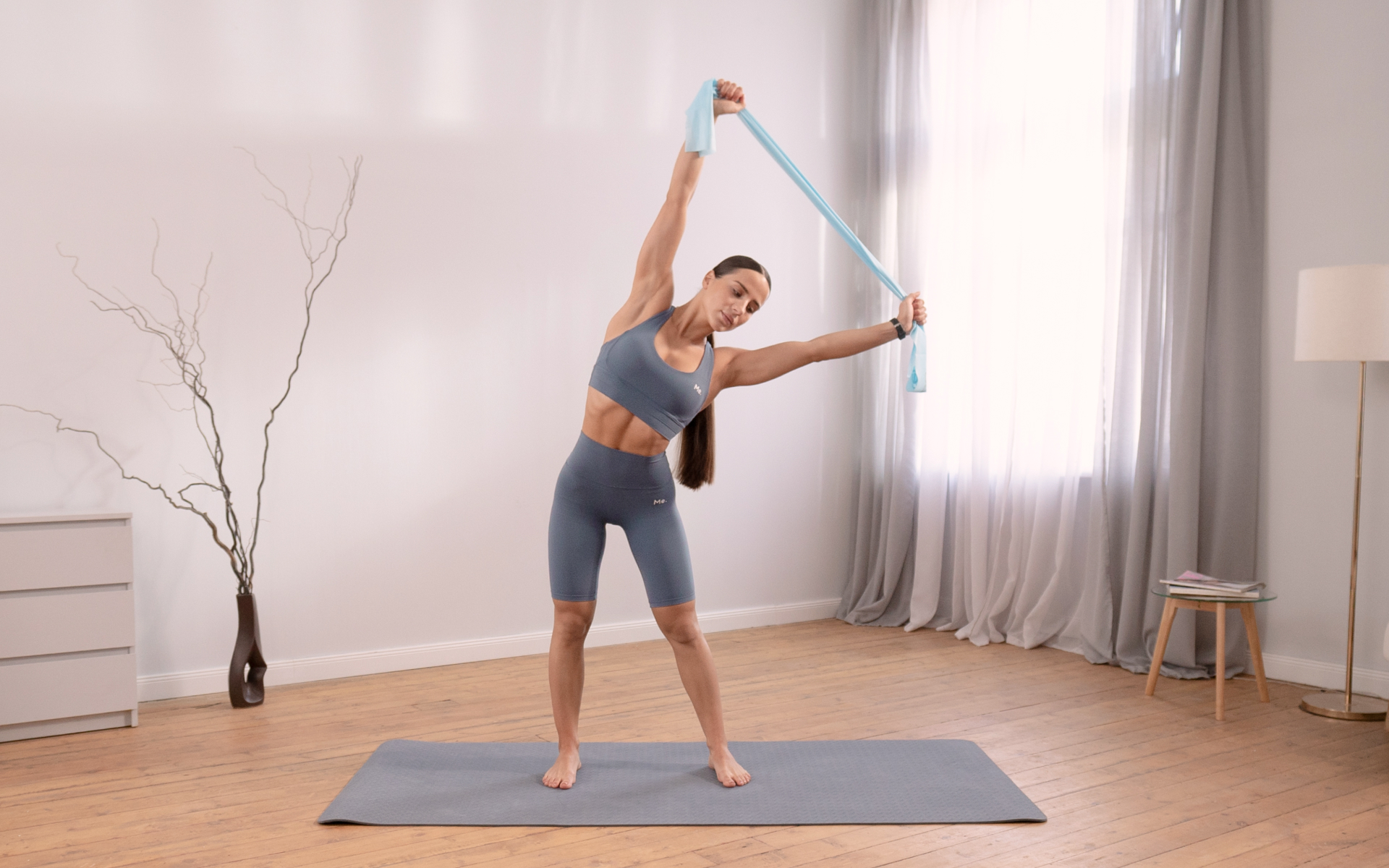
Many people believe that building a toned physique requires expensive gym memberships and heavy weights. While traditional strength training is effective, it’s not the only path to achieving your fitness goals. Resistance bands offer a versatile, accessible, and highly effective alternative for building strength and improving muscle definition right from the comfort of your home.
This guide will break down the science behind resistance band training and provide you with actionable workouts. We’ll explore how to use bands to target specific muscle groups, what to expect from your training, and how to perform each movement with proper form.
What Are Effective Resistance Band Workouts for Women Looking to Tone the Body?
To understand what makes a resistance band workout effective, it’s important to first clarify what “toning” means. The term “toning” generally refers to the appearance of visible muscle definition with a relatively low level of body fat. This is achieved through a combination of two processes: building muscle (hypertrophy) and reducing body fat (1). Resistance training is the key to building that muscle (2).
An effective resistance band workout is one that applies the core principles of strength training, primarily progressive overload. Progressive overload means continually increasing the challenge to your muscles over time (3). With resistance bands, this can be achieved in several ways:
- Using a heavier band: Progressing from a light band to a medium or heavy one increases the tension.
- Increasing repetitions: Performing more reps with the same band.
- Increasing sets: Adding another set to your workout.
- Decreasing rest time: Reducing the rest period between sets to increase metabolic stress.
- Improving form: Increasing the range of motion or control during an exercise.
A well-rounded routine should target all major muscle groups for balanced development. A full-body approach ensures you are building strength symmetrically and maximizing calorie expenditure.
Full-Body Resistance Band Toning Workout
Here is a sample full-body workout designed for women looking to improve muscle tone. It’s an excellent starting point for those new to resistance training and can be modified as you get stronger.
Program Notes:
- Glossary:
- 1RM (One-Rep Max): The maximum amount of weight you can lift for a single repetition. With bands, this is estimated based on perceived effort.
- RPE (Rate of Perceived Exertion): A scale of 1-10 used to measure workout intensity. An RPE of 8 means you feel you could have done two more reps.
- Progressive Overload: The gradual increase of stress placed upon the body during exercise training.
- Equipment Needed: A set of loop resistance bands (light, medium, heavy) and a long resistance band with handles.
- Split Structure: Perform this full-body workout 2-3 times per week on non-consecutive days (e.g., Monday, Wednesday, Friday).
- Reps and Sets: Aim for the rep ranges specified. Choose a band that makes the last 2-3 reps of each set challenging (around an RPE of 8).
Rest: Rest for 60-90 seconds between sets.
| Exercise | Sets | Reps | Target Muscles |
|---|---|---|---|
| Lateral Squat Walks | 3 | 10-12 steps per side | Glutes, Quads, Abductors |
| Straight Leg Deadlift | 3 | 12-15 | Hamstrings, Glutes |
| Seated Row (X-Move) | 3 | 12-15 | Upper Back, Rhomboids |
| Lat Pull Down | 3 | 12-15 | Lats, Shoulders |
| Bridge with Abduction | 3 | 15-20 | Glutes, Hamstrings |
| Donkey Kicks | 3 | 15-20 per side | Glutes, Hamstrings |
| Resisted External Rotation | 3 | 10-12 | Shoulders, Rotator Cuff |
This program provides a solid foundation. For a more comprehensive plan, you might explore an 8 week resistance band training program that systematically applies progressive overload.
BetterMe: Health Coaching app helps you achieve your body goals with ease and efficiency by helping to choose proper meal plans and effective workouts. Start using our app and you will see good results in a short time.
Exercise Instructions
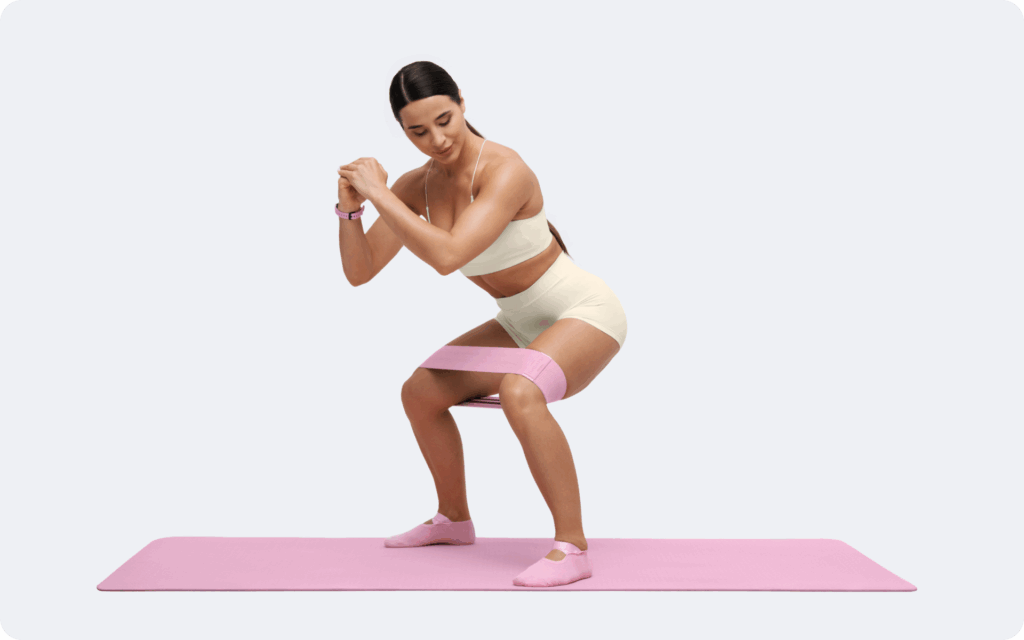
Lateral Squat Walks
- Place a loop band around your ankles or just above your knees. Stand with your feet hip-width apart so the band has slight tension.
- Lower into a half-squat by pushing your hips back and keeping your chest lifted.
- Step to the right with your right foot, maintaining tension on the band. Bring your left foot in to return to hip-width distance, but don’t let the band go slack.
- Continue for the prescribed number of steps, then repeat to the left.
Straight Leg Deadlift
- Stand on the middle of a long resistance band with feet shoulder-width apart.
- Hold the band ends firmly in each hand at your thighs, arms straight.
- Hinge at your hips, sending your buttocks backward and keeping a slight bend in the knees.
- Lower your torso toward the ground with a flat back until you feel tension in your hamstrings.
- Drive your hips forward and squeeze your glutes to return to standing position.
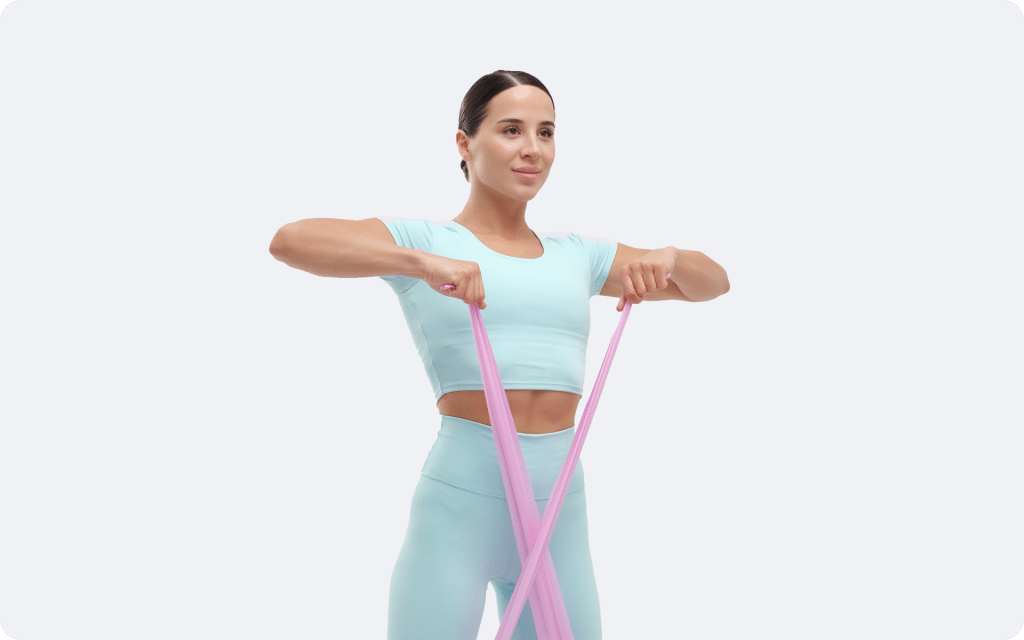
Seated Row (X-Move)
- Sit on the floor with your legs extended and the resistance band wrapped securely around the arches of your feet.
- Hold one end of the band in each hand so the bands cross in front and form an “X.”
- Sit tall, shoulders down and back, and extend arms forward.
- Pull the ends of the band toward your hips, keeping elbows close to your body and squeezing shoulder blades together.
- Hold briefly, then slowly return your arms to starting position with control.
Lat Pull Down
- Stand or sit and hold a resistance band overhead, hands slightly wider than shoulder width.
- With arms straight but not locked, stretch the band slightly.
- Pull both ends of the band down and out to shoulder level by drawing your elbows toward your ribs and squeezing your upper back.
- Pause for a second, feeling contraction in your lats and shoulders.
- Slowly return to the starting overhead position, maintaining tension.
Bridge with Abduction
- Lie on your back, knees bent and feet flat on the floor, with a loop band placed just above your knees.
- Keep your feet hip-width apart and press your knees out to create tension in the band.
- Engage your core and glutes, then lift your hips until your shoulders, hips, and knees form a straight line.
- At the top, push your knees outward against the band for extra glute engagement.
- Hold briefly, then lower your hips back down with control.
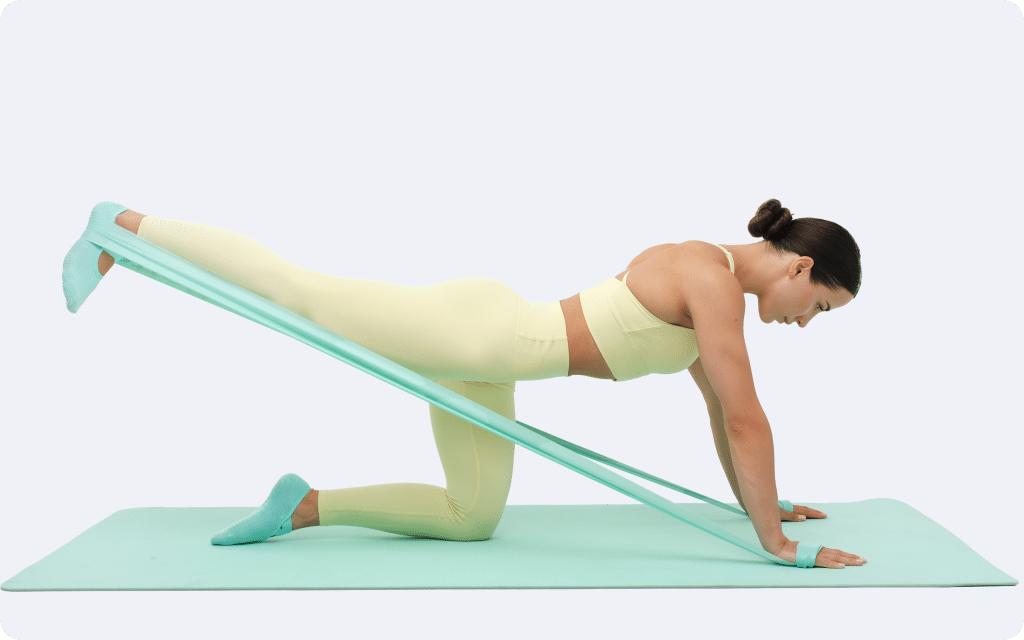
Donkey Kicks
- Start in an all-fours position with the band looped around the arch of your right foot and your hands anchoring the other end.
- Keep your right knee bent at 90 degrees as you drive your heel up toward the ceiling, extending your hip fully.
- Squeeze your glute at the top of the movement.
- Lower your knee back without touching it to the floor, maintaining tension.
- Complete all reps on one leg, then switch sides.
Resisted External Rotation
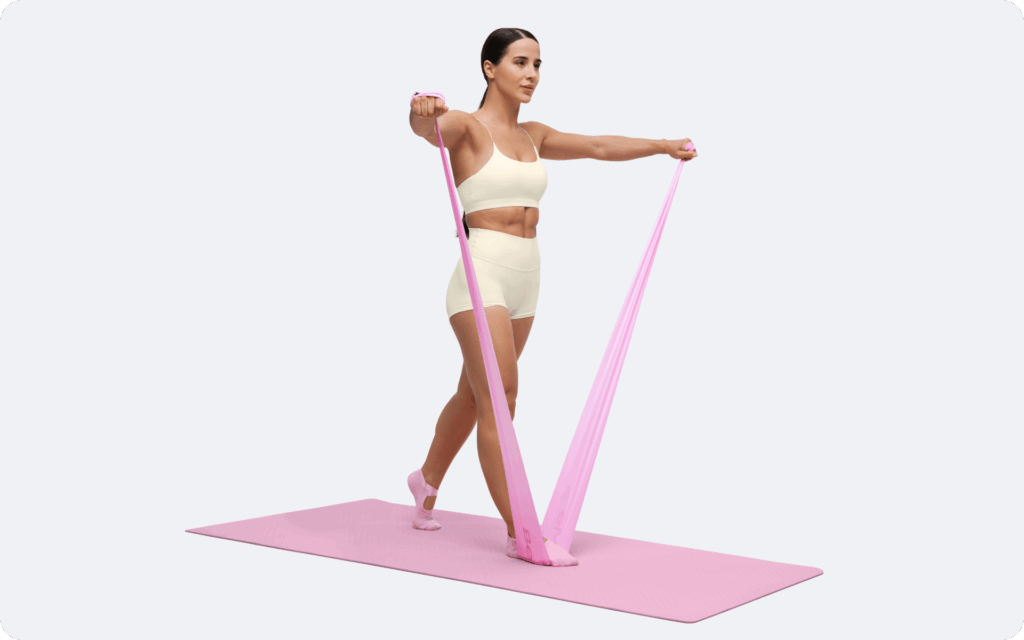
- Stand tall or sit with elbows bent at 90 degrees and tucked close to your sides. Hold a resistance band between both hands with palms facing upward.
- Keeping elbows tight to your sides, slowly move your hands apart by rotating your forearms outward.
- Squeeze your shoulder blades together as you rotate, pausing when you reach your max comfortable range.
- Slowly return to the start position with control.
Read more:Resistance Bands Calisthenics: The Simple, Powerful Way To Build Strength Anywhere
Do Resistance Band Workouts Actually Work?
Yes, resistance band workouts are highly effective for building muscle and strength (4, 5). The key lies in a principle called accommodating resistance. Unlike free weights, which exert a constant force due to gravity, resistance bands provide variable tension. The resistance increases as the band is stretched further (6).
This means your muscles are challenged throughout the entire range of motion, including at the end of the motion when muscle and tendon is stressed the most..
Research has shown that training with elastic bands can produce similar strength gains to training with conventional equipment like dumbbells and weight machines (4).
For muscle growth (hypertrophy) to occur, your muscles need to be subjected to sufficient mechanical tension or metabolic stress. Mechanical tension is the force generated within the muscle when it contracts against resistance, and metabolic stress is typically what happens inside your muscles with high rep, low rest exercise. (7).
As long as you train with high effort—taking your sets close to muscular failure—your body will trigger the adaptations that lead to muscle growth (8), regardless of whether the resistance comes from a dumbbell or a band.
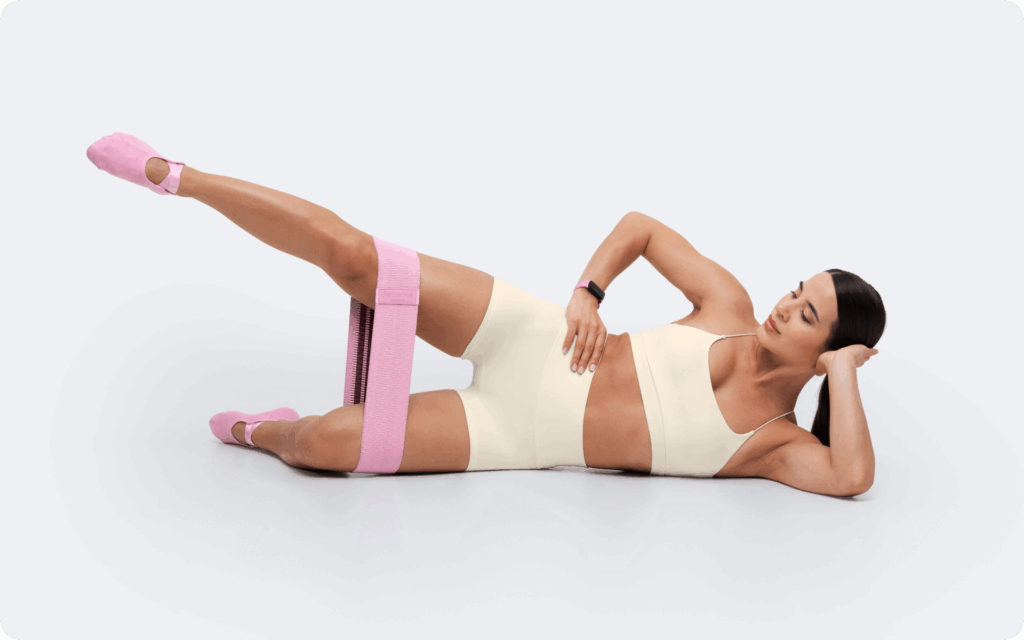
Are Resistance Bands Good for Women?
Resistance bands are an excellent tool for women for several reasons. They are low-impact, which makes them a joint-friendly option, especially for those new to exercise or recovering from an injury. This may reduce the risk of strain.
Furthermore, bands are incredibly versatile. They can be used for a wide range of goals:
- Muscle Toning and Strength: As discussed, they are effective for hypertrophy and strength gains (4, 5).
- Flexibility and Mobility: Bands can be used in warm-ups and cool-downs to improve range of motion (9).
- Rehabilitation: Physical therapists often use them to help patients regain strength after an injury (10, 11).
- Portability: Their lightweight and compact nature makes them perfect for resistance band workouts for women at home or while traveling.
For those looking to incorporate this type of training, resistance bands exercises for beginners female are a great place to start.
How Do I Tone My Stomach with Resistance Bands?
It’s important to understand that “toning your stomach” involves two components: strengthening your abdominal muscles and reducing the layer of body fat covering them. You cannot “spot reduce” fat from your stomach or any other specific area (12).
Fat loss occurs across the entire body when you are in a consistent calorie deficit–burning more calories than you consume (13).
However, you can certainly use resistance bands to build strong and defined abdominal muscles. A strong core is not just about aesthetics; it’s crucial for many daily activities, sports, and overall resilience in your body (14).
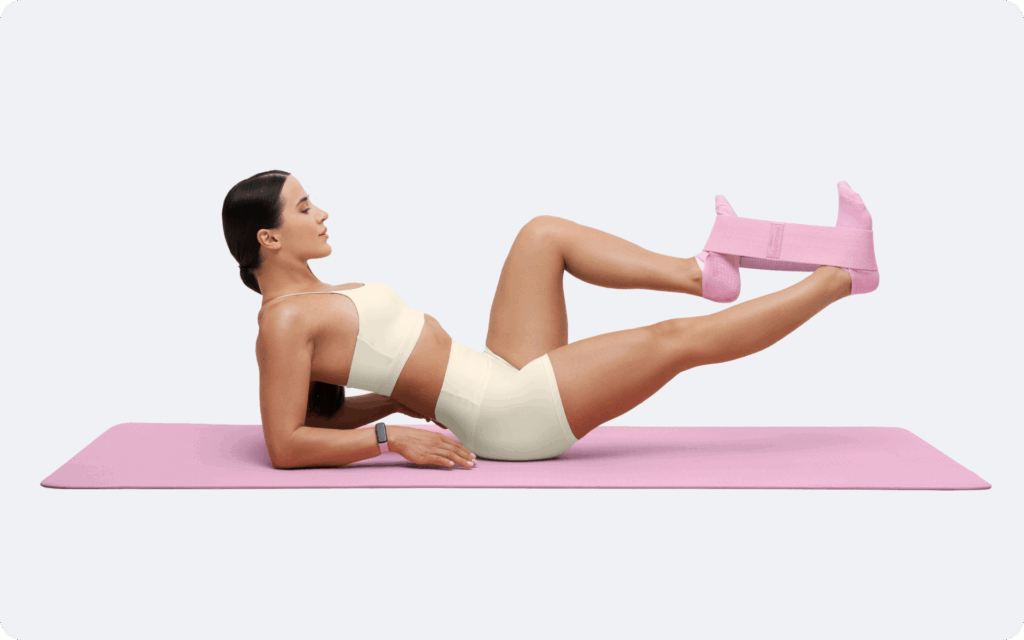
Here are some effective resistance band core exercises:
- Banded Crunches: Anchor a band to a sturdy object behind you. Lie on your back, hold the band with both hands by your head, and perform a crunch, feeling the band add resistance.
- Pallof Press: Stand sideways to an anchor point with a band held at chest height. Press the band straight out in front of you, resisting the rotational pull from the side. This is an excellent anti-rotation exercise for deep core stability.
- Banded Dead Bugs: Lie on your back with a loop band around your feet. Extend one arm and the opposite leg simultaneously, keeping your lower back pressed into the floor and feeling the tension from the band.
Incorporating these into your routine will strengthen your entire core. When combined with a nutritious diet and consistent workouts that promote overall fat loss, you will start to see more definition in your midsection.
A well-structured program is essential. Adding specific resistance band core exercises can help you target these muscles effectively within your broader fitness plan.
Read more:7 Exercises For A Pilates Resistance Bands Workout At Home
What Are Effective Resistance Band Workouts Targeting Glutes for Women?
The glutes are a powerful muscle group that many women want to strengthen and develop. Resistance bands can be particularly effective for targeting the glutes, especially the gluteus medius and minimus (the side glutes), which are responsible for hip abduction and stability.
Glute-Focused Resistance Band Workout
This workout can be done as a standalone session for targeted glute development.
Program Notes:
- Equipment: A set of loop resistance bands.
- Frequency: 2-3 times per week.
- Rest: 45-60 seconds between sets.
| Exercise | Sets | Reps | Placement of Band |
|---|---|---|---|
| Banded Squats | 3 | 12-15 | Above Knees |
| Glute Bridge with Abduction | 3 | 15-20 | Above Knees |
| Fire Hydrants | 3 | 15-20 per side | Above Knees |
| Standing Hip Abduction | 3 | 15-20 per side | Around Ankles |
| "The Clam Shell" | 3 | 20-25 per side | Above Knees |
Exercise Instructions
Banded Squats
- Place a loop band just above your knees and stand with your feet shoulder-width apart.
- Lower into a squat by pushing your hips back and bending your knees, keeping your chest lifted.
- Press your knees outward against the band to maintain tension.
- Push through your heels to return to the starting position.
Glute Bridge with Abduction
- Lie on your back with your knees bent, feet flat on the floor, and a loop band above your knees.
- Lift your hips until your body forms a straight line from shoulders to knees.
- At the top, press your knees outward against the band for extra glute engagement.
- Lower your hips back down with control.
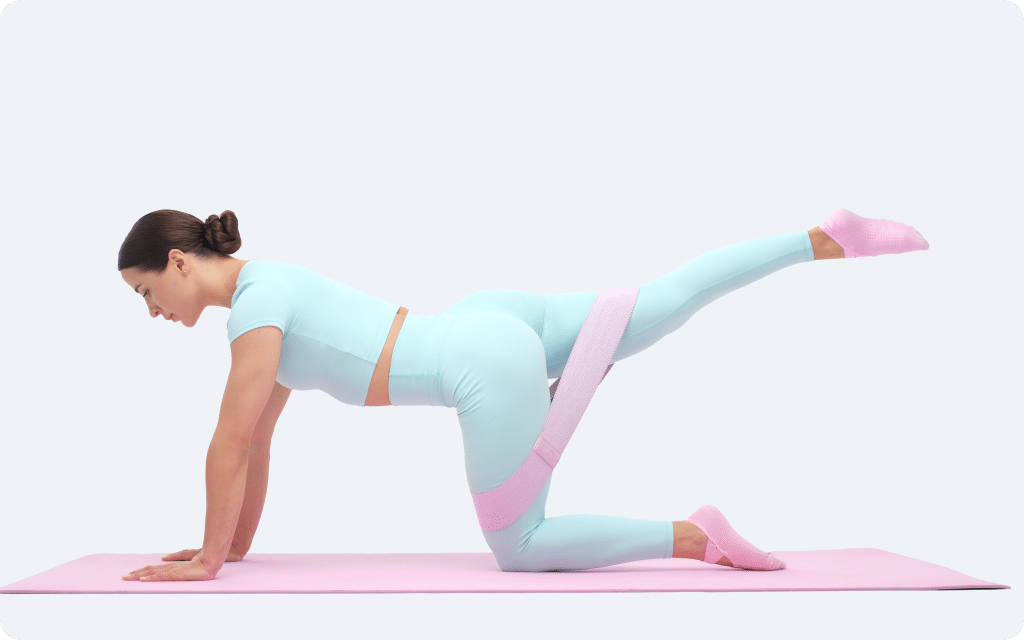
Fire Hydrants
- Start on all fours with a loop band above your knees.
- Keeping your knee bent, lift one leg out to the side until your thigh is parallel to the floor.
- Lower your leg back down without touching the floor and repeat.
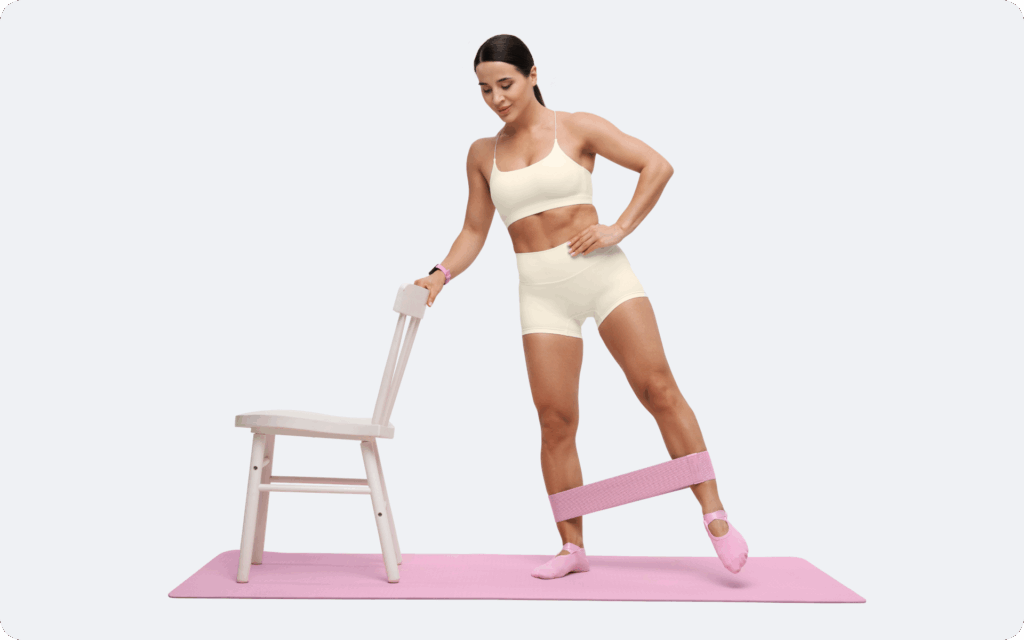
Standing Hip Abduction
- Place a loop band around your ankles and stand tall with your hands on your hips.
- Shift your weight onto one leg and lift the other leg out to the side, keeping it straight.
- Slowly return to the starting position and repeat on the other side.
“The Clam Shell”
- Lie on your side with your knees bent at a 90-degree angle and a loop band above your knees.
- Keeping your feet together, lift your top knee as high as possible without moving your pelvis.
- Lower your knee back down with control and repeat.
If you are looking to build muscle, consistency with your diet and training is critical. Combining band work with a solid nutrition plan is a key part of resistance training for weight loss and body composition changes.
What Happens if I Use Resistance Bands Every Day?
While the enthusiasm is great, using resistance bands to train the same muscle groups every day is generally not recommended. Your muscles need time to recover and repair to grow stronger. This process, known as recovery, is when the actual muscle growth occurs (15).
Training a muscle group daily can lead to overtraining, which can manifest as (16):
- Persistent muscle soreness
- Decreased performance
- Increased risk of injury
- Fatigue and burnout
A more effective approach is to train each major muscle group 2-3 times per week, allowing at least 48 hours of rest in between sessions for that specific muscle group (17).
However, this doesn’t mean you can’t use bands every day. Light-intensity activities like mobility work, stretching, or activation drills (e.g., light banded glute bridges before a run) can be done daily. These activities can aid recovery and improve movement patterns without overstressing the muscles.
How Long Does It Take to See Results from Resistance Bands?
The timeline for seeing results from any training program, including resistance bands, varies from person to person. It depends on several factors:
- Consistency: How often are you training? A consistent schedule of 2-3 full-body sessions per week will yield results faster than sporadic workouts.
- Intensity: Are you challenging yourself and applying progressive overload? Pushing your muscles close to failure is necessary for change.
- Nutrition: Are you eating enough protein to support muscle repair and a balanced diet to fuel your workouts and support fat loss?
- Genetics: Individual genetic factors play a role in how quickly one builds muscle (18).
- Starting Point: Beginners often see noticeable strength gains within the first 4-8 weeks, a phenomenon known as “newbie gains.” Visible changes in muscle tone may take a bit longer, typically around 8-12 weeks, as this requires both muscle gain and fat loss (19).
Be patient and focus on consistency. Track your progress not just by what you see in the mirror, but by how you feel. Are you getting stronger? Can you use a heavier band or do more reps? These are all signs that you are on the right track.
Yes, a 20-minute resistance training session can be very effective, provided the intensity is high. If you minimize rest times and take your sets close to muscular failure, you can create a significant stimulus for muscle growth in a short amount of time. Neither is inherently “better.” Both are effective tools for building strength. The best choice depends on your goals, preferences, access to equipment, and fitness level. Bands are more portable and joint-friendly, while weights allow for heavier loading. Many people find success using a combination of both. Absolutely. You can achieve a comprehensive, full-body workout using only resistance bands. By choosing the right bands and exercises, you can effectively target every major muscle group and apply progressive overload to continue making progress. For many people, yes. If your goal is general fitness, muscle toning, and building functional strength, a quality set of resistance bands can replace the need for a gym. They are sufficient to provide the resistance needed for muscle growth and strength development (4, 5). Yes, you can grow your glutes with resistance bands. To achieve significant growth (hypertrophy), you must consistently challenge the muscles with progressive overload and support your training with adequate nutrition, especially sufficient protein intake (20, 21).Frequently Asked Questions
Is 20 minutes of resistance training enough?
Is it better to lift weights or use resistance bands?
Can you get a good workout with just resistance bands?
Can I replace my gym with resistance bands?
Can I grow my glutes with just resistance bands?
The Bottom Line
Resistance bands are far more than just a convenient travel accessory; they are a powerful tool for transforming your physique. By understanding and applying the principles of progressive overload, you can build a strong, toned body without ever stepping foot in a gym. Focus on consistent effort, proper form, and patience, and you will achieve the results you’re looking for.
DISCLAIMER:
This article is intended for general informational purposes only and does not serve to address individual circumstances. It is not a substitute for professional advice or help and should not be relied on for making any kind of decision-making. Any action taken as a direct or indirect result of the information in this article is entirely at your own risk and is your sole responsibility.
BetterMe, its content staff, and its medical advisors accept no responsibility for inaccuracies, errors, misstatements, inconsistencies, or omissions and specifically disclaim any liability, loss or risk, personal, professional or otherwise, which may be incurred as a consequence, directly or indirectly, of the use and/or application of any content.
You should always seek the advice of your physician or other qualified health provider with any questions you may have regarding a medical condition or your specific situation. Never disregard professional medical advice or delay seeking it because of BetterMe content. If you suspect or think you may have a medical emergency, call your doctor.
SOURCES:
- Body Recomposition: Can Trained Individuals Build Muscle and Lose Fat at the Same Time? (2020, journals.lww.com)
- An Evidence-Based Narrative Review of Mechanisms of Resistance Exercise–Induced Human Skeletal Muscle Hypertrophy (2022, journals.lww.com)
- Complexity: A Novel Load Progression Strategy in Strength Training (2019, frontiersin.org)
- Effects of Different Resistance Exercise Forms on Body Composition and Muscle Strength in Overweight and/or Obese Individuals: A Systematic Review and Meta-Analysis (2022, frontiersin.org)
- Effects of training with elastic resistance versus conventional resistance on muscular strength: A systematic review and meta-analysis (2019, journals.sagepub.com)
- Accommodating resistance is more effective than free weight resistance to induce post-activation performance enhancement in squat jump performance after a short rest interval (2024, sciencedirect.com)
- Anabolic signals and muscle hypertrophy – Significance for strength training in sports medicine (2025, sciencedirect.com)
- Intensity of effort and momentary failure in resistance training: Are we asking a binary question for a continuous variable? (2022, sciencedirect.com)
- Effects of Elastic Band Training on Physical Performance in Team Sports: A Systematic Review and Meta-Analysis (2025, mdpi.com)
- The use of elastic band exercise as a physical therapy intervention for improving shoulder function in older adults: a scoping review (2021, e-jer.org)
- Effects of exercise therapy using elastic bands on strength and pain in women with non-specific neck pain: A randomised controlled trial (2023, sciencedirect.com)
- A proposed model to test the hypothesis of exercise-induced localized fat reduction (spot reduction), including a systematic review with meta-analysis (2022, hummov.awf.wroc.pl)
- Optimal Diet Strategies for Weight Loss and Weight Loss Maintenance (2020, pmc.ncbi.nlm.nih.gov)
- Core training and performance: a systematic review with meta-analysis (2023, ncbi.nlm.nih.gov)
- The Importance of Recovery in Resistance Training Microcycle Construction (2024, pmc.ncbi.nlm.nih.gov)
- Beyond physical exhaustion: Understanding overtraining syndrome through the lens of molecular mechanisms and clinical manifestation (2025, sciencedirect.com)
- Frequency: The Overlooked Resistance Training Variable for Inducing Muscle Hypertrophy? (2017,.researchgate.net)
- Influence of genetics and epigenetics on the process of muscle hypertrophy: a systematic review (2023, researchgate.net)
- Adaptations to Endurance and Strength Training (2018, pmc.ncbi.nlm.nih.gov)
- Maximizing Muscle Hypertrophy: A Systematic Review of Advanced Resistance Training Techniques and Methods (2019, mdpi.com)
- Systematic review and meta-analysis of protein intake to support muscle mass and function in healthy adults (2022, pubmed.ncbi.nlm.nih.gov)

 Reviewed by
 Reviewed by