
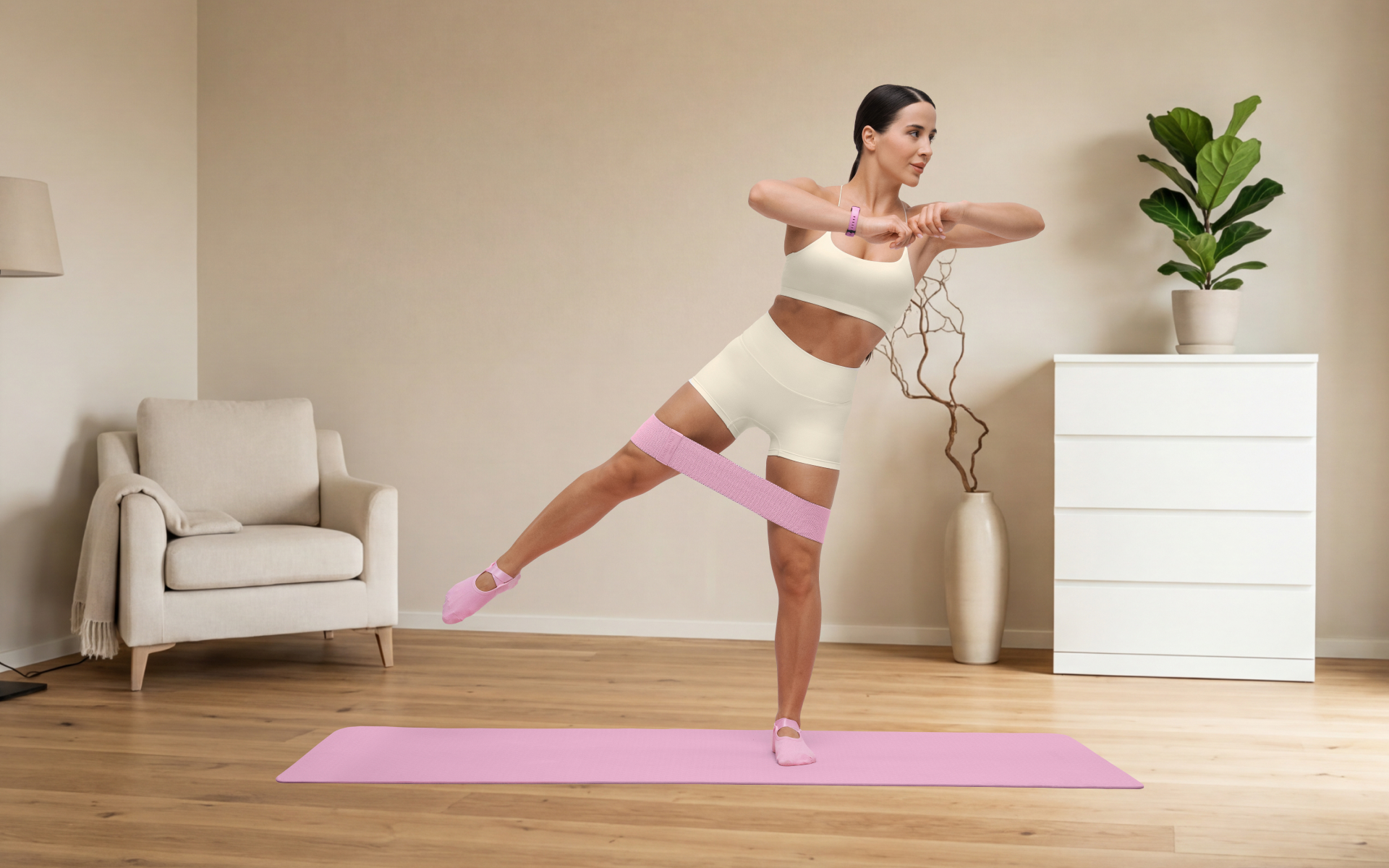
If you want to be good at your favorite exercise activities – whether that’s running, lifting, or just navigating daily life pain-free – there’s less room for improvisation regarding hip health.
The hips are the powerhouse of human movement, linking the upper and lower body and generating the force required for everything from sprinting to squatting. However, they are often a source of dysfunction due to sedentary lifestyles and imbalanced training.
This article explores how simple tools such as resistance bands can correct these imbalances. We will break down the mechanics of hip function, the role of resistance bands in strength development, and provide a structured, evidence-based program to enhance your hip strength and function.
What Are Hip Band Exercises and Why Are They Necessary?
Hip band exercises are resistance-based movements performed using elastic loops placed around the thighs, ankles, or feet to target the muscles surrounding the hip joint – specifically the gluteus maximus, medius, and minimus.
Why are they necessary? In modern life, we spend a significant amount of time sitting. This flexed hip position can lead to “gluteal amnesia”, a colloquial term for the inhibition of the gluteal muscles (1). When your hips are weak, your body compensates by overloading other areas, often leading to lower back pain, knee valgus (knees collapsing inward), and decreased athletic performance (2).
Hip band exercises are necessary because they provide a unique resistance profile. Unlike dumbbells, where resistance remains constant (gravity), bands provide ascending resistance. As the band stretches, the tension increases (3). This forces the muscle to work harder at the peak of the contraction, which is critical for maximizing metabolic stress – one of the key drivers of hypertrophy (muscle growth) (4).
Furthermore, bands provide a vector of resistance that gravity cannot. Gravity pulls downward. Bands can pull horizontally or diagonally. This is particularly important for the hip abductors (gluteus medius), which move the leg away from the midline of the body. To effectively target these lateral stabilizers, you need resistance that opposes that lateral movement (5).
Are Resistance Bands Good for the Hips?
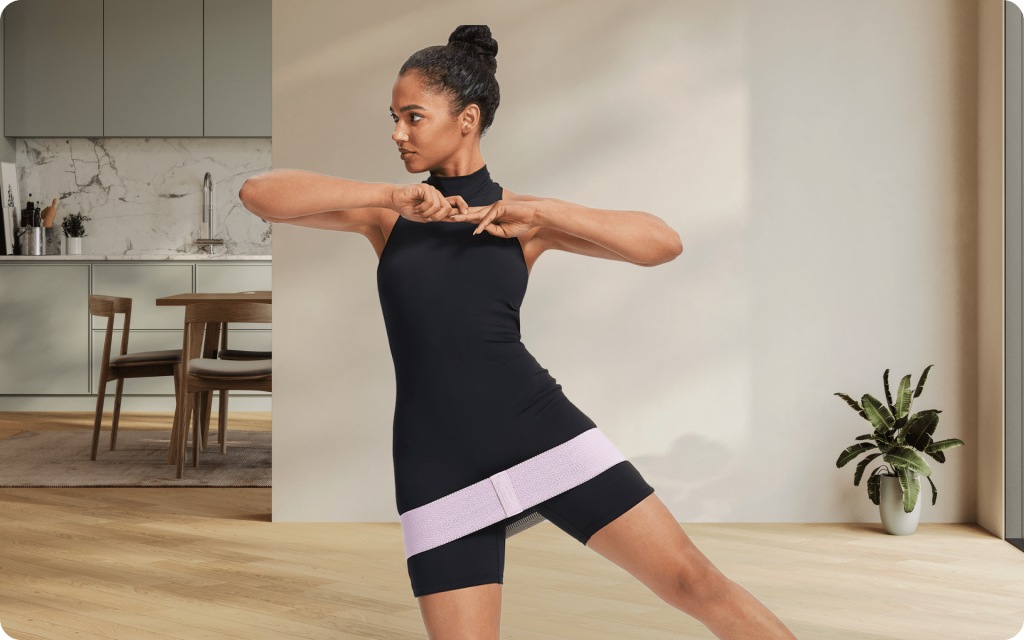
Resistance bands are good for the hips. Research supports the efficacy of elastic resistance for muscle activation and strength gains.
A 2019 study published in the Journal of Sports Science and Medicine compared elastic resistance to conventional weight machines. The researchers found that elastic resistance offered similar muscle activation levels to traditional machines during specific isolation exercises (6).
Resistance bands are particularly “good” for the hips as they facilitate neuromuscular activation (5). Before a heavy compound lift such as a squat or deadlift, you need your hip stabilizers firing to maintain joint integrity. Bands allow you to isolate these smaller muscle groups without causing excessive fatigue, priming the nervous system for heavier loads.
In addition, bands are versatile for rehabilitation. For individuals who are recovering from injury, the variable resistance of bands allows for a safer range of motion. You can control the tension precisely, reducing the load at the weakest points of the movement and increasing it where the muscle is strongest (7).
Read more: How to Use Calisthenics Resistance Bands to Progress Your Bodyweight Workout
How to Use Resistance Bands to Strengthen Hips
To use resistance bands effectively for strengthening, you need to apply the principle of progressive overload. It isn’t enough to simply do the same movements with the same band indefinitely.
1. Band Selection and Placement
Bands come in varying tension levels. Their thickness is one visual indicator and typically resistance bands are even color-coded to demonstrate their resistance (e.g. yellow for light, green for medium, black for heavy). If you’re unsure, start with a band that allows you to complete 12-15 repetitions with good form but significant fatigue by the final rep. You want to be able to control the band throughout the entire movement. Avoid allowing the band to quickly recoil back to the starting point. Instead, control this resistance.
- Placement: It will vary based on the exercise that you are performing. For example, placing the band just above the knees reduces the torque on the knee joint and may be better suited for beginners. Placing the band around the ankles or feet increases the lever arm, which makes the exercise significantly harder.
2. Tempo and Control
Momentum is the enemy of progress here. You must control the eccentric (lengthening) phase of the movement (8). A standard tempo recommendation is 2-0-2-0 (2 seconds out, 0 seconds hold, 2 seconds back, 0 seconds rest).
Reasons why BetterMe is a safe bet: a wide range of calorie-blasting workouts, finger-licking recipes, 24/7 support, challenges that’ll keep you on your best game, and that just scratches the surface! Start using our app and watch the magic happen.
3. Volume and Frequency
For hypertrophy and strength endurance, aim for 2-4 sets of 12-20 repetitions (9). As these muscles are postural stabilizers designed for endurance, they often respond well to higher repetition ranges that induce metabolic stress.
What Are the Best Muscle Building Hip Band Exercises?
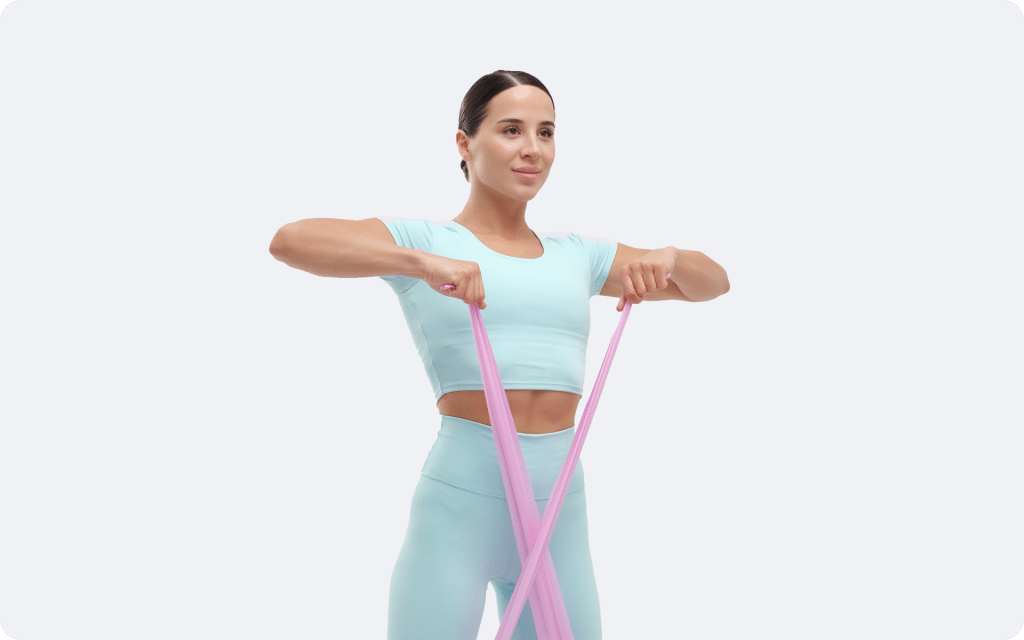
While “best” is subjective and dependent on individual mechanics, the most effective exercises are those that align the resistance with the muscle fibers’ direction of pull and allow for a full range of motion.
The exercises selected for this guide target the hip in three distinct planes of motion:
- Extension: Moving the leg behind the body (Gluteus Maximus).
- Abduction: Moving the leg away from the midline (Gluteus Medius).
- External Rotation: Rotating the thigh outward (Deep rotators and Gluteus Maximus).
How Long Does It Take to See Results from Resistance Bands?
Physiological adaptations take time. Neural adaptations – learning to fire the muscles more efficiently – can occur within the first 2-4 weeks. You’ll feel “stronger” simply because your brain is getting better at communicating with your muscles (10).
Structural changes, such as hypertrophy (increase in muscle size) and connective tissue strengthening, generally require 6-8 weeks of consistent training. A 2025 umbrella review indicated that consistent resistance training (2-3 times per week) yields measurable strength increases after roughly 8 weeks (11). Consistency is the variable that matters most.
For runners specifically, integrating these exercises can lead to noticeable improvements in gait stability and a reduction in knee pain within a similar timeframe. If you’re looking for a routine to support your running, check out our guide on hip strengthening exercises for runners.
Read more: Pilates Resistance Bands Exercises
The 7-Exercise Hip Band Program
Below is a structured program that’s designed to be performed 2-3 times per week. You can perform this as a standalone workout or as a primer before a lower-body lifting session.
Program Notes
- Equipment Needed: A set of mini loop resistance bands (light, medium, heavy).
- Rest Schemes: Rest 45-60 seconds between sets.
- RPE (Rate of Perceived Exertion): Aim for an RPE of 8/10. This means you should have roughly 2 reps left in the tank at the end of the set.
- Term: “AMRAP” stands for as many reps as possible (with good form).
| Exercise | Sets | Reps | Tempo | Focus |
|---|---|---|---|---|
| 1. Monster walk | 2 | 1 minute | Constant tension | Stabilization |
| 2. Lateral band walk | 3 | 12-15 steps/dir | Constant tension | Abduction (dynamic) |
| 3. Banded glute bridge | 3 | 15-20 | 2-2-2 | Extension |
| 4. Standing glute kickback | 3 | 12-15/side | 2-1-2 | Extension (unilateral) |
| 5. Banded clamshells | 3 | 15-20/side | 2-1-2 | External rotation |
| 6. Fire hydrants | 2 | 12-15/side | Controlled | Abduction/rotation |
| 7. Seated band abduction | 3 | 20-30 | 1-0-1 | Abduction (high rep) |
Exercise Instructions
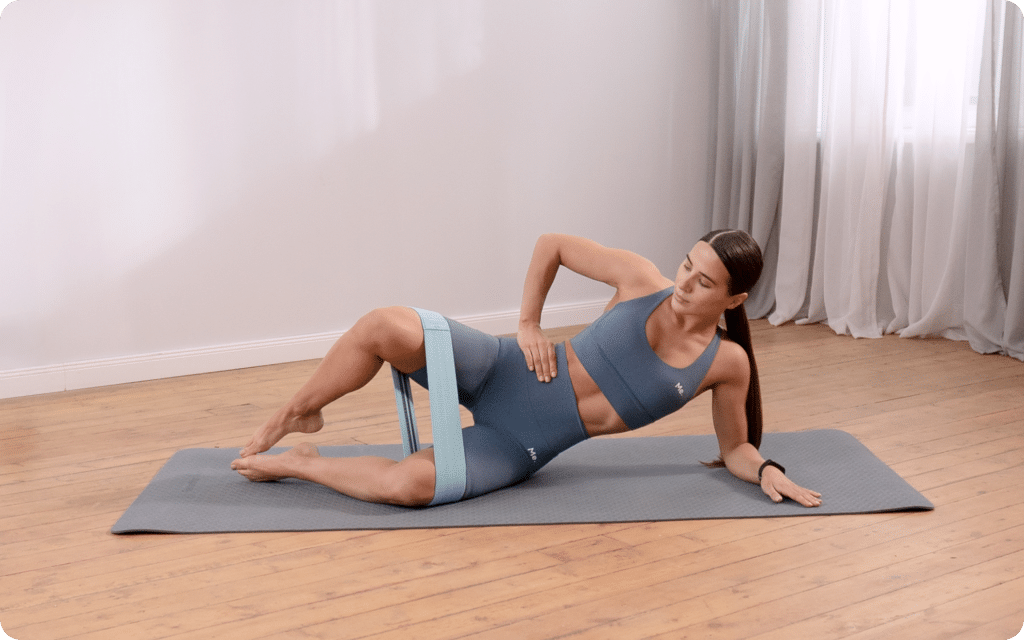
1. Banded Clamshells
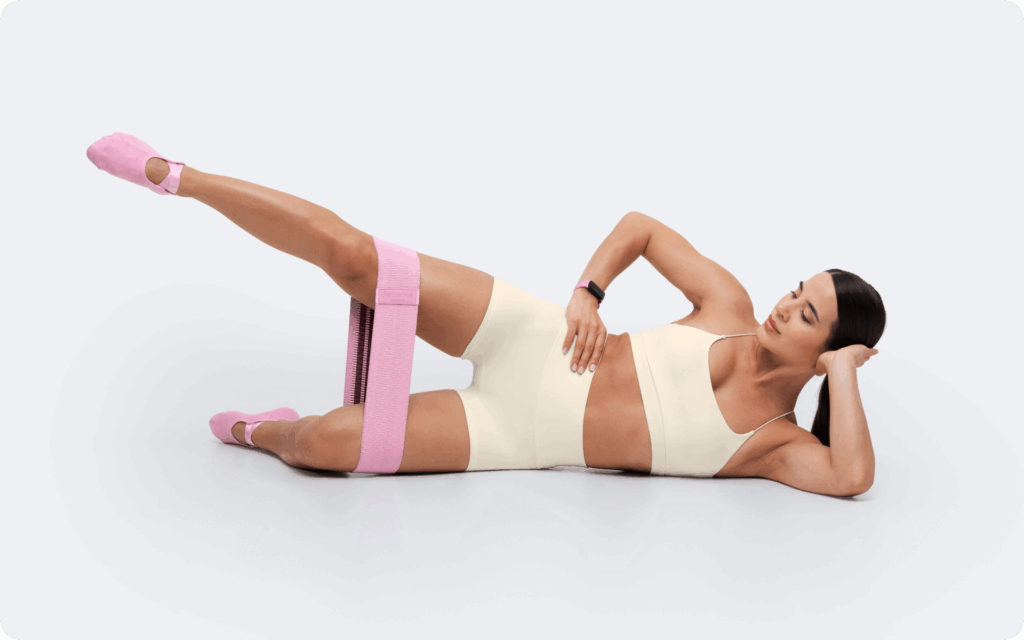
This is the gold standard for isolating the external rotators and the gluteus medius without involving the hip flexors (TFL).
- Setup: Lie on your side with your legs stacked and your knees bent at a 45-degree angle. Place a loop band just above your knees. Rest your head on your bottom arm or a pillow.
- Stabilize: Engage your core and ensure your hips are stacked directly on top of one another. Don’t let your top hip roll backward.
- Action: Keeping your feet touching, rotate your top knee upward against the band’s resistance. Imagine opening a clam.
- Peak: Pause at the top for 1 second, squeezing the side of your glute.
- Return: Slowly lower the knee back to the starting position.
2. Lateral Band Walk
This dynamic movement trains the gluteus medius functionally, mimicking the stabilization that is required during walking or running.
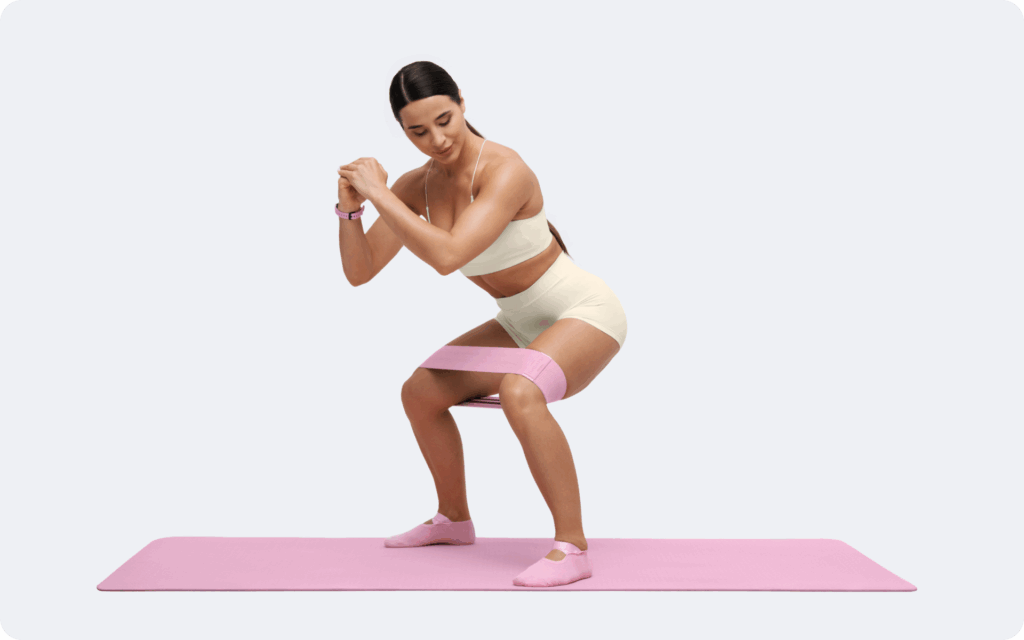
- Setup: Place a band around your ankles (harder) or above your knees (easier). Stand with your feet hip-width apart and knees slightly bent in an “athletic stance”.
- Action: Take a controlled step to the right with your right foot.
- Follow: Step your left foot to the right, returning to the hip-width stance. Important: Don’t let your feet come all the way together – maintain tension on the band at all times.
- Form Check: Keep your toes pointed forward or slightly inward. Don’t let them flare out. Keep your upper body still – don’t rock side to side.
- Repeat: Complete all steps in one direction before switching.
3. Banded Glute Bridge
This exercise targets hip extension while the band abduction recruits the glute medius, which creates a high-tension environment for the entire hip complex.
- Setup: Lie on your back with your knees bent and your feet flat on the floor, hip-width apart. Place the band just above your knees.
- Tension: Actively push your knees outward against the band. You should feel tension on the outside of your hips before you even lift.
- Action: Drive through your heels to lift your hips toward the ceiling until your body forms a straight line from your shoulders to your knees.
- Contraction: At the top, squeeze your glutes hard and hold for 2 seconds. Keep driving your knees outward.
- Return: Lower your hips to the floor with control.
4. Seated Band Abduction
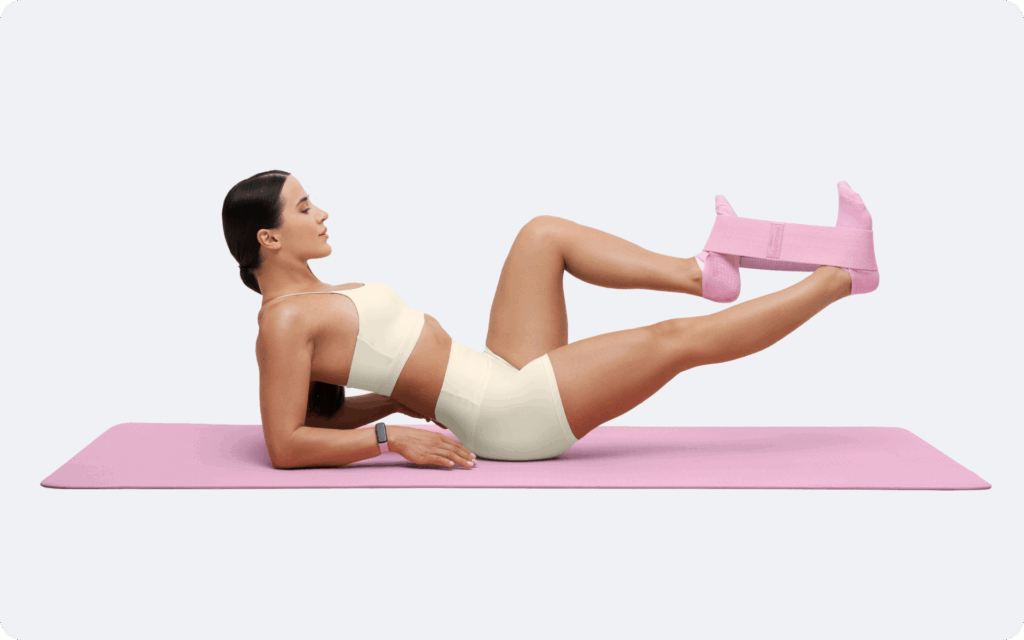
This is a metabolic stress specialist. By taking stability out of the equation (as you’re seated), you can focus entirely on the burnout.
- Setup: Sit on the edge of a sturdy bench or chair. Place the band just below your knees.
- Position: Place your feet wider than shoulder-width apart on the floor, or for a variation, keep your feet close together and hinge only at the knees.
- Action: Drive your knees outward as far as possible against the band.
- Tempo: Perform these with a faster, pumping tempo. Pulse your knees out and in, keeping constant tension.
- Goal: Fight through the burn. This exercise is meant to be taken close to failure.
5. Standing Glute Kickback
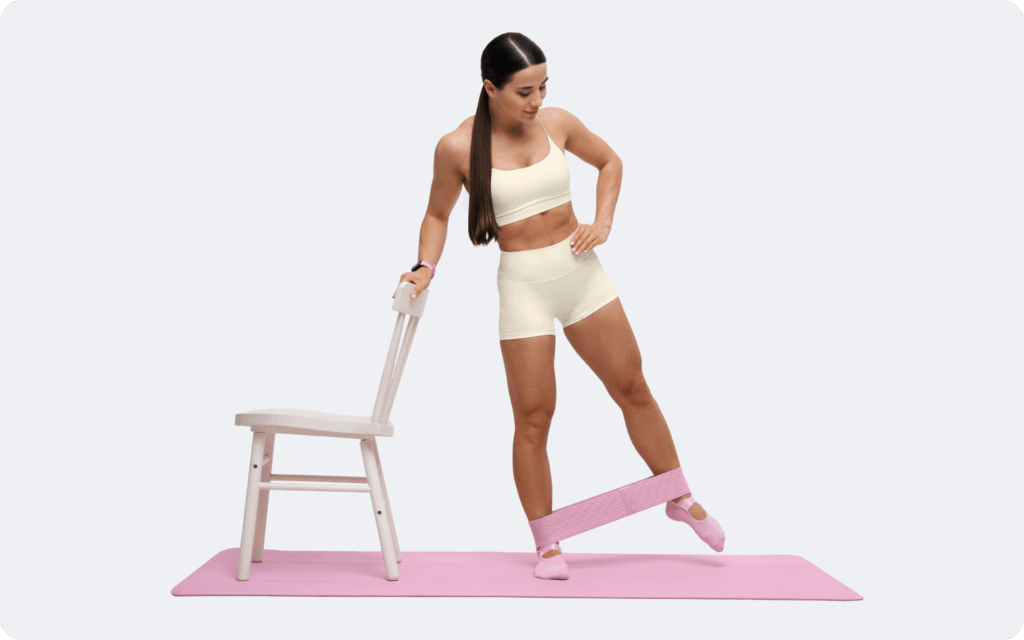
This targets the gluteus maximus in a functional, standing position.
- Setup: Place the band around your ankles. Stand facing a wall or sturdy chair for balance.
- Stabilize: Shift your weight onto your left leg. Keep a slight bend in your left knee.
- Action: Keeping the right leg straight, kick it directly backward.
- Focus: Squeeze the glute at the top of the movement. Avoid arching your lower back to get the leg higher – the range of motion is relatively small.
- Return: Slowly return your foot to the starting position without allowing it to touch the ground if possible (to maintain tension).
6. Fire Hydrants
This movement combines abduction and extension, challenging the hip in a quadruped position.
- Setup: Start on all fours (tabletop position) with your hands under your shoulders and your knees under your hips. Place the band above your knees.
- Brace: Tighten your core to flatten your back. Imagine balancing a glass of water on your lower back.
- Action: Lift your right knee out to the side, keeping it bent at 90 degrees.
- Range: Lift as high as you can without rotating your spine or shifting your weight excessively to the left side.
- Return: Lower with control.
7. Monster Walk
Unlike the lateral walk, this involves moving forward and backward and challenges the hips in a different vector.
- Setup: Place the band around your ankles. Widen your stance until the band is taut. Drop into a quarter squat.
- Action: Take a large diagonal step forward and out with your right foot.
- Follow: Take a large diagonal step forward and out with your left foot. You should look like you’re walking with a wide, “monster” gait.
- Backward: After reaching your distance target, reverse the movement, walking backward with the same wide, diagonal steps.
- Form: Keep your chest up and your knees driving outward over your toes.
If you’re looking for a more intense variation of these movements, specifically for glute development, read our article on the resistance band butt workout.
BetterMe: Health Coaching app helps you achieve your body goals with ease and efficiency by helping to choose proper meal plans and effective workouts. Start using our app and you will see good results in a short time.
Common Mistakes to Avoid
- Using a Band That’s Too Heavy
Ego lifting also applies to bands. If the band is too heavy, your body will compensate. In a lateral walk, this often looks like hiking the hip up (using the Quadratus Lumborum in the lower back) rather than using the hip muscles. If you can’t complete the full range of motion with perfect form, drop to a lighter band.
- Allowing Knee Valgus (Knees Caving In)
The primary purpose of the band is to force you to abduct (push out). If you let the band win and pull your knees inward, you’re reinforcing the exact dysfunction you’re trying to correct. Fight the band constantly and focus on using the outside of your hips/glutes.
- Rushing the Eccentric
Elastic potential energy wants to snap the band back to its resting state. If you let the band snap your leg back, you miss out on 50% of the muscle-building stimulus. Resist the return phase.
Programming These Exercises
- For Warm-ups
If using these as a warm-up before squats or running, reduce the volume. Perform 1 set of 10-12 reps of clamshells, lateral walks, and glute bridges. The goal here is activation, not exhaustion. You want the muscles “woken up”, not fatigued to the point of failure before your main lift or run.
- For Standalone Workouts
If this is your primary workout (e.g. a travel workout or a home session), increase the volume. Perform 3-4 sets and decrease rest times to 30 seconds to increase metabolic demand. You can also combine exercises into a circuit without rest for a higher-intensity session.
- For Rehabilitation
If you’re recovering from an injury, frequency is key. Lower-intensity, daily work is often prescribed to facilitate motor learning and blood flow without causing tissue damage. However, you should always consult with your physical therapist for specific protocols. For a quick, travel-friendly option, try this mini resistance band workout.
Yes, you can stimulate hypertrophy with resistance bands if you apply sufficient tension and perform sets close to failure (6). While heavy weights are superior for maximal force production, bands are highly effective for metabolic stress, which is a key mechanism of muscle growth. Neither is strictly “better” – they’re different tools for different goals. Weights are superior for absolute strength and bone density loading, while resistance bands are excellent for variable resistance, portability, and targeting stabilizer muscles that are difficult to hit with gravity-based tools. Using bands every day can lead to overtraining if the intensity is too high. However, because bands typically induce less muscle damage than heavy weightlifting, they can be used more frequently, often 5-7 times a week, as long as you manage the volume and listen to your body. Absolutely, as long as you complete each exercise with proper form, maintain high intensity, and take short rest periods. By stacking exercises back-to-back and focusing on the mind-muscle connection, you can achieve a high heart rate and significant muscle fatigue, which results in an effective workout. “Toning” is typically considered building muscle while losing fat – as we’ve already explained, resistance bands can be used to build muscle. The physiological process is hypertrophy, regardless of the tool used, as long as the muscle is forced to contract against adequate resistance that creates tension. Yes, resistance bands are particularly beneficial for seniors as they are low-impact and easier on the joints than free weights. They provide a safe way to build strength, improve balance, and prevent sarcopenia (age-related muscle loss) (12). Yes, 20 minutes is sufficient, as long as the training density is high. If you perform compound movements or move through a circuit with minimal rest, 20 minutes can provide a potent stimulus for health and strength maintenance.Frequently Asked Questions
Can you grow your glutes with just resistance bands?
Is it better to lift weights or use resistance bands?
What happens if I use resistance bands every day?
Can you get a good workout with just resistance bands?
Do resistance bands build muscle or just tone?
Can seniors build muscle using bands?
Is 20 minutes of resistance training enough?
The Bottom Line
Hip band exercises are more than just a warm-up fad – they’re a scientifically valid method for correcting imbalances, preventing injury, and building functional strength. By incorporating the seven exercises outlined above into your routine, you’ll ensure that your hips – the pivot point of your body – remain robust and capable.
Remember that the tool is only as effective as the execution. Focus on control, fight for range of motion, and progressively challenge yourself over time. Whether you’re an elite athlete or just starting on your fitness journey, strong hips are the foundation of a healthy, moving body. Start with the light band, master the movement, and earn your way to the heavy band.
DISCLAIMER:
This article is intended for general informational purposes only and does not serve to address individual circumstances. It is not a substitute for professional advice or help and should not be relied on for making any kind of decision-making. Any action taken as a direct or indirect result of the information in this article is entirely at your own risk and is your sole responsibility.
BetterMe, its content staff, and its medical advisors accept no responsibility for inaccuracies, errors, misstatements, inconsistencies, or omissions and specifically disclaim any liability, loss or risk, personal, professional or otherwise, which may be incurred as a consequence, directly or indirectly, of the use and/or application of any content.
You should always seek the advice of your physician or other qualified health provider with any questions you may have regarding a medical condition or your specific situation. Never disregard professional medical advice or delay seeking it because of BetterMe content. If you suspect or think you may have a medical emergency, call your doctor.
SOURCES:
- Are You at Risk for Dead Butt Syndrome? (2017, michiganmedicine.org)
- ASSESSING AND TREATING GLUTEUS MAXIMUS WEAKNESS – A CLINICAL COMMENTARY (2019, pmc.ncbi.nlm.nih.gov)
- The Effect of Elastic Band Variable Resistance Training on the Explosive Power of Lower Limbs in College Basketball Athletes (2025, journals.lww.com)
- Anabolic signals and muscle hypertrophy – Significance for strength training in sports medicine (2025, sciencedirect.com)
- Perceived loading and muscle activity during hip strengthening exercises: comparison of elastic resistance and machine exercises (2013, pubmed.ncbi.nlm.nih.gov)
- Effects of training with elastic resistance versus conventional resistance on muscular strength: A systematic review and meta-analysis (2019, journals.sagepub.com)
- Elastic band resistance for shoulder rehabilitation: Clinical applications and practical exercises (2023, sciencedirect.com)
- Eccentric Resistance Training: A Methodological Proposal of Eccentric Muscle Exercise Classification Based on Exercise Complexity, Training Objectives, Methods, and Intensity (2023, mdpi.com)
- Loading Recommendations for Muscle Strength, Hypertrophy, and Local Endurance: A Re-Examination of the Repetition Continuum (2021, mdpi.com)
- Resistance training-induced adaptations in the neuromuscular system: Physiological mechanisms and implications for human performance (2025, physoc.onlinelibrary.wiley.com)
- The influence of resistance exercise training prescription variables on skeletal muscle mass, strength, and physical function in healthy adults: An umbrella review (2024, sciencedirect.com)
- Effects of elastic band resistance training on the physical and mental health of elderly individuals: A mixed methods systematic review (2024, pmc.ncbi.nlm.nih.gov)
 Reviewed by
 Reviewed by
 Reviewed by