Many women approach weight training with a specific goal – to achieve a “toned” look. This often means building lean muscle and reducing body fat to reveal more definition, without necessarily adding significant size or bulk. A full-body workout routine is an incredibly efficient and effective way to achieve this outcome.
This guide breaks down the science and practical application of a full-body toning workout plan for females. We’ll explore how these workouts stimulate muscle growth, compare them to other training styles, and provide a detailed, actionable program. You will learn not just what to do, but why it works, empowering you to take control of your fitness journey with confidence.
What Is a Full-Body Toning Workout Plan for Females?
A full-body toning workout plan for females is a structured resistance training program that’s designed to engage all major muscle groups in a single session.
Physiologically, in this context, “toning” refers to the process of building lean muscle mass and decreasing the layer of subcutaneous fat that covers it, leading to enhanced definition (1).
This type of plan typically involves performing compound exercises, which are multi-joint movements that work several muscles simultaneously. The primary goals are:
- Balanced Muscle Development: By working the entire body, you ensure no muscle group is left behind, promoting a symmetrical and proportional physique (2).
- Increased Metabolic Rate: Resistance training builds metabolically active muscle tissue. It’s difficult to determine exactly how many calories you burn for each pound of muscle. However, the musculoskeletal system generally burns about 15-20 calories a day, increasing with more muscle mass, which can help with long-term fat management (3).
- Improved Body Composition: The plan aims to shift your ratio of muscle to fat, which is the key to a toned appearance (3).
It’s important to understand that a workout plan is only one piece of the puzzle. Achieving results also depends heavily on supportive nutrition to fuel muscle repair and growth, and adequate recovery – including 7-9 hours of quality sleep per night – to allow your body to adapt and change (4).
Do Full-Body Workouts Tone Your Body?
Yes, full-body workouts are highly effective for toning your body. The process works through two primary mechanisms: stimulating muscle growth (hypertrophy) and increasing energy expenditure, which helps reduce body fat.
When you perform resistance exercises, you create microscopic tears in your muscle fibers. In response, your body repairs these fibers, making them stronger and slightly larger to handle future stress (5). This is the essence of muscle hypertrophy. Consistent training leads to an increase in lean muscle mass, which provides the shape and firmness associated with a toned physique.
Reasons why BetterMe is a safe bet: a wide range of calorie-blasting workouts, finger-licking recipes, 24/7 support, challenges that’ll keep you on your best game, and that just scratches the surface! Start using our app and watch the magic happen.
From an energy perspective, full-body workouts are demanding. Engaging large muscle groups with compound movements such as squats and deadlifts requires a significant amount of energy, which leads to a higher calorie burn during the workout (1). Furthermore, this effect may continue after you’ve finished higher intensity training through a process that’s called excess post-exercise oxygen consumption (EPOC), where your body continues to burn calories at an elevated rate for several hours (6).
Research backs this up. Studies have consistently shown that resistance training is a powerful tool for improving body composition in overweight people (7). For example, a comprehensive review of multiple studies found that consistent resistance training programs, typically lasting 8-12 weeks, can lead to an average increase of 2-4 pounds of lean muscle mass while simultaneously reducing body fat, even without strict dieting (8). This combination is the exact formula for a more toned body.
For those who are just starting, learning how to structure a basic full-body workout is a fundamental first step.
Read more: Body Recomp Workout Plan: Gain Muscle and Lose Fat
Is It Better to Do a Full-Body Workout or Split to Tone?
When your goal is toning, both full-body workouts and split routines – where you train different muscle groups on different days – can be effective. However, full-body workouts offer several distinct advantages, particularly for women who are looking for efficient and balanced results.
One of the most significant benefits is frequency. With a full-body routine, you stimulate every major muscle group 2-3 times per week. Research published in the Journal of Sports Medicine suggested that training a muscle group at least twice per week promotes superior hypertrophic results compared to training it only once (9). A typical split routine might only hit each muscle group once a week, potentially slowing progress.
Full-body workouts are also more time-efficient. For individuals with busy schedules, fitting in 2-3 comprehensive sessions per week is often more manageable than committing to 4-5 days that many split routines require. You can achieve a highly effective workout in 45-60 minutes, which makes it a sustainable long-term strategy (10).
Furthermore, full-body sessions tend to generate a greater overall metabolic and hormonal response. By recruiting a large amount of muscle mass in a single workout, you can maximize calorie burn and stimulate the release of anabolic hormones such as growth hormone (11), which are beneficial for muscle growth and fat loss (12).
While split routines are excellent for bodybuilders who are aiming for maximal muscle size in specific areas, a female body toning workout plan often benefits more from the holistic and efficient nature of full-body training.
Understanding the difference between physique goals is key. Learn more about the distinction between a toned body vs muscular body in our guide.
What Is a Good Full-Body Toning Workout Plan for Females?
A good full-body toning workout plan is built on the principle of progressive overload, which means you must continually challenge your muscles to adapt. This can be done by increasing the weight, performing more reps or sets, or reducing rest times (13).
This program is designed to be performed three times per week on non-consecutive days (e.g. Monday, Wednesday, Friday) to allow for adequate recovery. Dive deeper into the active recovery workouts with our dedicated article.
Program Notes
- Key Terms:
- 1RM: One-repetition maximum. The heaviest weight you can lift for a single repetition.
- RPE: Rate of perceived exertion. A scale of 1-10 to measure how hard you feel you’re working. An RPE of 8 means you feel you could have completed 2 more reps.
- AMRAP: As many reps as possible. Perform the exercise until you can no longer maintain good form.
- Equipment Needed: Barbell, dumbbells, pull-up bar (or lat pulldown machine), bench.
- Loading: For the 8-12 rep range, select a weight that is approximately 70-80% of your 1RM, or that brings you to an RPE of 8-9 by the final rep.
- Rest: Rest for 60-90 seconds between sets. This duration is optimal for hypertrophic goals, allowing for partial recovery without letting intensity drop too much.
4-Week Full-Body Toning Workout
| Exercise | Sets | Reps |
|---|---|---|
| Barbell back squats | 3 | 8-12 |
| Dumbbell bench press | 3 | 8-12 |
| Bent-over barbell rows | 3 | 8-12 |
| Romanian deadlifts | 3 | 10-15 |
| Seated dumbbell shoulder press | 3 | 10-15 |
| Lat pulldowns (or pull-ups) | 3 | 8-12 (or AMRAP) |
| Plank | 3 | Hold for 45-60 sec |
This is an example of a full-body toning workout plan for females with weights. Remember to focus on proper form before you increase the load.
Exercise Instructions
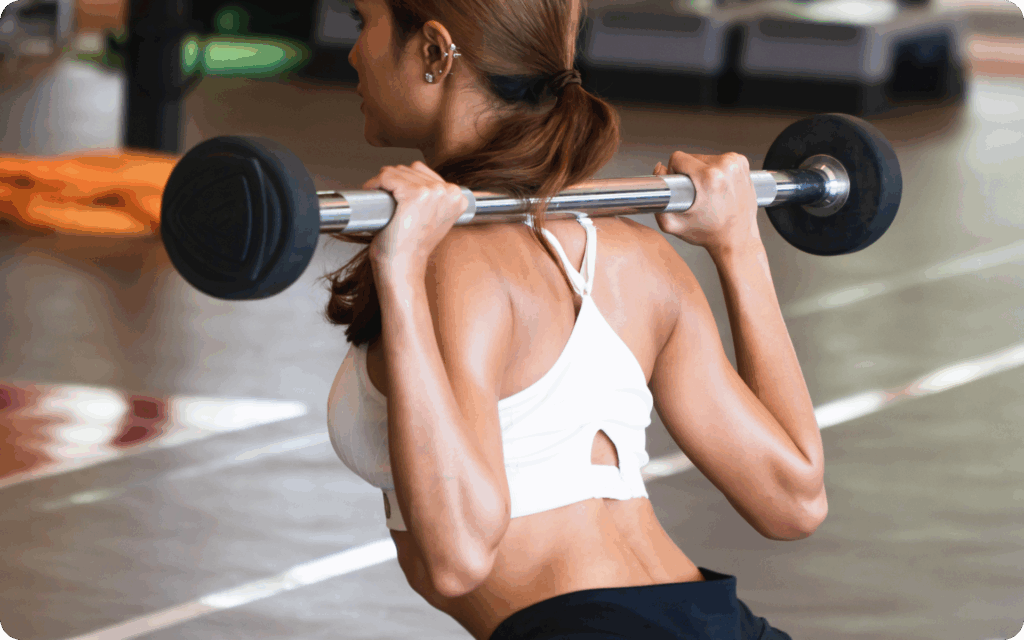
Barbell Back Squats
- Position a barbell on a squat rack at shoulder height. Step under the bar and rest it across your upper back and traps, not on your neck.
- Grip the bar with both hands wider than shoulder-width apart. Lift the bar off the rack and take a couple of steps back.
- Stand with your feet shoulder-width apart, your toes pointing slightly outward. Keep your chest up and your core engaged.
- Initiate the movement by hinging at your hips and then bending your knees, lowering your body as if sitting in a chair.
- Descend until your thighs are at least parallel to the floor, keeping your back straight.
- Drive through your heels to return to the starting position, squeezing your glutes at the top.
Dumbbell Bench Press
- Lie on a flat bench with a dumbbell in each hand, resting them on your thighs.
- Kick the dumbbells up to your chest one at a time and position them at the sides of your chest, with your palms facing forward.
- Engage your core and press your feet firmly into the floor.
- Push the dumbbells upward until your arms are fully extended, but not locked. The dumbbells should be almost touching at the top.
- Slowly lower the dumbbells back to the starting position at the sides of your chest.
Bent-Over Barbell Rows
- Stand with your feet shoulder-width apart, holding a barbell with an overhand grip slightly wider than your shoulders.
- Hinge at your hips and bend your knees slightly, lowering your torso until it’s almost parallel to the floor. Keep your back straight.
- Let the barbell hang directly in front of you with your arms fully extended.
- Pull the barbell up towards your lower chest, squeezing your back muscles and keeping your elbows close to your body.
- Pause at the top, then slowly lower the bar back to the starting position.
Whether you’re a workout beast or just a beginner making your first foray into the world of fitness and dieting – BetterMe has a lot to offer to both newbies and experts! Install the app and experience the versatility first-hand!
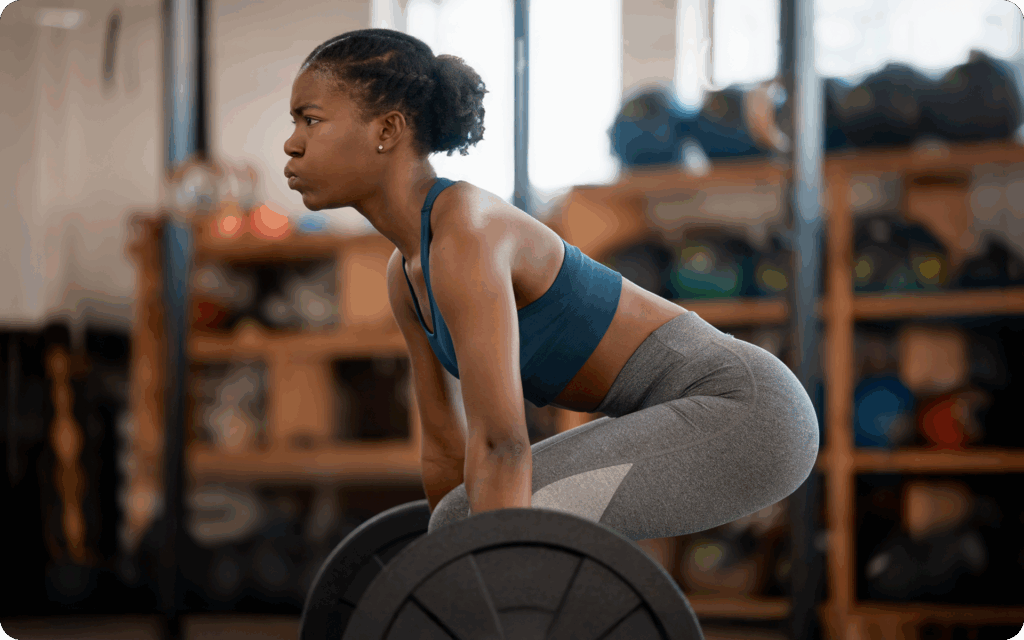
Romanian Deadlifts
- Stand with your feet hip-width apart, holding a dumbbell in each hand in front of your thighs, with your palms facing you.
- Keeping your back straight and legs almost straight (a slight bend in the knees is okay), hinge at your hips.
- Lower the dumbbells towards the floor, keeping them close to your legs. You should feel a deep stretch in your hamstrings.
- Lower the weights until you feel you can no longer maintain a flat back, typically to about mid-shin level.
- Drive your hips forward to return to the starting position, squeezing your glutes at the top.
Seated Dumbbell Shoulder Press
- Sit on a bench with back support. Hold a dumbbell in each hand at shoulder height, with your palms facing forward and elbows bent at a 90-degree angle.
- Engage your core and keep your back pressed against the bench.
- Press the dumbbells directly overhead until your arms are fully extended.
- Slowly lower the dumbbells back to the starting position at shoulder height.
Lat Pulldowns
- Sit at a lat pulldown machine and adjust the knee pad to fit snugly against your thighs.
- Grab the bar with a wide, overhand grip.
- Keeping your torso upright, pull the bar down toward your upper chest, squeezing your lats (the muscles on the sides of your back).
- Pause at the bottom, then slowly control the bar as it returns to the starting position.
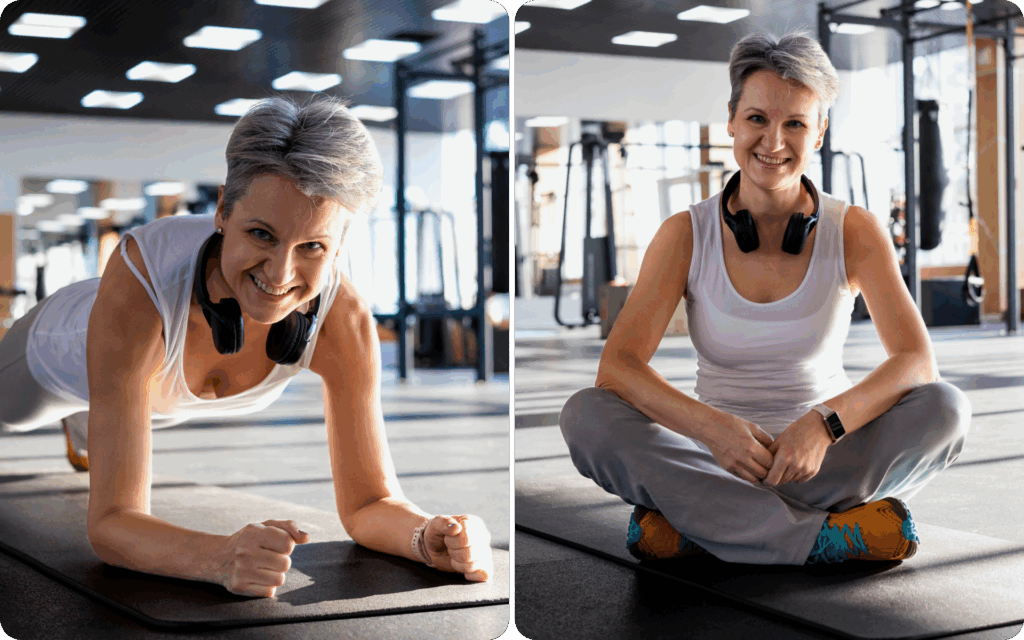
Plank
- Position yourself on the floor on your forearms and toes, as if about to do a push-up.
- Your elbows should be directly under your shoulders, and your forearms should be parallel to each other.
- Engage your core, glutes, and quads to create a straight line from your head to your heels. Don’t let your hips sag or rise too high.
- Hold this position for the prescribed time, breathing steadily.
Is There a Single Exercise that Tones the Whole Body?
While no single exercise can perfectly tone the entire body, some compound movements come very close. These body toning exercises for females are incredibly efficient as they recruit multiple muscle groups across both the upper and lower body, maximizing the training stimulus in minimal time.
If you had to choose just one, the barbell deadlift is a strong contender. It works the entire posterior chain (glutes, hamstrings, back), quads, core, and even your grip and upper-back muscles (14). Another excellent option is the squat, which is foundational for lower-body strength, but also requires significant core engagement (15).
For the upper body, the pull-up is unparalleled, as it targets the back, biceps, and shoulders (16). However, the reality is that a balanced physique requires a variety of movements. Relying on a single exercise can lead to muscle imbalances and plateaus. The best approach combines several key compound exercises to ensure all major muscle groups are effectively trained (1).
Setting achievable targets is an important part of your fitness journey. You can learn more in our guide to how to set toned body goals.
Read more: What Is a Consistent Workout Plan to Tone Your Body?
How Long Does It Take to Fully Tone Your Body as a Female?
The timeline for toning your body is highly individual and depends on several factors, including:
- Starting Body Composition: Someone with a lower body fat percentage will see muscle definition appear sooner.
- Training Consistency: Adhering to a workout schedule of 2-3 times per week is essential.
- Diet and Nutrition: You cannot out-train a poor diet. A calorie-controlled diet that is rich in protein is necessary to support muscle growth and fat loss.
- Genetics: Genetic factors can influence how easily you build muscle and store fat.
That being said, most women can expect to see noticeable changes within 8 to 12 weeks of consistent training and proper nutrition (8). Initial changes often include feeling stronger and clothes fitting differently.
Visual changes in muscle definition typically become more apparent after the first couple of months. Achieving a “fully toned” look is a continuous journey, but significant progress is absolutely achievable within a few months of dedicated effort.

Absolutely. “Flabby” is typically a combination of low muscle mass and a higher percentage of body fat. A consistent resistance training program combined with a nutrient-dense diet can build lean muscle and reduce body fat, leading to a firmer, more toned appearance. Resistance training is the best type of training for toning. This includes using free weights (dumbbells, barbells), bodyweight exercises, or resistance machines. The goal is to apply progressive overload to stimulate muscle growth. Combining this with some cardiovascular exercise can help accelerate fat loss. Yes, a well-structured 30-minute full-body workout can be very effective, particularly if you’re short on time. To make it effective, focus on compound exercises and minimize rest time between sets, or use time-saving techniques such as supersets (performing two exercises back-to-back). It’s not recommended to do a full-body resistance workout every day. Your muscles need time to recover and grow, and this process happens during rest days, not during the workout itself. Aim for 2-3 full-body sessions per week on non-consecutive days.Frequently Asked Questions
Can a flabby body be toned?
What type of training is best for toning?
Is a 30-minute full-body workout enough?
Is it okay to work out your full body every day?
The Bottom Line
Achieving a toned physique isn’t about magic exercises or quick fixes, it’s about the consistent application of proven principles. By combining a structured, full-body resistance training plan with supportive nutrition and adequate rest, you’ll provide your body with everything it needs to build lean muscle and shed fat.
This journey requires patience and dedication, but the rewarding feeling of becoming stronger, healthier, and more confident in your own skin is well worth the effort.
DISCLAIMER:
This article is intended for general informational purposes only and does not serve to address individual circumstances. It is not a substitute for professional advice or help and should not be relied on for making any kind of decision-making. Any action taken as a direct or indirect result of the information in this article is entirely at your own risk and is your sole responsibility.
BetterMe, its content staff, and its medical advisors accept no responsibility for inaccuracies, errors, misstatements, inconsistencies, or omissions and specifically disclaim any liability, loss or risk, personal, professional or otherwise, which may be incurred as a consequence, directly or indirectly, of the use and/or application of any content.
You should always seek the advice of your physician or other qualified health provider with any questions you may have regarding a medical condition or your specific situation. Never disregard professional medical advice or delay seeking it because of BetterMe content. If you suspect or think you may have a medical emergency, call your doctor.
SOURCES:
- Muscle toning term used in fitness and sports: a critical confusion (2023, repository.udca.edu.co)
- 5 Benefits of Compound Exercises (2016, acefitness.org)
- The Anatomy of Resting Energy Expenditure: Body Composition Mechanisms (2019, pmc.ncbi.nlm.nih.gov)
- Association between phase angle and body composition: New equations to predict fat mass and skeletal muscle mass (2025, sciencedirect.com)
- The Interplay Between Physical Activity, Protein Consumption, and Sleep Quality in Muscle Protein Synthesis (2024, arxiv.org)
- The Effect of High-Intensity Interval Training on Post-Exercise Oxygen Consumption: A Meta-Analysis (2021, pmc.ncbi.nlm.nih.gov)
- 7 Things to Know About Excess Post-exercise Oxygen Consumption (EPOC) (2014, acefitness.org)
- Resistance training effectiveness on body composition and body weight outcomes in individuals with overweight and obesity across the lifespan: A systematic review and meta‐analysis (2022, pmc.ncbi.nlm.nih.gov)
- Adaptations to Endurance and Strength Training (2018, pmc.ncbi.nlm.nih.gov)
- Effects of Resistance Training Frequency on Measures of Muscle Hypertrophy: A Systematic Review and Meta-Analysis (2016, link.springer.com)
- No Time to Lift? Designing Time-Efficient Training Programs for Strength and Hypertrophy: A Narrative Review (2021, link.springer.com)
- No Time to Lift? Designing Time-Efficient Training Programs for Strength and Hypertrophy: A Narrative Review (2021, link.springer.com)
- Effects of low-dose growth hormone treatment on obesity: a meta-analysis of randomized controlled trials (2025, pubmed.ncbi.nlm.nih.gov)
- Effects of Resistance Training Overload Progression Protocols on Strength and Muscle Mass (2024, pubmed.ncbi.nlm.nih.gov)
- Electromyographic activity in deadlift exercise and its variants. A systematic review (2020, journals.plos.org)
- A Biomechanical Review of the Squat Exercise: Implications for Clinical Practice (2024, pmc.ncbi.nlm.nih.gov)
- Electromyographic analysis of muscle activation during pull-up variations (2017, sciencedirect.com)
 Reviewed by
 Reviewed by