
The goal of simultaneously losing fat and building muscle, which is known as body recomposition, often feels like chasing two rabbits running in opposite directions. Conventional wisdom suggests you must choose one: a “cut” to lose fat (risking muscle loss) or a “bulk” to gain muscle (accepting some fat gain).
However, this narrative review confirms that body recomposition is not just possible, it’s also an achievable goal with the right strategies (1).
This guide will provide a structured, science-backed approach to shedding fat while building muscle. You’ll learn the physiological principles behind recomposition, how to structure your training for optimal results, and the nutritional strategies that are needed to fuel your progress. We’ll move beyond vague advice and provide a detailed workout plan, complete with exercise instructions, to give you a clear path forward.
How to Effectively Do a Body Recomposition
Body recomposition is the process of altering your body’s ratio of fat mass to lean muscle mass. It involves simultaneously decreasing your body fat percentage while increasing your muscle mass (1).
This is distinct from traditional weight loss, which often results in the loss of both fat and muscle. The key to successful recomposition lies in creating an environment where your body is encouraged to build muscle while pulling energy from its fat stores.
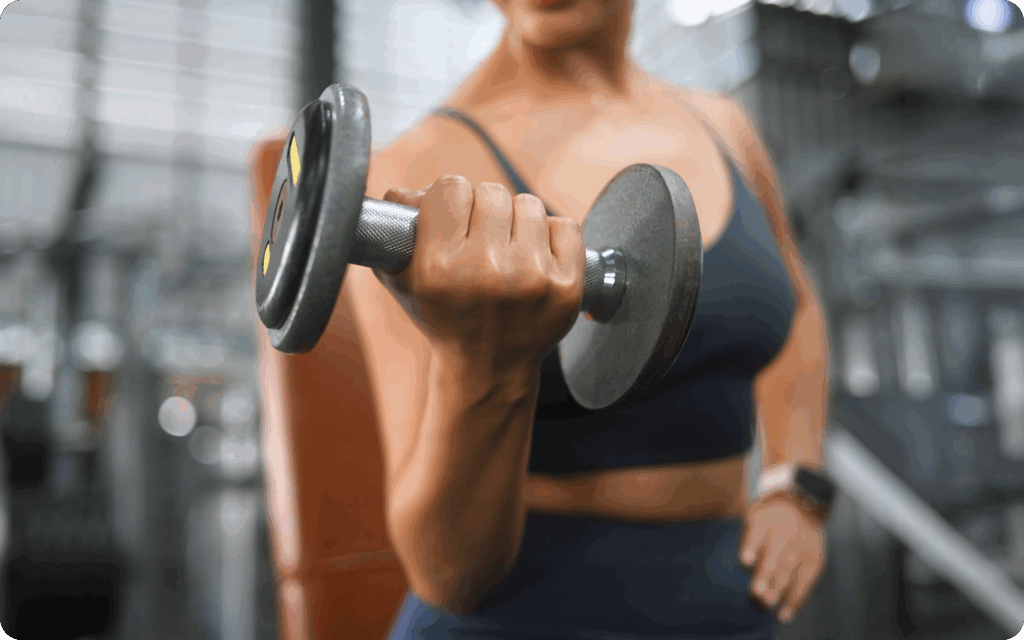
This process hinges on two primary stimuli:
- Resistance Training: This provides the signal for muscle protein synthesis (MPS), the process of building new muscle tissue (2).
- Strategic Calorie and Protein Intake: This provides the energy and raw materials for muscle growth while encouraging the body to burn stored fat (1).
Recent research published in Frontiers in Nutrition highlighted that this phenomenon is achievable through a combination of tailored exercise and dietary interventions. The study emphasized that strategies such as high-protein diets and progressive energy restriction, when paired with resistance training, can effectively preserve – and even build – fat-free mass (1).
So, how do you put this into practice? You need to send your body a strong signal to build muscle through challenging workouts. At the same time, you must manage your nutrition to fuel that growth without creating a large calorie surplus that leads to fat storage. A small calorie deficit or maintenance intake, combined with high protein, is often the most effective approach (1).
Read more: Strength and Conditioning Workout Plan: Benefits and Tips to Create a Beginner Plan
Is It Better to Bulk or Cut for Body Recomposition?
The traditional fitness approach involves distinct phases of “bulking” (eating in a significant calorie surplus to maximize muscle gain) and “cutting” (eating in a calorie deficit to lose fat). While it’s effective for competitive bodybuilders, this cyclical approach isn’t always necessary or desirable for everyone.
- Bulking: Involves eating more calories than your body burns. This provides ample energy for muscle growth but almost always leads to some level of fat gain (3).
- Cutting: Involves eating fewer calories than your body burns. This is effective for fat loss (4), but aggressive deficits can lead to muscle loss, decreased performance, and metabolic adaptation (5).

Body recomposition offers a middle path. It’s particularly effective for certain individuals:
- Beginners: Those new to resistance training have a high sensitivity to its muscle-building effects (6). Their bodies can readily build muscle even while in a slight calorie deficit, a phenomenon that is often called “newbie gains”.
- Detrained Individuals: People who have trained previously but have taken a long break can regain muscle quickly due to muscle memory (7), even while losing fat.
- Individuals with Higher Body Fat: Those with more body fat have larger energy reserves (8). Their bodies can more easily pull from these fat stores to fuel muscle building while in a calorie deficit.
For these groups, a dedicated recomposition phase is often superior to a traditional bulk or cut. It allows for simultaneous progress on both fronts, which leads to dramatic visual changes without the extremes of gaining excess fat or losing hard-earned muscle. For more advanced trainees with lower body fat, the process is slower, and alternating between small, lean bulks and short cuts might be more efficient.
Are you thinking about the myth of spot reduction? Learn more about whether you can turn fat into muscle by lifting.
BetterMe: Health Coaching app helps you achieve your body goals with ease and efficiency by helping to choose proper meal plans and effective workouts. Start using our app and you will see good results in a short time.
What Is a Transformative Body Recomp Workout Plan?
A transformative workout plan for body recomposition is built on the principle of progressive overload. This means continually increasing the challenge to your muscles over time, forcing them to adapt by growing stronger and larger. An effective plan integrates resistance training, cardiovascular work, and recovery.
Here are the key components:
Resistance Training
This is the cornerstone of any body recomp plan. The primary goal is to stimulate muscle protein synthesis (MPS) (2). The plan should focus on compound movements that work multiple muscle groups simultaneously, as these provide the most “bang for your buck” in terms of stimulus and calorie expenditure (9).
Cardiovascular Exercise
Cardio supports recomposition by increasing your total daily energy expenditure, which helps create a calorie deficit for fat loss (10). It may also improve your work capacity (11), allowing you to recover faster between sets and handle more volume in your weight training sessions.

Recovery
Muscles are broken down in the gym and rebuilt during rest. Adequate sleep and recovery days are non-negotiable (12). Chronic under-recovery can elevate cortisol, a stress hormone that promotes fat storage and muscle breakdown – the exact opposite of our goal (13).
Below is a structured, full-body recomp workout plan that’s designed for beginners and intermediates. It can be performed at a gym or with sufficient equipment at home.
Program Notes
- Glossary:
- 1RM (One-Rep Max): The maximum weight you can lift for a single repetition of an exercise.
- RPE (Rate of Perceived Exertion): A scale of 1-10 to measure intensity. An RPE of 8 means you feel you could have done 2 more reps.
- Progressive Overload: The principle of gradually increasing the stress placed on your muscles. You can do this by adding weight, reps, or sets.
- Equipment Needed: Barbell, dumbbells, pull-up bar (or lat pulldown machine), bench, squat rack. This makes it an ideal body recomp workout plan at home if you have a well-equipped garage gym.
- Split Structure: Perform this full-body workout 3 days per week on non-consecutive days (e.g. Monday – Workout A, Wednesday – Workout B, Friday – Workout A).
- Rep and Set Schemes: The program uses a mix of rep ranges to target both strength (myofibrillar hypertrophy) and muscle size (sarcoplasmic hypertrophy).
- Rest: Rest for 90-120 seconds between sets for compound exercises and 60 seconds for isolation exercises.
- Progression: Aim to add a small amount of weight (e.g. 2.5-5 lbs) to your lifts each week or increase the number of reps you perform with the same weight.

3-Day Full-Body Recomp Workout Plan
Workout A
| Exercise | Sets | Reps | Intensity |
|---|---|---|---|
| Barbell squats | 3 | 5-8 | RPE 8 |
| Dumbbell bench press | 3 | 8-12 | RPE 8 |
| Barbell bent-over rows | 3 | 8-12 | RPE 8 |
| Dumbbell shoulder press | 3 | 10-15 | RPE 9 |
| Lat pulldowns | 3 | 10-15 | RPE 9 |
| Plank | 3 | 45-60 sec | To failure |
| Exercise | Sets | Reps | Intensity |
|---|---|---|---|
| Deadlifts | 3 | 4-6 | RPE 8 |
| Incline dumbbell press | 3 | 8-12 | RPE 8 |
| Pull-ups (or assisted) | 3 | As many reps as possible | To failure |
| Dumbbell lunges | 3 | 10-12 per leg | RPE 8 |
| Lateral raises | 3 | 12-15 | RPE 9 |
| Leg raises | 3 | 15-20 | To failure |
Exercise Execution Guide
Barbell Squats
- Set the barbell in a squat rack just below shoulder height. Position yourself under the bar, resting it across your upper back, not on your neck.
- Grip the bar with both hands, lift it off the rack, and take two steps back. Your feet should be shoulder-width apart, with your toes pointed slightly outward.
- Keep your chest up and your core braced. Initiate the movement by pushing your hips back and bending your knees, as if sitting in a chair.
- Descend until your thighs are at least parallel to the floor, keeping your back straight.
- Drive through your heels to return to the starting position, squeezing your glutes at the top.

Dumbbell Bench Press
- Lie on a flat bench with a dumbbell in each hand, resting on your thighs.
- Kick the dumbbells up to your chest one at a time, positioning them at the sides of your chest with your palms facing forward.
- Press the dumbbells upward until your arms are fully extended, but not locked out.
- Slowly lower the weights back to the starting position, keeping them under control.
Barbell Bent-Over Rows
- Stand with your feet shoulder-width apart, holding a barbell with an overhand grip.
- Hinge at your hips and bend your knees slightly, lowering your torso until it’s almost parallel to the floor. Your back should remain straight.
- Pull the barbell up toward your lower chest, squeezing your back muscles.
- Lower the bar slowly and with control back to the starting position.
Dumbbell Shoulder Press
- Sit on a bench with back support, holding a dumbbell in each hand at shoulder height, your palms facing forward.
- Press the dumbbells overhead until your arms are fully extended.
- Slowly lower the dumbbells back to the starting position.
BetterMe will shake off your mental funk, rid you of your energy-zapping habits, and help you sculpt the body of your dreams. Intrigued? Hurry up and change your life for the better!
Lat Pulldowns
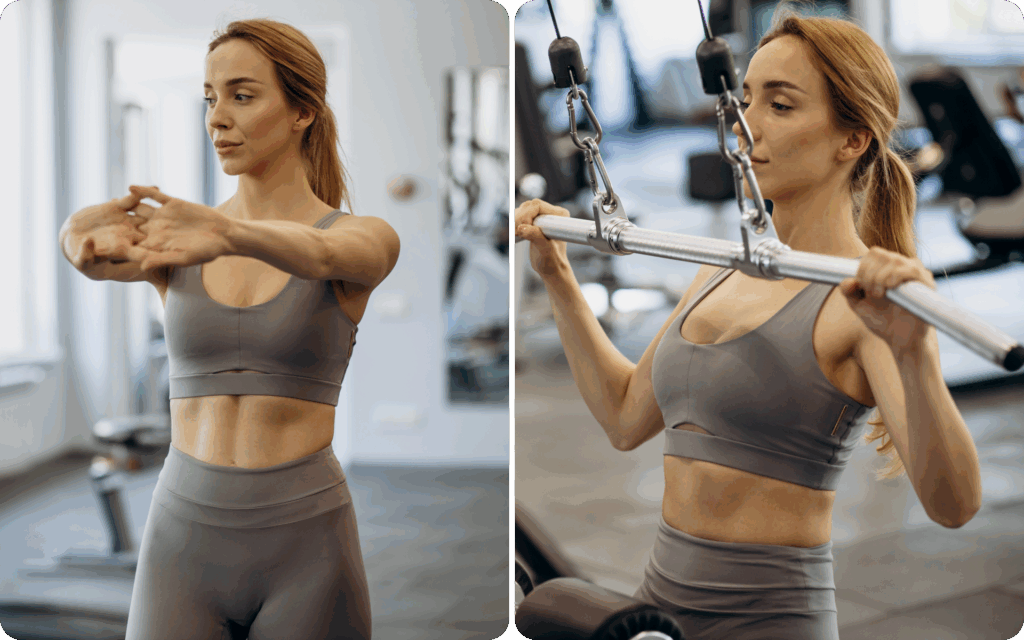
- Sit at a lat pulldown machine and adjust the knee pad to secure your legs.
- Grasp the bar with a wide, overhand grip.
- Keeping your torso upright, pull the bar down to your upper chest. Focus on using your back muscles, not your arms.
- Slowly release the bar back to the starting position.
Plank
- Start by lying face down on the floor. Prop yourself up on your forearms and toes with your elbows directly under your shoulders.
- Engage your core, glutes, and legs to form a straight line from your head to your heels.
- Hold this position without letting your hips sag or rise, maintaining a neutral neck.
- Breathe steadily and hold for the prescribed time.

Deadlifts
- Stand with your mid-foot under the barbell. Your feet should be hip-width apart.
- Hinge at your hips and bend your knees to grip the bar just outside your shins. Keep your back straight, your chest up, and your hips down.
- Brace your core, and drive through your feet to lift the weight. Keep the bar close to your body as you stand up.
- Finish the lift by standing tall, pulling your shoulders back. Don’t hyperextend your back.
- Lower the weight by reversing the motion, hinging at your hips first.
Incline Dumbbell Press
- Set a bench to a 30-45 degree incline.
- Lie on the bench and perform the press with the same technique as the flat dumbbell bench press. The incline shifts the focus to the upper chest.
Pull-Ups
- Grip a pull-up bar with your hands slightly wider than shoulder-width, your palms facing away from you.
- Hang from the bar with your arms fully extended.
- Pull your body up until your chin is over the bar. Focus on driving your elbows down and back.
- Lower yourself back to the starting position with control. If you cannot do a full pull-up, use an assisted machine or a resistance band.
Dumbbell Lunges
- Stand with your feet together, holding a dumbbell in each hand.
- Take a large step forward with one leg, lowering your hips until both knees are bent at a 90-degree angle. Your front knee should be directly above your ankle, and your back knee should hover just above the ground.
- Push off your front foot to return to the starting position.
- Alternate legs with each repetition.
Lateral Raises
- Stand with a light dumbbell in each hand at your sides, your palms facing inward.
- Keeping a slight bend in your elbows, raise the weights out to your sides until they reach shoulder height.
- Lower the dumbbells back to the starting position with control.
Leg Raises
- Lie flat on your back on a mat with your legs extended and your arms at your sides, your palms pressing gently into the floor.
- Keeping your legs straight, engage your core and lift your legs toward the ceiling until your hips come slightly off the floor.
- Slowly lower your legs back toward the floor with control, stopping just before your heels touch down.
- Repeat for the prescribed number of repetitions, keeping your lower back pressed into the floor throughout the movement. Stand with a light dumbbell in each hand at your sides, your palms facing in.
- Keeping a slight bend in your elbows, raise the weights out to your sides until they reach shoulder height.
- Lower the dumbbells back to the starting position with control.
Read more: Beginner Gym Workout Plan: Tips for a Balanced Routine That Meets Your Goals
How Long Will Body Recomposition Take?
The timeline for body recomposition varies significantly from person to person. It’s influenced by several factors:
- Training Experience: Beginners will see results much faster than advanced lifters. A body recomp workout plan for beginners can yield noticeable changes in as little as 8-12 weeks (15).
- Starting Body Fat Percentage: Individuals with more body fat to lose and more muscle to gain have the potential for more dramatic and rapid changes.
- Consistency: Adherence to your training and nutrition plan is the single most important factor. Missing workouts or deviating from your diet will slow progress.
- Genetics and Hormones: Individual genetic predispositions and hormonal profiles (like testosterone and insulin sensitivity) can affect the rate of muscle gain and fat loss (16, 17).
For a beginner who is consistent, visible changes in muscle definition and a reduction in body fat can be seen within 2-3 months (15). For an intermediate lifter, the process is slower and may take 6 months or more to achieve significant recomposition (15). It’s a marathon, not a sprint.

What Are Signs of Successful Body Recomp?
As your body weight might not change much during recomposition (as you’re losing fat and gaining an equivalent weight in muscle), the scale isn’t the best tool for measuring progress. Instead, focus on these quantifiable signs:
- Improved Body Composition Measurements: Use tools such as skinfold calipers, bioelectrical impedance analysis (BIA), or DEXA scans to track your body fat percentage and lean muscle mass.
- Progress Pictures: Take photos from the front, side, and back every 4 weeks in the same lighting. Visual changes are often more motivating than numbers on a scale.
- Clothing Fit: Notice how your clothes fit. Your pants may feel looser around the waist while your shirts feel tighter around the shoulders and arms – a classic sign of successful recomposition.
- Increased Strength: Are you lifting more weight or completing more reps in the gym? Strength gains are a reliable indicator that you’re building muscle.
Are you looking for a more structured, time-bound plan? Consider how a 4-week body transformation female program applies these principles.
Whether you’re a workout beast or just a beginner making your first foray into the world of fitness and dieting – BetterMe has a lot to offer to both newbies and experts! Install the app and experience the versatility first-hand!
What Are the Biggest Body Recomp Mistakes?
Avoiding common pitfalls can make the difference between success and frustration. Here are the biggest mistakes to look out for:
- Too Large a Calorie Deficit: While a deficit is needed for fat loss, an aggressive one will sabotage muscle growth and may even lead to muscle loss (5). Aim for a small, sustainable deficit of 200-400 calories per day.
- Inadequate Protein Intake: Protein provides the amino acids necessary for repairing and building muscle (18). Not eating enough is one of the fastest ways to halt progress.
- Inconsistent Training: Skipping workouts or not pushing yourself in the gym is typically not sufficient to see true changes. Consistency and intensity are essential for stimulating muscle growth.
- Ignoring Progressive Overload: Doing the same workouts with the same weights for months on end will lead to a plateau. You must continuously challenge your muscles to force adaptation (19).
- Poor Sleep: A lack of quality sleep (less than 7-8 hours per night) impairs recovery, disrupts muscle-building hormones, and increases cortisol (20).

What Diet Is Best for Body Recomposition?
Nutrition is just as important as training for body recomposition. The best diet supports muscle growth while facilitating fat loss.
Here are the key nutritional strategies:
- High Protein Intake
This is the most critical nutritional component. A 2023 study published in the Journal of the International Society of Sports Nutrition found that a daily protein intake of 1.6 grams per kilogram of body weight (or about 0.73 g/lb) was superior for promoting muscle mass improvements compared to a lower intake in resistance-trained men (21). For optimal results, many experts recommend aiming even higher – up to 2.2 g/kg (1 g/lb) (22).
- Calorie Control
A small calorie deficit is ideal (1). You can calculate your maintenance calories using an online calculator and subtract 200-400 calories from this number. Adjust based on your progress.
- Carbohydrates and Fats
Don’t fear carbs or fats. Carbohydrates provide the primary fuel for your workouts (23), while dietary fats are essential for hormone production (24). A balanced intake of all three macronutrients is key. Focus on whole-food sources such as fruits, vegetables, whole grains, and healthy fats.
- Creatine Supplementation
Research has consistently shown that creatine monohydrate supplementation can enhance strength, power, and muscle mass gains from resistance training, particularly in men (25). A typical dose is 3-5 grams per day.
For more detailed guidance on meal planning, explore a complete body recomposition diet.

Yes and no. “Heavy” is relative, but you must lift challenging weights. To stimulate muscle growth, you need to create sufficient mechanical tension. A narrative review from 2021 in Sports suggested that muscle can be built across a wide spectrum of rep ranges (from 5 to 30 reps) (26), as long as sets are taken close to muscular failure. A good program will include both lower-rep, heavier-strength work (5-8 reps) and higher-rep, lighter-metabolic stress work (10-20 reps). For a full-body routine, 3 days per week is highly effective, as it allows for adequate recovery between sessions. If you prefer an upper/lower split, 4 days per week is a great option. The key is to ensure each muscle group is trained with sufficient volume and intensity at least twice per week. Fat loss is systemic; you cannot choose where you lose fat from (a concept that is known as “spot reduction”). Your genetics primarily determine the pattern of fat loss (27). Often, the areas where you gained fat last are the first to become leaner, while more stubborn areas (such as the lower abdomen for men or hips and thighs for women) are typically the last to go. Yes, protein shakes are an excellent tool for body recomposition. They provide a convenient, fast-digesting, and high-quality source of protein, which makes meeting your daily protein targets easier, especially post-workout. However, they are a supplement to a diet that is rich in whole-food protein sources, not a replacement for it.Frequently Asked Questions
Do you have to lift heavy for body recomp?
How many days a week should I work out for body recomposition?
Which body part loses fat first?
Are protein shakes good for body recomp?
The Bottom Line
Achieving body recomposition is a testament to consistency and smart training. By applying the principles of progressive overload, managing your nutrition with a focus on high protein, and prioritizing recovery, you can fundamentally change your physique. This process empowers you to build a stronger, leaner body without the drastic swings of traditional bulking and cutting.
DISCLAIMER:
This article is intended for general informational purposes only and does not serve to address individual circumstances. It is not a substitute for professional advice or help and should not be relied on for making any kind of decision-making. Any action taken as a direct or indirect result of the information in this article is entirely at your own risk and is your sole responsibility.
BetterMe, its content staff, and its medical advisors accept no responsibility for inaccuracies, errors, misstatements, inconsistencies, or omissions and specifically disclaim any liability, loss or risk, personal, professional or otherwise, which may be incurred as a consequence, directly or indirectly, of the use and/or application of any content.
You should always seek the advice of your physician or other qualified health provider with any questions you may have regarding a medical condition or your specific situation. Never disregard professional medical advice or delay seeking it because of BetterMe content. If you suspect or think you may have a medical emergency, call your doctor.
SOURCES:
- Editorial: New insights and advances in body recomposition (2024, frontiersin.org)
- Resistance training‐induced changes in integrated myofibrillar protein synthesis are related to hypertrophy only after attenuation of muscle damage (2016, pmc.ncbi.nlm.nih.gov)
- The Effects of Overfeeding on Body Composition: The Role of Macronutrient Composition – A Narrative Review (2017, pmc.ncbi.nlm.nih.gov)
- Achieving an Optimal Fat Loss Phase in Resistance-Trained Athletes: A Narrative Review (2021, mdpi.com)
- Prolonged Calorie Restriction Downregulates Skeletal Muscle mTORC1 Signaling Independent of Dietary Protein Intake and Associated microRNA Expression (2016, pubmed.ncbi.nlm.nih.gov)
- Neuromuscular adaptations to resistance training in elite versus recreational athletes (2025, frontiersin.org)
- After a break from strength training, muscle memory may help you bounce back (2024, npr.org)
- A Comparison of Substrate Utilization Profiles During Maximal and Submaximal Exercise Tests in Athletes (2022, frontiersin.org)
- 5 Benefits of Compound Exercises (2016, acefitness.org)
- Effect of Exercise Training on Fat Loss—Energetic Perspectives and the Role of Improved Adipose Tissue Function and Body Fat Distribution (2021, pmc.ncbi.nlm.nih.gov)
- Effects of 12 months aerobic exercise intervention on work ability, need for recovery, productivity and rating of exertion among cleaners: a worksite RCT (2018, pubmed.ncbi.nlm.nih.gov)
- The Importance of Recovery in Resistance Training Microcycle Construction (2024, pmc.ncbi.nlm.nih.gov)
- Hypothalamic-Pituitary-Adrenal (HPA) Axis Functioning in Overtraining Syndrome: Findings from Endocrine and Metabolic Responses on Overtraining Syndrome (EROS)—EROS-HPA Axis (2017, sportsmedicine-open.springeropen.com)
- Impact of Cortisol on Reduction in Muscle Strength and Mass: A Mendelian Randomization Study (2022, pubmed.ncbi.nlm.nih.gov)
- Adaptations to Endurance and Strength Training (2018, pmc.ncbi.nlm.nih.gov)
- Genome-wide association study of exercise-induced skeletal muscle hypertrophy and the construction of predictive model (2024, pubmed.ncbi.nlm.nih.gov)
- Genetics of Exercise and Diet-Induced Fat Loss Efficiency: A Systematic Review (2024, pmc.ncbi.nlm.nih.gov)
- Amino acids regulating skeletal muscle metabolism: mechanisms of action, physical training dosage recommendations and adverse effects (2024, nutritionandmetabolism.biomedcentral.com)
- Effects of Resistance Training Overload Progression Protocols on Strength and Muscle Mass (2024, pubmed.ncbi.nlm.nih.gov)
- Sleep and muscle recovery: Endocrinological and molecular basis for a new and promising hypothesis (2011, sciencedirect.com)
- Effects of 16 weeks of two different high-protein diets with either resistance or concurrent training on body composition, muscular strength and performance, and markers of liver and kidney function in resistance-trained males (2023, tandfonline.com)
- Dose-response relationship between protein intake and muscle mass increase: a systematic review and meta-analysis of randomized controlled trials (2020, pubmed.ncbi.nlm.nih.gov)
- High-Quality Carbohydrates and Physical Performance (2017, pmc.ncbi.nlm.nih.gov)
- The Role of Fat, Fiber, and Micronutrients in Hormone Health (2025, foodasmedicineinstitute.com)
- Effects of Creatine Supplementation and Resistance Training on Muscle Strength Gains in Adults <50 Years of Age: A Systematic Review and Meta-Analysis (2024, pubmed.ncbi.nlm.nih.gov)
- Loading Recommendations for Muscle Strength, Hypertrophy, and Local Endurance: A Re-Examination of the Repetition Continuum (2021, mdpi.com)
- Spot reduction: why targeting weight loss to a specific area is a myth (2023, sydney.edu.au)

 Reviewed by
 Reviewed by