Building an effective fitness routine doesn’t require a gym membership or expensive equipment. With a structured approach grounded in exercise science, you can achieve meaningful results in the comfort of your home. This guide will provide a detailed, evidence-based framework for creating and executing a one-week workout plan. We’ll break down the essential principles of training, quantify key concepts, and give you the actionable tools needed to start your fitness journey with confidence.
You’ll learn how to structure your training week, choose the right exercises, and progress them safely. We’ll also explore realistic expectations, the science of recovery, and how to measure your progress. By the end, you’ll have a complete 1-week workout plan at home that’s adaptable and built for results.
Can I Get in Shape in 1 Week?
One week isn’t enough time for a dramatic transformation in body composition or fitness level. Substantial muscle gain, significant fat loss, and major cardiovascular improvements (1) all require several weeks to months of consistent, structured effort. However, seven days is enough to make measurable progress in other areas.
What you can achieve in one week:
- Enhanced workout consistency: Successfully completing planned workouts helps cement a habit (2), a crucial foundation for future gains.
- Reduced water retention and bloating: Many people report feeling “less puffy” after a week of regular exercise and improved hydration (3, 4).
- Better mood, energy, and sleep: You can expect a noticeable boost in mental clarity and daily energy, supported by a surge in exercise-related endorphins (5, 6, 7).
What you cannot achieve in one week:
- Improved neuromuscular coordination: Studies have shown that new exercisers can increase strength in a few weeks due to better muscle recruitment (8).
- Significant fat loss: At a healthy rate (0.5-1% of body weight per week) (9), most adults will lose 0.3-1 kg (0.7-2.2 lbs) of fat at best – much of the weight loss in the first week is water, not fat.
- Substantial muscle gain: True muscle hypertrophy takes multiple weeks (10). Any “pump” you see or feel is temporary and not sustained growth.
- Visible transformation: Noticeable differences in physique (tightened waist, defined arms, etc.) require at least 4-8 weeks for most individuals.
- Maximal cardiovascular improvement: While you can make your first strides, measurable changes in VO2 max or endurance aren’t yet significant.
One week is ideal for building momentum, boosting motivation, and laying the groundwork for success. Use it to master your exercise technique, start developing consistency, and experience some immediate improvements in well-being. Sustainable changes come with continued effort beyond week one.
Read more: Pilates Push Ups – The Complete Guide To Form And Technique
How to Create a 1-Week Workout Plan at Home
Creating a plan that works involves more than just picking random exercises. It requires a methodical approach that is based on established training principles. Here are the steps to build your own effective 1-week workout plan at home for beginners.
Understand Key Training Principles
To ensure your workouts are effective, you need to understand three core concepts: volume, intensity, and progressive overload.
- Training Volume: This refers to the total amount of work you perform, typically measured as sets × reps × weight (11). For muscle growth (hypertrophy) and strength, research indicates a target of 10-20 hard sets per major muscle group per week is optimal (12). A “hard set” is one that is taken close to muscular failure.
- Intensity of Effort: This is how hard you push during a set. We can measure this using reps in reserve (RIR), which is how many more repetitions you could have completed with good form. For most exercises, aiming for 1-3 RIR ensures the set is challenging enough to stimulate adaptation without causing excessive fatigue (13). This is a more precise measure than simply lifting until you feel tired.
- Progressive Overload: This principle states that for your body to adapt, you must continually increase the demands placed upon it (14). This doesn’t just mean adding weight. You can achieve progressive overload by adding reps, improving your tempo (e.g. slowing the lowering phase of a lift), increasing the range of motion, or choosing a more difficult exercise variation (15).
Define Your Weekly Schedule
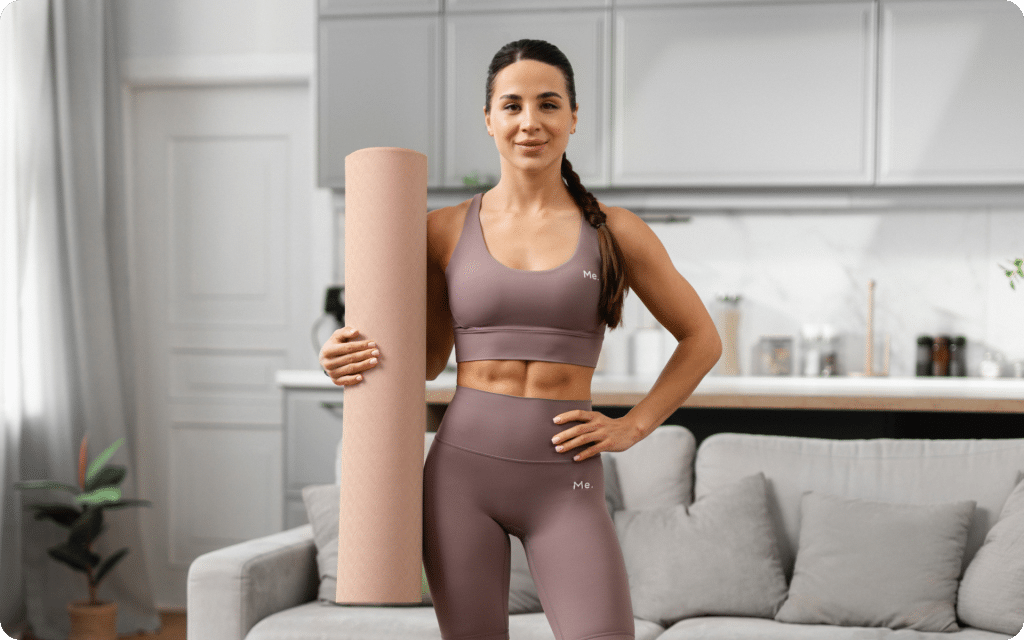
A common misconception is that you need to train every day. For beginners, and even for many experienced lifters, 3 to 4 training days per week is highly effective. This frequency allows for adequate recovery, which is when your muscles actually repair and grow stronger (16).
Here’s a sample weekly structure that balances work and rest:
- Day 1: Full-body strength training A
- Day 2: Active recovery (e.g. a 30-minute walk, stretching)
- Day 3: Full-body strength training B
- Day 4: Active recovery
- Day 5: Full-body strength training C
- Day 6: Cardio or active recovery
- Day 7: Complete rest
This schedule provides 48-72 hours of recovery between strength sessions, which is generally sufficient for muscle protein synthesis to complete its cycle (17).
BetterMe: Health Coaching app helps you achieve your body goals with ease and efficiency by helping to choose proper meal plans and effective workouts. Start using our app and you will see good results in a short time.
Select Your Exercises
A balanced program should target all major movement patterns to ensure symmetrical development and reduce the risk of injury. Structure your workouts around these categories.
- Knee-Dominant (Quads): Split squats, goblet squats
- Hip-Dominant (Glutes and Hamstrings): Single-leg Romanian deadlifts (RDLs), glute bridges
- Horizontal Push (Chest, Shoulders, Triceps): Push-up variations
- Horizontal Pull (Back, Biceps): Dumbbell or band rows
- Vertical Push (Shoulders): Pike push-ups, overhead press
- Core (Anti-Rotation/Flexion): Pallof press, planks
Structure Your Sessions
Each 45 to 60-minute workout should include a warm-up, the main workout, and a cool-down.
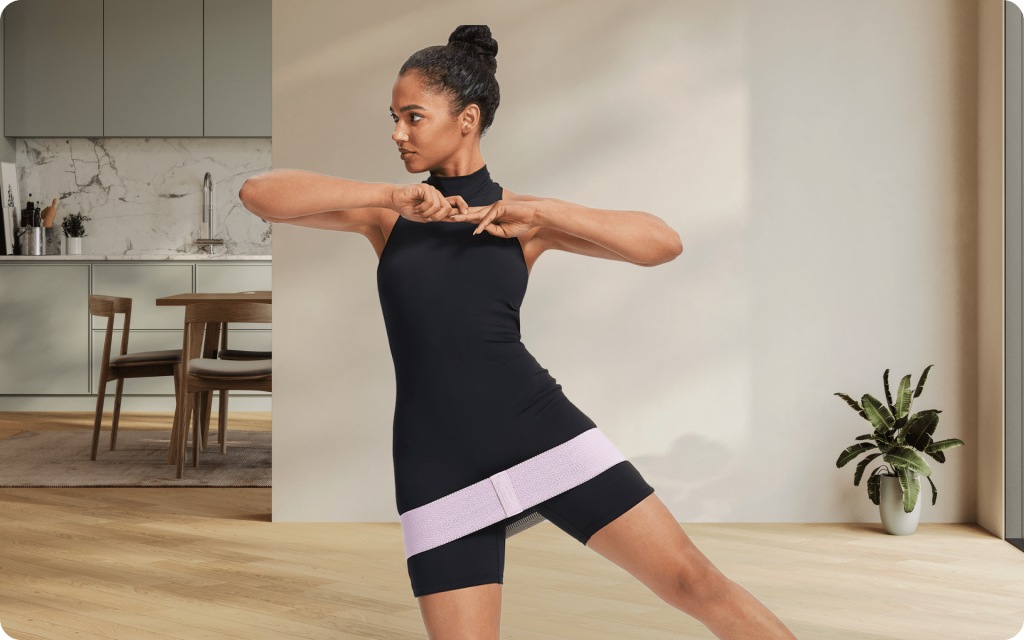
- Warm-Up (5-10 minutes): Start with 3 minutes of light cardio (jumping jacks, high knees) to increase your core temperature (18). Follow this with dynamic stretches such as leg swings and arm circles, and then activation exercises such as glute bridges and band pull-aparts to prime the muscles you’re about to use.
- Main Workout (35-45 minutes): Perform 5-6 exercises, completing 3-4 sets of 6-12 reps for each. Focus on compound movements that work multiple muscle groups at once.
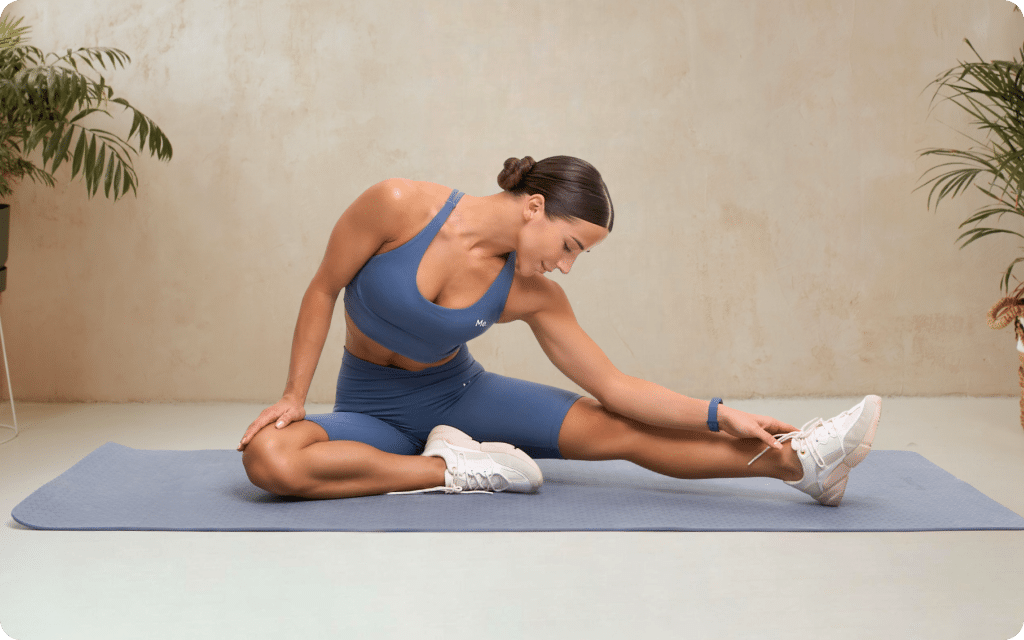
- Cool-Down (5 minutes): Finish with static stretching, holding each stretch for 30 seconds. Focus on the major muscles you worked, like the quads, hamstrings, chest, and back.
The 1-Week Workout Plan
Here’s a detailed plan you can follow. It includes options for a 1-week workout plan at home no equipment and a 1-week workout plan at home with dumbbells. Choose the variation that matches your resources.
Workout A: Full-Body Strength
- Glute bridge: 3 sets of 15-20 reps (1 RIR)
- Split squat: 3 sets of 8-12 reps per side (1-2 RIR)
- Push-up variation: 3 sets to 1-2 RIR
- Single-arm dumbbell/band row: 3 sets of 10-15 reps per side (1-2 RIR)
- Plank: 3 sets, hold for 30-60 seconds (until form breaks)
Workout B: Full-Body Strength
- Goblet squat (with dumbbell) or bodyweight squat: 3 sets of 10-15 reps (1-2 RIR)
- Single-leg RDL: 3 sets of 8-12 reps per side (2 RIR)
- Overhead press (dumbbell or band): 3 sets of 10-15 reps (1-2 RIR)
- Inverted row (under a sturdy table): 3 sets to 1-2 RIR
- Pallof press: 3 sets of 10-12 reps per side (slow and controlled)
Workout C: Full-Body Strength and Cardio Finisher
- Push-up variation: 3 sets to 1-2 RIR
- Split squat: 3 sets of 8-12 reps per side (1-2 RIR)
- Single-arm dumbbell/band row: 3 sets of 10-15 reps per side (1-2 RIR)
- Side plank: 3 sets, hold for 30-45 seconds per side
- Cardio finisher: 6 rounds of 30 seconds of high knees or jumping jacks, followed by 60 seconds of rest.
This structure is an excellent foundation for a 1-week workout plan at home for men and women alike, focusing on fundamental strength.
For those who want to build a comprehensive routine without any gear, you can explore our complete guide to a home workout plan without equipment.
Exercise Steps
Proper form is essential for maximizing results and reducing the risk of injury (19). Use these steps and cues for each movement.
Split Squat
- Stand two to three feet in front of a bench or chair. Place the top of one foot on the surface behind you.
- Keep your torso upright. Lower your hips until your front thigh is parallel to the floor and your shin is vertical.
- Briefly pause at the bottom.
- Drive through your front foot’s heel to return to the starting position. Maintain balance and control throughout.
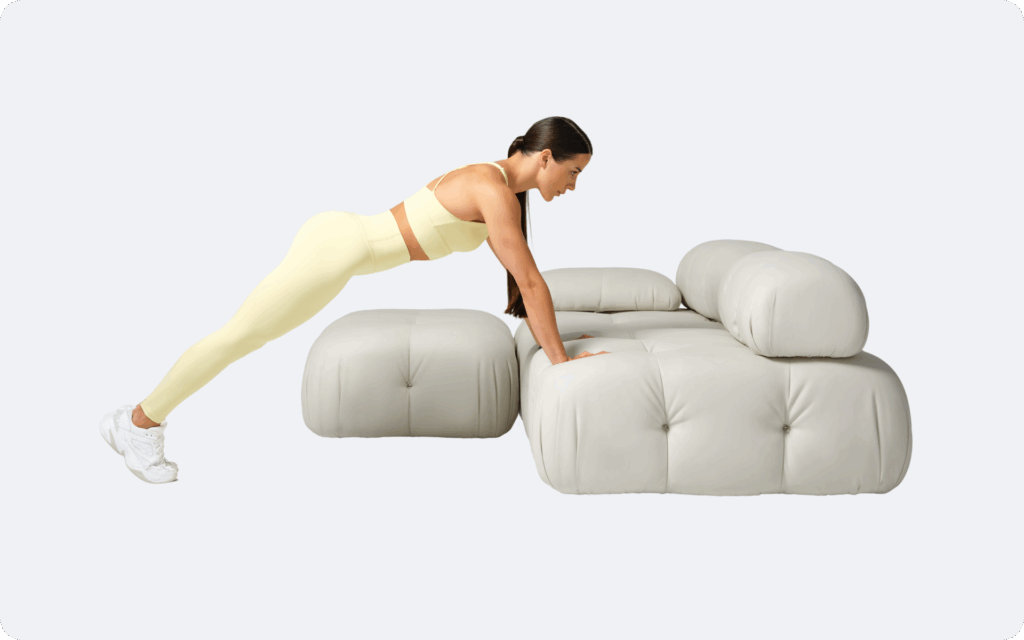
Push-Up Variation
Easier: Perform wall push-ups or incline push-ups (using an elevated surface).
Standard:
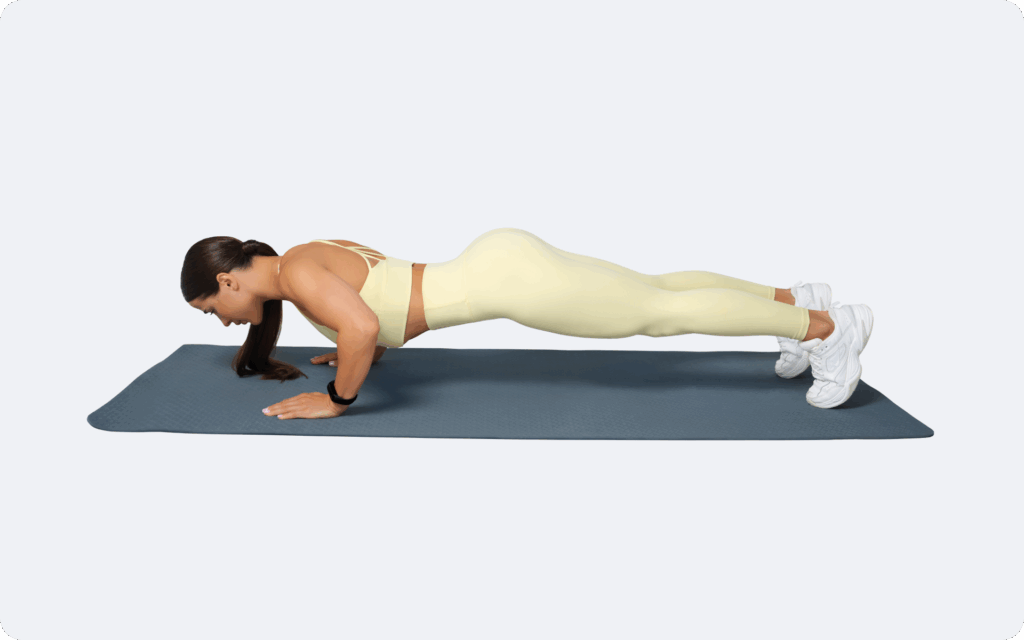
- Start in a plank with your hands slightly wider than shoulder-width apart and your body in a straight line from head to heels.
- Lower your chest, keeping your elbows at a 45-degree angle.
- Continue until your chest is about an inch from the floor. Take 3 seconds on the descent for increased tension.
- Press powerfully back to the top.
Focus on controlled movement – don’t allow your hips to sag.
Single-Leg RDL (Romanian Deadlift)
- Stand tall, holding a dumbbell in one hand (optional), opposite the working leg.
- Soften your standing knee, hinge at your hips, and extend your free leg straight behind.
- Lower the weight until your torso and free leg form a straight line, and you feel a stretch in your standing leg’s hamstring.
- Keep your back flat and square your hips toward the floor.
- Push through your standing leg’s heel to return upright. Move slowly and focus on balance.
Goblet Squat
- Hold a dumbbell or other weight close to your chest, your elbows tucked under.
- Stand with your feet shoulder-width apart and your toes slightly out.
- Brace your core and lower your hips back and down as if sitting into a chair, keeping your chest up.
- Squat until your thighs are parallel or just below, your knees tracking over your toes.
- Drive through your heels to stand tall, squeezing your glutes at the top. Avoid allowing your knees to collapse inward.
Inverted Row
- Lie under a sturdy table, bar, or suspension strap, gripping with your hands slightly wider than shoulder-width apart.
- Plant your heels on the floor and extend your body in a straight line (plank).
- Pull your chest toward the bar/table edge, keeping your elbows at about 45 degrees.
- Pause with your chest at the bar, then slowly lower until your arms are straight.
If needed, bend your knees to decrease the resistance or elevate your feet to increase the difficulty.
Overhead Press (Dumbbell or Band)
- Stand with your feet hip-width apart, your core engaged.
- Hold dumbbells at shoulder height or grip the ends of a resistance band anchored under your feet.
- Press the weights or band overhead, fully extending your arms without shrugging your shoulders.
- Pause briefly with your arms extended, then lower under control to shoulder level.
- Keep your ribs down and avoid arching your lower back as you press.
Pallof Press (with Resistance Band)
- Anchor a band at chest height. Stand sideways to it, your feet shoulder-width apart, holding the band at your chest.
- Step out laterally from the anchor point to create tension and brace your core.
- Press the band straight out, resisting rotational pull.
- Hold for two seconds, then return your hands to your chest. Move slowly and avoid twisting.
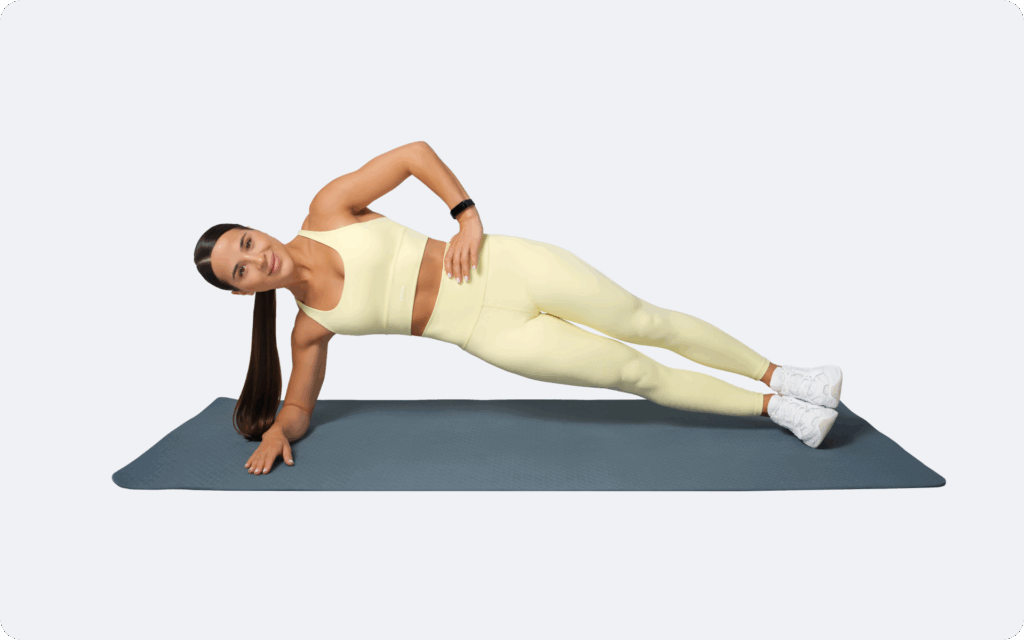
Side Plank
- Lie on your side with your elbow below your shoulder and your legs stacked.
- Lift your hips until your body forms a straight line from head to feet.
- Hold, keeping your hips lifted and your glutes engaged. Optionally, raise your top leg for an extra challenge.
- Switch sides after each set. Avoid allowing your hips to drop during the hold.
Glute Bridge
- Lie on your back, your knees bent, and your feet flat and hip-width apart.
- Brace your core, drive through your heels, and lift your hips until your shoulders, hips, and knees are aligned.
- Squeeze your glutes at the top for one second.
- Lower with control and repeat. Don’t hyperextend your lower back.
Plank
- Place your forearms on the floor, your elbows under your shoulders, and your legs extended.
- Lift your hips, keeping your body in a straight line from head to heels.
- Brace your core and pull your shoulder blades back and down.
- Hold until form breaks, avoid letting your hips sag or pike.
Cardio Finisher: High Knees or Jumping Jacks
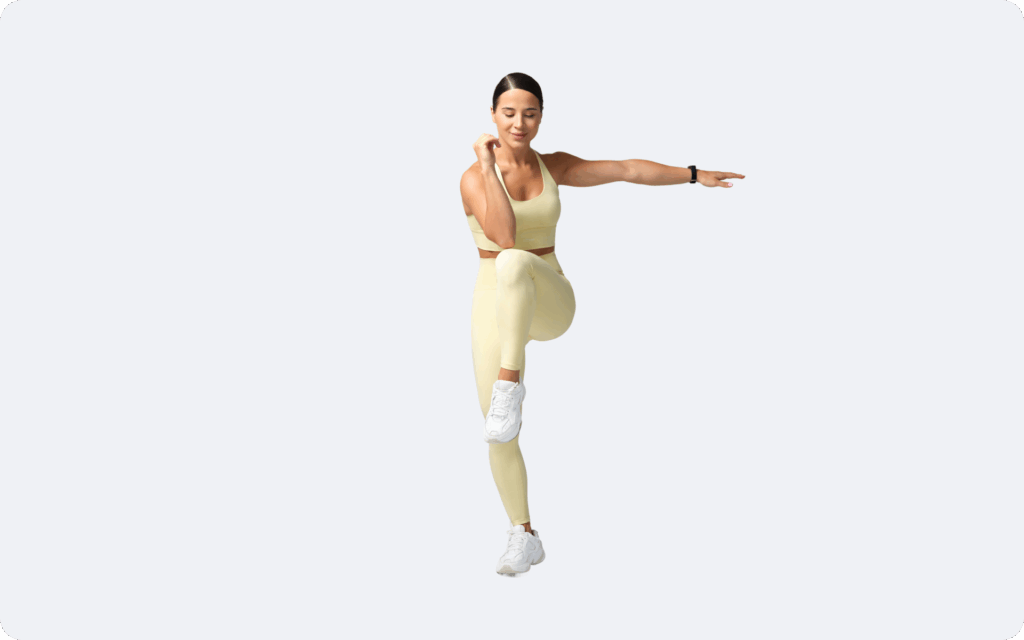
- High knees: Stand tall, quickly alternating driving your knees up toward your chest, pumping your arms for 30 seconds.
- Jumping Jacks: Stand with your feet together and your arms at your sides. Jump your feet out wide as you lift your arms overhead, then return to the start. Repeat briskly for 30 seconds.
- Rest for 60 seconds between rounds, repeat for six total intervals.
Maintain a steady pace and focus on rhythmic breathing throughout each interval.
This step-by-step guide supports both the 1-week workout plan at home for weight loss and muscle building, regardless of equipment availability.
For a training program that’s designed with female physiology in mind, check out our guide to a workout routine for women at home.
Is It a Good Idea to Work Out 7 Days a Week?
Working out seven days a week is generally not recommended, especially for beginners. Your muscles don’t grow during the workout itself – they grow during the recovery period that follows. Overtraining can lead to diminished returns, increased risk of injury, and systemic fatigue (20).
Recent exercise science has reinforced that for strength gains, total weekly volume is more important than training frequency. A 2018 meta-analysis found that when volume is equated, training 2-3 days per week yields similar strength gains to training 4-5 days per week (21).
Light activity such as walking, stretching, or mobility work on your “off” days is beneficial and counts as active recovery (22). However, true rest days are essential for your nervous system and muscles to fully repair (23).
Whether you’re a workout beast or just a beginner making your first foray into the world of fitness and dieting – BetterMe has a lot to offer to both newbies and experts! Install the app and experience the versatility first-hand!
Which Workout Time Is Better for Beginners?
The best time to work out is the time you can consistently commit to. Physiologically, there are minor differences between morning and evening training. Some research has suggested that physical performance, including strength and power, may peak in the late afternoon due to higher core body temperatures (24).
However, for beginners, habit formation is far more important than these marginal physiological advantages. Morning workouts can prevent daily responsibilities from derailing your plan, while evening workouts may help some people de-stress from the day. Experiment to see what integrates best with your lifestyle. The most effective workout is one that gets done.
When Do You Start Seeing Results from Working Out?
Results manifest on different timelines. It’s helpful to categorize them into short-term, medium-term, and long-term changes.
- After 1 Week: You’ll likely feel better. Expect improved mood, more energy, and better sleep, thanks to the endorphin release from exercise. You may also feel “stronger” as your brain improves its ability to recruit muscle fibers.
- After 4-8 Weeks: Visible changes begin to appear. You may notice increased muscle definition and a better fit in your clothes. Your strength will have measurably increased, which means you can perform more reps or use more challenging variations of exercises.
- After 3-6 Months: Significant changes in body composition are evident. With consistent training and nutrition, you can expect noticeable muscle growth and fat loss. Your cardiovascular health and endurance will have improved substantially.
Read more: Bodyweight Circuit Exercises: Your Definitive Scientific Guide
What Are Realistic Goals for One Week of Working Out?
Setting achievable goals for your first week is key to staying motivated. Focus on process-oriented goals rather than outcome-oriented ones.
Goal 1: Master Form on Key Lifts
Your primary goal should be to learn and correctly perform 3-5 foundational movements. For this week, focus on perfecting your form for the split squat, push-up, and row. Record yourself on your phone to check your technique against the cues provided.
Goal 2: Achieve Training Consistency
Commit to and complete your three scheduled strength workouts for the week. This is a behavioral goal that builds the foundation for long-term habits. Successfully completing the week’s plan is a significant victory.
Goal 3: Learn to Gauge Intensity
Practice using the reps in reserve (RIR) scale. By the end of the week, you should be able to accurately estimate if you have 1, 2, or 3 reps left in the tank on your main exercises. This skill is essential for ensuring your workouts are sufficiently intense to drive progress.
Goal 4: Establish a Routine
Integrate your workouts into your weekly schedule. This includes not just the exercise itself, but also preparing your workout clothes, planning your pre-workout meal or drink, and setting aside time for your warm-up and cool-down.
This 1-week workout plan at home with dumbbells or without equipment is designed to help you meet these initial goals and prepare you for continued success.
If you are new to resistance training and want a deeper dive into the fundamentals, our guide to weightlifting for beginners female provides essential information.
The ideal workout time depends on your personal chronotype, schedule, and preference. Morning workouts are great for consistency, while some people feel physically stronger in the afternoon or evening. The most important factor is to choose a time you can stick with in the long term. Yes, for most people, working out in a fasted state is safe, particularly for moderate-intensity cardio or shorter strength sessions (25). However, if you feel lightheaded or your performance suffers, eating a small, easily digestible carbohydrate snack (such as a banana) 30-60 minutes before your workout can help. After a workout, your goal is to replenish energy stores and provide protein for muscle repair. Aim to consume a meal containing 20-40 grams of high-quality protein and a source of complex carbohydrates within two hours of finishing your session (26). A meal such as grilled chicken with quinoa or a protein shake with a piece of fruit is an excellent choice. There is no universally “too late” time, but exercising vigorously too close to bedtime can interfere with sleep for some individuals. Intense exercise raises your core body temperature and heart rate, which can make it difficult to wind down (27). As a general guideline, try to finish intense workouts at least 90 minutes before you plan to sleep.Frequently Asked Questions
Is it better to work out in the morning or at night?
Is it OK to work out on an empty stomach?
What should you eat after a workout?
What time is too late to workout?
The Bottom Line
Embarking on a new fitness journey is an empowering decision, and a well-structured plan is your greatest asset. In one week, you can lay a powerful foundation for future success by mastering fundamental movements, establishing a consistent routine, and learning to listen to your body. This 1-week workout plan isn’t a magic bullet, but a strategic starting point that is rooted in proven training principles. Use it to build confidence, create momentum, and take the first decisive step toward a healthier lifestyle.
DISCLAIMER:
This article is intended for general informational purposes only and does not serve to address individual circumstances. It is not a substitute for professional advice or help and should not be relied on for making any kind of decision-making. Any action taken as a direct or indirect result of the information in this article is entirely at your own risk and is your sole responsibility.
BetterMe, its content staff, and its medical advisors accept no responsibility for inaccuracies, errors, misstatements, inconsistencies, or omissions and specifically disclaim any liability, loss or risk, personal, professional or otherwise, which may be incurred as a consequence, directly or indirectly, of the use and/or application of any content.
You should always seek the advice of your physician or other qualified health provider with any questions you may have regarding a medical condition or your specific situation. Never disregard professional medical advice or delay seeking it because of BetterMe content. If you suspect or think you may have a medical emergency, call your doctor.
SOURCES:
- Exercise Physiology (2023, ncbi.nlm.nih.gov)
- A Systematic Review Examining the Relationship Between Habit and Physical Activity Behavior in Longitudinal Studies (2021, frontiersin.org)
- How to Lose Water Weight Effectively (n.d., blog.nasm.org)
- Bloating (2022, nhs.uk)
- Role of Physical Activity on Mental Health and Well-Being: A Review (2023, pmc.ncbi.nlm.nih.gov)
- The Effect of Chronic Exercise on Energy and Fatigue States: A Systematic Review and Meta-Analysis of Randomized Trials (2022, frontiersin.org)
- The Effect of Physical Activity on Sleep Quality and Sleep Disorder: A Systematic Review (2023, pmc.ncbi.nlm.nih.gov)
- Strength Training: In Search of Optimal Strategies to Maximize Neuromuscular Performance (2021, journals.lww.com)
- Rate of weight loss can be predicted by patient characteristics and intervention strategies (2013, pmc.ncbi.nlm.nih.gov)
- Adaptations to Endurance and Strength Training (2018, pmc.ncbi.nlm.nih.gov)
- Resistance Training Variables for Optimization of Muscle Hypertrophy: An Umbrella Review (2022, frontiersin.org)
- A Systematic Review of The Effects of Different Resistance Training Volumes on Muscle Hypertrophy (2022, pmc.ncbi.nlm.nih.gov)
- Reps in Reserve (RIR): What You Need to Know (n.d., blog.nasm.org)
- Progressive Overload Explained: Grow Muscle & Strength Today (n.d., blog.nasm.org)
- Exercise progression and regression (n.d., us.humankinetics.com)
- Progression Models in Resistance Training for Healthy Adults (2009, journals.lww.com
- Warm Up, Cool Down (2024, heart.org)
- Weight training: Do’s and don’ts of proper technique (2022, mayoclinic.org)
- Overtraining Syndrome as a Complex Systems Phenomenon (2022, frontiersin.org)
- Weekly Training Frequency Effects on Strength Gain: A Meta-Analysis (2018, sportsmedicine-open.springeropen.com)
- Active Recovery: Reduce Fatigue and Enhance Performance (2020, issaonline.com)
- Why Rest Days Are Important for Muscle Building (n.d., blog.nasm.org)
- Time of Day and Muscle Strength: A Circadian Output? (2019, journals.physiology.org)
- Exercise Training and Fasting: Current Insights (2004, pmc.ncbi.nlm.nih.gov)
- International society of sports nutrition position stand: nutrient timing (2017, pmc.ncbi.nlm.nih.gov)
- Dose-response relationship between evening exercise and sleep (2025, nature.com)
 Reviewed by
 Reviewed by