A practical buyer’s guide for HR and People leaders evaluating corporate wellness challenge software — covering the ten features that determine whether a platform sustains engagement or quietly fades after launch.
Most platforms check the feature boxes. Fewer deliver the outcomes.
The difference is usually in what the features are actually designed to do.
Choosing an employee wellness challenge platform is not simply about selecting the longest feature list. A recent review found that participation rates in workplace wellness programs are measured across different target groups, activities, and time points, which means vendor benchmarks are not always directly comparable (1).
For HR teams, the more useful question is whether a platform makes it simple to launch a challenge, gives employees clear reasons to return, and provides practical visibility into participation throughout the program. The features behind that experience matter more than a generic promise of engagement.
When evaluating employee wellness challenge platforms, the right question is not “does this platform have gamification?” It is: what kind of gamification, designed around what behavioral logic, producing what daily pull for employees who have a full calendar and twelve other apps competing for their attention?
This guide walks through the ten features that can influence sustained participation — and what to look for (and ask about) in each one.
The evaluation trap most HR teams fall into
Wellness platform evaluations often collapse into feature comparison spreadsheets: leaderboard (yes/no), challenges (yes/no), mobile app (yes/no). The problem with this approach is that it treats features as binary when the meaningful difference between platforms is almost always in the implementation — how a feature is designed, how it connects to the others, and what employee behavior it produces.
A platform with a leaderboard that only shows total score is categorically different from one that tracks streak length as a separate, prominent metric. Both have a leaderboard. One sustains engagement across a diverse workforce. The other tends to disengage anyone not in the top five positions by day ten.
The goal of this guide is to give HR teams a more specific set of questions — ones that distinguish between a feature being present and a feature being designed to work.

Feature 1: Challenge structure and daily goal design
What it is: The mechanism that determines what employees are asked to do each day and how that action is structured within the challenge.
What good looks like: Some platforms use predefined daily goals that rotate across formats throughout the challenge — one day might be a step target, the next a meditation session, then a workout, then a reading activity. The challenge designer sets the sequence; employees complete what the day requires. This rotation serves two purposes: it prevents the challenge from becoming one-dimensional over several weeks, and it makes participation more practical for employees with different work styles, physical contexts, and fitness levels.
What to watch out for: Platforms where the “challenge” is simply ongoing access to content with an optional activity log. Without a defined daily action and a completion event, there is no daily urgency and no streak to build. These programs look like challenges on a feature list but function like libraries.
Questions to ask vendors: How are daily goals set — by the platform, the HR admin, or the employee? Can goal types vary day to day within a single challenge? What counts as a completed day?
Feature 2: Streak mechanics and habit formation
What it is: The system that tracks and displays how many consecutive days an employee has completed their daily goal.
What good looks like: Streak length should be the primary personal metric in an employee’s challenge dashboard — more prominent than total points, more visible than rank. The longest streak, not the highest cumulative score, should be the main signal of progress. This matters because it shifts the competition from “who has the most time and fitness” to “who shows up consistently” — a metric every employee can compete on from day one.
Streak mechanics may draw on motivation created by visible progress and reluctance to break a run that took time to build. Well-designed platforms make this progress visible early in the challenge.
What to watch out for: Platforms where streak data exists but is buried in a profile page or secondary screen. If it’s not in the primary view, employees may be less likely to build their daily behavior around it.
Questions to ask vendors: Where does streak length appear in the employee dashboard? Is longest streak tracked on the leaderboard? Is there any streak protection or buffer mechanism for missed days?

Feature 3: Leaderboards designed for broad participation
What it is: The real-time ranking system that shows employees where they stand relative to colleagues.
What good looks like: Well-designed leaderboards can track streak length alongside total score, giving employees two ways to follow their progress. An employee who is not near the top score can still work toward a longer streak, which may be more motivating for some participants. Leaderboards can also show movement over time rather than only an employee’s current position.
Team leaderboards alongside individual ones add the accountability dimension that keeps participation alive past the initial competitive phase: employees who wouldn’t complete a goal for themselves will complete it when their team’s score is visible to colleagues.
What to watch out for: What to watch out for: A total-score leaderboard as the only way to participate. In a longitudinal analysis of about 500 wearable-device users, the effect of leaderboards differed according to participants’ prior activity levels and the makeup of the leaderboard. A single competitive ranking may not motivate every employee in the same way preferences (2).
Questions to ask vendors: Does the leaderboard track streak length separately from total score? Is there a team leaderboard? Does the platform show position changes, not just absolute ranking?
Looking to make your recognition program more meaningful? BetterMe Business can help employee milestones with wellness rewards may help reinforce a culture where people feel genuinely valued.
Feature 4: Built-in group chat and social layer
What it is: A native in-challenge communication tool where employees can interact, share progress, and encourage each other.
What good looks like: The group chat is inside the challenge itself — not a link to an external tool, not a separate app, not an HR-managed Slack channel. When employees see a colleague’s streak update or a coach acknowledgement in the same space where they complete their daily goal, the social prompt and the participation action are in the same place. This connection is what makes social features work as an engagement driver rather than a nice-to-have add-on.
The social layer functions as a participation multiplier: it doesn’t generate engagement independently, but it can amplify every other mechanic. An employee who might skip a day’s goal in isolation will often complete it when the group chat contains three messages from colleagues who already did.
What to watch out for: Platforms that describe “social features” but route them through external tools. If the conversation happens in Slack and the challenge happens in the platform, the social pull and the participation action are disconnected — and the social pull stops working.
Questions to ask vendors: Is the group chat native to the challenge experience or linked to an external tool? Can employees interact in the group chat without leaving the challenge? Is coach activity part of the same chat?

Feature 5: Coach support within the challenge
What it is: Access to a wellness coach who is active within the challenge experience — posting in the group chat, acknowledging milestones, and offering guidance throughout the challenge window.
What good looks like: Coach support built into the challenge structure, not offered as a separate service employees have to request. A coach who is visible in the group chat — celebrating a seven-day streak, prompting reflection on a challenging week, acknowledging the team’s participation rate — creates the human presence that automated points systems cannot replicate. This is particularly valuable at weeks three and four, when novelty has worn off and participation requires more deliberate daily effort.
What to watch out for: Platforms that list “coaching” as a feature but mean an optional one-on-one booking service. If coaching is only available on request, some employees may not access it. Its engagement value may depend on how visible and active the coach is within the challenge experience.
Questions to ask vendors: Is coach support active within the challenge, or is it a separate on-request service? How does the coach interact with the challenge group? Is coach engagement part of the standard program or a paid add-on?

Feature 6: A prize system built around streaks, not points thresholds
What it is: The reward structure that determines what employees win and how winning is defined.
What good looks like: Prizes awarded at the end of a defined challenge window to the employees with the longest streaks. This structure works because it creates a clear motivational arc — employees know from day one what they’re competing for, how the winner is determined, and when the outcome happens. There is no points threshold to cross, no opaque accumulation path, no uncertainty about whether the effort will ever convert to a real reward.
Physical prizes — wellness equipment, fitness accessories — have a specific advantage: they have staying power after the challenge ends. An employee who uses a yoga mat or a foam roller at home connects that object to the program that rewarded it. The prize extends the program’s presence beyond the challenge window.
What to watch out for: Points-based reward systems where employees accumulate points toward a redemption threshold. These create a distant, uncertain reward path that most employees deprioritize the first time something else competes for their attention. Programs using points-threshold systems often see participation decline after week two — the reward never feels close enough to act on today.
Questions to ask vendors: How are prizes awarded — at the end of a challenge or via ongoing points redemption? What determines who wins — streak length, total score, or both? What do the prizes consist of?

Feature 7: Multi-format daily goals for broader participation
What it is: The range of activity types that can count as a completed daily goal within a challenge.
What good looks like: Challenge goals that rotate across formats — steps, workouts, meditation sessions, reading activities — so that participation is available to employees regardless of their role, physical context, or fitness level. A desk-based employee who can’t realistically hit a step target can complete a meditation and contribute fully to the challenge. This diversity is not just an equity consideration — it’s a participation rate driver. Programs that exclude significant portions of the workforce through format inflexibility consistently show lower participation overall.
Multi-format challenges also produce richer data for HR: when the daily goal includes mental well-being activities alongside physical ones, participation analytics reflect a broader picture of employee well-being engagement.
What to watch out for: Step-only or activity-only challenges. These formats may suit already-active employees but can be less practical for people with different roles, mobility levels, schedules, or access to exercise settings.
Questions to ask vendors: What activity types can count as a daily challenge goal? Can the goal type vary day to day within a single challenge? Are all goal types weighted equally in the challenge scoring?
Feature 8: Real-time HR analytics — during the challenge, not just after
What it is: The reporting and dashboard capability that gives HR administrators visibility into participation, engagement, and performance.
What good looks like: Participation data HR can review throughout the challenge—not only after it ends—and break down by team, location, and goal type. A 2021 review found that only 27 of 307 published workplace-program evaluations reported a process evaluation (3). That gap matters: an end-of-program report shows what happened, while an in-program dashboard gives HR a timely view of participation patterns and a basis for adjusting communications or challenge support while the program is still running.
The data points that matter most are active participation rate (not just registrations), streak distribution across the participant population, goal type completion rates, and team-level trends over time.
What to watch out for: Platforms where analytics require manual data exports or are only available as end-of-program reports. If HR can’t see the data during the challenge, they can’t use it to improve the program while it’s running.
Questions to ask vendors: When is participation data available — in real time or only at program close? Can data be filtered by team, department, or location? Does the dashboard show streak distribution or only aggregate scores?

Feature 9: Implementation speed and admin overhead
What it is: How much time and effort it takes to set up the platform, provision employee access, and manage the program on an ongoing basis.
What good looks like: Access provisioning from an email list or company domain, with no manual enrollment required at the employee level. A dedicated Customer Success Manager assigned from onboarding who handles setup guidance, engagement strategy, and ongoing support. Most well-designed platforms in this category require less than one hour per month of HR admin time after the initial launch — if a platform requires more, that overhead will eventually compete with the time HR has available to run other programs.
What to watch out for: Platforms that require IT integration, individual employee enrollment, or complex SSO configuration before the first challenge can launch. Platforms with no dedicated success support, where HR manages the program entirely through self-service documentation.
Questions to ask vendors: How long does it typically take from contract to first challenge launch? How is employee access provisioned? Is a dedicated Customer Success Manager included in the standard plan?

Feature 10: A well-being app that works beyond the challenge window
What it is: Individual well-being content — workouts, nutrition guidance, meditation, habit support — available to employees outside of challenge cycles.
What good looks like: A challenge program drives engagement and team habits. An app gives employees something to return to when the challenge ends — customized workouts, nutrition plans, meditation sessions, breathing exercises — available in their language, at their fitness level, in their own time. The best platforms combine both: challenges create the social engagement and shared rhythm; the app sustains individual well-being habits between challenge cycles.
For global teams, language support in the app is a significant differentiator. Challenge content may be delivered in one primary language, but app content in 30+ languages ensures that the individual well-being experience is available to every employee regardless of their first language.
What to watch out for: Platforms where the challenge and the content library are the same product — with no meaningful individual experience outside of challenge participation. When a challenge ends, employees who have no reason to stay in the app will leave until the next one starts.
Questions to ask vendors: What content is available to employees outside of active challenge cycles? How many languages does the app support? Is app access included in the standard plan or an add-on?

The feature checklist: quick-reference for platform evaluation
| Feature | What to look for | Considerations |
|---|---|---|
| Challenge structure | Predefined rotating daily goals, varied formats | Open-ended content access with no daily completion event |
| Streak mechanics | Streak as primary dashboard metric, longest-streak recognition | Streaks buried in secondary screens |
| Leaderboards | Streak leaderboard + score leaderboard, team + individual | Score-only individual leaderboard |
| Social layer | Native in-challenge group chat | Social features routed through external tools |
| Coach support | Active coach presence in challenge group chat | Coaching only available on request |
| Prize system | Fixed end-of-challenge prize for top streak holders, physical rewards | Points-to-threshold redemption with unclear timeline |
| Goal variety | Multiple formats (steps, workout, meditation, reading) | Step-only or activity-only |
| HR analytics | Real-time data by team and goal type during the challenge | End-of-program reports only |
| Implementation | Email/domain provisioning, dedicated CSM, low ongoing admin | Complex IT integration required |
| App beyond challenges | Broad content library and broad language support | No meaningful individual experience outside challenges |
Frequently asked questions
How many features should an employee wellness challenge platform have?
Depth matters more than breadth. A platform with five well-designed features that work together will consistently outperform one with fifteen features that operate in isolation. The features that most reliably drive sustained participation are streak mechanics, a native social layer, rotating daily goal formats, and a clear prize structure. Everything else supports these — it doesn’t replace them.
What’s the most important feature for sustaining participation beyond week two?
Streak mechanics combined with a social layer. Streaks create the daily behavioral pull — the cost of breaking a run that took effort to build. The social layer (group chat, coach presence, team dynamics) creates the external accountability that sustains engagement when individual motivation dips. These two features together address the most common cause of mid-challenge drop-off: no personal urgency to act today, and no social cost for not doing so.
How should HR evaluate gamification features specifically?
Ask what behavior each gamification element is designed to reinforce. Points that reward logging in reinforce logging in. Streak metrics that reward daily goal completion reinforce daily goal completion. Prizes awarded to the top three streak-holders reward showing up consistently. The question is not whether a platform has gamification — it’s whether the gamification is designed around the behavior the program is trying to build.
What HR analytics does a wellness challenge platform actually need to provide?
At minimum: active participation rate (not registrations) by team and location, streak distribution across participants, goal type completion rates, and trend data over the challenge duration. These four data points let HR identify where the program is working, where it’s losing people, and why — during the challenge, not after. Platforms that only deliver a summary report at program close give HR no opportunity to act on the data while it matters.
How do you evaluate a wellness platform for a distributed or multilingual team?
Check three things specifically: whether daily goal formats are location-agnostic (no gym required), whether the app content is available in your team’s languages, and whether the challenge social layer works async (group chat that doesn’t require simultaneous participation). For multilingual teams, also distinguish between challenge content language (which may be limited) and app content language (which should be broad) — these are often different and both matter.
What should HR ask about implementation during a vendor demo?
Ask how long the typical time-to-first-challenge is. Ask exactly how employee access is provisioned and whether IT involvement is required. Ask what’s included in standard onboarding support versus what’s an add-on. Ask how much HR admin time the platform typically requires per month after launch. The answers to these questions reveal more about what the working relationship will actually look like than any feature demonstration.

How BetterMe Business is built against this checklist
BetterMe Business is designed around the feature logic this guide describes.
Challenge structure: Each challenge has a predefined daily goal set by the challenge designer — rotating across steps, workouts, meditations, and reading activities across the challenge window. Employees complete what the day requires; the changing formats keep the program varied and support broader participation.
Streak mechanics: Streak length is the primary personal metric in every participant’s dashboard. The longest streak, not the highest total score, determines who wins.
Prize system: At the end of each challenge, the top 3 employees with the longest streaks receive physical prizes from the BetterMe wellness store — yoga mats, foam rollers, pilates kits. The prize is defined at launch, the competition window is fixed, and the metric is visible daily. No points threshold, no opaque accumulation path. The cost of physical prizes is not included in the basic plan. Employers who want to add prizes to their program should contact the BetterMe team to discuss available options, pricing, quantities, and delivery details.
Social layer: A built-in group chat is native to each challenge. Employees and coaches interact in the same space where the daily goal lives — no external tools required.
Coach support: Coaches are active within the challenge group chat throughout the program window, not available only on request.
HR analytics: The HR workspace provides participation data by team and goal type throughout the challenge — available in real time, not only as an end-of-program report.
Implementation: Access is provisioned from an employee email list or company domain. A dedicated Customer Success Manager is included from onboarding through ongoing program cycles.
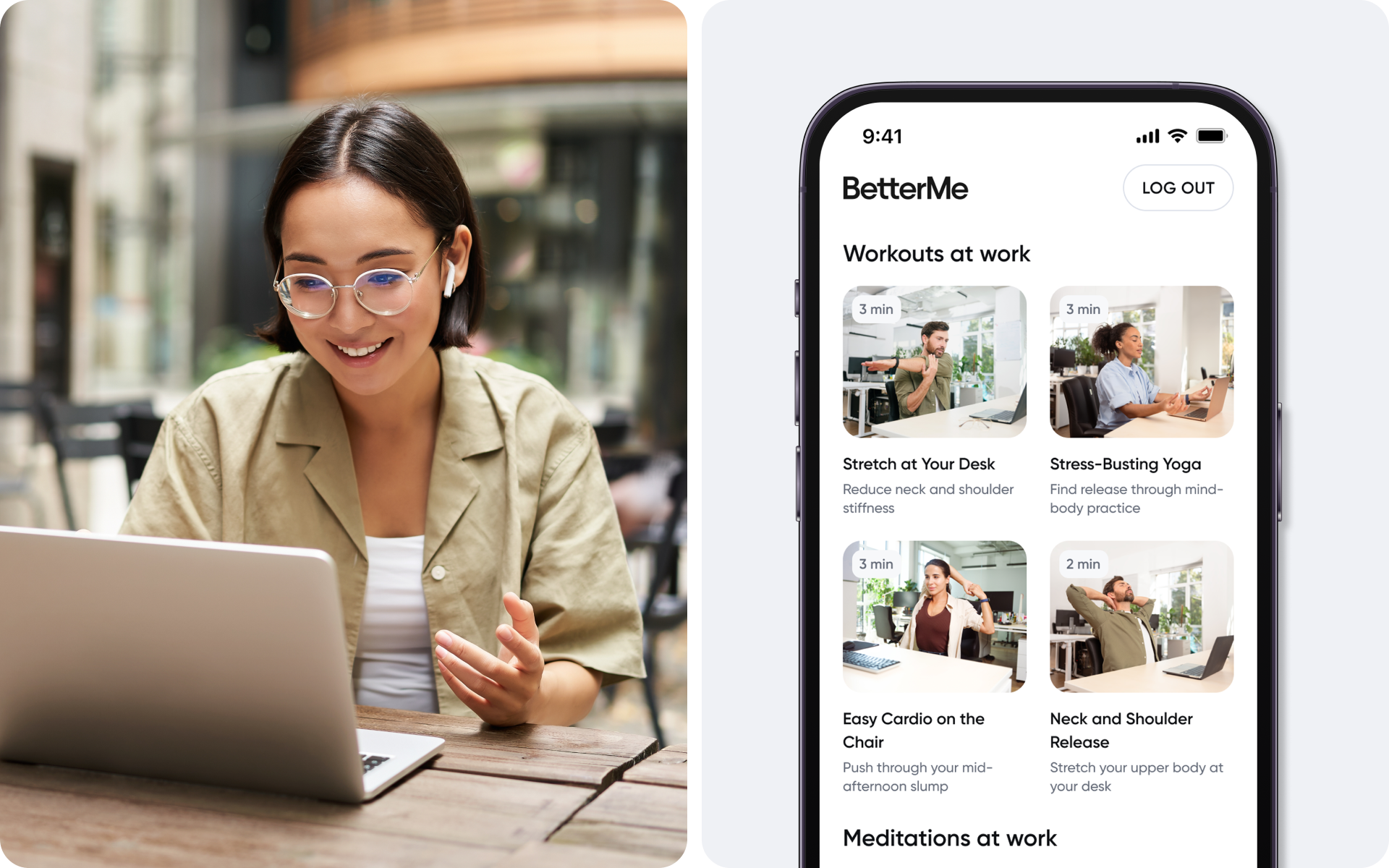
App beyond challenges: The BetterMe app gives employees access to 4,000+ personalized workouts, nutrition plans, meditations, and breathing exercises in 30+ languages — available between challenge cycles and independent of challenge participation.
If you’d like to see how these features work together in practice, the BetterMe Business team offers a live demo.
DISCLAIMER:
This article is intended for general informational purposes only and does not serve to address individual circumstances. It is not a substitute for professional advice or help and should not be relied on for making any kind of decision-making. Any action taken as a direct or indirect result of the information in this article is entirely at your own risk and is your sole responsibility.
BetterMe, its content staff, and its medical advisors accept no responsibility for inaccuracies, errors, misstatements, inconsistencies, or omissions and specifically disclaim any liability, loss or risk, personal, professional or otherwise, which may be incurred as a consequence, directly or indirectly, of the use and/or application of any content.
You should always seek the advice of your physician or other qualified health provider with any questions you may have regarding a medical condition or your specific situation. Never disregard professional medical advice or delay seeking it because of BetterMe content. If you suspect or think you may have a medical emergency, call your doctor.
SOURCES:
- Is It Time to Re-Shift the Research Agenda? A Scoping Review of Participation Rates in Workplace Health Promotion Programs (2023, pmc.ncbi.nlm.nih.gov)
- Health Wearables, Gamification, and Healthful Activity (2022, pmc.ncbi.nlm.nih.gov)
- Decades of workplace health promotion research: marginal gains or a bright future ahead (2021, sjweh.fi)