A data-informed look at why gamification works in corporate wellness programs — what the data says about participation, habit formation, streaks, team competition, and where design determines whether it works or fails.
Gamification is used widely. It works specifically.
Not every version of it produces the same result — and the data makes the difference clear.
Employee wellness challenges work best when they give people a reason to return throughout the program—not just sign up on launch day. In a 12-week randomized trial, participants using a digital activity program with team-based game-inspired mechanics were more likely to track activity daily; those in the version without these mechanics had 47% lower odds of tracking seven days per week (1).
A separate randomized field experiment found that combining competitive and cooperative elements produced the largest improvement in step counts compared with non-game tracking (2). For HR, the implication is clear: a challenge platform should bring together clear goals, visible progress, and flexible social elements that keep the experience active from week to week.
This article examines the evidence on gamified corporate wellness challenges: what drives participation, why some mechanics sustain engagement while others cause it to collapse, and what the research says about the specific features — streaks, team competition, social layers, rewards — that determine outcomes.

What gamification actually means in corporate wellness
The word gamification covers a wide range of implementations, from a simple points system to a fully structured challenge program with daily goals, leaderboards, team competition, social interaction, and physical prizes. That breadth is part of why results vary so significantly: adding a badge system to a passive content library is categorically different from building a time-bound team challenge with streak mechanics and a built-in group chat.
In the context of corporate wellness, gamification is better understood as behavioral design that uses elements that drive consistent engagement in games (achievement, progress visibility, social comparison, loss aversion, reward anticipation) to the context of daily well-being habits. When those mechanisms are mapped correctly to the behavior the program is trying to build, participation increases and sustains. When they’re applied superficially — points for logging in, badges for completing an onboarding step — the novelty wears off quickly and the program reverts to its baseline participation level.
The research on what works is fairly consistent. The mechanisms that matter are not the most complex ones. They are the ones that create daily urgency, social accountability, and a clear connection between effort and outcome.
The baseline: the participation gap gamification addresses
Before examining which game-inspired elements matter, it helps to separate access from active participation. In a workplace study of 298 office workers, a digital challenge experience with team challenges, social features, and progress feedback was associated with 634 more daily steps during its five-week challenge phase than a basic tracking app (3).
That does not make a points system the answer on its own. It illustrates why the experience after enrollment matters: a challenge can give employees reasons to return, check their progress, and take part throughout the program.
When assessing a wellness challenge platform, look for mechanics that work together—clear goals, visible progress, timely feedback, and opportunities for social participation. The next section breaks down the features behind that experience.

What the data shows: which gamification elements drive participation
Structured prizes: why a clear reward beats a points threshold
The most widely deployed reward mechanic in corporate wellness is a points accumulation system: employees earn points for activity and redeem them once they cross a threshold — a gift card, a wellness credit, some form of benefit. The logic seems sound. In practice, the data tells a different story.
The problem is the gap between effort and outcome. When an employee earns 150 points on Monday with no clear picture of when those points will become something tangible — or how many more they’ll need — the motivational signal is weak. Participation data on points-only programs consistently shows the same pattern: a spike at launch when earning feels novel, and a steady decline as employees realize the accumulation path to a real reward is longer and more opaque than expected. Many never reach the threshold at all. The reward was always theoretically possible — it just never felt close enough to act on today.
Structured challenge prizes work differently. Employees know from day one what they’re competing for, how success is measured, and when the outcome will happen. A challenge that runs for six weeks, with a prize awarded to the employees with the longest streaks at the end, creates a clear motivational arc: a defined competition window, a visible daily metric, and a concrete outcome on a specific date. The reward is not hypothetical — it’s scheduled.
Clear, predefined reward criteria can give participants a concrete target during a challenge. In a 2020 randomized trial, participants offered shopping-point rewards for meeting specified step goals increased their daily steps by more than the control group during the three-week incentive period (4). The difference was not maintained once the incentive ended, underscoring the need to pair rewards with an engaging challenge experience rather than treating prizes as a complete participation strategy.
The nature of the prize also matters. Physical wellness gifts — a yoga mat, a foam roller, a pilates kit — have staying power that digital rewards and points redemptions don’t. They’re present in an employee’s home or workspace after the challenge ends, used repeatedly, and visible to colleagues. They make the program’s outcome real in a way that a points balance never quite does.
Streaks as a Consistency-Focused Mechanic
Streaks make daily consistency easy to see. Rather than rewarding only the highest total score, a challenge can also recognize employees who keep showing up over time.
For HR teams, the design question is whether the platform makes consistency visible without turning participation into a winner-take-all competition. A streak can be one useful progress signal alongside personal goals, team progress, and milestone recognition.
The practical implication is straightforward: assess whether the platform can surface consistent participation clearly and broadly — not only highlight the employees already at the top of the score table.
Social Features and Shared Participation
Social features in wellness challenges — in-challenge communication, visible peer activity, coach presence — function as a participation multiplier. They don’t drive engagement independently, but they amplify the effect of every other gamification element when they’re present.
The mechanism is social proof: when an employee sees a colleague complete a daily goal, post a streak update, or receive recognition from a coach, it creates a prompt to do the same. This happens passively (seeing activity in a group chat) and actively (a direct message from a coach acknowledging a milestone). Both generate re-engagement with the program at moments when an employee might otherwise drift.
Programs that build this social layer into the challenge platform — not as a separate communication channel but as a native feature of the daily challenge experience — show higher sustained participation than those that rely on external tools (Slack, email) to carry the social context. When the conversation happens inside the program, it pulls people back into the program. When it happens elsewhere, the connection between social activity and challenge participation is lost.
Rewards: structure matters more than size
The data on reward systems in wellness challenges is nuanced. Reward value is only one part of the program design. HR teams should also assess how rewards are allocated, which actions are recognized, and whether the criteria are clear to employees.
The failure mode that appears most often in the data is a top-heavy reward structure: significant prizes for the highest-performing employees, minimal recognition for everyone else. Programs designed this way see high participation from already-fit or highly competitive employees and low participation from the majority. The employees who most need a reason to engage are the ones most likely to conclude that the competition isn’t for them.
Reward structures that distribute recognition across the participant population — longest streak prizes, team participation rate awards, milestone rewards for first-time completions — may give more employees a visible path to recognition. When any employee has a realistic path to recognition, the program has a realistic chance of changing their daily behavior.
Physical rewards have a specific advantage over digital or monetary ones in workplace settings: they create visible social artifacts. An employee using a wellness prize at their desk or in a shared space reinforces the program’s presence beyond the challenge window and generates conversations that function as organic peer recruitment.
The teams that tend to stay most engaged are often those where effort gets noticed. BetterMe Business combines structured challenges with progress visibility — so managers can easily recognize and reward participation.
When gamification fails
The data on gamification failure is as instructive as the data on success. The most common causes of gamification-driven engagement collapse are predictable and avoidable.
Competition designed for high performers. Individual leaderboards without team structures or streak-based parallel rankings systematically demotivate the majority of participants. The lower half of a competitive leaderboard stops competing when the gap between positions becomes fixed. Dropout accelerates.
No daily behavioral pull. Reward systems that require reaching a redemption threshold give employees no reason to act today specifically. Without a defined challenge window, a streak to maintain, or a prize tied to a specific end date, participation drifts — employees know they can engage whenever and end up engaging rarely. A structured prize with a clear timeline creates the daily urgency that open-ended accumulation systems cannot.
Gamification without social context. Points, streaks, and leaderboards in isolation generate competition. Competition without social connection is fragile — it depends entirely on the individual employee’s motivation and produces no pull from peers or coaches. Gamification that includes a social layer sustains participation beyond what purely competitive mechanics can achieve alone.
Rewards disconnected from consistent behavior. Programs that reward total accumulation rather than daily effort incentivize the wrong pattern: irregular high-effort activity rather than daily consistency. When the reward structure recognizes consistency — longest streak, not highest total — it aligns the incentive with the habit the program is trying to form.
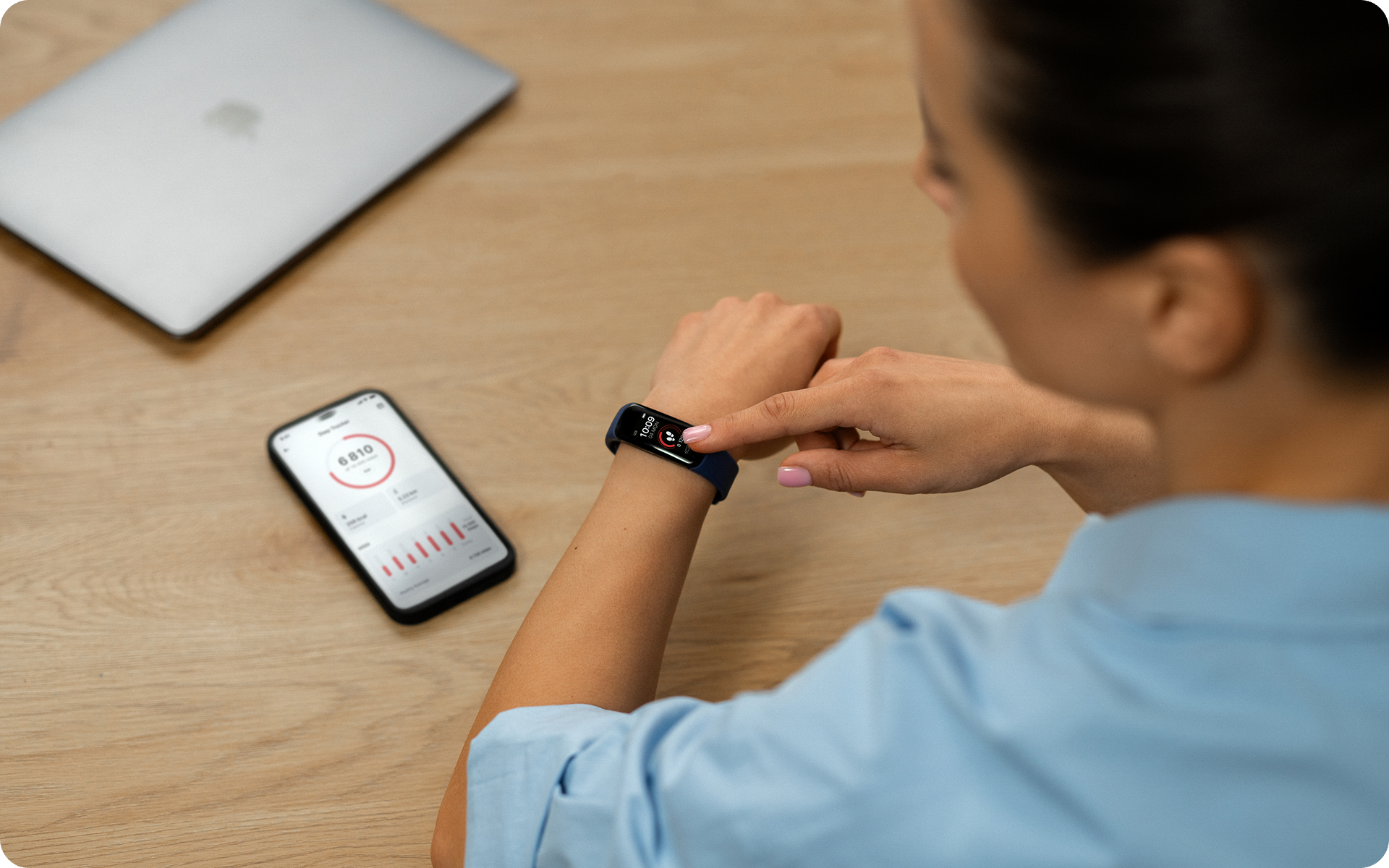
What well-designed gamification looks like in a corporate wellness challenge
Drawing the evidence together, the gamification mechanics that consistently produce strong and sustained participation in corporate wellness challenges share a common design logic.
Daily goals create the behavioral anchor — a specific action to complete today, not an open invitation to use the platform whenever. Streak mechanics make consistency visible and valued — the longest streak as the primary personal metric, with recognition that any employee can compete for regardless of fitness level. Team-based competition creates social accountability that individual competition doesn’t — colleagues whose participation affects your team’s outcome give you a reason to complete a goal on a day when self-motivation wouldn’t be enough. A social layer inside the platform — group chat, coach presence, visible peer activity — multiplies the effect of every other mechanic by creating daily prompts to re-engage. And a reward structure that distributes recognition across the participant distribution — not just the top performers — keeps more of the team invested from week one through week six.
When challenge mechanics work together, the goal is not simply enrollment—it is sustained participation through the final week. In an analysis of 10,183 participants in an eight-week workplace step challenge, daily step counts at week eight were 506 to 1,223 higher than at week one across four annual campaigns (5).
That is not a universal participation benchmark. It is a useful standard for evaluation: look for a platform that makes it practical for employees to stay involved from the first week of a challenge to the last.

Frequently asked questions
Does gamification actually improve wellness program outcomes, or just participation numbers?
Participation is the mechanism, not the outcome. Repeated completion of daily goals—whether steps, mindful breaks, workouts, or habit activities—is the behavior a wellness challenge is designed to encourage. Participation data gives HR an early signal of whether that behavior is occurring throughout the program, not merely at enrollment.
In a four-week workplace step challenge, reporting participants increased their self-reported daily steps by an average of 3,374 by week four (6). The study also observed changes in some work-related measures, while work engagement did not change—an important reminder to measure participation and outcomes separately.
For HR teams, active participation is therefore a leading indicator: it shows whether employees are returning to the challenge and completing its daily actions while there is still time to reinforce momentum.
What’s the most effective single gamification element in corporate wellness?
If forced to choose one, streak mechanics have the strongest evidence base for sustained daily participation. Streaks create both a pull (progress motivation — continuing a run already started) and a cost to stopping (loss aversion — not wanting to reset). These two forces in combination produce more consistent daily engagement than points, badges, leaderboards, or reward systems used independently. The effect is strongest when streak length is prominently displayed and when recognition is tied to it.
Why do competitive leaderboards sometimes hurt participation?
Because competition benefits the people who expect to win and discourages everyone else. A leaderboard showing total score rewards prior fitness level as much as program effort, which means the ranking is often predictable from day one. Employees who can see they won’t compete for the top positions stop competing. The fix is parallel leaderboards — one for total score, one for longest streak — so there are two competitions running simultaneously with different winners. The streak leaderboard rewards consistency and gives every employee a competition they can be in.
How long does the gamification effect last before engagement drops?
Many gamified wellness programs experience a participation drop-off between week two and week four without re-engagement mechanics in placeWith strong design — rotating daily goal types, mid-challenge recognition moments, coach activity in group chat, and a streak mechanic that creates cost to breaking a run — programs sustain strong participation through six-week challenge windows. For longer programs, a new challenge launch with a refreshed prize structure resets the motivational cycle.
Is gamification appropriate for all employees, or does it create unwanted competitive pressure?
Well-designed gamification is opt-in and distributed — it creates social energy rather than pressure. The distinction matters: programs where the primary mechanic is individual competition against named colleagues can create social discomfort, particularly in teams with existing hierarchies. Programs where team-based goals and streak recognition are primary — with individual competition as secondary and visible only to those who want to engage with it — tend to generate enthusiasm rather than pressure. Mandatory enrollment combined with heavy individual competition is the combination most likely to produce negative outcomes.

How BetterMe Business applies these mechanics
BetterMe Business is built around the gamification design principles described in this guide.
Each challenge has a predefined daily goal that rotates across formats — steps, a workout, a meditation session, or a reading activity — set by the challenge designer. The rotating schedule keeps the daily action varied and ensures the program addresses multiple dimensions of well-being across the challenge window, not just physical activity.
Streak length is the primary personal metric in every participant’s dashboard. The longest streak, not the highest total score, drives the prize system — with physical wellness gifts from the BetterMe store (yoga mats, foam rollers, pilates kits) as the reward.
A built-in group chat is native to each challenge. Employees interact, celebrate streaks, and stay connected to the program through the conversations happening within it — not in a separate tool. Coaches are active in the same space, adding the human presence that sustains engagement past the point where novelty alone can carry it.
The HR workspace provides participation data by team and goal type throughout the challenge, so HR can identify drop-off patterns and act on them before they compound.
The BetterMe app supports the individual well-being side with 4,000+ customized workouts, nutrition plans, meditations, and breathing exercises in 30+ languages — extending the program’s impact beyond the challenge window.
DISCLAIMER:
This article is intended for general informational purposes only and does not serve to address individual circumstances. It is not a substitute for professional advice or help and should not be relied on for making any kind of decision-making. Any action taken as a direct or indirect result of the information in this article is entirely at your own risk and is your sole responsibility.
BetterMe, its content staff, and its medical advisors accept no responsibility for inaccuracies, errors, misstatements, inconsistencies, or omissions and specifically disclaim any liability, loss or risk, personal, professional or otherwise, which may be incurred as a consequence, directly or indirectly, of the use and/or application of any content.
You should always seek the advice of your physician or other qualified health provider with any questions you may have regarding a medical condition or your specific situation. Never disregard professional medical advice or delay seeking it because of BetterMe content. If you suspect or think you may have a medical emergency, call your doctor.
SOURCES:
- Harnessing technology and gamification to increase adult physical activity: a cluster randomized controlled trial of the Columbia Moves pilot (2023, link.springer.com)
- A field experiment on gamification of physical activity – Effects on motivation and steps (2024, sciencedirect.com)
- Combining Web-Based Gamification and Physical Nudges With an App (MoveMore) to Promote Walking Breaks and Reduce Sedentary Behavior of Office Workers: Field Study (2021, jmir.org)
- Effect of a financial incentive (shopping point) on increasing the number of daily walking steps among community-dwelling adults in Japan: a randomised controlled trial (2020, bmjopen.bmj.com)
- The Effectiveness of an Annual Nationally Delivered Workplace Step Count Challenge on Changing Step Counts: Findings from Four Years of Delivery (2021, mdpi.com)
- Measuring Productivity, Perceived Stress and Work Engagement of a Nationally Delivered Workplace Step Count Challenge (2022, mdpi.com)