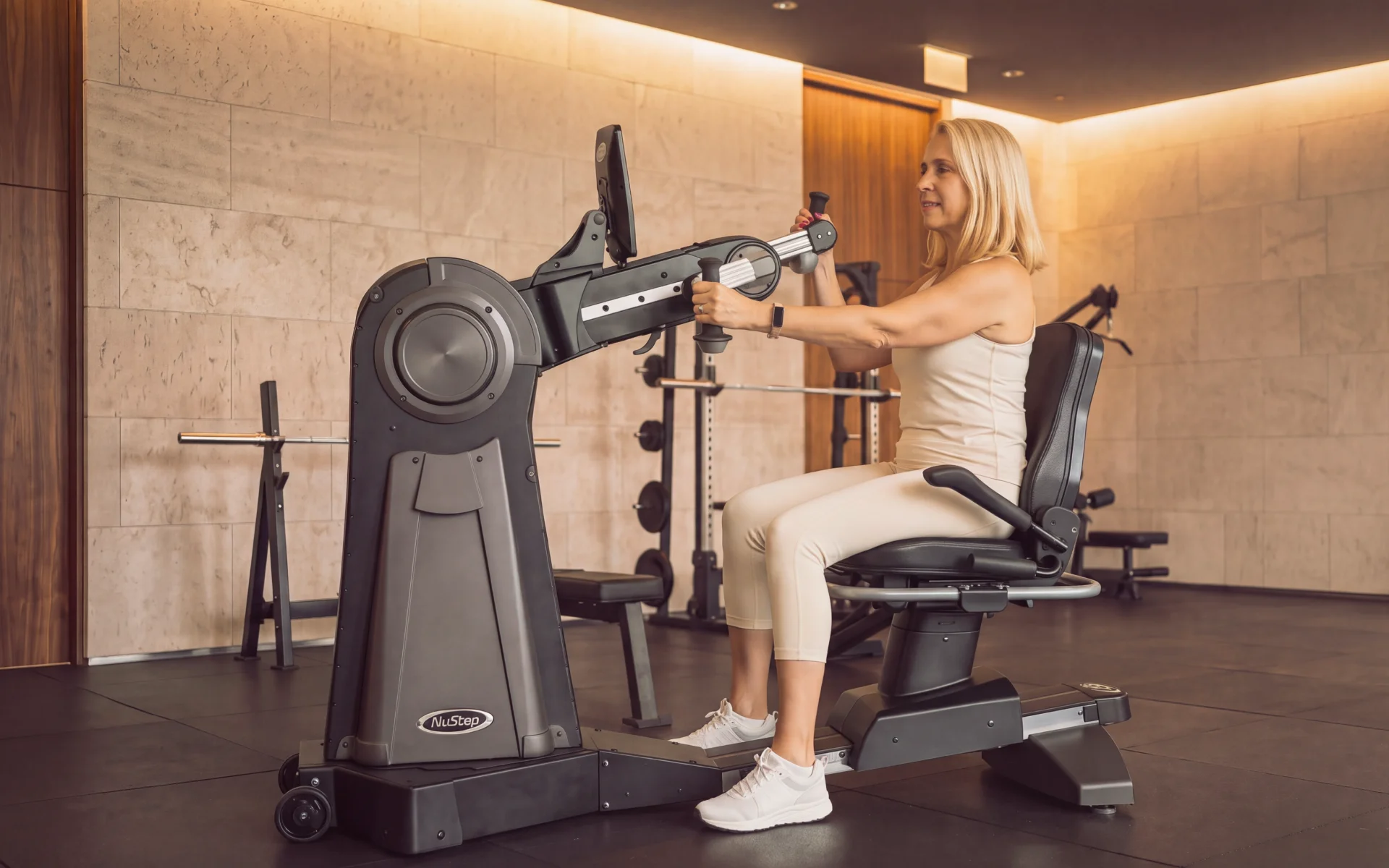
You can do cardio without legs by using your arms, shoulders, and upper body to raise your breathing and effort for a sustained period. Cardio simply means rhythmic, continuous movement that lifts your heart rate. Arm cycling, seated boxing, brisk wheelchair pushing, and fast upper-body circuits all count.
This guide breaks down how to get your heart pumping using your upper body, which movements tend to work well, how long to go, and how it stacks up against full-body training. You’ll get simple steps, quick examples, and beginner-friendly ideas you can adjust to your level.
The steps below help you choose a movement, set your effort, and build up over time.
Key takeaways
These points summarize how to do cardio with your upper body.
- You can exercise without your legs by repeating movements your upper body can control, done rhythmically for time (1).
- Mixing different upper-body motion patterns can help reduce strain from repeating the same actions (2).
- The talk test or a 1 to 10 effort scale can guide intensity, with moderate effort at about 5 to 6 out of 10 (3).
- Cardio is defined by sustained effort that challenges your heart and lungs, whichever muscles you use (4).
- Some research suggests upper-body training can improve stamina and breathing capacity (5).
- Arm cycling, handcycling, brisk wheelchair pushing, adapted rowing, and seated circuits are common options.
- Beginners can start with 5 to 10 minutes, 2 to 3 days a week, and build up gradually.
How can you exercise when you can’t use your legs?
When you can’t use your legs, you exercise by focusing on movements your upper body can control, done rhythmically for time (1). The goal is steady, repeated motion that raises your breathing and effort. Such exercise can also be useful if you want to alternate the muscles you work, for example, arm cycling one day, rowing the next, and running if you can.
Here’s a simple framework to start:
- Pick a movement you can repeat: Arm cycling, seated punches, or pushing a wheelchair briskly all work.
- Set your effort level: Aim for a pace where you can talk, but not sing.
- Build gradually: Start with 5 to 10 minutes, then add time as you feel ready.
- Support your shoulders: Add pulling moves and gentle stretches to balance things out.
For many people who rely heavily on their arms for daily movement, the shoulders do a lot of work already. Mixing in different motion patterns can help reduce strain from repeating the same actions (2).
A quick tip on effort: heart rate can be a tricky guide for some people. Instead, use the “talk test” or a simple 1 to 10 effort scale. Moderate feels like 5 to 6 out of 10. Vigorous starts at 7 to 8 (3).
Checkpoint: Choose one repeatable move, set a gentle time goal, and build from there.
Can you do cardio without using your legs?
Yes, you can do cardio without using your legs, and it can help build stamina. Cardio is defined by sustained effort that challenges your heart and lungs, not by which muscles you use (4).
Your legs contain a lot of muscle, which is why they’re popular for cardio, but they aren’t required. Your arms, shoulders, and trunk can drive the same kind of rhythmic work.
Some research on upper-body training has suggested that it can improve (5):
- Stamina and breathing capacity
- Confidence in staying active
- Everyday movement endurance
- Some markers linked to wellness, but findings here are mixed
Upper-body cardio is a genuine option. It is more active than sitting still, and it can build fitness over time. Results depend on your effort, consistency, and starting point, and individual outcomes vary.
If you’re exploring seated cardio workouts without using legs, know that the same rules apply: keep it rhythmic, keep it repeatable, and keep it at an effort that feels like real work.
Read more: Cardiovascular endurance exercises: cardio workout guide
How can you do a cardio workout effectively without using your legs?
You can do an effective cardio workout without your legs by combining a sustainable movement, enough intensity, and enough time, repeated regularly. Effectiveness comes from structure, not from any single move.
Here’s a simple session format for cardio for arms and the wider upper body:
- Warm-up (5 to 10 minutes): Easy arm cycling or gentle rolling to get blood flowing.
- Main set (10 to 30 minutes): Steady effort or intervals.
- Cool-down (5 to 10 minutes): Slow movement and light stretching.
For the main set, you have two easy formats:
- Steady pace: 15 to 25 minutes at a moderate effort (5 to 6 out of 10).
- Intervals: 1 minute harder, then 1 minute easy, repeated 8 to 10 times.
Intervals suit people who get bored easily or want variety. Steady work suits those who prefer a predictable rhythm.
Consistency matters more than any perfect plan. Two to three sessions a week is a reasonable beginner cardio workout starting point. You can spread them out, for example on Monday, Wednesday, and Friday, so your body gets rest time.
One more thing on effort. As your arms are smaller than your legs, they may tire faster, which is normal. If your shoulders tire before your lungs, the workout still counts, and you can progress at your own pace.
If you’d like a structured routine to follow along with, take a look at our chair cardio workout guide for ready-made ideas.
What are the top upper-body cardio exercises?
Good upper-body cardio exercises are ones you can sustain rhythmically, adjust to your level, and repeat without excess strain. Arm cycling, handcycling, brisk wheelchair pushing, and upper-body circuits are common favorites.
Here’s a quick comparison to help you choose:
| Exercise | Why it works | Suits | Equipment needed |
|---|---|---|---|
| Arm bike (arm ergometer) | Easy to control effort and pace | Beginners to advanced | Arm cycle machine |
| Handcycling | Engaging, good for steady or interval work | Outdoor movers | Handcycle |
| Brisk wheelchair pushing | Functional and accessible | Manual wheelchair users | None extra |
| Adapted rowing | Uses arms and trunk together | Those wanting fuller motion | Adapted rower |
| Seated boxing or circuits | Fun, needs little to no gear | Home exercisers | Little or none |
If your goal is calorie use, the key with cardio without legs is intensity and duration, not the specific move. Any of these can raise your effort enough to support calorie use, and results depend on your overall routine.
For cardio without legs with no equipment, seated options shine. Try these at home:
- Fast seated punches or shadow boxing (30 to 60 seconds per round)
- Overhead reaches at a quick, steady pace
- Seated arm swings or “speed” arm circles
These count as chair cardio workout moves, and they require nothing more than a chair and a little space.
Want more targeted seated ideas? Explore our guide to 8 seated upper-body exercises for extra variety.
BetterMe offers a variety of workouts, recipes, challenges, and support tools to help you stay more consistent with your wellness routine. Explore the app to find features that fit your goals, preferences, and schedule.
How long should a cardio workout without legs be?
A cardio workout without your legs can start at 5 to 10 minutes, 2 to 3 days a week, then build toward 20 to 30 minutes as your fitness grows. These are gentle starting points, not hard rules.
Here’s a simple progression you can adapt:
| Level | Session length | Frequency | Format tip |
|---|---|---|---|
| Beginner | 5 to 10 minutes | 2 to 3 days/week | Break into short intervals |
| Intermediate | 15 to 25 minutes | 2 to 4 days/week | Steady pace or intervals |
| Advanced | 20 to 30+ minutes | 3+ days/week | Mix steady and interval work |
If you’re new to moving this way, cardio without legs for beginners usually goes better when you go easy at first. Give your body time to adjust before adding harder efforts.
A few practical notes:
- A short session still counts.
- Spread sessions across the week rather than cramming them into one day.
- Rest for 1 to 2 days between harder efforts if your upper body feels worn out.
For older movers, cardio without legs for seniors often pairs well with gentle warm-ups and slower progression. Comfort and steadiness matter more than speed.
If you’d like ready-made routines to structure your week, browse our low-impact cardio workout plans guide for options at different levels.
Read more: Cardio barre for weight management: a sample routine
How does upper-body cardio compare with a full-body cardio workout?
Upper-body cardio uses less total muscle than a full-body workout, so its peak intensity is often lower, but it can still build stamina and support wellness (5). For someone who can’t use their legs, it’s the main cardio path, not a lesser one.
Here’s how they compare:
- Full-body cardio recruits more muscle, so it usually reaches a higher peak effort (6, 7).
- Upper-body cardio may tire your arms sooner, which can cap how hard you push.
- Both can improve endurance, mood, and daily movement capacity (8).
For many people, the useful comparison is upper-body cardio versus no cardio at all, and moving your arms and trunk adds activity to the week.
What can improve with consistent upper-body sessions?
- Stamina for everyday tasks
- Endurance while moving or pushing
- Energy and mood, for many people
- Some wellness markers, though evidence is less consistent here
Full-body cardio has a higher ceiling, but cardio for chest, arms, and shoulders is still worthwhile and can be adapted as you progress.
FAQs
Can you do cardio without jumping?
Yes, you can do cardio without jumping by using low-impact, rhythmic movements instead. Cardio depends on sustained effort, not impact. Seated punches, arm cycling, brisk wheelchair pushing, and fast arm circles all raise your heart rate without a single jump. These moves tend to be gentle on the body and easy to repeat, which makes them a user-friendly choice for many people at different levels.
Can you do upper-body cardio at home?
Yes, you can do upper-body cardio at home with little or no equipment. A chair and some space are often enough. Try fast seated punches, overhead reaches, or speedy arm swings for 30 to 60 seconds per round. Repeat several rounds with short rests. Resistance bands or light weights can add variety later, but bodyweight moves work well when you’re getting started.
Is 10 minutes of upper-body cardio enough?
10 minutes of upper-body cardio can be enough, particularly when you’re starting out or short on time. Any movement counts, and short sessions still support stamina (9). If your goal is more endurance over time, you might build toward 20 to 30 minutes across several days each week. Consistency tends to matter more than one long session, and individual results vary.
Can you burn calories with upper-body cardio?
Yes, you can burn calories with upper-body cardio, as it raises your effort and energy use. The amount depends on your intensity, duration, and body. Working at a moderate-to-vigorous pace, about 5 to 8 out of 10, for 20 minutes or more can support calorie use. Pairing it with balanced eating and regular sessions tends to help (10), though outcomes differ from person to person.
Which upper-body cardio exercise is easiest to start with?
Arm cycling is often the easiest to start with because it’s easy to control and beginner-friendly. In general, the right exercise is one you’ll do consistently and can sustain at a real effort. Handcycling, brisk wheelchair pushing, and seated circuits also work well. The right pick depends on your access to gear, your comfort, and what keeps you coming back.
The bottom line
Cardio without legs is a real, flexible way to move, build stamina, and support your wellness using your upper body. You have options, from arm cycling to seated circuits, and you can shape them to your level and goals. Pick a movement you enjoy and repeat it regularly; results vary from person to person.
DISCLAIMER:
This article is intended for general informational purposes only and does not serve to address individual circumstances. It is not a substitute for professional advice or help and should not be relied on for making any kind of decision-making. Any action taken as a direct or indirect result of the information in this article is entirely at your own risk and is your sole responsibility.
BetterMe, its content staff, and its medical advisors accept no responsibility for inaccuracies, errors, misstatements, inconsistencies, or omissions and specifically disclaim any liability, loss or risk, personal, professional or otherwise, which may be incurred as a consequence, directly or indirectly, of the use and/or application of any content.
You should always seek the advice of your physician or other qualified health provider with any questions you may have regarding a medical condition or your specific situation. Never disregard professional medical advice or delay seeking it because of BetterMe content. If you suspect or think you may have a medical emergency, call your doctor.
SOURCES:
- Exercise After Spinal Cord Injury (SCI) (2025, msktc.org)
- Impact of Different Isokinetic Movement Patterns on Shoulder Rehabilitation Outcome (2022, mdpi.com)
- How to Measure Physical Activity Intensity (2025, cdc.gov)
- Cardiovascular exercise (2025, healthdirect.gov.au)
- Effects of Upper Body Exercise Training on Aerobic Fitness and Performance in Healthy People: A Systematic Review (2023, mdpi.com)
- Comparison of Cardiovascular Response to Lower Body and Whole Body Exercise Among Sedentary Young Adults (2023, cureus.com)
- Maximal O2 Uptake Is Higher During Whole-Body Compared to Lower-Body Exercise due to Higher Convective, but not Diffusive, O2 Transport (2026, ovid.com)
- Navigating the Physical and Mental Landscape of Cardio, Aerobic, Zumba, and Yoga (2024, ovid.com)
- Physical activity, cardiorespiratory fitness, and cardiovascular health: A clinical practice statement of the American Society for Preventive Cardiology Part II: Physical activity, cardiorespiratory fitness, minimum and goal intensities for exercise training, prescriptive methods, and special patient populations (2022, sciencedirect.com)
- Dietary and Behavioral Strategies for Weight Loss and Weight Loss Maintenance: A Narrative Review (2025, mdpi.com)

 Reviewed by
 Reviewed by



 Reviewed by